Running Rivalry Statistics 2026: Why Rivals Make You Faster
Running Rivalry Statistics 2026: Why Rivals Make You Faster
Rivalry is one of the most measurable performance levers in running. A landmark NYU study of 184 races found that runners ran roughly 4.92 seconds faster per kilometer when a personal rival was on the start line. Strava users gave 14 billion kudos in 2025, a 20% jump on the prior year, and over half of athletes say they are most motivated by friends and family who exercise. Running USA's 2025 Global Runner Survey, which drew 12,700+ responses, shows 56% of runners have raced or are training for an event. These 16 statistics from peer-reviewed studies and industry reports reveal how the urge to beat someone, real or remembered, shapes the way you train.
Running participation is back above pre-pandemic levels, and the social layer of the sport is what is driving the climb. Strava clubs nearly quadrupled in 2025, parkrun cleared 18.2 million 5K finishes worldwide, and large U.S. marathons grew by double digits. Behind those numbers is a quieter force: the runner who you check the results sheet for, the friend you would never admit you want to outpace.
This post collects the 16 most credible statistics on running rivalry and competition in 2026. It is built for runners who feel the pull of competition and want the data behind it.
1. Rivals cut about 4.92 seconds per kilometer off race pace
A 2014 archival study by NYU Stern's Gavin Kilduff analyzed 184 races held over six years inside a U.S. running club and found that when at least one personal rival was on the start line, runners ran roughly 4.92 seconds faster per kilometer. That is about 7.44 seconds per mile, or close to 25 seconds across a 5K, which is often the gap between a top-three finish and missing the podium entirely.
The effect held after controlling for runner ability, weather, and race distance. Rivalry, the study argued, is not about liking or disliking another runner. It is about caring more about the outcome because of who is in the field. Bring a rival to the line and your pace responds before your brain catches up.
Source: Sage Journals - Driven to Win: Rivalry, Motivation, and Performance (Kilduff, 2014)
2. Runners report having about three rivals on average
Survey data from the same Kilduff research line found that competitive long-distance runners reported having approximately three personal rivals on average. Rivals were not necessarily the fastest people in the field. They were peers who runners had raced before, who fell within a similar age and gender bracket, and who had finished close to them in past results.
Three is a useful number. It is small enough that you can hold each rival in your head, large enough that one of them is usually on the start line. Runners told researchers that the presence of a rival increased their motivation to train and to race harder, an effect that survey respondents described as a clear performance edge rather than vague encouragement.
Source: EurekAlert - Harnessing a Personal Rivalry Can Boost Athletic Performance
3. 56% of runners have raced or are training for an event
The 2025 Global Runner Survey from Running USA, which gathered more than 12,700 responses, reports that 56% of runners have previously taken part in a competitive event or are actively training for one. The 5K was the most completed race distance in 2025 at 20% of runners, followed by fun runs at 17%.
That majority figure matters. It means competitive running is not a fringe pursuit. More than half of the global running base has at least one bib number in their drawer. Even runners who describe themselves as casual end up on a start line, comparing their finishing position to other people in their age group.
Source: Running USA - 2025 Global Runner Survey Findings
4. Top 100 U.S. race finishers grew 15% in late 2024
Running USA's 2024 Top Races Report found that finishers across the top 100 races in the 5K, 10K, half marathon, and marathon categories grew by an average of 15% in the second half of 2024 compared with the same period in 2023. Marathon participation in the United States is now about 5% above pre-pandemic levels.
The TCS New York City Marathon crossed 56,000 finishers in November 2024, the largest race of any distance in the country. Chicago followed at roughly 52,000. The growth is broad, not concentrated at the elite end, which is exactly the demographic where rivalry tends to drive training. Faster recreational fields raise the bar for everyone behind them.
Source: Running USA - 2024 Top Races Report
5. Strava users gave 14 billion kudos in 2025
Strava's 12th annual Year in Sport report, released in December 2025, found that athletes on the platform gave more than 14 billion kudos during the year, a 20% increase on 2024. Grouped activities received roughly twice the likes and kudos of solo efforts.
Kudos are a soft form of competition. They are a public thumbs-up that signals "I saw you go faster than usual" or "I noticed you logged the miles." When 14 billion of them get exchanged in a single year, the running social graph starts to behave like a leaderboard whether or not it is labeled one. Athletes adjust their pace and consistency partly because they know other athletes are watching.
Source: Strava Press - 2025 Year in Sport Trend Report
6. Over half of Strava athletes are most motivated by friends and family
The 2025 Strava Year in Sport report found that over half of all Strava athletes cite friends or family who exercise as their top source of motivation. Among Gen Z athletes, 77% say they feel more connected to others when they see their friends' or family's activities in the feed.
That is rivalry's quieter relative: social comparison inside trusted relationships. You do not need a stranger on the start line if your brother just logged a Tuesday tempo run that was faster than yours. Strava's data suggests the modern running rival is often a sibling, a colleague, or a college friend who lives 1,500 miles away and pushes you through a notification.
Source: Strava Press - 2025 Year in Sport Trend Report
7. 66% of Strava users hit a new segment personal record in 2025
According to the 2025 Year in Sport report, 66% of runners and cyclists on Strava set a new personal record on a segment during the year. The distribution skewed by age: 80% of Boomers logged a segment PR, compared with 56% of Gen Z athletes.
Segments are the purest expression of digital rivalry in running. They are short, fixed stretches of road or trail where every attempt slots into a public leaderboard. The fact that two-thirds of active users beat their own previous best on at least one segment suggests that head-to-head comparison, even against a past version of yourself, is a powerful pacing cue.
Source: Strava Press - 2025 Year in Sport Trend Report
8. The world's most popular Strava segment has been attempted 2.8M+ times
Strava's 2025 data identified "Mi Segmento: de la redomita a Patios" outside Bogota, Colombia as the most ridden segment on the platform, attempted more than 2.8 million times. The figure quantifies how a single piece of road becomes a venue for ongoing public competition.
Each attempt is a private decision to chase the leaderboard. Multiply that decision by 2.8 million and you get a global picture of how rivalry compounds in a digital format. Segments do not have referees, registration fees, or finishing chutes. The competition simply exists, anchored by GPS coordinates and a sorted list of names.
Source: Strava Press - 2025 Year in Sport Trend Report
9. Strava clubs nearly quadrupled in 2025, topping 1 million
Strava reported that the number of clubs on its platform nearly quadrupled in 2025, surpassing 1 million total clubs worldwide. Clubs are voluntary mini-leaderboards. Members can see each other's runs, compare weekly mileage, and chase club-internal segment standings.
The growth is significant because clubs convert anonymous social comparison into named, repeated rivalry. You see the same handful of people week after week. Your Tuesday recovery jog sits next to your clubmate's Tuesday recovery jog. The format quietly trains runners to expect comparison, which research consistently shows raises both training volume and intensity.
Source: Strava Press - 2025 Year in Sport Trend Report
10. Strava reached roughly 180 million registered users in 2025
By the end of 2025, Strava had grown to approximately 180 million registered users across more than 185 countries, with around three million new users joining every month. The platform processed roughly four billion logged activities during the year.
The scale matters for rivalry because it changes the math of who can be your rival. Twenty years ago, your competition was the runner who lived in your town and showed up at the local 10K. Today, the comparison set includes a stranger in another country who runs your same pace and shows up in your follow recommendations. Rivalry is no longer geographically bounded.
Source: Business of Apps - Strava Revenue and Usage Statistics 2026
11. parkrun recorded 18.2 million 5K finishes worldwide in 2025
parkrun, the free weekly 5K event series, recorded 18.2 million finishes across 111,000 individual events in 2025, a 14.4% increase over 2024. An additional 1.2 million people registered for a parkrun barcode during the year. Roughly 87% of finishes came from three countries: the UK, Australia, and South Africa.
parkrun is rivalry in its most democratic form. Every finisher gets a time, a position, and an age-graded score that lets a 62-year-old runner compare themselves with a 24-year-old runner across the same course. The format has scaled because the recurring weekly comparison creates lightweight, repeatable competition without requiring race fees or training peaks.
Source: Ordinary Runners - parkrun Participation Statistics
12. Running club members finish marathons up to 40 minutes faster
A 2024 PLOS One analysis of London Marathon results, titled "Smells like team spirit," found a statistically significant association between running club membership and faster finish times. Club members showed marathon improvements of up to 40 minutes compared with non-members, and the effect helped mitigate the typical age-related decline in pace.
A separate Kansas State University study found that exercising with a more capable partner increased workout intensity and duration by roughly 200%. Both findings point to the same mechanism. Putting yourself in a group with runners you respect and want to keep up with raises the floor of every session, not just race day. Rivalry, in this form, looks a lot like accountability.
Source: PLOS One - Smells Like Team Spirit: Running Clubs and London Marathon Performance
13. App-enabled social feedback measurably improves running times
A 2024 study by Babar, Chan, and Choi, published in Production and Operations Management, ran an 18-month randomized field experiment with 1,241 military service members. The researchers measured the causal effect of app-based performance feedback and social feedback on actual running times. Both features improved performance, but social feedback was effective specifically for already-stronger runners, and only positive social signals carried a significant effect.
The takeaway is nuanced. Public visibility lifts performance, but the lift is uneven across the runner population. For runners who already perceive themselves as competitive, knowing that peers can see their splits adds enough psychological pressure to translate into faster times. For newer runners, the same visibility can backfire if the social signal is negative.
14. 32% of male runners say challenging themselves is a top motivator
The 2026 SportsShoes Running Report found that 32% of male runners cite the desire to challenge themselves as a top driver of running, compared with 28% of female runners. Across the full sample, 39% of runners said maintaining or improving fitness was their primary motivation, while 29% pointed to mental health and personal challenge.
Competitive framing skews male in the survey data, but the gap is narrower than the stereotype suggests. Almost a third of men explicitly described their motivation as a challenge to themselves, which research generally treats as a self-directed form of rivalry. The runner you are trying to beat is often last month's version of yourself.
Source: SportsShoes - Running Report 2026
15. Moderate upward comparison predicts higher end-of-season performance
A semester-long study of student athletes published in Psychology of Sport and Exercise found that moderate upward social comparison, looking up at peers who are slightly better than you, predicted significantly higher end-of-semester performance. Extreme upward comparison, where the target was far beyond reach, was associated with a drop in motivation and increased disengagement.
The result reframes rivalry as a tuning problem. A rival who is two minutes faster over 10K pushes you forward. A rival who is twenty minutes faster pushes you backward. Effective rivalries sit inside what researchers call a "zone of plausible improvement," which is one reason age group and tier-based leaderboards work better for sustained motivation than a single global ranking.
Source: ScienceDirect - Motivational and Emotional Effects of Social Comparison in Sports
16. Gen Z is 75% more likely than Gen X to run for a race
Strava's 2025 Year in Sport report found that Gen Z athletes are 75% more likely than Gen X athletes to say their main motivation for exercising is an upcoming race or event. More than half of Gen Z plans to increase their Strava use in 2026, while most expect to spend the same or less time on Instagram and TikTok.
The generational shift is meaningful for the future of rivalry in running. Younger runners are choosing event-driven, comparison-rich platforms over passive social feeds. They want a leaderboard, a finish line, and a public log of how they stacked up. That preference suggests the next decade of running growth will lean even harder into measured competition rather than away from it.
Source: Strava Press - 2025 Year in Sport Trend Report
What These Numbers Tell Runners
The data lines up around a single thesis: rivalry is one of the most reliable performance multipliers in running, and it works at every level of the sport. Kilduff's archival study quantified the elite-amateur version, where a known rival on the start line trims roughly 5 seconds per kilometer. Strava's 14 billion kudos, 1 million clubs, and 2.8-million-attempt segments quantify the digital version, where the comparison happens asynchronously through a phone screen. Both produce the same downstream effect: more consistent training and faster race results. Our running consistency deep-dive explores the consistency side in detail.
For beginners, the takeaway is that finding even one peer who runs slightly faster than you is worth more than any new pair of shoes. For recreational runners, joining a club or a structured leaderboard is the single biggest research-backed lever for breaking through plateaus. For competitive racers, the implication is that race selection should consider not just the course and the weather but the field. The right rival on the start line is worth the entry fee on its own.
The trajectory is clear. Strava grew to 180 million users, parkrun cleared 18.2 million finishes, and U.S. marathon participation surpassed pre-pandemic levels. Running is moving toward more measured comparison, not less. Younger runners in particular are choosing platforms and events that make comparison visible. Our running streak statistics breakdown shows how this same comparison instinct drives daily consistency, and our strava usage statistics deep-dive digs into how social tracking shapes training week to week.
Rivalry is not the loud, hostile cliche. It is the quiet, measurable presence of someone whose pace you respect enough to chase.
How Runify Turns Rivalry Into Daily Motivation
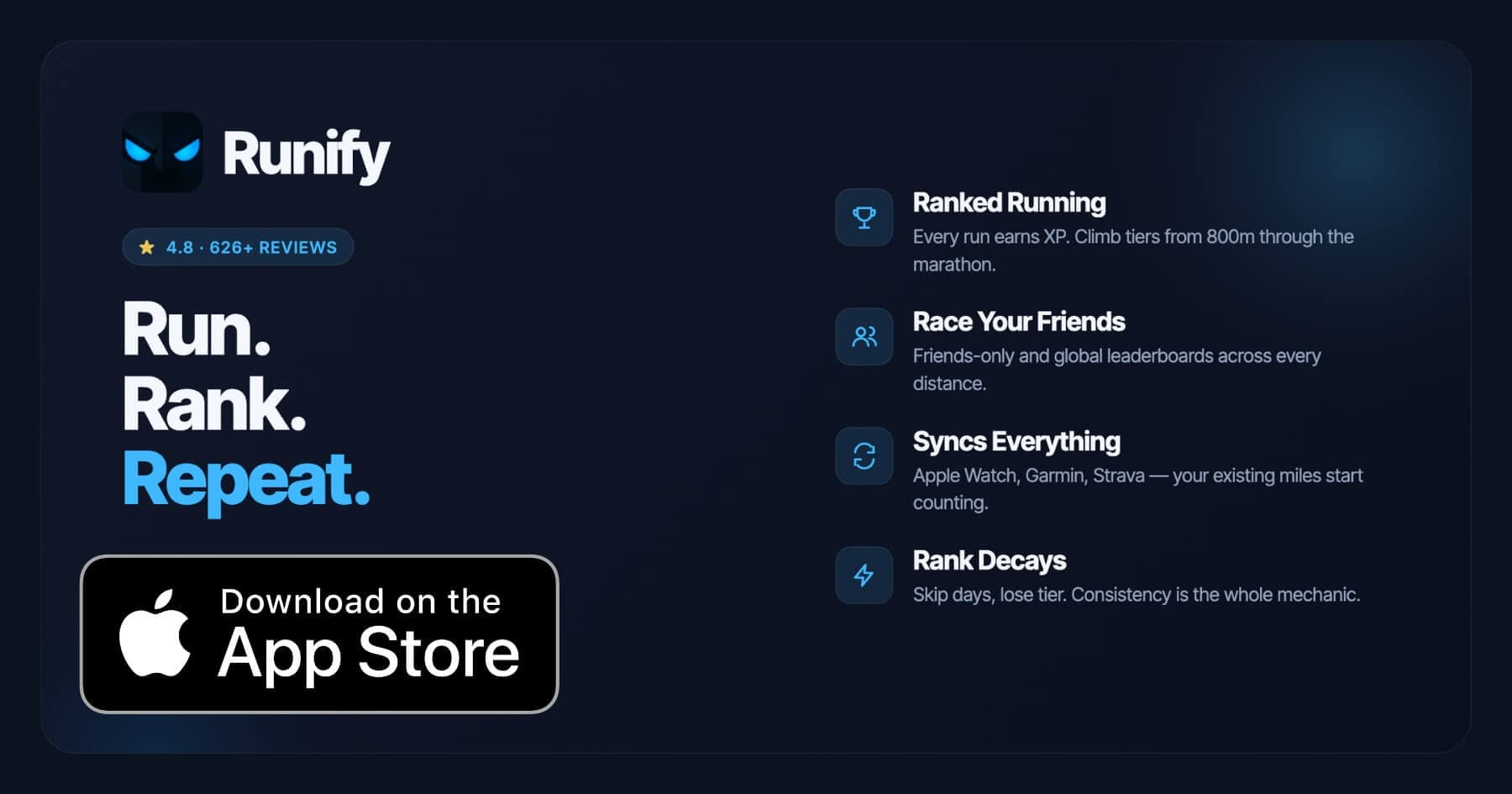
If the data shows anything, it is that visible, repeated comparison drives faster running. The problem is that most apps either bury the comparison in a noisy social feed or hide it behind a generic activity score. Runify is built around the comparison. Every run you log inside the app, or sync from Apple Watch, Garmin, or Strava, earns XP, moves you through a tier system, and slots you onto leaderboards across 800m, 1K, 5K, 10K, half marathon, and marathon distances. Your rival is no longer a vague feeling. They are a name on a leaderboard, a tier above or below yours, and a target you can train toward.
The friends-only leaderboards let you pick your rivals deliberately. Add the three or four runners who push you most, and let the rankings update every time one of you logs a session. Go inactive and your rank decays, which is the part most fitness apps avoid because it feels uncomfortable. The research says discomfort is where the performance gain lives.
Ready to make your runs count? Download Runify on the App Store and turn every mile into XP across leaderboards from 800m through the marathon.
4.8 stars on the App Store, 626+ reviews worldwide.
Download Runify on the App Store

4.8 on the App Store · Built for iOS