Running Consistency Statistics 2026: What Drives Runners
Running Consistency Statistics 2026: What Drives Runners
180 million runners and cyclists now log on Strava, yet roughly 30% of novice runners stop running within six months. The median runner needs 66 days on average to make a new behavior automatic, and exercise habits take about 1.5x longer than eating or drinking habits to stick. On the motivation side, Strava users hit 72% of their 2024 run goals, running-club participation grew 59% year over year, and group runs last 40% longer than solo sessions. The data tells a clear story: showing up is the hard part, and social accountability plus visible progress are what keep runners from dropping off.
Running participation is up. U.S. race finishers across 5K, 10K, half marathon, and marathon events grew 15% in the second half of 2024 versus 2023, and the New York City Marathon set a new world record with more than 56,000 finishers. Younger runners are coming back to the sport, too, with 16% of 2024 race participants in the 18-29 age group.
But total runs logged is only half the picture. The other half is who keeps going after their first month, and why. The 16 statistics below pull from Strava's Year in Sport reports, peer-reviewed injury and habit research, Running USA's 2024 Top Races Report, and RunRepeat's U.S. marathon database, to show what actually drives running consistency heading into 2026.
1. Strava has 180 million registered users across 185+ countries
Strava crossed 180 million registered users by the end of 2025, up 35 million year over year, with roughly three million new users added every month. That scale matters for consistency research because it gives behavioral scientists and app makers the largest dataset of human endurance activity ever assembled. Four billion activities were completed on the platform in 2025 alone. For individual runners, the number tells you something simpler: logging your runs is no longer a niche behavior. A majority of recreational runners now record their miles through some app, and a huge share of that traffic flows through Strava specifically. If you are on Apple Watch or Garmin and your runs end up in Strava, you are already part of the world's largest running dataset.
Source: Strava - 12th Annual Year in Sport Trend Report 2025
2. 72% of 2024 Strava run goals were completed
Strava users hit 72% of the run goals they set in 2024, and 77% of ride goals, according to the platform's Year in Sport Trend Report. That completion rate is higher than most general-population exercise adherence studies, which typically show 50% or more attrition by six months. The gap suggests that runners who publicly set a goal inside a tracking app stay on track at a meaningfully higher rate. Part of that is selection (people who sign up for Strava are already motivated), but part of it is the design: a visible goal paired with daily activity logs creates both accountability and a record of progress. For runners trying to stay consistent, setting an explicit, measurable goal inside an app you open daily is one of the simplest leverage points.
Source: Strava - Annual Year in Sport Trend Report 2024
3. Running club participation grew 59% globally in 2024
Strava measured a 59% year-over-year increase in running club participation globally in 2024, continuing a multi-year social-running boom. The rise is real-world, not just digital. Local run clubs in major U.S. and European cities report waitlists, and brands like Nike, Adidas, and Lululemon have all expanded community run programming. The consistency angle is straightforward: a club puts a recurring run on your calendar that someone else is expecting you to attend. Research on exercise adherence consistently finds that peer accountability is a stronger predictor of attendance than general social support. If you are struggling to get out the door solo, a weekly club run is one of the highest-leverage changes you can make before touching gear, plans, or pace.
Source: Strava - Year in Sport Trend Report 2024
4. Group activities last 40% longer than solo workouts
Strava data shows that group activities ran about 40% longer on average than the same user's solo sessions in 2024. That is one of the cleanest data points on the group-versus-solo question because it controls for the same person training both ways. The implication is that showing up with others does not just increase how often you run, it also stretches each run. For a runner trying to build volume toward a half marathon or marathon, that's a massive compounding effect. It's consistent with the broader exercise-adherence literature, where group-based programs outperform individual programs on both attendance and duration. A 40% longer Saturday long run, repeated weekly, adds up to tens of extra miles per training block.
Source: Strava - Annual Year in Sport Trend Report 2024
5. It takes 66 days on average to form a new habit
The most-cited figure in habit science comes from Phillippa Lally's 2010 study published in the European Journal of Social Psychology, which tracked 96 volunteers performing a new daily behavior for 12 weeks. The median time to reach automaticity was 66 days, but the range was dramatic, from 18 days to 254 days, depending on the person and the behavior. The popular "21 days to form a habit" claim has no empirical basis. For runners, 66 days is roughly two marathon training blocks, or about nine weeks of consistent three-to-four run weeks. Set your expectations around the two-month mark rather than the three-week mark, and you are much less likely to quit before the behavior locks in.
Source: Lally et al. 2010 - European Journal of Social Psychology
6. Exercise habits take about 1.5x longer to form than diet habits
Inside the same Lally 2010 study, a clear split emerged: participants who chose an exercise behavior took roughly 1.5 times as long to hit their automaticity plateau as participants who chose a new eating or drinking behavior. That matters for any beginner runner comparing themselves against the "drink water after breakfast" crowd. Running is physically demanding, weather-dependent, and requires changing clothes and shoes every time. That complexity stretches the habit curve. It also explains why running specifically has higher early-dropout rates than simpler health behaviors. If your running habit isn't automatic yet after 40 days, you are not behind, you are on schedule. Keep the cadence small and non-negotiable (three short runs per week beats one ambitious long run) and the habit will land.
Source: UCL News - How long does it take to form a habit?
7. Missing one day does not materially damage habit formation
A key secondary finding from the Lally 2010 research: missing one opportunity to perform the behavior did not materially affect the habit formation process. That single detail is arguably the most important consistency insight for new runners. Many beginners quit running after a single skipped day because they feel they have "broken the streak" and the whole thing is ruined. The data says the opposite. One missed run doesn't reset the habit clock. Two or three missed days in a row starts to cost you. A short rolling streak (3-4 runs per week, measured as a rate, not a consecutive-day streak) is far more forgiving than a rigid daily run goal and produces better long-term adherence for almost everyone who is not already running daily.
Source: UCL News - How long does it take to form a habit?
8. Roughly 30% of novice runners stop running within six months
A 2018 prospective cohort study tracking novice runners who enrolled in a structured running program found that nearly one-third had stopped running entirely by the six-month mark. The leading predictor of dropout was a running-related injury. Life disruptions (new job, new baby, moving, vacation) were the second-largest driver. For beginners, the practical takeaway is that the first six months of running are the highest-risk window for quitting, and injury is the biggest single threat. Ramping mileage too quickly, skipping recovery days, and wearing worn-out shoes are the most common avoidable causes. Running volume should increase gradually (the classic 10% rule is a reasonable guide) and rest days should be treated as training days, not lost training days.
Source: Fokkema et al. 2018 - Reasons for discontinuation of running in novice runners
9. Exercise program attrition averages 50-70% after six months
Looking across broader exercise-adherence research, not just running, average dropout rates for structured exercise programs lasting at least six months land between 50% and 70%. Marathon-specific studies sit near the high end of that range. Three patterns show up in the attrition research: lack of time as the top self-reported reason, lack of visible progress as the top emotional reason, and boredom or monotony as the top structural reason. Runners who track their runs, see measurable progress, and vary distance or route tend to stay in the sport longer than runners who follow a fixed weekly plan with no feedback loop. The combination of measurement and variety beats willpower on almost every timeframe longer than a month.
Source: Running State - Why New Runners Quit
10. Running injuries affect an estimated 44.6% of runners on average
A systematic review covering multiple running injury studies put the pooled prevalence of running-related musculoskeletal injuries at 44.6% (SD ±18.4%), with injury incidence at 40.2%. The knee, ankle, and lower leg accounted for the highest proportion of both incidence and prevalence. That's a big number, and it's the single biggest threat to running consistency. The runners who stay in the sport longest tend to do three things differently: they ramp mileage gradually, they strength-train consistently (runners who lift 2x per week have notably lower injury rates), and they respect early warning signs rather than running through pain. Injury prevention is consistency work, even if it does not feel like running, and the best long-term runners treat it that way.
Source: Videbæk et al. - Systematic review of running-related injuries
11. Novice runners are 2-3x more likely to be injured per hour than recreational runners
The 2015 Videbæk meta-analysis in Sports Medicine quantified how much more fragile beginners really are: novice runners experience 17.8 running-related injuries per 1,000 hours of running, compared to 7.7 per 1,000 hours for recreational runners. That is a roughly 2-3x injury rate difference for the same amount of time on feet. The reason is not mysterious. Novice runners have less conditioned connective tissue, less developed running economy, and often less awareness of their own fatigue signals. The takeaway for beginners is to treat the first three to six months of running as a special, protected window: run less than you think you should, rest more than you think you need to, and let your ligaments and tendons catch up to your cardio. Injury-free beginners become long-term runners.
Source: Videbæk et al. 2015 - Running injuries per 1000h by runner type
12. Top-100 U.S. race finishers grew 15% in the second half of 2024
Running USA reported that the total number of finishers across the top 100 races in the second half of 2024 grew 15% versus the same period in 2023, covering 5K, 10K, half marathon, and marathon events. The recovery from the 2020-2022 participation dip is now firmly over; 2024 represented a new high-water mark for U.S. race participation. Mid-sized city marathons in Indianapolis, Long Beach, Charlotte, Boulder, and Chattanooga each saw more than 30% growth in finishers. For individual runners, the headline is that more races are filling faster; signing up earlier is increasingly necessary for flagship events. For the sport's long-term consistency picture, it means the post-pandemic base of active racers is larger than it has ever been.
Source: Running USA - 2024 Top Races Report
13. The 2024 TCS New York City Marathon finished over 56,000 runners
The 2024 TCS NYC Marathon crossed more than 56,000 finishers across the line, reclaiming its title as the world's largest marathon and the largest race of any distance ever held in the United States. The previous world record for the largest marathon was broken earlier the same year in Berlin, and then broken again in New York. Ten other U.S. races in 2024 each finished more than 25,000 runners. The data points to a clear trend: marathons, long assumed to be a niche endurance event, are operating at scale previously reserved for 5Ks and 10Ks. That's not just nostalgic post-pandemic demand; it reflects a structural shift in how mainstream long-distance running has become.
Source: Running USA - 2024 Top Races Report
14. 16% of 2024 U.S. race participants were 18 to 29 years old
Running USA reported that 16% of 2024 race finishers were between 18 and 29, confirming that young adult runners are returning to racing at scale after the pandemic dip. That generational shift matters for the sport's consistency metrics because running's largest historical challenge has been retaining younger runners past their early 20s. The post-pandemic wave brought in a different cohort: runners who started during lockdowns, bought their first GPS watch in 2021 or 2022, and are now signing up for their first half marathons and marathons. Running clubs, social-first apps, and Instagram-native sharing are part of why this cohort is sticking. The sport's forward trajectory depends on this group staying active past 30, and the early signs are positive.
Source: Running USA - 2024 Top Races Report
15. The U.S. median marathon finish time was 4:22 in 2025
RunRepeat's State of U.S. Marathons 2025 analysis, covering more than 400,000 finishers across 251 U.S. marathons, put the overall U.S. median marathon time at 4:22, or about 9:55 per mile. Men's median was 4:10 (9:32/mile), women's 4:38 (10:38/mile). Finish times nudged slightly faster in 2024 compared to 2023, despite a huge influx of first-time marathoners, many of them younger. That is a counterintuitive pattern: more new runners should pull the median slower, not faster. The likely explanation is that today's new marathoners arrive better prepared than historical cohorts (better watches, better plans, more year-round training apps, better recovery knowledge). The median runner in 2025 is faster than the median runner in 2019 across most U.S. marathons.
Source: RunRepeat - The State of U.S. Marathons 2025
16. Average Strava running pace worldwide is 10:15 per mile (6:22 per km)
Across Strava's global user base in 2024, the median running speed was 10:15 per mile, or 6:22 per kilometer. That's a useful benchmark precisely because it pulls from a global dataset of everyday runners rather than race finishers. It lands slower than the median U.S. marathon pace (9:55/mile) because most logged runs are easy runs, not races, and the easy-to-race-pace gap is real. For runners trying to self-assess, the honest answer is that the 10:00-10:30/mile zone is the genuine middle of the everyday running population. Chasing sub-9:00/mile as a beginner is setting yourself up for injury and burnout. Run most of your miles at conversational pace, add one faster session per week when you are ready, and the performance gains arrive on their own.
Source: Strava - Year in Sport Trend Report 2024
What These Numbers Tell Runners
The sixteen data points above tell three stories at once. First, running is bigger than ever: 180 million registered Strava users, 15% race-finisher growth year over year in the U.S., and world records for the largest marathon broken twice in one year. Second, running is harder to stick with than most people assume: 30% of novice runners quit within six months, average habit formation takes 66 days, and exercise behaviors specifically take about 1.5 times longer to lock in than diet behaviors. Third, the levers that keep runners going are surprisingly consistent: goal-setting inside a tracker (72% completion on Strava), group accountability (40% longer runs in groups), running clubs (up 59% year over year), and gradual, injury-aware mileage ramps.
For runners trying to stay consistent through their first year, the practical playbook is short. Track every run so your progress is visible. Make at least one weekly run a group run or a shared run with a friend. Expect the habit to take eight to ten weeks to feel automatic, not three. Treat injury prevention (gradual mileage, strength work, rest days) as part of training rather than a distraction from it. And accept that missing a single day is normal and does not reset the clock.
The trajectory into 2026 is clear. More runners are joining the sport, they are arriving better prepared, and the winners on the consistency axis are the ones who treat running as a social, measured, long-term practice rather than a short willpower sprint.
Running consistency is not built on motivation. It is built on systems that make showing up the easy option, not the hard one.
Make Every Run Count
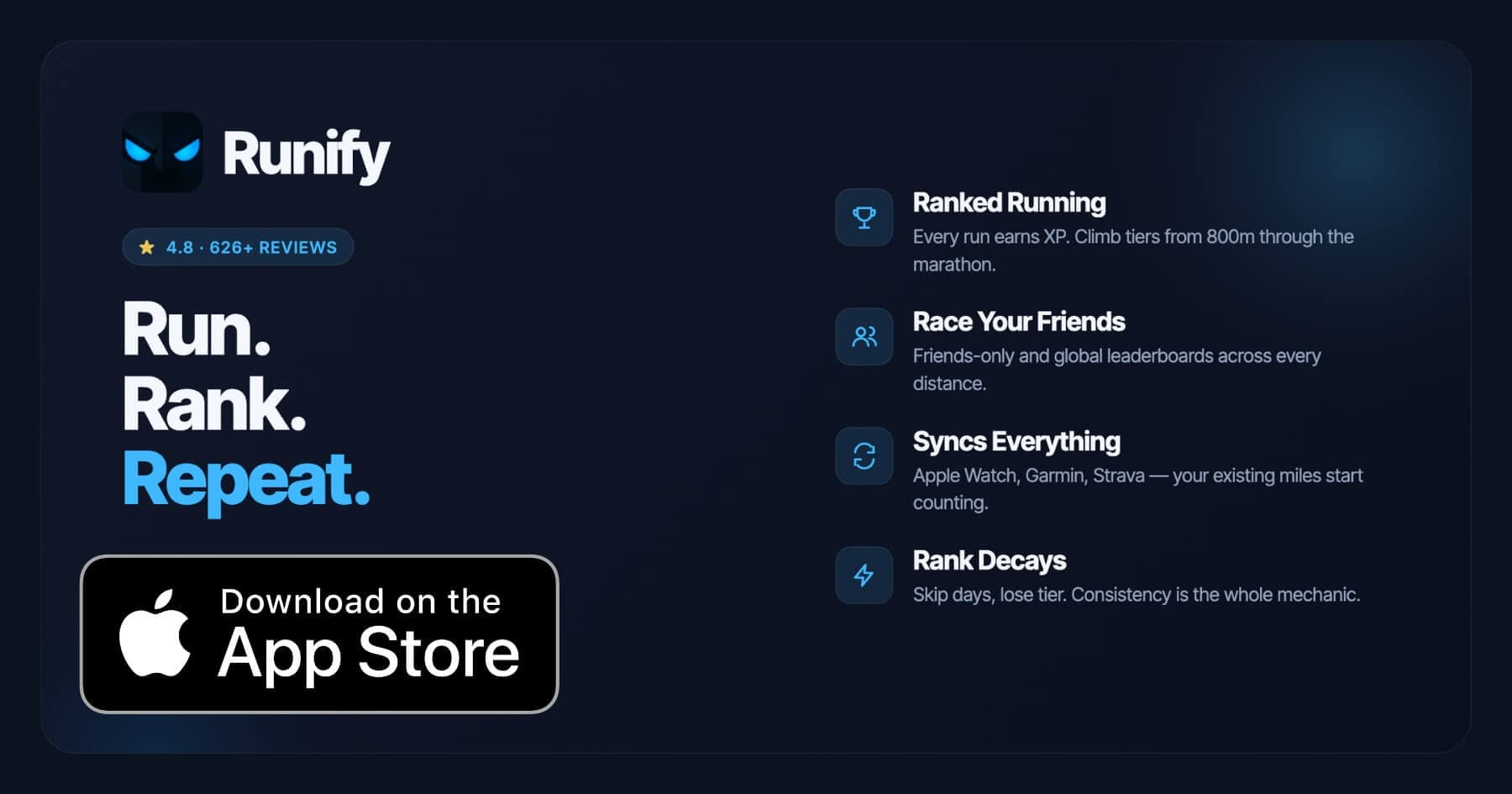
Most of the consistency research points in the same direction: runners who log their runs, set visible goals, and get social accountability stick around longer than runners who do not. Runify is built on that idea. Every run you log inside the app or sync from Apple Watch, Garmin, or Strava earns XP and moves your Runify Rank. Keep showing up and your rank climbs. Skip too many days and it decays - the same accountability loop the habit research keeps pointing at, made visible.
If you already track on an Apple Watch or with Garmin, you do not have to switch. Runify imports from HealthKit, Garmin Connect, and Strava, so your existing miles start counting toward your rank and your spot on friends-only or global leaderboards from 800m through the marathon.
Ready to make your runs count? Download Runify on the App Store and turn every mile into XP across leaderboards from 800m through the marathon.
4.8 stars on the App Store, 626+ reviews worldwide.
Download Runify on the App Store

4.8 on the App Store · Built for iOS