Strava Usage Statistics 2026
Strava Usage Statistics 2026
Strava is the largest social fitness network on the planet. The app reports more than 195 million athletes in over 185 countries, and Strava users uploaded roughly 4 billion activities in 2025 alone. Running is the top sport on the platform, and 72% of Strava runners hit their 2024 run goals. Female participation is climbing fast, with women accounting for more than 40% of new athletes in 2024 and an 89% jump in women joining run clubs. Revenue has nearly doubled in two years, from $338M in 2024 to about $500M in 2025, with a confidential IPO filing in early 2026.
Most runners you know either log on Strava, follow their friends on Strava, or have at least signed up once. The platform shapes how a generation of runners trains, races, and ranks themselves. Its annual Year in Sport reports have become one of the cleanest looks we have at how the running boom is actually behaving.
This post pulls together 16 verifiable statistics on Strava usage in 2026, drawing on Strava's own press releases, Year in Sport reports, and reputable industry trackers. It is built for runners trying to understand the platform they already use, and for anyone watching where social fitness is heading next.
1. Strava reports more than 195 million athletes in 2026
Strava's April 2026 communications reference more than 195 million athletes across 185+ countries. That is up from 180 million users cited in late 2025 and 150 million in mid-2025, reflecting one of the fastest growth phases in the company's history. Strava saw more than 50% growth in new users during 2024, and CEO Michael Martin has publicly described user acquisition as accelerating again into the IPO window.
For runners, the takeaway is scale. Almost any race start line, run club, or training partner you meet has a Strava account. That density is what makes the platform's leaderboards and segments meaningful, and it is also why Strava data is treated as a credible proxy for global running behavior.
Source: Strava Press - Year in Sport Trend Report
2. Roughly 4 billion activities were logged on Strava in 2025
Strava users completed approximately 4 billion activities during 2025, according to figures reported by Business of Apps and aligned with Strava's own subscriber communications. That works out to more than 10 million activities every day, or about 76 million per week, across runs, rides, walks, hikes, swims, and weight sessions.
The number puts the platform's earlier milestones in context. Strava crossed 1 billion activities in 2017, then hit 3 billion total by early 2020, and 1.8 billion uploads in 2021 alone. The 2025 figure shows that activity volume has more than doubled in four years as the user base has scaled.
Source: Business of Apps - Strava Revenue and Usage Statistics 2026
3. About 51 million activities are uploaded every week
Strava's platform handles around 51 million activity uploads per week, which works out to roughly 204 million per month. That cadence comes from a base of more than 180 million registered users, with about 3 million new signups added each month during 2025.
For runners thinking about it as a feed, that is the volume you are competing with for attention on any given long run. It is also why Strava's segment, kudos, and club features can run at scale. The platform sees enough data each week to detect macro running trends in near real time, which is the basis for the company's mid-year and end-of-year reports.
Source: Business of Apps - Strava Revenue and Usage Statistics 2026
4. Running is the most-uploaded sport on Strava
Running remains the single most-uploaded activity type on Strava, ahead of cycling and other sports. The 2024 Year in Sport report flagged running as the dominant category, and the 2025 report doubled down by highlighting running as a centerpiece of Gen Z's "movement over scrolling" shift.
This matters because Strava started as a cycling-first product. The fact that running has overtaken cycling on the upload feed reflects the broader running boom of the 2020s, with new runners entering the sport through couch-to-5K plans, run clubs, and social-first content. If you are running and posting, you are now part of the platform's biggest activity bucket. Our running consistency deep-dive shows how often that translates into a real habit.
Source: Strava Press - 2024 Year in Sport Trend Report
5. Run club participation grew 59% globally in 2024
Strava recorded a 59% increase in run club participation worldwide during 2024. Walking clubs grew 52%, and total group activities of 10 or more participants climbed 18% year over year. The "run club instead of nightclub" framing was Strava's headline social trend for the year.
Group runs are not just bigger. They are also longer, with group activities running 40% farther on average than solo ones, and they generated up to 95% more kudos compared to solo efforts in larger group sizes. For new runners, that is a measurable signal that joining a club correlates with logging more miles and getting more reinforcement.
Source: Strava Press - 2024 Year in Sport Trend Report
6. Strava crossed 1 million total clubs in 2025
Strava's 12th annual Year in Sport report confirmed that the platform crossed 1 million total clubs in 2025, with new club creation nearly quadrupling year over year. Hiking clubs grew the fastest at 5.8x, followed by running clubs at 3.5x. Club-organized events rose 1.5x.
The shape of this data line tells you something. Younger runners are using Strava as a meet-up engine, not just a tracker. With 1 million clubs already on the platform, the chance that a club exists for your city, distance, or pace bracket is high enough that "I cannot find one" is rarely a real blocker. If you want a sample of which apps make these communities most visible, see our roundup of the best running apps with leaderboards on iPhone.
Source: Strava Press - 12th Annual Year in Sport Trend Report
7. The median run pace on Strava in 2024 was 10:15 per mile
The median running speed across all Strava users in 2024 was 10:15 per mile, or 6:22 per kilometer. That figure spans the full population on the platform, from new joggers to elite age-groupers, and it is a useful benchmark for runners trying to decide whether they are "on pace" with the wider community.
The number suggests that the typical Strava run is firmly in the easy-to-moderate aerobic zone. It also lines up with what coaches recommend, since most weekly mileage for recreational runners should be conversational. If your everyday pace is around or slightly slower than 10:15, you are running in the same band as half the platform.
Source: Strava Press - 2024 Year in Sport Trend Report
8. Median Strava activity duration was 53 minutes in 2024
The median activity logged on Strava during the September 2023 to August 2024 reporting window was 53 minutes long. That includes runs, rides, hikes, walks, and weight training sessions. In a survey paired with the same dataset, 57% of respondents said the ideal workout falls between 45 and 60 minutes.
The data points line up neatly. Most Strava users are not logging two-hour epics. They are logging a single, focused session that fits inside a normal workday, and they prefer it that way. For runners, that is permission to stop chasing volume that does not match your life and to value consistency in the 45 to 60 minute band.
Source: Strava Press - 2024 Year in Sport Trend Report
9. 72% of Strava runners hit their 2024 run goals
Of Strava users who set a run goal for 2024, 72% completed it. Cyclists hit 77% of their goals, walkers and hikers came in slightly higher, and the cross-platform completion rate signaled one of Strava's strongest goal-achievement years on record.
The number is striking because most "New Year's resolution" research lands far below this. The difference is selection bias plus a real platform effect. People who set goals inside Strava are already engaged enough to track them, and the kudos, clubs, and progress chart provide steady feedback. If you are debating whether logging your goal somewhere visible matters, the 72% rate is a meaningful argument that it does.
Source: Strava Press - 2024 Year in Sport Trend Report
10. Marathons, ultras, and century rides logged grew 9% in 2024
Strava saw a 9% increase in the number of marathons, ultramarathons, and 100-mile cycling efforts logged on the platform during 2024 compared to 2023. The growth came on top of an existing post-pandemic surge in race participation, and it held up despite the broader trend toward shorter, more social workouts.
The signal is that endurance is not dying. While casual fitness is moving toward 45 to 60 minute social sessions, a meaningful and growing slice of the platform is still chasing big-distance goals. Strava also observed that 2024 marathoners logged 51% of the final 16 weeks before race day as rest or active recovery, hinting at smarter, more recovery-focused training. For more context on marathon outcomes, see our marathon finishing time statistics.
Source: Strava Press - 2024 Year in Sport Trend Report
11. Women made up over 40% of new Strava athletes in 2024
More than 40% of new athletes joining Strava in 2024 were women, the highest share the platform has reported. Women joining run clubs jumped 89% year over year, women cyclists grew 11%, and weight training was the fastest-growing women's sport at 25% growth in uploads.
The gender gap on Strava has historically been a real one. The 2024 numbers show it narrowing fast, especially in running. UK alone added 349,000 new runners in 2024, with growth driven almost entirely by Gen Z women. For anyone interested in the broader female-running surge, our half marathon statistics post covers race-day numbers that match this platform-level trend.
Source: Strava Press - 2024 Year in Sport Trend Report
12. Women were 20% more likely than men to claim a Strava crown in 2024
Inside the Strava segment system, women were 20% more likely than men to earn the fastest-time "crown" (KOM/QOM/CR) on a segment in 2024. Older generations also overperformed younger ones. Boomers and Gen X out-paced Millennials and Gen Z on both mileage and crowns earned.
This is one of the more counterintuitive findings in the dataset. The viral image of Strava is a Gen Z runner in a club, but the people actually winning segment competitions on the platform skew older and increasingly female. Crowns reward a mix of fitness, course knowledge, and showing up repeatedly to the same routes, all of which compound with age and consistency.
Source: Strava Press - 2024 Year in Sport Trend Report
13. Strava revenue rose from $338M in 2024 to about $500M in 2025
Strava's reported revenue jumped from roughly $338 million in 2024 to approximately $500 million in 2025, an increase of about 48%. Industry trackers also report annual recurring revenue approaching $500 million by mid-2025, with subscriber retention in the 80% to 90% band.
About 90% of Strava's revenue comes from paid subscriptions, with subscription pricing at $11.99 per month or $79.99 per year in the US. The combination of fast user growth, high ARR, and strong retention is what powered the company's $2.2 billion valuation in May 2025 and its confidential IPO filing in early 2026.
Source: Business of Apps - Strava Revenue and Usage Statistics 2026
14. Strava users gave 14 billion kudos in 2025
Strava recorded 14 billion kudos given in 2025, up by 2 billion compared to the prior year. Kudos are Strava's lightweight social-validation mechanic. They are the equivalent of a like, attached to a specific run, ride, or session.
The growth in kudos volume tracks the growth in users, but it also tracks deeper social use of the platform. Group activities of 10 or more drew up to 95% more kudos per session than solo workouts, which is one reason run clubs are sticky on Strava. For most runners, the 14 billion figure translates into a simple practical reality. Posting your run gets you small but consistent feedback that helps with consistency, especially in the early weeks of a habit.
Source: Business of Apps - Strava Revenue and Usage Statistics 2026
15. Strava subscribers spent one hour active for every two minutes in app
Strava's 2025 Year in Sport report disclosed a striking engagement ratio. Subscribers averaged one hour of real-world activity for every two minutes of screen time spent inside the Strava app. That is a 30:1 ratio of moving to tapping, which is rare among consumer apps.
The ratio is the result of how Strava is designed. The app rewards uploads and quick social check-ins rather than infinite scrolling. More than half of Gen Z respondents said they plan to use Strava more in 2026, while saying they will use Instagram and TikTok the same amount or less. For runners worried about app overuse, this is a friendlier ratio than almost any social platform you currently have on your phone.
Source: Strava Press - 12th Annual Year in Sport Trend Report
16. The 2024 report covered 135 million users in 190+ countries
Strava's 2024 Year in Sport report drew on activity data from more than 135 million users in over 190 countries, paired with a randomized global survey of more than 5,000 people. The 2025 follow-up expanded the survey base to more than 30,000 respondents alongside billions of activities.
The methodology matters because it makes Strava's reports one of the most-cited public sources for running behavior anywhere. Sample sizes that big push past anecdote and into something closer to a global running census. When you see Strava numbers referenced in mainstream press, this is the dataset behind them. For anyone curating a stack of running apps beyond Strava itself, our Strava alternatives roundup compares the next tier of options on the same axes.
Source: Strava Press - 2024 Year in Sport Trend Report
What These Numbers Tell Runners
Strava is no longer a niche social network for cyclists. It is the de facto layer of record for running culture, with nearly 200 million accounts, 4 billion activities a year, and a goal-completion rate that beats almost any wellness app on the market. The 2024 and 2025 datasets show a platform that is broader, younger, and more female than it was even three years ago.
For real runners, the practical lesson is that Strava-style logging is doing measurable work. People who set a goal on the platform hit it 72% of the time. Group runs through Strava clubs draw 95% more kudos and run 40% farther than solo efforts. The median user is logging a 53 minute session at a 10:15 pace, which gives every recreational runner a clean public benchmark to compare against without paying for a coach.
Where this is heading is clear. Endurance volume is still growing, with marathons and ultras up 9% in 2024. Younger runners are entering through clubs and social hooks, while older runners keep collecting crowns. Strava's IPO filing in early 2026 simply confirms what the activity data already showed: this is a generational behavior shift, not a fad.
Strava is now the world's largest dataset on how recreational runners actually train, and the numbers say running consistently and logging it socially correlate with hitting goals more often.
Where Runify Fits Alongside Strava
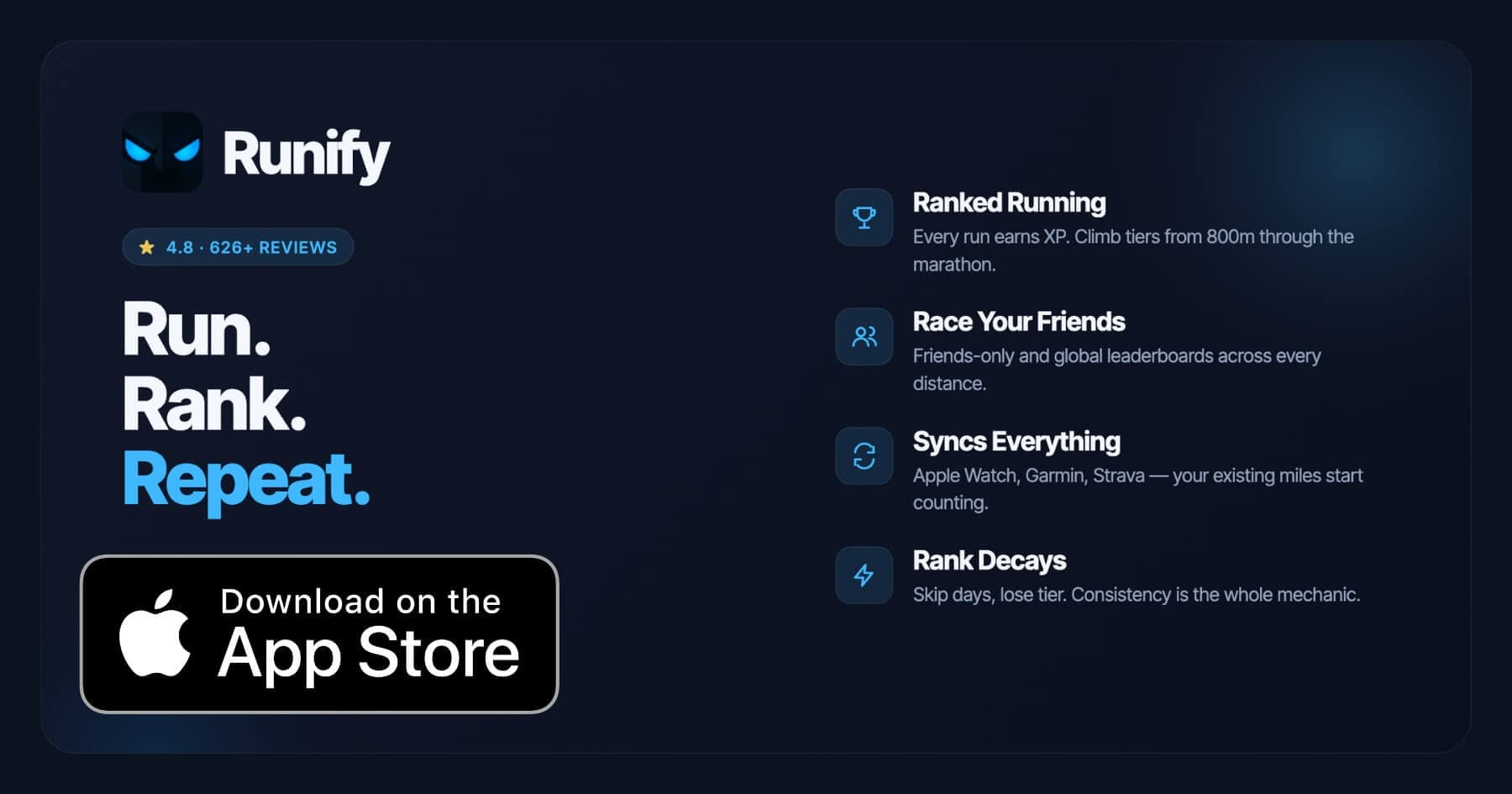
Most committed runners do not pick one app. They run with a watch, sync to Strava for the social layer, and use a second app for whatever Strava does not give them. Runify is built for that second slot. Your existing Strava miles can sync into Runify and start counting toward your competitive rank across 800m, 1K, 5K, 10K, half marathon, and marathon distance leaderboards. Nothing about your Strava feed has to change.
The point is to give the runs you are already logging a second kind of payoff. Strava shows you what you ran. Runify shows you where that run puts you among friends and globally at a specific race distance, and how your rank moves as you keep running or fall off. If 72% of Strava runners hit their goal in 2024, the runners who layer in a ranked-progression system on top of social logging tend to be the ones who keep showing up week after week.
Ready to make your runs count? Download Runify on the App Store and turn every mile into XP across leaderboards from 800m through the marathon.
4.8 stars on the App Store, 626+ reviews worldwide.
Download Runify on the App Store

4.8 on the App Store · Built for iOS