Running Tier Progression Statistics 2026
Running Tier Progression Statistics 2026
86% of Runna-connected runners on Strava set a personal best in 2025. The average new habit takes about 66 days of repetition to feel automatic. Beginner runners shave 3-5 minutes off their 5K time in a structured 8-12 week block, and fitness apps using game mechanics report a 60% retention lift. These 16 statistics map the real curve of runner progression in 2026: how long the early jumps last, when the plateau hits, and what actually keeps runners climbing through the tiers.
Running progression is not a straight line. The first 18-24 months produce most of a runner's lifetime gains, then the curve flattens and the work shifts to consistency, recovery, and small percentage improvements. That shape, supported by sports science and large-scale activity data, is why "tier" thinking has crept from gaming into running apps - it gives a visible structure to a slow process.
This post pulls together 16 verifiable statistics on how runners move from beginner to intermediate to advanced, what derails them, and which behaviors correlate with continued progression. It is for runners who want to know what realistic tier progression actually looks like.
1. 86% of Runna-connected Strava runners set a PR in 2025
Eighty-six percent of runners who linked Runna to Strava recorded a personal best across the 5K, 10K, half marathon, or marathon in 2025, according to Strava's 12th Annual Year in Sport report. Across the broader Strava base, 42% of runners hit a PR at one of those four distances during the year. The gap is striking: connected, structured runners progressed at roughly double the rate of the general logging population. For tier-progression purposes, the finding suggests that runners who treat their training as a system - logged, structured, reviewed - move up faster than those who simply run when they feel like it. A personal best is the cleanest signal that a runner has crossed a tier boundary at a given distance.
Source: Strava - 12th Annual Year in Sport Trend Report (2025)
2. Strava users self-classify as 26% beginner, 34% intermediate
Strava's 2025 Year in Sport report shows that 26% of runners on the platform rate themselves as beginners and 34% as intermediate, with the remainder split across advanced and other categories. That distribution implies that roughly six in ten active, app-using runners still see themselves in the lower tiers of the sport. The number matters because most published "good 5K time" charts treat advanced and elite paces as the reference, even though the typical app user is one or two tiers below that. For a tier-progression model, the realistic ladder starts at beginner, treats intermediate as the central plateau, and frames advanced as the destination most runners never officially claim - they just keep moving up the leaderboard.
Source: Strava - 12th Annual Year in Sport Trend Report (2025)
3. Habits take an average of 66 days to feel automatic
A landmark University College London study led by Phillippa Lally, published in the European Journal of Social Psychology, found it takes an average of 66 days for a new daily behavior to become automatic. The range across participants ran from 18 days to 254 days, with the daily activity itself - one of which was running for 15 minutes before dinner - the strongest predictor of automaticity. Sixty-six days is the rough length of one tier in any progression system that rewards daily or near-daily input. For runners, this means the first two to three months of a new training routine are where the habit either locks in or breaks. Tier-based apps that reward this exact window are aligned with the underlying behavioral science, not just borrowing the aesthetic of games.
Source: UCL News - How long does it take to form a habit?
4. Beginners gain 3-5 minutes on a 5K in 8-12 weeks
Structured 8-12 week training blocks produce 3-5 minute 5K improvements for beginner runners, with recreational runners gaining 1-3 minutes in the same window. The gains come from a mix of one weekly speed session, three to four total run days, and the 80/20 rule of easy mileage. The takeaway for tier progression: the biggest measurable jump usually happens in the first three months of structured training, which is also the window where most beginners abandon the sport entirely. Apps and frameworks that bridge this period - by making the first 90 days visible, rewarded, and socially reinforced - sit directly on top of where the biggest performance gains are available.
Source: RunV - How to Progress From Beginner to Intermediate Running
5. Most lifetime gains come in the first 18-24 months
The large majority of a beginner runner's improvement happens in the first 18 to 24 months of consistent, structured training. After that, the improvement curve flattens, and the work shifts from raw fitness gains to running economy, race tactics, and incremental seconds rather than minutes. This is the central shape of every realistic tier-progression model: a steep early climb, a long middle, and a slow advanced tier. Runners who quit during the early flattening - often around month nine or ten - frequently misinterpret the natural curve as a personal failure. Knowing the shape in advance is one of the most underrated forms of retention insurance for new runners.
Source: RunV - How to Progress From Beginner to Intermediate Running
6. VO2 max blocks plateau after 6-8 weeks
VO2 max training drives measurable gains for about six to eight weeks before performance plateaus and the body holds the level while it adapts in other systems. Recreational athletes can improve VO2 max by 5-10% in 60-90 days of focused work, and a documented case study tracked a 96% improvement over 24 months in a non-elite runner using targeted intense training. The 6-8 week ceiling on any single training stimulus is why "block" training works and why infinite linear progress on the same plan is biologically impossible. Tier progression in running is essentially the stacking of these short stimulus blocks across years.
Source: PMC - VO2 Max Improvement of 96% Over 24 Months in a Recreational Athlete
7. The new 10% rule cuts injury risk on single runs
A British Journal of Sports Medicine cohort of more than 5,200 runners found that overuse injury risk jumped 64% when runners exceeded their longest single run from the previous 30 days by 10-30%. Total weekly mileage changes did not predict injury well. The key driver was the spike on any single run. For tier progression, the practical implication is that ranking systems and training plans that quietly cap or warn against oversized single sessions protect runners from the most common reason they fall out of progression: getting hurt, missing weeks, and losing the habit window described in stat 3.
Source: Marathon Handbook - The 10% Rule In Running
8. Roughly one-third of novice runners quit within six months
A peer-reviewed study on novice runner programs found that almost one-third of new runners stopped running within six months of starting. Injury was the leading cause, followed by loss of motivation. Six months is a critical tier-boundary number: it sits just past the 66-day habit window, just before the first major fitness plateau, and well before the 18-24 month period where most lifetime gains accumulate. The runners who survive the six-month mark are statistically far more likely to still be running at year two and beyond. Any tier-progression system that holds attention through that first half-year materially changes the population of runners who reach intermediate.
Source: ScienceDirect - Reasons and predictors of discontinuation of running
9. Gamification lifts fitness app retention by up to 60%
Fitness apps that use gamification - points, levels, streaks, leaderboards - have reported up to a 60% increase in user retention, with engagement up to 150% higher than non-gamified equivalents. A meta-analysis of 16 randomized controlled trials found gamification produced a Hedges g effect size of 0.42 on physical activity behavior, a small-to-medium positive effect on real-world movement. The numbers matter for runners because the average 30-day retention rate across fitness apps is around 3.4%. Anything that visibly rewards consistency - tier progression, XP, rank decay - sits directly on top of the behavioral weak point that ends most running journeys before tier two.
Source: Imaginovation - Why Fitness Apps Lose Users, And How to Fix It
10. The average global 5K time is around 30 minutes
Aggregated 5K race results put the global average finish time near 30 minutes, with men averaging around 28:30 and women around 34:30. Other large datasets, including 736,928 race results compiled by running statistics site Runbundle, place the overall average at 34:29. Beginner runners following a structured plan typically finish their first 5K between 30 and 40 minutes. The tier interpretation: an honest "intermediate" 5K sits roughly at the global average, "advanced" lives meaningfully below it, and most runners overestimate where they actually rank because they compare themselves to elites rather than to the realistic median.
Source: Marathon Handbook - Good 5K Time: Average by Age, Sex, and Ability
11. Boulder runners hit PRs at a 57% rate in 2025
Strava's 2025 Year in Sport report named Boulder the top US running city, with 57% of its runners earning a PR during the year - far above the platform-wide rate of 42%. Boulder also led the country on longest average runs (4.4 miles), most weekly moving time (3:09:58), and longest median streak (39 days). The combination shows that PR rate, weekly volume, and streak length move together. Tier progression is not driven by any single behavior in isolation: cities that produce the most PRs are also the cities running the longest, most consistently, with the longest unbroken stretches. The same pattern, scaled down, is what individual progression looks like.
Source: Strava - 12th Annual Year in Sport Trend Report (2025)
12. Optimal mortality gains come from just 2-3 runs per week
A landmark study published in the Journal of the American College of Cardiology found that running 1 to 2.4 hours per week, spread across 2 to 3 sessions, at a slow or average pace produced the strongest mortality-reduction effect. Higher volumes did not produce better survival outcomes. For tier-progression purposes, this is important context: the health payoff for running is largely unlocked at the beginner tier, and the work above that level is mostly about performance, not longevity. Runners do not need to reach an advanced tier to capture the health benefit. They do, however, often need the visible reward of progression to keep showing up two or three times a week long enough to capture it.
Source: JACC - Optimal Dose of Running for Longevity
13. Half marathon finishers grew 20.9% in 2024
The half marathon was the fastest-growing race distance in 2024, with finishers up 20.9% year over year. Thirty-five percent of runners now name the half as their preferred race distance, and roughly a quarter more men than women race the half. The half marathon's growth is a tier-progression story in aggregate: runners who clear the 5K and 10K tiers increasingly choose the half as the next visible benchmark, rather than jumping to the full marathon. The distance now functions as the de facto bridge between the recreational and serious tiers of road running.
Source: Running Industry Alliance - Running Up 39% Year on Year
14. US marathon participation reached 432,562 finishers in 2024
US marathons recorded 432,562 finishers in 2024, a 5.0% increase year over year and now only 12.8% below the all-time peak set in 2014. RunSignup reported 11.1% growth in average race size across its platform, and the top 100 US races grew by an average of 15% in the second half of 2024. The marathon, the apex tier of mass-participation road running, is rebounding toward record participation. Combined with the half marathon surge in stat 13, the data points to a clear tier ladder forming again in 2025-2026, with runners progressing from 5K to 10K to half to full at scale, rather than treating any of those as a terminal goal.
Source: RunRepeat - The State of US Marathons 2025
15. Gen Z 5K participation rose 28% year over year
Strava's 2025 Year in Sport report tracked a 28% year-over-year increase in Gen Z 5K participation, 39% in 10Ks, 31% in half marathons, and 33% in full marathons. Gen Z now drives most of the running industry's growth, and the larger jumps at longer distances suggest younger runners are not stopping at the entry tier. They are climbing the distance ladder fast. The implication for any tier-progression model is that the incoming generation of runners expects visible structure, social reinforcement, and clear next steps - the exact properties that game-like progression systems have already built for them everywhere else in their lives.
Source: Athletech News - Strava Year in Sport Report
16. Strava users gave 14 billion kudos in 2025
Strava users gave 14 billion kudos in 2025, up 2 billion from the previous year, on a platform that now serves more than 180 million users across 185 countries. The metric is not about pace or distance: it is pure social reinforcement. Research on leaderboards and social comparison shows that upward comparison - seeing runners just slightly ahead - tends to raise effort and exercise frequency, while flat ranking with no reference point tends to suppress motivation. The 14 billion kudos figure quantifies how much of running's modern progression is social rather than purely physical. Tier systems that combine personal data with friend-level comparison work because they sit on top of the same psychology.
Source: Strava - 12th Annual Year in Sport Trend Report (2025)
What These Numbers Tell Runners About Tier Progression
The data describes a specific shape. New runners gain a lot quickly, then less, then very slowly, and the biggest predictor of whether they ever reach the slow part is whether they survive the first six months and the 66-day habit window. Around one-third drop out before then, usually through injury or loss of motivation, and the runners who do not drop out are the ones who eventually post the personal bests, finish the halves, and climb into the upper tiers.
The structural lesson is that visible progression does most of its work at the bottom of the ladder, not the top. Advanced runners do not need an app to know they ran well. Beginners and recreational runners do. Our running consistency deep-dive and running streak statistics breakdown both reinforce the same point: the runners who keep moving up tiers are the ones who keep showing up, not the ones with the best raw talent.
The trajectory across 2024 and 2025 - rising marathon and half marathon participation, Gen Z growth across every distance, more PRs per active runner - suggests the running ladder is being climbed faster and by more people than at any point since 2014. The next few years of running will likely be defined less by raw participation growth and more by how clearly that ladder is communicated to the runners on it.
Tier progression in running is mostly a survival problem at the bottom and a structure problem in the middle - solve those two and the advanced tier mostly takes care of itself.
Turn Your Tier Progression Into Something You Can See
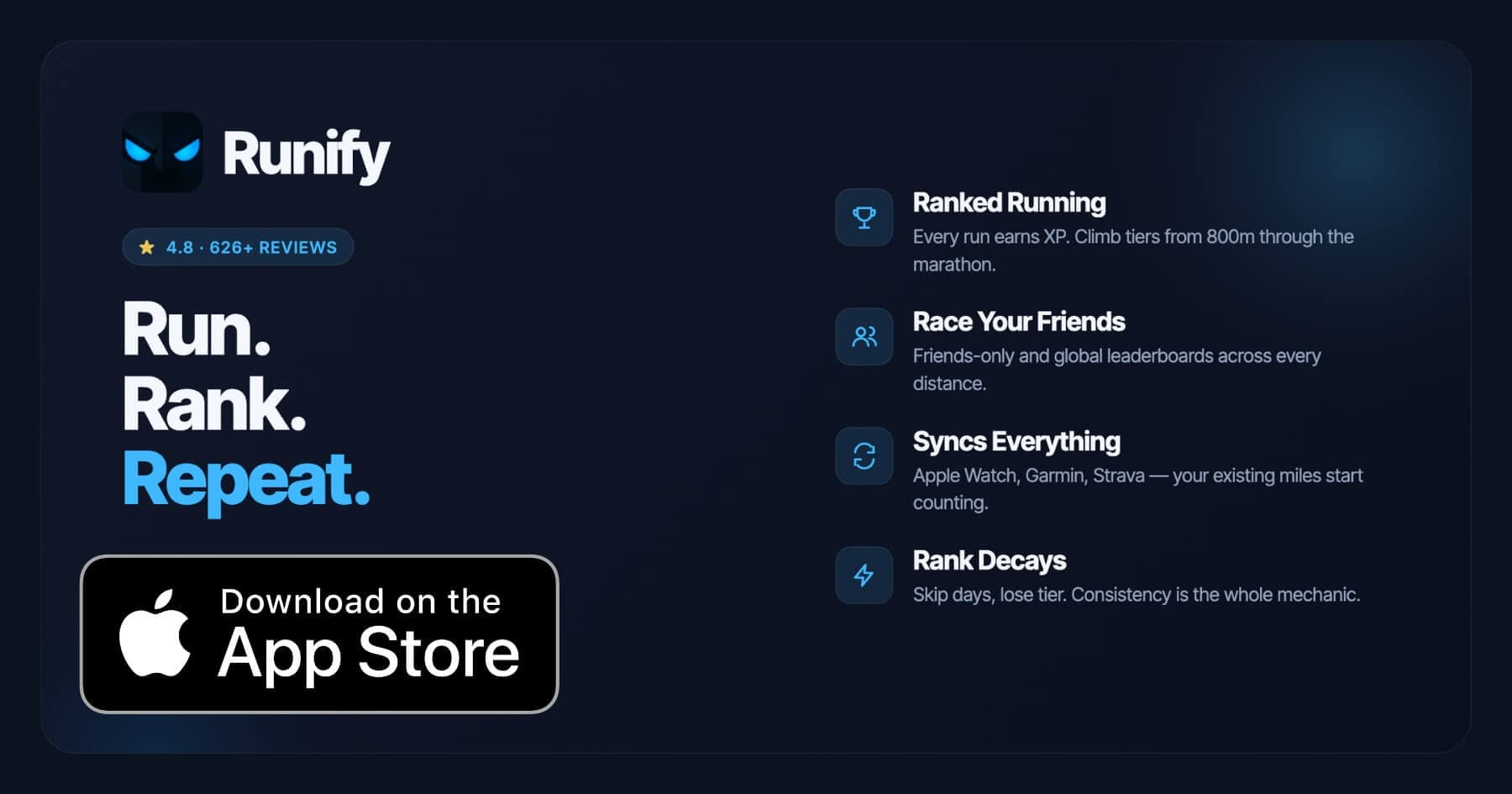
The statistics keep pointing at the same thing: runners climb tiers when their progress is visible and socially reinforced, not just when they train hard. That is the gap Runify is built for. Every run you log inside Runify, or sync from Apple Watch, Garmin, or Strava, earns XP, moves you through a competitive tier system, and puts you on friends-only or global leaderboards from 800m through the marathon. Your average runner mileage benchmarks translate into actual position on a board, not just a number in a log.
Keep running and your rank climbs. Skip too many weeks and it decays. That decay is the point - it mirrors the real biology in stat 6 and the real dropout pattern in stat 8, and it turns the abstract idea of "progression" into something you can see move every week.
Ready to make your runs count? Download Runify on the App Store and turn every mile into XP across leaderboards from 800m through the marathon.
4.8 stars on the App Store, 626+ reviews worldwide.
Download Runify on the App Store

4.8 on the App Store · Built for iOS