Nike Run Club vs Runkeeper: Compared in 2026
Nike Run Club vs Runkeeper: The Quick Verdict
Nike Run Club wins for runners who want free, structured audio coaching and guided workouts without spending a cent. Runkeeper wins for runners who want multi-sport tracking, deeper metrics, and Garmin integration behind a single, affordable subscription.
Nike Run Club is completely free, holds 4.8 stars on the App Store from hundreds of thousands of reviews, and offers around 300 audio-guided runs plus six training plans at no cost. Runkeeper (owned by ASICS) offers GPS tracking on iOS and Android, with its premium tier - Runkeeper Go - priced at $9.99/month or $39.99/year to unlock training plans and advanced analytics.
Neither app turns your runs into a competitive ranking system. For runners who want XP, a visible rank, and leaderboards across race distances, Runify is a strong third option worth knowing about.
At a Glance: Nike Run Club vs Runkeeper
| Feature | Nike Run Club | Runkeeper |
|---|---|---|
| Best For | Free guided coaching and community challenges | Multi-sport tracking and structured training plans |
| Pricing | Free | Free; Go $9.99/mo or $39.99/yr |
| Platform | iOS + Android | iOS + Android |
| Standout Feature | 300+ free audio-guided runs with Nike coaches | Garmin and wearable sync with training plan export |
| Main Limitation | Limited advanced metrics for serious athletes | Key features increasingly locked behind paywall |
What Is Nike Run Club?
Nike Run Club (NRC) launched in 2010 and has grown into one of the most widely used free running apps in the world. Nike positions it as a coaching companion as much as a tracker. The app is available on iOS and Android as part of the Nike Member program, which is also free to join.
NRC is aimed at runners across all ability levels, but it particularly resonates with beginners and recreational runners who want motivation and structure without paying for it. The app's biggest draw is its library of audio-guided runs led by Nike coaches and professional athletes like Eliud Kipchoge.
Nike Run Club Key Features
- GPS Run Tracking: Records pace, distance, elevation, and heart rate during every run, with mile split data.
- Audio-Guided Runs: Around 300 guided workouts narrated by Nike coaches - easy runs, long runs, speed sessions, and motivational pushes.
- Training Plans: Six training plans built into the app at no cost, from beginner 5K to marathon preparation.
- Challenges: Create friend challenges, join community challenges, or set monthly mileage goals with a social group.
- Apple Watch and Music Integration: Syncs natively with Apple Watch and works with Spotify and Apple Music for run-pace playlists.
Nike Run Club Pricing
Nike Run Club is free. There is no premium subscription, no paywall on guided runs, and no hidden tier. You need a Nike Member account (also free). All six training plans, all 300+ guided runs, and all social features are available without spending anything.
Nike Run Club Strengths
- Completely free with no paywall on core features, including coaching
- High-quality audio guidance from real coaches and elite athletes
- Beginner-friendly onboarding that makes running feel approachable
- Active challenge system that works well for friend groups and workplace competitions
Nike Run Club Weaknesses
- Limited advanced metrics - serious athletes will find it lacks the depth of Garmin Connect or Strava
- Social features are shallow; you cannot view detailed stats for friends beyond total distance
- Syncing bugs with Apple Watch have caused some users to lose run data
- Not ideal for multi-sport athletes - running is the primary focus
What Is Runkeeper?
Runkeeper launched in 2008, making it one of the oldest GPS running apps still in active development. ASICS acquired it in 2016 and has since added training plans, guided workouts, and deeper wearable integrations. The app targets runners and walkers who want reliable tracking across multiple activity types.
Runkeeper sits in the middle ground: more metrics and integrations than a basic tracker, less social complexity than Strava. It works on iOS and Android, connects to Apple Watch, Garmin, Fitbit, COROS, and Suunto, and exports workout data to Apple Health and MyFitnessPal.
Runkeeper Key Features
- GPS Tracking: Tracks pace, distance, elevation, splits, and heart rate across running, walking, cycling, and other cardio activities.
- Audio Cues: Voice updates at your chosen interval for distance, pace, and time - customizable frequency.
- Training Plans: Structured plans for 5K through marathon, adjustable to your current fitness level. Available behind the Go subscription.
- Live Tracking: Share a unique link so friends and family can follow your run in real time.
- Wearable Sync: Connects to Garmin, Fitbit, COROS, and Suunto; syncs training plans directly to compatible Garmin watches.
Runkeeper Pricing
Runkeeper has a free tier with basic GPS tracking and history. Runkeeper Go unlocks training plans, guided workouts, advanced analytics, and live tracking. Go costs $9.99/month or $39.99/year. The annual plan works out to roughly $3.33/month, making it one of the more affordable paid running subscriptions.
Runkeeper Strengths
- Strong wearable integration - Garmin owners can push training plans directly to their watch
- Multi-sport tracking beyond just running makes it useful for mixed-activity athletes
- Reliable, consistent GPS tracking without over-engineering the interface
- Reasonable annual pricing compared to competitors like Strava Premium
Runkeeper Weaknesses
- Previously free features have been progressively moved behind the Go paywall, frustrating long-time users
- Audio cues default to a chatty frequency that many users find disruptive
- GPS accuracy can be inconsistent in areas with poor signal compared to dedicated GPS watches
- The app's social layer is minimal - no community feed, no segments, no leaderboards
Nike Run Club vs Runkeeper: Head-to-Head
Both apps track runs and help runners train, but they prioritize very different things. Nike Run Club is built around the coaching experience. Runkeeper is built around reliable, device-agnostic tracking. The sections below break down where each one pulls ahead.
Tracking Accuracy
Runkeeper edges ahead on raw tracking consistency, especially for runners who use GPS watches alongside their phone. Its Garmin and Fitbit integrations let you rely on dedicated hardware for GPS and pull the data into one place automatically. Nike Run Club's GPS tracking is solid for phone-based runs, but syncing bugs with Apple Watch have been a recurring complaint in App Store reviews - some users report lost runs when the watch and iPhone fail to sync correctly.
Training Plans and Coaching
Nike Run Club wins this category clearly, and it's not close. Around 300 audio-guided runs from Nike coaches and athletes like Coach Bennett are free to all users. Six training plans covering 5K through marathon are built in at no cost. Runkeeper's training plans are locked behind Runkeeper Go, and while they are structured and adjustable to your fitness level, they lack the narrative coaching quality that makes NRC's guided runs genuinely engaging.
Social and Community Features
Nike Run Club's challenge system is the more social of the two. You can create friend challenges, join community challenges, and track each other's mileage toward a shared goal. The limitation is depth - you cannot view a friend's detailed run stats, only their total distance. Runkeeper has almost no social layer. It offers live tracking (a link to share your real-time location) but no community feed, no challenges, and no leaderboard. If social accountability matters to you, our best Runkeeper alternatives breakdown covers apps with stronger community features.
Pricing and Value
Nike Run Club is the clearest winner here: free beats any subscription for runners on a budget. Runkeeper Go at $39.99/year is still reasonable if training plans and Garmin sync are features you will actively use. The frustration for longtime Runkeeper users is not the price itself but the pattern - features that were once free have migrated behind Go, which erodes trust. NRC has kept its full coaching library free since launch, which is a significant differentiator.
Hardware Integration
Runkeeper has a broader wearable story. It connects to Garmin, Fitbit, COROS, and Suunto, and can push training plans directly to a compatible Garmin watch so you can follow workouts from your wrist. Nike Run Club works well within the Apple ecosystem - Apple Watch, Spotify, Apple Music - but offers little outside of it. Android users get NRC, but wearable integration beyond Apple Watch is limited.
Platform and Availability
Both apps are available on iOS and Android. Nike Run Club requires a Nike Member account to use. Runkeeper requires an ASICS Runkeeper account. Neither app has a dedicated web dashboard for viewing run history, though both sync to Apple Health. For offline runs, both apps can track without an active internet connection and sync when you reconnect.
Who Should Choose Nike Run Club?
Nike Run Club is the stronger fit if you want a coaching-first experience that costs nothing. The quality of the guided runs is genuinely high, and the training plans are structured enough to take a beginner from couch to 5K or beyond.
- You want free audio-guided runs and coaching without a subscription
- You run primarily on your phone or Apple Watch and stay within the Apple ecosystem
- You enjoy challenge-based social features with friends or coworkers
- You're a beginner or recreational runner who values motivation over advanced metrics
Who Should Choose Runkeeper?
Runkeeper suits runners who want straightforward, reliable tracking and are willing to pay for training plans. The Garmin integration in particular makes it a practical choice for runners who use a GPS watch as their primary device. As covered in our Nike Run Club alternatives guide, Runkeeper often appears on that list for exactly this reason - it overlaps with NRC on basics but diverges sharply on wearable depth.
- You use a Garmin watch and want your training plan synced directly to your wrist
- You track multiple activity types beyond running and want them in one place
- You're a serious runner who needs splits, cadence, and elevation data in a clean view
- You don't need social features and just want honest, reliable run logs
A Third Option: Runify for Ranked, Competitive Running
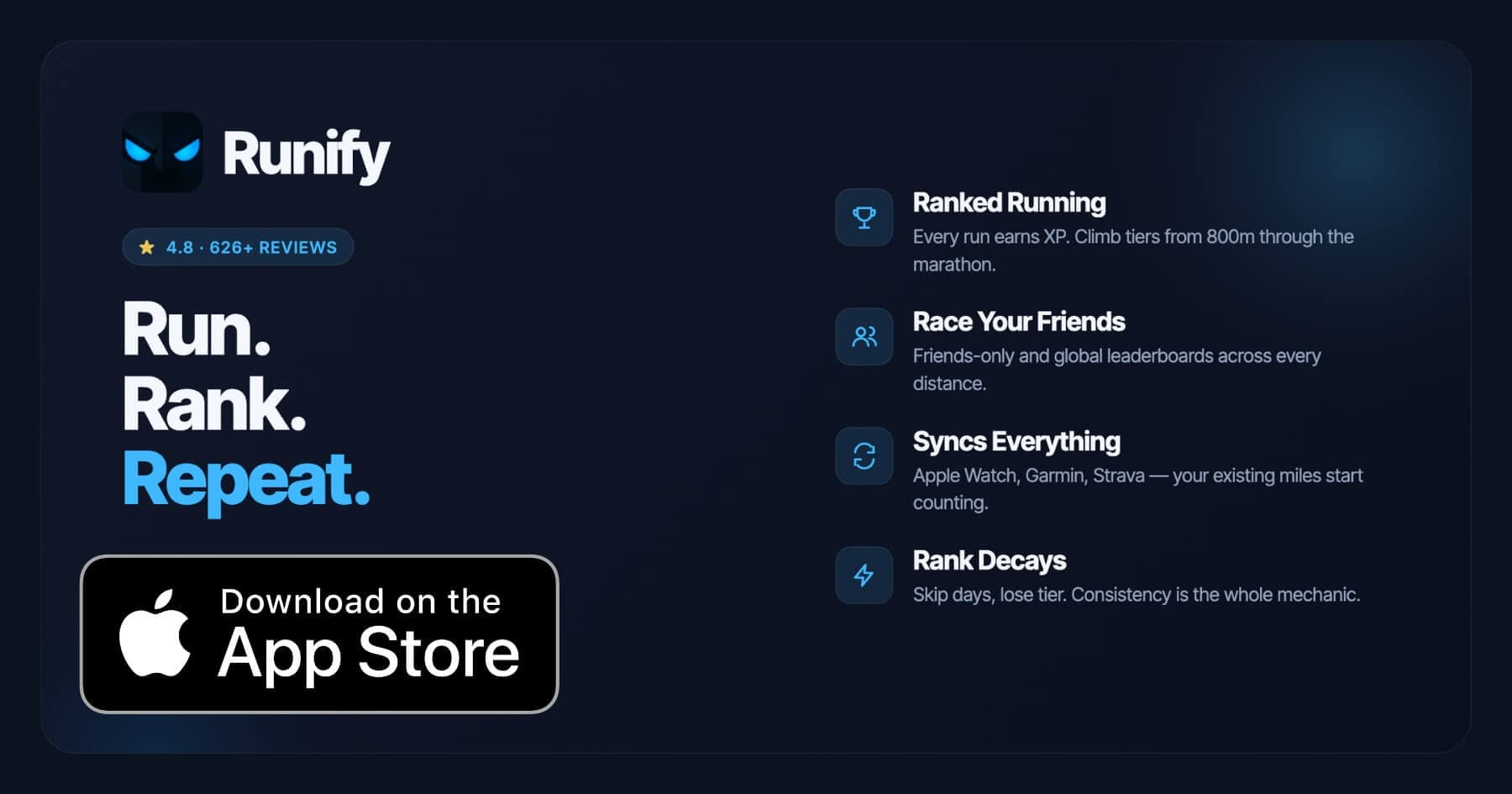
Neither Nike Run Club nor Runkeeper answers the question: "What happens to my rank if I stop running for three weeks?" Runify does. Runify is the first ranked running app - every run you log earns XP, moves you through a competitive tier system, and puts you on friends-only or global leaderboards across distances from 800m through the marathon. Go inactive and your rank decays.
That accountability mechanic is what makes Runify different from both apps in this comparison. NRC uses challenges and streaks to keep you engaged; Runkeeper uses scheduled workouts. Runify uses your rank - a visible, persistent measure that climbs when you run consistently and slips when you don't.
Runify also meets you where you already run. If you use Apple Watch, Garmin, or Strava as your primary tracker, Runify pulls in your existing runs automatically via HealthKit, Garmin Connect, or Strava sync. You don't have to abandon NRC or Runkeeper to use it. Many runners keep their preferred tracker for GPS data and use Runify for the ranking and competitive layer on top. You can see more context in our Strava vs Nike Run Club comparison on how these apps can stack together.
Runify holds a 4.8 App Store rating from 626+ reviews worldwide. Monthly plan is $4.99/month with no free trial; annual is $39.99/year with a 7-day free trial.
When Runify Is the Better Pick Than Both
- You want a visible, competitive reason to keep running - XP, rank, and rank decay make consistency tangible
- You already track on Apple Watch, Garmin, or Strava and want your existing miles to count toward something
- You care about distance-specific performance across 800m, 5K, 10K, half, and full marathon leaderboards
- You like sharing stylized run recaps to Instagram Stories with a rank card attached
When Runify Is Not the Right Fit
- You're on Android. Runify is iOS only today.
- You want structured training plans, pace coaching during a run, or audio-coached workouts. Runify focuses on tracking, ranking, and social competition - not coaching.
- You want route discovery or race event signup features.
How to Choose Between Nike Run Club and Runkeeper
The right app depends on what you actually want from running software. Here are the five factors that matter most.
-
Budget: Nike Run Club is free, full stop. If cost is a barrier, there's no reason to pay for Runkeeper Go unless its specific features - Garmin sync, training plans - are priorities you'd use every week.
-
Coaching quality: NRC's audio-guided runs are a genuine differentiator. If you like running with a voice in your ear that actually coaches you through the workout, NRC is the stronger choice and it costs nothing.
-
Device ecosystem: Garmin users will get more from Runkeeper thanks to direct watch sync. Apple Watch users get a smoother experience with NRC. Check which wearable you use daily before deciding.
-
Social motivation style: NRC suits runners who like shared challenges and friendly group competition. Runkeeper suits runners who want a private, clean log without a social layer. If you want competitive leaderboards and rank-based accountability, look at Runify instead.
-
Activity variety: If you run, walk, and cycle and want everything in one app, Runkeeper handles multi-sport better. NRC is built around running as the primary discipline.
Frequently Asked Questions
Is Nike Run Club or Runkeeper better in 2026?
Nike Run Club is better for runners who want free audio coaching and a beginner-friendly experience. Runkeeper is better for runners who want Garmin integration and structured training plans and don't mind paying $39.99/year for the Go tier. For a purely free experience, NRC is the clear winner. For device-agnostic tracking with wearable depth, Runkeeper Go earns its price. The best choice depends on whether you prioritize coaching quality or tracking flexibility.
Can I use Nike Run Club and Runkeeper together?
Yes. Both apps track GPS runs independently, and both sync to Apple Health on iOS. You can log a run in one and have it appear in Apple Health for the other to reference. Many runners use NRC for guided workouts and Runkeeper for everyday logs - or vice versa. Worth noting: Runify also pulls from Apple Health, Garmin Connect, and Strava, so if you use either app as your tracker, Runify can layer competitive rankings on top without disrupting your existing setup.
Which is cheaper, Nike Run Club or Runkeeper?
Nike Run Club is free - no subscription, no paywall, no hidden cost. Runkeeper has a free tier with basic tracking, but training plans and advanced features require Runkeeper Go at $9.99/month or $39.99/year. For budget-conscious runners who want coaching and training plans at no cost, Nike Run Club wins outright. Runkeeper Go is reasonably priced relative to Strava Premium ($11.99/month), but NRC's free tier remains the most generous in the category.
Which has better tracking accuracy, Nike Run Club or Runkeeper?
Runkeeper is generally regarded as slightly more reliable for consistent GPS accuracy, particularly for runners who pair the app with a Garmin or Fitbit watch. Using dedicated GPS hardware removes phone signal variability. Nike Run Club tracks well in standard conditions but has a documented history of sync failures between Apple Watch and iPhone that can result in lost run data - a complaint that appears frequently in App Store reviews. For critical race tracking, a Garmin-plus-Runkeeper setup is lower risk.
What is the best alternative to both Nike Run Club and Runkeeper?
Runify is the strongest alternative for runners who want competitive motivation rather than coaching. It combines GPS tracking, XP-based progression, and leaderboards across 800m through marathon distances. Runify syncs from Apple Watch, Garmin, and Strava, so you can keep your current tracker and add a rank layer on top. It holds a 4.8 App Store rating with 626+ reviews. The annual plan is $39.99/year with a 7-day free trial. It is iOS only and does not offer coaching or training plans - it is built for runners who want their consistency to show up as a visible rank.
Final Verdict
Nike Run Club and Runkeeper solve different problems. NRC is the better app if you want to run more, enjoy it more, and spend nothing - the audio coaching library alone makes it one of the best free fitness apps available. Runkeeper is the better app if you own a Garmin, track multiple sports, and want structured training with reliable data sync across devices.
Neither app is wrong. They just serve different runners. NRC suits the motivated beginner or social runner who wants a coach in their ear for free. Runkeeper suits the data-conscious athlete who wants their Garmin synced and their metrics clean.
If you want your runs to move you up a competitive rank - and your rank to slip if you go quiet - Runify sits alongside both as a third option built specifically around that accountability mechanic.
Ready to make every run count toward a visible rank? Try Runify free for 7 days on the App Store.

4.8 on the App Store · Built for iOS