Winter Race Season Statistics 2026
Winter Race Season Statistics 2026
Turkey Trots alone drew 1,109,909 finishers across 936 races in 2024, a 21% jump over the prior year's record. November had the highest race growth rate of any month at 10%, even though December, January, and February still account for the fewest events on the calendar. Cold-weather races carry a hidden performance advantage: research shows most runners hit their fastest times at 42-46°F, the temperature range that dominates winter race mornings. These 15 statistics reveal how the winter race season actually shapes up for runners willing to show up when it's cold.
Winter racing does not get the marketing attention that spring marathon season does. But the data tells a different story. Participation is growing fast in November, race fields in January marathons like Houston draw 25,000 runners, and science backs up what winter regulars already know - cold mornings produce fast times. The numbers below draw from RunSignup's 2024 and 2025 RaceTrends reports, Road Race Management's global finisher survey, and peer-reviewed sports science research.
Whether you are eyeing a Thanksgiving Day 5K or a January half marathon as your first race of the year, these 15 statistics show what winter racing looks like from the inside.
1. November Has the Highest Race Growth Rate of Any Month at 10%
November produced the strongest per-race participation growth of any month in 2024, according to RunSignup's annual RaceTrends report. This is counterintuitive given that winter is typically the slowest event season. The driver is clear: Turkey Trots. Thanksgiving Day races pull in first-time participants, family groups, and casual runners who rarely show up for spring events. November's outsized turnout relative to available events pushes its growth rate above every other month on the calendar. For race directors, this data point suggests November is significantly undersupplied - more events would almost certainly fill.
Source: RunSignup - The State of the Industry: 2024 RaceTrends Report
2. Turkey Trots Drew 1,109,909 Finishers Across 936 Races in 2024
Thanksgiving Day race participation broke records again in 2024. A total of 1,109,909 runners crossed the finish line across 936 events nationwide, raising more than $3.6 million for charities in the process. That number represents a 21% increase, or more than 189,000 additional finishers compared to the previous record set in 2023. The average Turkey Trot had 1,185 participants, and 34% of Thanksgiving races exceeded 1,000 finishers. For comparison, only 5.1% of all 2024 race weekends reached that threshold. Turkey Trots have become the single largest collective running event of the winter season by participation volume.
Source: RunSignup - 2024 Turkey Trots Break Records (Again)
3. Seventy New Inaugural Turkey Trots Launched in 2024
At least 70 races in the 2024 Turkey Trot data appear to be inaugural events, meaning they ran for the first time that Thanksgiving. An additional 65 established races migrated to RunSignup from other platforms or began using online registration for the first time in 2024. These two factors - new events and platform migration - contributed alongside existing race growth, which averaged 12% per race year-over-year. The winter race calendar is not just growing through bigger established events. New races are actively forming to meet demand, particularly at shorter distances that work well for casual participants and families.
Source: RunSignup - 2024 Turkey Trots Break Records (Again)
4. December, January, and February Have the Fewest Events of Any Season
Winter holds the fewest available races on the calendar. December, January, and February consistently produce the lowest event counts, a pattern that persists across multiple years of RunSignup data. The gap between supply and demand is widest in winter: participation rates at winter events tend to be high relative to event count, but total participant numbers stay lower simply because there are fewer races to enter. Runners who want a winter race often face a narrower selection than they would find in spring or fall. This supply constraint explains why individual winter races, particularly in January and February, frequently sell out faster than comparable spring events.
Source: RunSignup - Winter Events Case Study
5. The Optimal Racing Temperature for Most Runners is 42-46°F
Sports science research identifies 42.6°F (5.9°C) for men and 45.9°F (7.7°C) for women as the temperatures where running performance peaks for most recreational runners. A peer-reviewed analysis published in PMC covering 1,258 races found that temperature, wind speed, and humidity all significantly affect finish times, with warm conditions consistently slowing performance. Winter race mornings in most US cities land squarely in this optimal range from November through February. Runners who race in winter are not battling the elements - they are racing in conditions that science says produce their best times.
Source: PMC - Effects of Weather Parameters on Endurance Running Performance: 1,258 Races
6. Slower Runners Lose 9% More Time in Heat Than Fast Runners
Heat hurts everyone, but it disproportionately affects recreational runners. Research shows a 3-hour marathoner could expect roughly 9% slower finish times in warm conditions compared to racing at 41°F. Elite runners slow down too, but by a smaller margin because they generate heat for less total time. This performance asymmetry makes winter races particularly valuable for mid-pack runners. A runner who typically finishes a half marathon in 2:15 stands to gain more from racing in January than a 1:30 finisher would. Winter conditions effectively level the field relative to warm-weather events.
Source: Runners Connect - How Running in the Cold Impacts Race Performance
7. Running Club Participation Grew 59% Globally in 2024
Strava's 2024 Year in Sport data recorded a 59% global increase in running club participation. Group runs in winter also showed a 40% average increase in activity length compared to solo runs. These numbers point to a cultural shift in how winter running is experienced. Runners who might skip solo cold-weather training are showing up for group events. Winter races feed directly into this social dynamic - they give running clubs a shared goal during the months when solo motivation is hardest to sustain. Race organizers who lean into group registration and team features are capturing demand that did not exist five years ago.
Source: Strava - 2024 Year in Sport Trend Report
8. Global Road Race Finishers Rose 17.1% in 2024
A survey of 600 established road races in 44 countries by Race Results Weekly logged 4,668,261 finishers in 2024, a 17.1% year-over-year increase. This growth spans all distances from 5K through 86K. Marathon finishers grew 14.6% to 1,144,630 across 135 surveyed races. Half marathon finishers climbed even faster at 20.9%, with 1,513,531 finishers across 190 races. This broad-based global surge means winter events are not running against a declining sport - they are riding a rising tide. The runners are there. The question is whether winter race calendars are building enough events to absorb them.
Source: Road Race Management - Global Road Running Finishers Up 17% in 2024
9. The Houston Marathon Draws 25,000 Runners Each January
The Chevron Houston Marathon weekend, held each January in Texas, now draws approximately 25,000 marathon and half marathon runners, making it one of the largest winter race events in North America. Houston grew from fewer than 200 participants in 1972 to a full race weekend including the marathon, the Aramco Houston Half Marathon, and the We Are Houston 5K, with 300,000 combined participants, volunteers, and spectators on race day. The event's January timing - chosen in 1975 - gives runners flat terrain and historically mild winter weather conditions that produce fast times. Houston has become a standard early-season benchmark for runners targeting spring marathons.
Source: Chevron Houston Marathon
10. Winter Marathons Are Growing Faster Than Traditional Spring Events
The running calendar is diversifying. From Valencia in December to Osaka in February and Marrakech to Houston in January, winter marathon fields now sell out as temperatures drop. Race Results Weekly data confirms that cities not traditionally associated with the spring marathon circuit are seeing double-digit finisher growth. Winter offers what spring cannot always guarantee: cool conditions, less crowded race calendars, and often faster course records. The shift is not incidental - it reflects both saturated traditional marathon weekends and runners deliberately choosing races where PR conditions are most likely.
Source: Marathons.com - Winter Marathons Are Booming
11. 18-29 Year Olds Reached Their Highest Participation Share Since 2017
Runners aged 18-29 made up 17.9% of all 2025 race participants on RunSignup's platform, the highest share recorded since 2017. This matters for winter racing because younger runners are more likely to treat the Turkey Trot and holiday race circuit as a social event. The 18-29 cohort is driving much of the growth in shorter distances - 5Ks and 10Ks that dominate the November-February race calendar. Race directors targeting this demographic should note that they register later (often race week or the morning of), prefer mobile registration, and respond well to team and group sign-up features.
Source: RunSignup - The State of the Industry: 2025 Race Trends Report
12. 87% of Races Have Fewer Than 500 Participants
Across all seasons, 87% of US races are small events with under 500 finishers, and those small races collectively account for 38% of total participation. This matters for winter racing specifically because the cold season is dominated by local and community events rather than destination marathons. The Turkey Trot in your town, the New Year's Day 5K, the February Fun Run - these are almost all sub-500-participant events. The winter race scene is built on community participation, not the mass-market events that attract national media coverage. This data point also explains why winter racing doesn't show up loudly in industry headlines even as it grows steadily.
Source: RunSignup - The State of the Industry: 2025 Race Trends Report
13. Race Churn Hit Its Lowest Point Since 2018
Only 3.1% of 2024 races with more than 500 participants did not return in 2025, the lowest churn rate RunSignup has recorded since it began tracking in 2018. Event stability matters for winter racing because many seasonal events (Turkey Trots, New Year's runs, February charity races) have historically been vulnerable to volunteer burnout and permit issues. Lower churn means the winter race calendar is becoming more predictable and reliable. Runners can plan ahead, and the events they ran last year are increasingly likely to still be there next year.
Source: RunSignup - The State of the Industry: 2025 Race Trends Report
14. Strava Logged Over 80 Million Sunrise Activities in 2024
Strava's 2024 data captured more than 80 million sunrise activities, and the median activity duration was 53 minutes. Cold-weather runners are disproportionately morning runners - early starts allow them to finish before temperatures drop further in the afternoon, and winter sunrise timing encourages pre-work training. These 80 million logged activities represent a broad base of committed winter runners who are already training. They need races to target. The gap between the number of winter-trained runners and available winter race events is a structural opportunity in the race industry.
Source: Strava - 2024 Year in Sport Trend Report
15. 72% of Strava Run Goals Were Met in 2024
Strava runners achieved 72% of their logged run goals in 2024, and the platform recorded a 9% increase in marathons and ultramarathons being logged. Goal achievement rates in running are strongly linked to having a target event. Winter racing provides that structure during the months when most recreational runners are at highest risk of losing consistency. A Turkey Trot in November, a New Year's resolution race in January, or a February half marathon gives runners a date-specific reason to keep training through the cold. The goal-completion data suggests that runners with a winter race on the calendar are more likely to hit their training targets too.
Source: Strava - 2024 Year in Sport Trend Report
What These Numbers Tell Runners
The winter race season is bigger than most runners realize, and it is growing. Turkey Trots alone now exceed one million finishers. Running clubs are growing fast. Global road race participation climbed 17% in 2024. And the scientific case for racing in cold weather is solid: 42-46°F produces peak performance for most runners, which means winter race mornings are often the best racing conditions of the year.
The data also reveals a structural gap: winter has the fewest events of any season despite having participation rates that rival or exceed warmer months relative to available races. Runners who run in winter are often chasing a small field of events. The upside for you is that winter races are less crowded, easier to enter, and frequently faster than their spring equivalents.
For runners tracking their performance across seasons, as covered in our road race statistics deep-dive, winter events deserve a place in the annual plan, not just as training benchmarks but as legitimate PR opportunities. The runners showing up in November and January are often the same ones who outperform their spring splits. Staying consistent through cold-weather months also directly ties to the patterns documented in our running consistency statistics.
The cold-weather season is not a gap in the racing calendar - it is an underused window for fast times and consistent training.
Track Every Winter Run With Runify
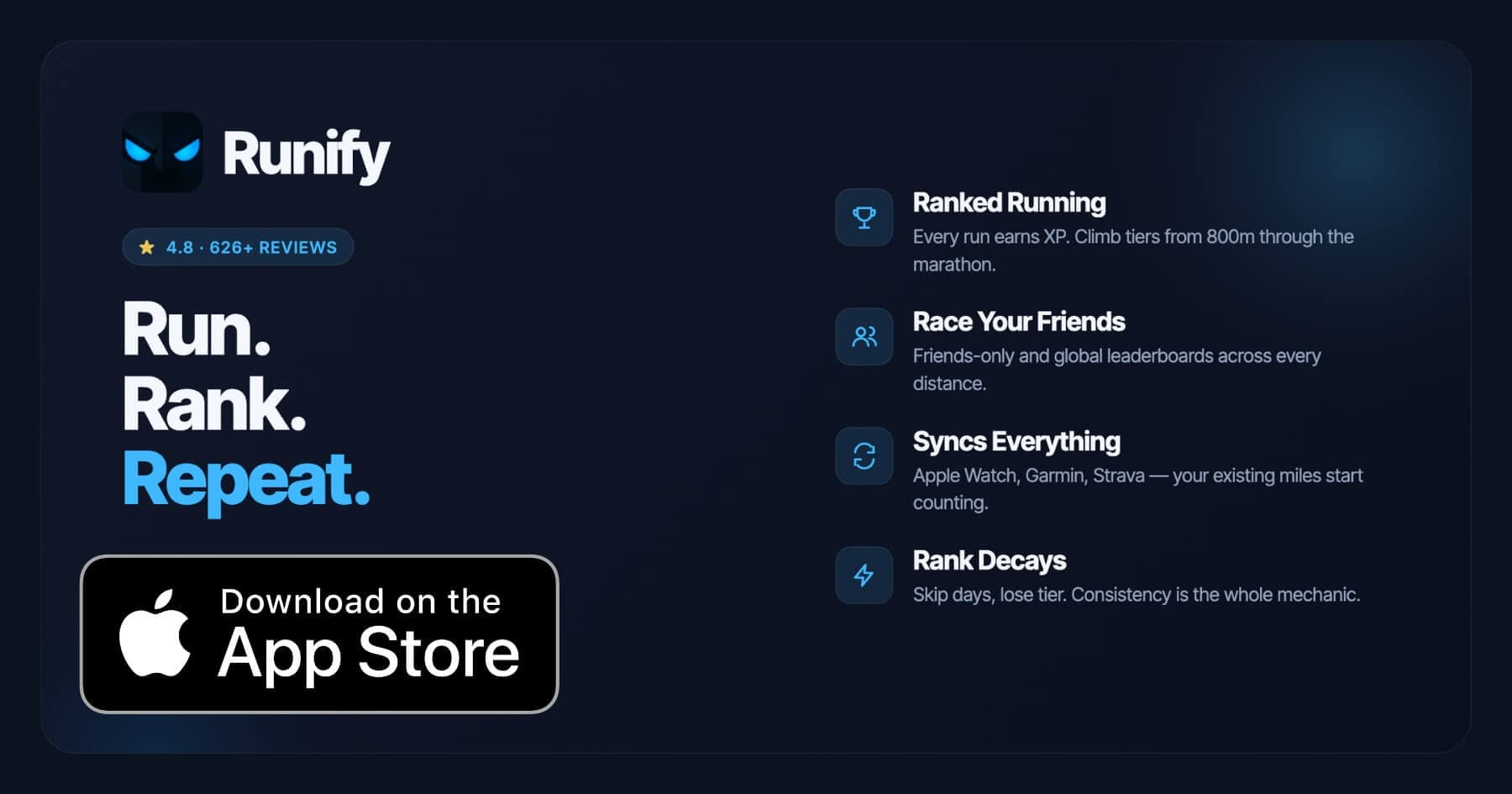
The training consistency that leads to a strong winter race takes months of logged effort. Runify turns every run into visible XP and rank - including runs synced from Apple Watch, Garmin, or Strava - so the gap between Turkey Trot and New Year's Day 5K is a progression you can see, not just feel.
Every distance on the Runify leaderboard, from 800m through the marathon, gives winter training a competitive edge. You're not just running through the cold. You're climbing a rank.
Ready to make every winter mile count? Download Runify on the App Store and turn every run into XP across leaderboards from 800m through the marathon.
4.8 stars on the App Store, 626+ reviews worldwide.
Download Runify on the App Store

4.8 on the App Store · Built for iOS