Suunto Race vs Garmin Forerunner: 2026
Suunto Race vs Garmin Forerunner: The Quick Verdict
The Suunto Race suits performance-focused runners who want premium build quality, detailed route navigation, and clean software at a single price point - no subscriptions. The Garmin Forerunner line suits a wider audience: beginners can start with the $249 Forerunner 165, while serious marathon and triathlon athletes can step up to the Forerunner 965 at $599. Garmin's training ecosystem, with daily suggested workouts and race predictor tools, is deeper than Suunto's on nearly every axis. The Suunto Race retails around $499 and carries a 4.4-star average from running forum communities. If you want ranked, competitive running on top of your existing GPS data, Runify imports from both Garmin and other sources and puts your miles on a global leaderboard.
At a Glance: Suunto Race vs Garmin Forerunner
| Feature | Suunto Race | Garmin Forerunner |
|---|---|---|
| Best For | Serious runners wanting clean, no-sub watch | Runners at every level, beginner to elite |
| Pricing | $499 one-time, no subscription | $249 to $599 depending on model |
| Platform | iOS + Android | iOS + Android + Web |
| Standout Feature | Offline maps with color display | Daily Suggested Workouts and race predictor |
| Main Limitation | Smaller third-party app ecosystem | Some key features require Garmin Connect app |
What Is the Suunto Race?
The Suunto Race is a premium GPS running watch from the Finnish brand Suunto, released in 2023 and updated with the Suunto Race S variant in 2024. It targets dedicated road and trail runners who want accurate GPS tracking, a sharp AMOLED display, and offline map support packaged in a clean, no-subscription design.
Suunto positions the Race as their flagship road-running watch. It sits above the Suunto 9 Peak Pro in their lineup, and competes directly with the upper-mid tier of Garmin's Forerunner range. The watch connects to the Suunto app for route planning, history review, and workout syncing.
Build quality is a consistent highlight in user reviews. The 43mm case uses a lightweight titanium bezel option and a scratch-resistant display that holds up to daily wear. Battery life reaches up to 40 hours in GPS mode, and up to 300 hours in time-only mode.
Suunto Race Key Features
- Dual-frequency GPS (GNSS): L1 + L5 multi-band satellite support for accurate tracking on trails and in cities.
- AMOLED color display: Always-on or gesture-to-wake options with a bright, readable screen in sunlight.
- Offline maps: Preloaded heatmaps and breadcrumb navigation work without a phone or cell connection.
- Suunto app integration: Route import, workout syncing, and training history stored in the Suunto ecosystem.
- Heart rate and SpO2: Optical wrist HR with blood oxygen monitoring for altitude and recovery insight.
- Sleep and recovery tracking: Sleep stages, readiness scores, and recovery recommendations each morning.
- Interval and structured workouts: Create and sync interval sessions from the Suunto app to the watch.
Suunto Race Pricing
The Suunto Race retails at $499 (USD) for the standard titanium option. The Suunto Race S, a smaller 43mm variant, is priced around $449. There is no subscription fee. All features, including maps and third-party app access through SuuntoPlus, are included in the purchase price.
Suunto Race Strengths
- No subscription required - every feature unlocks with the hardware purchase.
- AMOLED display is among the best in its class for brightness and clarity.
- Dual-frequency GNSS produces reliable GPS accuracy on tree-covered trails and city canyons.
Suunto Race Weaknesses
- The training ecosystem is less sophisticated than Garmin's - no daily AI-suggested workouts or deep race predictor tools.
- Third-party app support via SuuntoPlus is limited compared to Garmin's Connect IQ store.
- Suunto's coaching integration options are fewer - popular platforms like TrainingPeaks have limited two-way sync.
What Is the Garmin Forerunner?
The Garmin Forerunner is a family of GPS running watches spanning entry-level to elite, all made by Garmin, the dominant brand in GPS running hardware. The current lineup includes the Forerunner 165 ($249), Forerunner 265 ($449), Forerunner 965 ($599), and the recently released Forerunner 570 and 970 models in 2025.
Garmin targets the full spectrum of runners with the Forerunner line. The 165 suits beginners and casual runners. The 265 and 965 serve intermediate and competitive runners who want structured training, recovery metrics, and advanced GPS precision. Garmin Connect, the companion app and web platform, is one of the most feature-rich training ecosystems in the category.
Garmin Connect has over 100 million active users globally. The Forerunner 265 and 965 both carry 4.6-star ratings on major retail platforms, making them among the highest-rated GPS running watches available. Training depth, ecosystem size, and hardware range give Garmin broad appeal.
Garmin Forerunner Key Features
- Daily Suggested Workouts: AI-generated daily training recommendations that adapt based on your recent training load and recovery status.
- Race Predictor: Estimates finish times for 5K, 10K, half marathon, and marathon based on your VO2max and recent runs.
- Connect IQ app store: Hundreds of third-party watch faces, data fields, and apps available for Forerunner models.
- Garmin Coach: Free structured training plans (5K, 10K, half, full marathon) that sync directly to your watch.
- Multi-band GPS: Available on Forerunner 265 and 965 for high-accuracy tracking in challenging environments.
- Body Battery: Proprietary energy-level metric that combines HRV, sleep, and stress to estimate daily readiness.
- AMOLED display: Available on Forerunner 165, 265, and 965 with crisp resolution and always-on option.
Garmin Forerunner Pricing
- Forerunner 165: $249 (AMOLED, entry-level training features, no multi-band GPS)
- Forerunner 265: $449 (AMOLED, multi-band GPS, full training suite)
- Forerunner 965: $599 (AMOLED, titanium bezel, music storage, full elite feature set)
- Forerunner 570: $399 (2025 model, mid-range with Garmin Coach integration)
- Forerunner 970: $699 (2025 model, top-of-line with expanded triathlon and recovery tools)
No ongoing subscription is required for hardware features. Garmin Explore (mapping features) is included free.
Garmin Forerunner Strengths
- The widest range of price points in running watches - a Forerunner exists for almost every budget.
- Training ecosystem depth is hard to match: Garmin Coach, Daily Suggested Workouts, and Race Predictor work together.
- The Connect IQ ecosystem gives runners access to hundreds of third-party data fields and apps.
Garmin Forerunner Weaknesses
- The Garmin Connect app is feature-rich but can feel cluttered and slow compared to cleaner alternatives.
- Premium models (Forerunner 965, 970) carry a significant price premium over Suunto's single flagship SKU.
- Some users report that feature complexity creates a learning curve, especially for first-time Garmin owners.
Suunto Race vs Garmin Forerunner: Head-to-Head
Both watches track GPS, heart rate, and training load. The difference is where each brand chose to invest its engineering. Suunto focused on hardware elegance and simplicity; Garmin focused on data depth and ecosystem breadth. Here is how that plays out across the axes that matter most to runners.
GPS Tracking Accuracy
Both watches offer dual-frequency (multi-band) GNSS on their flagship versions, so raw accuracy is similar in open conditions. Independent testers from DC Rainmaker and Running With Miles have found both within 1-2% of measured course distances on standard road runs. In dense urban canyons, the Suunto Race's L1+L5 performance has a slight edge in some tests, while Garmin's multi-band implementation on the 265 and 965 delivers comparable results. For most runners, GPS accuracy is a draw at the top tier of each lineup.
Training Plans and Coaching
Garmin wins this category clearly. Daily Suggested Workouts, Garmin Coach plans (5K through marathon), and the Race Predictor are integrated, adaptive, and free with the hardware. Suunto offers interval session creation and basic workout guidance through the Suunto app, but there is no equivalent to Garmin Coach and no AI-suggested daily training. Runners building toward a race goal who want structured guidance will find more on a Forerunner 265 or 965. Our Garmin Forerunner vs Coros Pace breakdown covers how Garmin's training tools compare to another competitor if you want more context.
Social and Community Features
Neither the Suunto Race nor Garmin Forerunner is built primarily for social running. Garmin Connect includes a social feed, challenges, and the ability to follow friends, but it is secondary to the training and analytics focus. Suunto's app has basic social sharing. Strava integration is available on both, which is how most runners on either platform handle social competition. If community and leaderboards matter to you, both watches sync well with Strava and other platforms that handle the social layer.
Pricing and Value
The Suunto Race at $499 with no subscription offers strong value for a single purchase. The Garmin Forerunner 265 at $449 is similarly priced with no subscription and adds training tools the Suunto Race lacks. At the entry end, the Forerunner 165 at $249 has no Suunto equivalent - Suunto doesn't compete in the sub-$300 running watch market. At the high end, the Forerunner 965 at $599 and the new Forerunner 970 at $699 exceed the Suunto Race's price while offering more features. The Suunto Race hits a clean spot at $499 if you want a no-fuss flagship with no ecosystem lock-in.
Hardware Integration and App Ecosystem
Garmin's Connect IQ store is one of the broadest in running hardware - training apps, custom data fields, and watch faces are plentiful. TrainingPeaks, Strava, and major coaching platforms all offer deep Garmin integration. The Suunto Race connects to Strava and supports SuuntoPlus partner apps (including Komoot for route planning), but the third-party ecosystem is smaller. Runners who rely on specific coaching platforms should verify compatibility before choosing. If you're comparing Suunto's range more broadly, our Garmin Fenix vs Suunto Vertical comparison covers how the two brands match up at the adventure/trail tier.
Platform and Availability
Both watches connect to iOS and Android via Bluetooth. Garmin Connect also offers a full web dashboard for deeper data analysis and training planning - a significant advantage for runners who prefer managing data on a desktop or laptop. Suunto's web presence is more limited. Both watches operate offline once configured, with GPS and stored workouts working without a phone nearby.
Who Should Choose the Suunto Race?
The Suunto Race is a strong pick for runners who want a premium, clean GPS watch without subscriptions, feature bloat, or a steep learning curve.
- Runners who value simplicity: The Suunto interface is clean and direct. If you want GPS data, heart rate, and offline maps without navigating dozens of menus, the Race delivers that.
- Aesthetic-first runners: The titanium bezel and AMOLED display are genuinely attractive. If you wear your running watch all day and care about how it looks off the track, the Suunto Race stands out.
- Privacy-conscious runners: Suunto's ecosystem is smaller, which some runners prefer. Less data flowing to third-party app stores and a more contained software footprint appeal to runners wary of data sharing.
Who Should Choose the Garmin Forerunner?
The Forerunner suits runners who want structured training support, a deep data ecosystem, and hardware options at multiple price points.
- Runners training for a specific race: Garmin Coach and Daily Suggested Workouts provide a real training plan that adapts to your fitness. No other watch in this class matches that out of the box.
- Budget-conscious buyers: The Forerunner 165 at $249 brings a full-featured AMOLED GPS watch to a price the Suunto Race cannot touch. If you're new to GPS running watches, the 165 is hard to beat.
- Data-driven runners: If you want Body Battery, HRV status, race predictor, Connect IQ apps, and a full training log with web access, the Forerunner ecosystem is the most complete in its class.
A Third Option: Runify for Ranked, Competitive Running
Neither the Suunto Race nor Garmin Forerunner addresses one question that more runners are asking: what does your mileage actually mean compared to other runners? That is what Runify is built for.
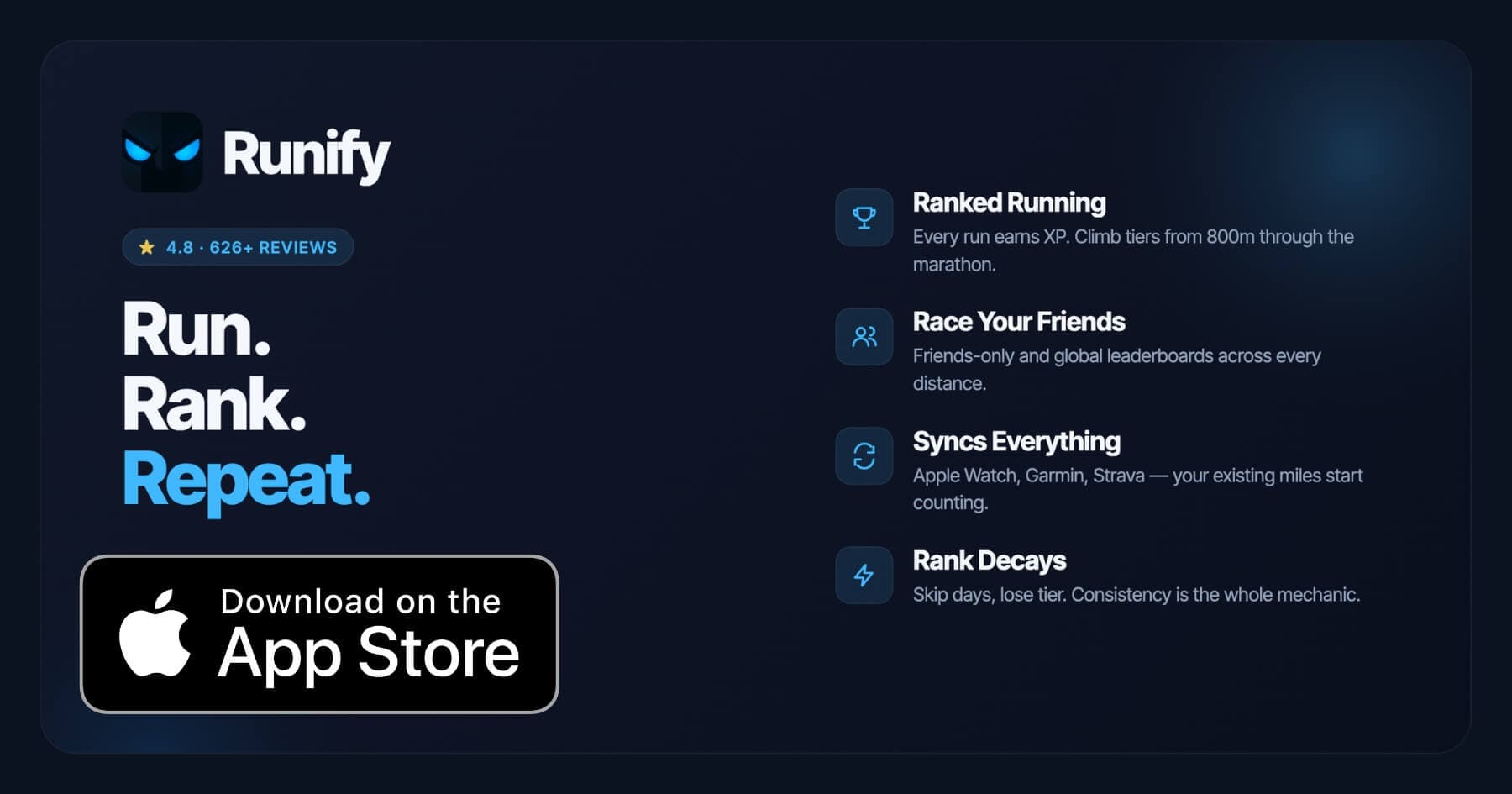
Runify is the first ranked running app. Every run you log earns XP, which moves you through a competitive tier system. Friends-only and global leaderboards track your standing across actual race distances - 800m, 1K, 5K, 10K, half marathon, and marathon. Go inactive and your rank decays, making consistency a visible, tangible motivator rather than just a personal stat.
Runify connects to Garmin, Apple Watch, and Strava, so your existing miles already count. You don't have to switch watches or apps - runners using a Forerunner 265 or Suunto Race can keep their current tracking setup and let Runify add a competitive layer on top. Our best running apps for Suunto Race guide covers the full range of apps that pair well with that watch.
Runify holds a 4.8-star rating on the App Store with 626+ reviews. It is iOS only and not a training plans app - it doesn't replace Garmin Coach or offer audio-coached workouts. It suits runners who want their existing training to count toward something competitive, not runners looking for a new GPS device or structured coaching program.
When Runify Is the Better Pick Than Both
- You want a visible, competitive reason to keep running (XP, rank, rank decay)
- You already track on Apple Watch, Garmin, or Strava and want those miles to count toward something
- You care about distance-specific performance (800m through marathon) on friends and global leaderboards
- You like sharing stylized run recaps to Instagram Stories
When Runify Is Not the Right Fit
- You're on Android. Runify is iOS only today.
- You want structured training plans, pace coaching during a run, or audio-coached workouts. Runify focuses on tracking, ranking, and social competition - not coaching.
- You want route discovery or race signup features.
How to Choose Between Suunto Race and Garmin Forerunner
The right pick depends on what you actually use a running watch for. Here are five practical questions that narrow it down.
-
Do you want structured training plans on your watch? If yes, choose a Garmin Forerunner. Garmin Coach and Daily Suggested Workouts are built into the watch and Garmin Connect - no separate app or subscription required. Suunto doesn't offer an equivalent.
-
What is your budget? If you need something under $300, the Forerunner 165 at $249 is your only option here - Suunto has no entry-level competitor. If your budget is around $450-$500 and you want a single flagship with no trade-offs, the Suunto Race and Forerunner 265 are nearly matched on price.
-
How much do third-party apps matter? If you rely on TrainingPeaks, a coaching platform, or specific data fields, Garmin's Connect IQ ecosystem offers far more integrations. Suunto's partner app list is more limited.
-
Do you want a clean software experience or maximum data? The Suunto Race app and interface are streamlined. Garmin Connect is powerful but can feel overwhelming. If you check metrics daily and love data dashboards, Garmin. If you prefer to run and review only what matters, Suunto.
-
Are you comparing the full lineup or a specific model? Garmin Forerunner is a family, not a single watch. The Forerunner 165, 265, and 965 are meaningfully different products. The Suunto Race is one model. Make sure you're comparing the right Forerunner to the Suunto Race - the 265 at $449 is the closest direct competitor.
Frequently Asked Questions
Is Suunto Race or Garmin Forerunner better in 2026?
It depends on your training style. The Garmin Forerunner 265 or 965 is better if you want structured training plans, Garmin Coach, and a deep data ecosystem - those tools have no Suunto equivalent. The Suunto Race is better if you want a clean, subscription-free watch with premium hardware and offline maps without feature overload. For pure GPS accuracy, both are comparable at the top of their respective lineups. Most runners choosing between the two should ask whether training plan integration matters more than simplicity.
Can I use the Suunto Race and Garmin Forerunner together?
You can own both, but there is little practical reason to run both simultaneously. Each watch tracks GPS independently and syncs to its own platform. You can connect both Garmin Connect and the Suunto app to Strava to consolidate activity history in one place. Runify imports from Garmin and Strava, so if you use either watch and want your miles ranked on leaderboards, Runify works with either source without you changing your current tracking setup.
Which is cheaper, Suunto Race or Garmin Forerunner?
The Garmin Forerunner line starts at $249 for the Forerunner 165, making it significantly cheaper at entry level. The Suunto Race starts at $449 for the Race S and $499 for the standard model. At the mid-tier, the Forerunner 265 at $449 and the Suunto Race S at $449 are priced equally. Neither watch requires an ongoing subscription. The Forerunner 965, 570, and 970 models exceed the Suunto Race's price at the premium end.
Which has better tracking accuracy, Suunto Race or Garmin Forerunner?
Both the Suunto Race and Garmin Forerunner 265/965 use dual-frequency multi-band GNSS, and independent testing shows they perform comparably on standard road routes (within 1-2% of measured distance). In heavily forested or urban environments, results vary by test and route. The Suunto Race's L1+L5 implementation has received strong marks in trail-running tests. The Forerunner 165 uses single-frequency GPS, so if tracking accuracy in difficult terrain matters to you, compare specifically against the Forerunner 265 or 965 - not the entry-level model.
What is the best alternative to both Suunto Race and Garmin Forerunner?
Runify is a strong alternative for runners who want something the hardware watches don't provide: a competitive ranking system and leaderboards tied to your existing GPS miles. Runify syncs from Garmin and Strava, earns XP on every run, and tracks your rank across 800m through marathon on both friends and global leaderboards. It holds a 4.8-star App Store rating with 626+ reviews. It's not a GPS watch replacement - it's a competitive layer built on top of the tracking you already do. If you want a different GPS watch entirely, the Coros Pace 3 and Apple Watch Ultra are worth comparing at their respective price points.
Final Verdict
The Suunto Race and Garmin Forerunner serve runners well, but they serve different runners. The Suunto Race is a clean, no-subscription flagship with premium hardware and offline maps - a strong choice for runners who want simplicity and don't need training plan coaching built into the watch. The Garmin Forerunner line offers more: training plan integration, a massive third-party ecosystem, and hardware at every price from $249 to $699, making it the default recommendation for most runners.
If budget flexibility matters, Garmin's range is unmatched. If you know you want a single premium watch without ecosystem lock-in, the Suunto Race is a genuine competitor, especially against the Forerunner 265 at a similar price.
For runners who already own either watch and want to make their miles count competitively, Runify adds a ranked layer on top of your existing tracking - no new hardware required.
Ready to put your miles on the board? Download Runify on the App Store and start climbing the global leaderboard.

4.8 on the App Store · Built for iOS