Garmin Fenix vs Suunto Vertical: Compared in 2026
Garmin Fenix vs Suunto Vertical: The Quick Verdict
The Garmin Fenix 8 suits data-hungry runners and athletes who want the deepest training metrics on the market. The Suunto Vertical 2 is built for trail runners and mountaineers who want outstanding battery life, clean offline maps, and a lower price tag.
Garmin Fenix 8 AMOLED starts at $999. Suunto Vertical 2 starts at $599 - a $400 gap that is hard to ignore. Garmin offsets that with a richer ecosystem, smarter watch features, music storage, NFC payments, and a deep Connect IQ app store. Suunto counters with 65 hours of GPS battery (vs Garmin's 48 hours) and map-panning that users consistently call faster and smoother.
For runners who want their GPS miles to earn XP and climb a competitive rank, Runify is worth a look alongside either watch - it syncs directly with Garmin via Strava.
At a Glance: Garmin Fenix 8 vs Suunto Vertical 2
| Feature | Garmin Fenix 8 | Suunto Vertical 2 |
|---|---|---|
| Best For | Data-driven athletes and multisport | Trail runners and outdoor adventurers |
| Pricing | From $999.99 (AMOLED) | From $599 (steel) or $699 (titanium) |
| Platform | iOS + Android + Web | iOS + Android + Web |
| Standout Feature | Deep training metrics and Connect IQ ecosystem | 65-hour GPS battery and fast offline maps |
| Main Limitation | High price; steep interface learning curve | Weaker HR sensor; limited third-party ecosystem |
What Is the Garmin Fenix 8?
The Garmin Fenix 8 is Garmin's flagship multisport GPS watch, designed for endurance athletes, trail runners, triathletes, and anyone who wants exhaustive data from every workout. Garmin released the Fenix 8 in late 2024, and it remains the benchmark premium outdoor watch heading into 2026.
It comes in two display variants - AMOLED and Solar MIP - and two case sizes (47mm and 51mm). Military-grade MIL-STD-810H durability, a 40-meter dive rating, and an integrated LED flashlight make it as much an adventure tool as a running watch.
Garmin Fenix 8 Key Features
- Multi-band GNSS with SatIQ: Simultaneous L1 and L5 satellite tracking for accuracy in dense terrain and canyons.
- Elevate Gen 5 heart rate sensor: Six photodiodes for ECG capability and improved accuracy during intervals.
- Training readiness and load metrics: Daily readiness score, training load, acute/chronic load balance, and heat/altitude acclimation tracking.
- Connect IQ app store: Access to hundreds of third-party watch faces, apps, and data fields.
- Music storage: Stores up to 2,000 songs from Spotify, Deezer, or Amazon Music for phone-free listening.
- NFC payments: Garmin Pay works at contactless terminals without your phone.
- Integrated LED flashlight: Adjustable intensity, red light night mode, and emergency SOS strobe.
Garmin Fenix 8 Pricing
- Fenix 8 AMOLED 47mm: $999.99
- Fenix 8 AMOLED 51mm: $1,099.99
- Fenix 8 Solar MIP (titanium): from $1,099.99 to $1,299+
- Garmin Connect app: free; some premium Connect+ features require a subscription
Garmin Fenix 8 Strengths
- The most comprehensive training metrics of any consumer GPS watch.
- Connect IQ ecosystem gives it near-unlimited third-party customization.
- Multi-band GNSS is among the most accurate available in any watch form factor.
Garmin Fenix 8 Weaknesses
- $999+ starting price is steep; the Fenix 7 Pro remains more sensible for most runners.
- Menu system is deeply complex and frustrating for new Garmin users.
- LTE and audio features on the Pro model are inconsistent in real-world testing.
What Is the Suunto Vertical 2?
The Suunto Vertical 2 is Suunto's premium outdoor GPS watch, launched in 2025 and updated into 2026. It targets trail runners, ultramarathoners, and mountaineers who want outstanding battery performance, clean built-in maps, and a no-clutter interface - at a price significantly below Garmin's flagship.
The Vertical 2 features a 1.5-inch AMOLED display, sapphire crystal glass, and a choice of titanium or stainless steel bezels. With over 115 sport modes and dual-band GNSS, it handles everything from track intervals to multi-day mountain routes. If you're comparing running apps for your Suunto watch, the best running apps for Suunto watches breakdown covers the full field.
Suunto Vertical 2 Key Features
- AMOLED display with 1.5-inch screen: Bright, high-contrast view without sacrificing battery life.
- Dual-band GNSS: Accurate positioning with 65 hours of GPS battery in standard mode.
- Free offline topo maps: Downloadable full-colour maps with fast pan and zoom performance.
- 115+ sport modes: Covers trail running, mountaineering, swimming, cycling, and more.
- Suunto App training analysis: TrainingPeaks-style metrics (ATL, CTL, TSB) with a clean mobile interface.
- Titanium option with solar charging: Extends daily battery to up to 20 days without charging.
- Flashlight: Built-in LED light added in the Vertical 2.
Suunto Vertical 2 Pricing
- Suunto Vertical 2 steel: $599
- Suunto Vertical 2 titanium: $699
- Suunto app: free; some advanced features available through Suunto Plus subscription
Suunto Vertical 2 Strengths
- Exceptional 65-hour GPS battery - 17 hours more than Garmin Fenix 8 AMOLED.
- Fast, smooth offline map rendering consistently praised over Garmin in head-to-head tests.
- $400 cheaper than the Fenix 8 at entry level, with premium sapphire crystal and titanium available.
Suunto Vertical 2 Weaknesses
- Optical heart rate sensor underperforms during high-intensity intervals compared to Garmin's Elevate Gen 5.
- Limited third-party app ecosystem - no equivalent to Connect IQ.
- Firmware updates have introduced bugs, and Suunto is slow to release fixes according to community forums.
Garmin Fenix 8 vs Suunto Vertical 2: Head-to-Head
Both watches serve serious outdoor runners. The differences come down to what you value more: maximum features and ecosystem depth, or battery life, simpler software, and a lower price.
GPS Tracking Accuracy
Both watches use dual-band GNSS (L1 + L5), placing them in the top tier for positioning accuracy. In dense forest and technical canyon terrain, both perform reliably. Garmin's SatIQ system switches intelligently between single and multi-band to conserve battery, while Suunto's dual-band runs consistently. Reviewers at DC Rainmaker and Tom's Guide found negligible real-world accuracy differences between the two.
Battery Life
Suunto Vertical 2 wins this comparison clearly. It delivers 65 hours of GPS in standard mode versus the Fenix 8 AMOLED's 48 hours - a 35% advantage. For ultramarathon runners covering 50+ miles or multi-day trips without charging access, that extra 17 hours matters. The Fenix 8 Solar MIP variants close the gap, but they cost $1,100+, which erases the price advantage entirely.
Maps and Navigation
Suunto's map performance has improved dramatically in the Vertical 2. Users who own both watches consistently note that map rendering, panning, and zooming feel faster and more responsive on the Suunto. Garmin has a wider maps ecosystem and broader navigation options, but its processor shows its age when panning at high zoom. For trail runners needing quick in-run map checks, Suunto's interface is the more practical choice.
Training Metrics and Analytics
Garmin leads here - and it is not close. The Fenix 8 offers training readiness scores, acute/chronic load balance, acclimation tracking for heat and altitude, running power, and dozens of additional metrics. The Suunto Vertical 2 provides solid TrainingPeaks-compatible metrics (ATL, CTL, TSB) that endurance athletes will recognize, but the depth of analysis is lower. If you study your training data deeply after every run, Garmin is the better tool. For runners who want a summary without analysis overload, Suunto's streamlined approach is easier to act on. For broader context on Garmin software, the Garmin Connect vs Suunto App comparison is worth reading.
Smartwatch Features and Ecosystem
The Fenix 8 functions as a capable smartwatch alongside its sports capabilities. Music from Spotify, Garmin Pay, Connect IQ third-party apps, and an LTE option (Pro model) make it a phone companion. The Suunto Vertical 2 focuses on sport - you get the Suunto app and a handful of integrations, but there is no app store and no music storage. Runners who want the watch to replace their phone on short runs will prefer Garmin. Runners who just want to track and recover can do that on either.
Pricing and Value
The Suunto Vertical 2 at $599 is harder to argue against from a pure value standpoint. You get AMOLED, dual-band GPS, sapphire crystal, offline maps, and 65-hour battery for $400 less than the Fenix 8. What you give up is training depth, ecosystem, and smartwatch features. If you are comparing the Fenix 8 against the Suunto Vertical 2 and do not need Connect IQ or music storage, the Suunto case is very strong.
Who Should Choose the Garmin Fenix 8?
The Fenix 8 rewards runners who treat their data seriously and want one device for training, travel, and daily wear.
- Triathletes and multisport athletes who need Garmin's full suite of swim, bike, and run metrics in one platform.
- Runners who use Garmin Connect heavily and want their watch to sync seamlessly with a deep ecosystem of third-party tools.
- Athletes who want music storage and Garmin Pay for phone-free runs and errands.
- Runners already invested in the Garmin ecosystem who want the newest hardware without switching platforms.
Who Should Choose the Suunto Vertical 2?
The Suunto Vertical 2 rewards trail runners and outdoor athletes who want a lighter kit with exceptional battery.
- Trail runners and ultramarathoners who need 50+ hours of GPS battery without charging mid-race.
- Mountaineers and hikers who want fast, readable offline maps with intuitive zooming.
- Runners switching from Garmin who find the interface overloaded and want a cleaner experience.
- Athletes on a budget who want premium materials (sapphire crystal, titanium option) without paying flagship Garmin prices.
A Third Option: Runify for Ranked, Competitive Running
Neither the Garmin Fenix 8 nor the Suunto Vertical 2 turns your GPS miles into a visible competitive rank. That is exactly what Runify does.
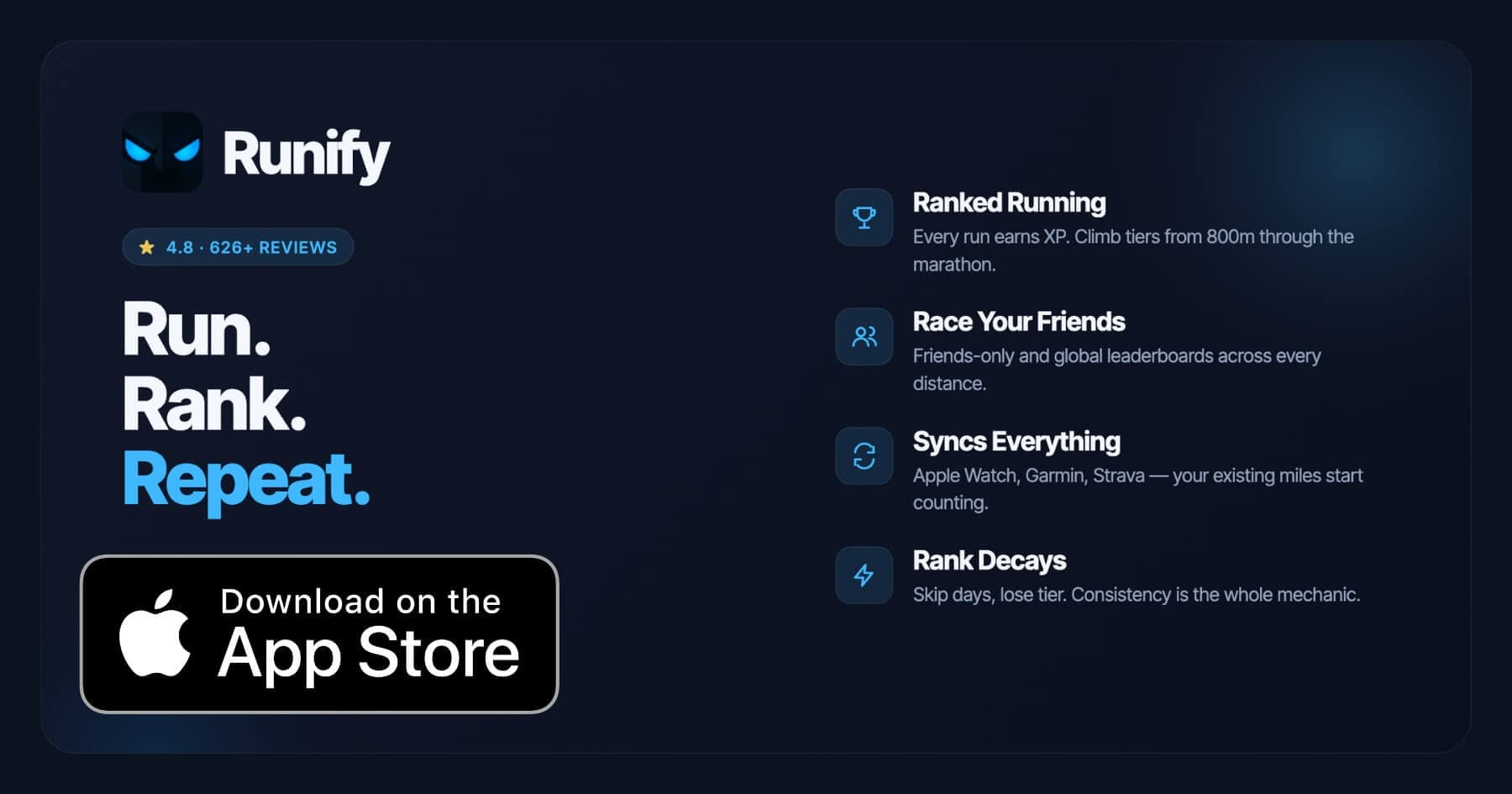
Runify is the first ranked running app. Every run you log earns XP, moves you through a competitive tier system, and puts you on friends-only or global leaderboards across distances from 800m through the marathon. Garmin users can feed their runs into Runify via Strava sync - so your existing Fenix or Vertical keeps doing the GPS tracking while Runify handles the ranking and competition. You can read more about Runify-compatible options in the best apps for Garmin Fenix series post.
With 4.8 stars on the App Store across 626+ reviews, Runify has built a following among runners who want their training to feel like more than data. Rank decay keeps things honest - go inactive and your rank drops, so consistency is always visible.
When Runify Is the Better Pick Than Both
- You want a visible, competitive reason to keep running (XP, rank, rank decay).
- You already track on Garmin or Strava and want those miles to count toward a rank.
- You care about distance-specific performance (800m through marathon) on friends and global leaderboards.
- You like sharing stylized run recaps to Instagram Stories.
When Runify Is Not the Right Fit
- You're on Android. Runify is iOS only today.
- You want structured training plans, pace coaching during a run, or audio-coached workouts. Runify focuses on tracking, ranking, and social competition - not coaching.
- You want route discovery or race signup features.
How to Choose Between Garmin Fenix 8 and Suunto Vertical 2
Five questions that determine which watch fits your running better:
- How deep do you go with training data? If you analyze training load, readiness scores, and running dynamics daily, Garmin's toolset is unmatched. If you want a summary and a good map, Suunto is enough and easier to use.
- How long are your longest efforts? Multi-day events, ultras, or 50-mile training weeks without charging access favor the Suunto's 65-hour GPS battery. For marathons and halfs, both watches finish the job comfortably.
- Do you need smartwatch features? Garmin Pay, Spotify sync, and the Connect IQ app store add real utility for daily life. Suunto is built around sport first and smartwatch second.
- What is your budget? The Suunto Vertical 2 at $599 undercuts the Fenix 8 by $400. If you can spend $999+ without hesitation, Garmin's feature set may justify it. If budget matters, Suunto delivers most of what you need at a significantly lower price.
- Are you already in the Garmin ecosystem? Switching costs are real. If your training history, Connect friends, and third-party integrations live in Garmin Connect, the Fenix 8 is the obvious upgrade path. If you're buying your first premium watch, evaluate both ecosystems before committing.
Frequently Asked Questions
Is Garmin Fenix or Suunto Vertical better in 2026?
It depends on your priorities. The Garmin Fenix 8 is better for runners who want the deepest training metrics, a full smartwatch ecosystem, music storage, and NFC payments - at a starting price of $999. The Suunto Vertical 2 is better for trail runners and ultramarathoners who prioritize battery life (65 hours GPS vs 48 hours), fast offline maps, and a $599 starting price. Neither is objectively superior; the right answer depends on what you actually use.
Can I use Garmin Fenix and Suunto Vertical together?
You would not typically wear both simultaneously, but you can export data from either watch to shared platforms. Both sync with Strava, which means your runs from either device flow into the same Strava activity feed. Runify imports from Strava, so Garmin and Suunto users can both compete on the same Runify leaderboards without changing their primary tracking device.
Which is cheaper, Garmin Fenix or Suunto Vertical?
The Suunto Vertical 2 is significantly cheaper. It starts at $599 for the steel model and $699 for titanium. The Garmin Fenix 8 AMOLED starts at $999.99, with titanium variants pushing past $1,299. That $400 gap at entry level is substantial. The Suunto delivers premium materials (sapphire crystal, titanium option) at a price closer to mid-range Garmin watches than to the Fenix 8.
Which has better GPS tracking accuracy, Garmin Fenix or Suunto Vertical?
Both use dual-band GNSS (L1 + L5) and perform at the top tier for GPS accuracy in real-world conditions. In independent reviews, including testing from DC Rainmaker and Tom's Guide, the gap is negligible. Garmin's SatIQ dynamically adjusts between single and multi-band to balance accuracy and battery, while Suunto's dual-band runs consistently. For trail running in technical terrain, either watch holds a reliable track.
What is the best alternative to both Garmin Fenix and Suunto Vertical?
For pure hardware alternatives, the COROS Vertix 2S and Polar Vantage V3 compete in the same space at varying price points. For runners specifically looking to add competition and ranked progression on top of any GPS watch, Runify is the go-to app. It works with Garmin and Suunto via Strava sync, earns XP from every run, and puts you on distance-specific leaderboards (800m through marathon). Rated 4.8 stars on the App Store, Runify fits naturally alongside your existing tracking hardware.
Final Verdict
The Garmin Fenix 8 and Suunto Vertical 2 are both excellent GPS watches for serious runners - they just serve different runner profiles and budgets.
Choose the Fenix 8 if training metrics, smartwatch features, and ecosystem depth are non-negotiable. It is the most feature-complete sports watch available, and for triathletes or data-obsessed endurance athletes, the price is justifiable.
Choose the Suunto Vertical 2 if you run long, care about battery life, and want clean offline maps without paying $400 more. It is a focused, capable outdoor watch that beats Garmin on battery and map performance while trailing on ecosystem and training depth.
If what you actually want is a reason to keep showing up - XP, a rank that climbs with consistency, and leaderboards across your best distances - try Runify alongside whichever watch you already own.
Ready to turn your Garmin or Suunto miles into rank? Download Runify on the App Store and see where your runs put you on the global leaderboard.

4.8 on the App Store · Built for iOS