Smashrun vs Runalyze: Compared in 2026
Smashrun vs Runalyze: The Quick Verdict
Smashrun is the better pick for runners who want beautiful data visualizations, quirky badges, and an accessible dashboard that makes their running history genuinely fun to explore. Runalyze is the better pick for self-coached athletes who want scientific-grade analytics - VO2max estimates, training load modelling, and accurate race time predictions - without paying a subscription. Smashrun Pro runs around $45/year. Runalyze's core features are free, with Premium at €6/month or €66/year. Both are web-first platforms aimed at runners who care about their numbers. If you want those numbers to feed a competitive rank and friends leaderboard on top of either platform, Runify is a strong third option.
At a Glance: Smashrun vs Runalyze
| Feature | Smashrun | Runalyze |
|---|---|---|
| Best For | Visualization-focused recreational runners | Self-coached athletes wanting deep analytics |
| Pricing | Free basic; Pro ~$45/yr | Free core; Premium €6/mo or €66/yr |
| Platform | Web + mobile-friendly site | Web only (no dedicated mobile app) |
| Standout Feature | Badges, streaks, and fun run visualizations | VO2max modelling and race time predictions |
| Main Limitation | Limited social features; no dedicated mobile app | Steep learning curve; no in-app run tracking |
What Is Smashrun?
Smashrun is a data visualization platform for runners, built around the idea that understanding your running history should be visual, interesting, and even a little fun. The platform pulls in your GPS activity data from devices and services like Garmin, Strava, and Runkeeper, then turns it into charts, heatmaps, badge collections, and trend graphs.
Founded as a passion project, Smashrun has grown into a dedicated analytics dashboard favored by runners who want more depth than their GPS watch offers but don't need the complexity of a full training-science platform. The interface is clean and approachable, and even casual runners can get meaningful insight from it within minutes of connecting their account.
Smashrun operates as a web platform rather than a dedicated mobile app. There is no standalone iOS or Android app - you access it through a browser, though the site is mobile-friendly.
Smashrun Key Features
- Run Visualizations: Charts and graphs that show pace distribution, elevation trends, heart rate zones, and effort patterns across your entire history.
- Badge System: Quirky milestone badges and challenges that reward consistency and personal records, making logging feel rewarding.
- Personal Record Tracking: Automatic detection and display of your best times across key distances.
- Pace Trend Analysis: Pro feature showing pace stability, pace buckets, and performance-over-time comparisons.
- Smashrun Performance Index: Pro metric that benchmarks your running effort relative to your own history and, optionally, other runners.
Smashrun Pricing
Smashrun has a free tier that covers basic activity sync, visualizations, and badge tracking. Smashrun Pro, the paid tier, unlocks detailed pace trends, the Performance Index, pace stability scores, Garmin lap data, Stryd power display, and advanced comparison tools. Pro runs approximately $45/year. There is no monthly billing option - Pro is sold as an annual plan.
Smashrun Strengths
- Clean, approachable interface that works for runners of all experience levels
- Badge and gamification system makes reviewing training history genuinely engaging
- Strong visualization of long-term trends and run patterns
- No complexity overhead - you get clear, visual insight quickly
Smashrun Weaknesses
- No dedicated mobile app; browser-only access can be inconvenient on the go
- Limited social features - no friend leaderboards, group challenges, or community feed
- Strava sync requires exporting GPX files manually, rather than a live API integration
- Some integration options (like Adidas Runtastic) were discontinued in 2025
What Is Runalyze?
Runalyze is a manufacturer-independent analytics platform for endurance athletes. It processes GPS, heart rate, power, and lactate data to deliver training science metrics that most GPS watches and running apps only approximate. The platform was originally open-source, and that heritage shows - it is deeply feature-rich, built by and for data-minded athletes.
The platform's core strength is its performance modelling. Runalyze estimates your effective VO2max from real activity data, tracks acute and chronic training load (ATL/CTL), and generates race time predictions across distances from 3K to ultra-marathon. These are not estimates copied from your watch - Runalyze recalculates them from your actual history.
Runalyze does not offer in-app GPS run tracking. It is a post-run analysis tool that imports data from Garmin, Coros, Suunto, Polar, and Strava. A mobile app has been in development, but the platform remains web-first as of 2026.
Runalyze Key Features
- VO2max Estimation: Calculates effective VO2max from heart rate and pace data across your actual training history.
- Training Load Modelling: Tracks ATL (acute) and CTL (chronic) training load using a scientifically grounded performance model.
- Race Time Predictions: Generates distance-specific race predictions that update automatically as you log more runs.
- Equipment Tracking: Monitors shoe and gear mileage so you know when to replace overstrained footwear.
- Heatmap and Route History: Premium feature showing a personal heatmap of every route you've ever run.
Runalyze Pricing
Runalyze's core analytics features are free - this includes VO2max estimation, race predictions, training load modelling, and activity history. A Supporter tier removes ads and provides early access to beta features. Premium unlocks extended data visualizations, historical HRV analysis, and the personal heatmap. Premium costs €6/month or €66/year. Long-term users who joined during the "Early Premium" phase locked in a permanent rate of approximately €5.50/month or €60/year.
Runalyze Strengths
- Comprehensive training science metrics free of charge, including VO2max and race predictions
- Accurate performance modelling built from your actual activity data, not watch estimates
- Broad device and platform compatibility (Garmin, Coros, Suunto, Polar, Strava, and more)
- Equipment tracking helps prevent injury from worn-down footwear
Runalyze Weaknesses
- Steep learning curve - the dashboard can feel overwhelming for runners new to training science
- No dedicated mobile app; web-only access limits on-the-go usability
- No in-app GPS tracking; Runalyze is an analysis layer, not a standalone run tracker
- No social or community features - no friends, leaderboards, or activity feeds
Smashrun vs Runalyze: Head-to-Head
Both platforms serve runners who want more from their data than a GPS watch alone provides. Where they diverge is in depth versus accessibility. Here is how they compare across the axes that matter most.
Analytics Depth
Runalyze wins on raw analytical depth. It calculates effective VO2max, models ATL/CTL training load, and generates race predictions using a performance model built from your complete activity history. Smashrun's analytics are more visual and less scientific - pace trends, distribution charts, and performance indexes are useful but do not approach the training-science rigor of Runalyze's modelling. If you want numbers that serious coaches use, Runalyze is the deeper tool.
Ease of Use
Smashrun wins on approachability. The dashboard is clean and immediately legible to a runner who has never encountered ATL/CTL concepts. Runalyze's dashboard is powerful but dense - first-time users often report feeling lost for the first few sessions. If you want to connect an account and get clear insight within ten minutes, Smashrun is the faster path.
Gamification and Motivation
Smashrun wins clearly. The badge system, milestone challenges, and quirky per-run "fun facts" make revisiting your training history enjoyable. Runalyze has no gamification layer - it is a pure analytics tool. If the numbers alone are not enough to keep you engaged, Smashrun's rewards structure adds a pull that Runalyze does not offer.
Pricing and Value
Runalyze's free tier offers more analytical depth than Smashrun's free tier. Core VO2max estimates, race predictions, and training load models are all free on Runalyze. Smashrun's free tier gives you basic visualizations and badges, but the more useful analytics - pace trends, the Performance Index, Garmin lap data - sit behind the $45/year Pro plan. For budget-conscious runners who want serious analytics, Runalyze's free tier is the stronger free offering. For runners who just want clean charts and a badge or two, Smashrun's free tier is plenty.
Hardware and Platform Integration
Both platforms integrate with Garmin, Strava, and most major GPS devices. Runalyze supports a broader range of devices natively, including Coros, Suunto, and Polar. Smashrun's Strava integration historically required manual GPX exports rather than a direct API connection, which adds friction for Strava users. If you train on a Coros or Suunto device, Runalyze's native support is a meaningful advantage. For those already using our Runalyze alternatives breakdown, it's worth noting that Runalyze's integration depth is one of the main reasons runners stick with it over simpler tools.
Platform and Availability
Both Smashrun and Runalyze are web-first platforms with no dedicated native mobile app. Smashrun's site is mobile-friendly. Runalyze has been developing a mobile app, though the platform remains browser-based as the primary experience. Neither platform offers in-app GPS run tracking - both are post-run analytics layers that require a separate tracker (GPS watch, Garmin, or an app like Strava) to record the run itself.
Who Should Choose Smashrun?
Smashrun suits runners who find their GPS watch data dry and want their training history to feel engaging and visual. If you respond to badges, streaks, and fun-fact comparisons on each run, Smashrun adds a layer of motivation that pure analytics platforms do not.
- Recreational runners who want a visual, accessible dashboard without a steep learning curve
- Runners who are motivated by badges, milestones, and progress comparisons
- Athletes who want to track long-term trends without needing to understand training load science
- Garmin and device users who want more visual depth than Garmin Connect's default charts
Who Should Choose Runalyze?
Runalyze suits self-coached runners who take their training data seriously and want platform-grade analytics without paying for a coaching tool. If you want to understand your VO2max trajectory, track fitness versus fatigue, and get distance-specific race predictions calibrated to your actual history, Runalyze is built for that.
- Self-coached runners who want scientific metrics - VO2max, ATL/CTL, race predictions
- Endurance athletes who train across multiple disciplines (running, cycling, multisport)
- Runners using Coros, Suunto, or Polar devices who want deeper post-run analysis
- Data-minded athletes who want the most analytical depth available free of charge
Runners comparing analytics-heavy tools may also find value in our Smashrun alternatives breakdown, which covers several platforms that sit in the same niche.
A Third Option: Runify for Ranked, Competitive Running
Neither Smashrun nor Runalyze offers social competition. Both platforms are analytics tools that help you understand your own data - but they do not let you race your friends across a leaderboard or earn a visible rank that climbs when you train and decays when you go inactive.
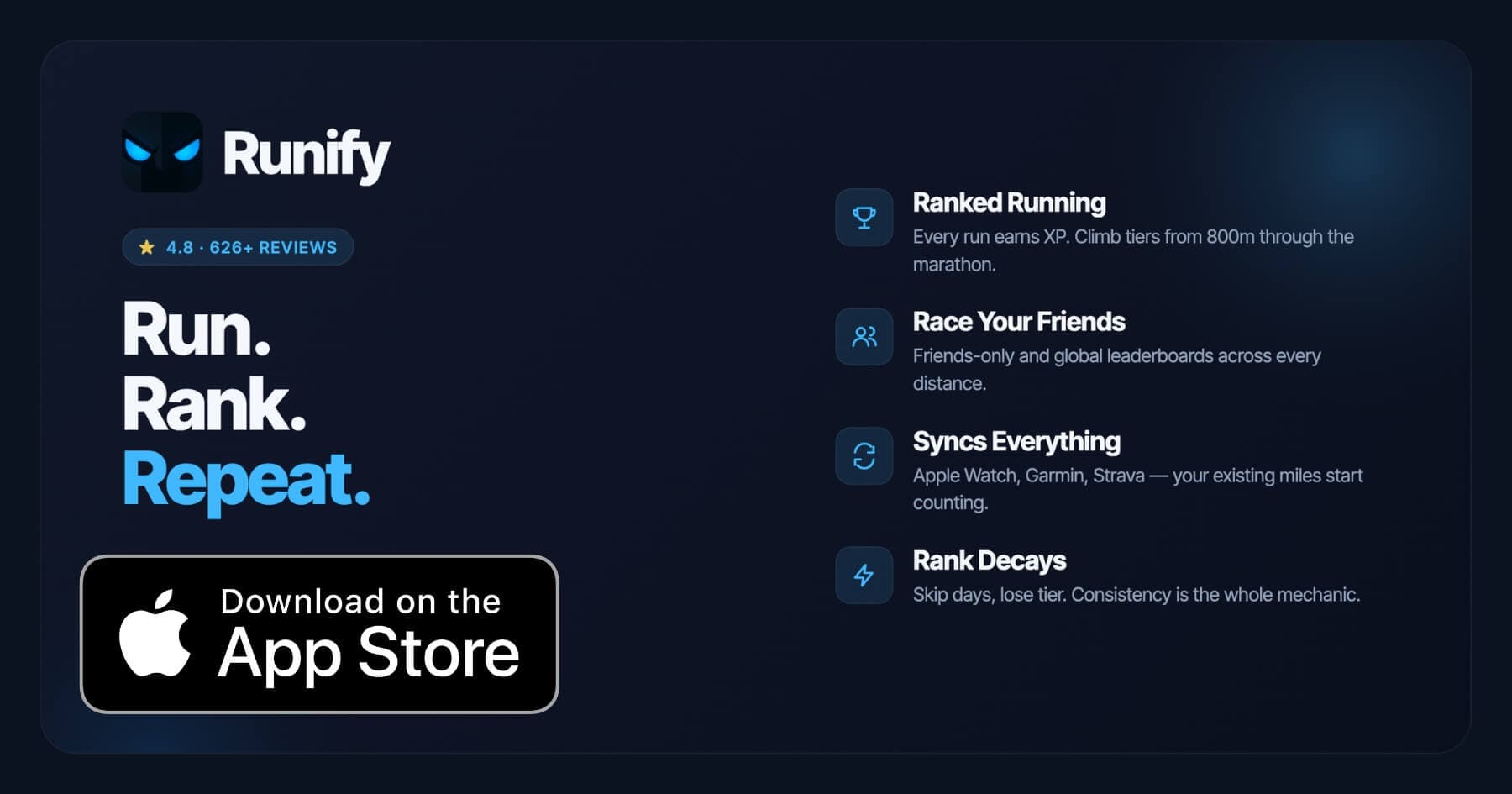
Runify does something different. Every run you log earns XP and pushes you through a competitive tier system with friends-only and global leaderboards across 800m, 1K, 5K, 10K, half marathon, and marathon. The rank decay mechanic means going inactive costs you rank - turning consistency into something tangible and visible. Runify holds a 4.8-star App Store rating across 626+ reviews.
Runify imports from Apple Watch and HealthKit, Garmin, and Strava, so if you are already using either Smashrun or Runalyze as your analytics layer, you can keep both and add Runify on top for the competitive ranking piece. Many runners use Runalyze for deep training analysis and Runify for the social motivation layer - the two tools complement each other rather than conflict.
Runify is not a replacement for either platform if analytics depth is your priority. It does not calculate VO2max, model ATL/CTL, or generate race predictions. What it does offer - ranked competitive running, XP-based progression, and stylized shareable run recaps - is something neither Smashrun nor Runalyze provides. For more on how Runify fits into the broader analytics-app landscape, see our TrainingPeaks vs Runalyze comparison.
When Runify Is the Better Pick Than Both
- You want a visible, competitive reason to keep running (XP, rank, rank decay)
- You already track on Apple Watch, Garmin, or Strava and want those miles to count toward something
- You care about distance-specific performance (800m through marathon) on friends and global leaderboards
- You like sharing stylized run recaps to Instagram Stories
When Runify Is Not the Right Fit
- You're on Android. Runify is iOS only today.
- You want structured training plans, pace coaching during a run, or audio-coached workouts. Runify focuses on tracking, ranking, and social competition - not coaching.
- You want route discovery or race signup features.
How to Choose Between Smashrun and Runalyze
The right choice comes down to why you want a running analytics platform in the first place.
- Depth of analytics: If you want VO2max modelling, training load science, and race predictions calibrated to your history, choose Runalyze. If you want clean charts and a visual history you enjoy reviewing, choose Smashrun.
- Learning curve tolerance: Runalyze rewards patience - the dashboard is complex at first but powerful once understood. Smashrun is immediately accessible. If you want results on day one, Smashrun is faster to start.
- Budget: Runalyze's most useful analytics are free. Smashrun's deeper features are behind a $45/year paywall. If cost matters, Runalyze's free tier offers more analytical depth.
- Device compatibility: Runalyze natively supports a wider range of devices including Coros, Suunto, and Polar. If you use a non-Garmin device, check Runalyze's integrations first.
- Motivation style: If data alone keeps you logging, Runalyze is sufficient. If you need badges, milestones, and visual rewards to stay engaged, Smashrun's gamification layer adds real motivation that Runalyze does not provide.
Frequently Asked Questions
Is Smashrun or Runalyze better in 2026?
Neither is objectively better - it depends on what you want from a running analytics platform. Smashrun is better for runners who want approachable visualizations, badges, and a motivation layer built around their running history. Runalyze is better for self-coached athletes who want scientific-grade metrics like VO2max estimation, training load modelling, and accurate race time predictions. Runalyze's core analytics are free, making it the stronger value for serious data-driven runners. Smashrun's visual dashboard is friendlier to runners who find training science terminology overwhelming.
Can I use Smashrun and Runalyze together?
Yes. Both platforms are post-run analytics tools that import data from devices and services like Garmin, Strava, and Coros - they do not record GPS runs themselves. You can connect the same Garmin or Strava account to both and get different analytical perspectives from each. Some runners use Smashrun for motivation and visual history and Runalyze for deep performance modelling. Runify can also layer on top of either, importing from Garmin or Strava to feed the ranking and leaderboard system independently.
Which is cheaper, Smashrun or Runalyze?
Runalyze's core features - including VO2max estimation, race predictions, and training load modelling - are free. A Premium tier adds extended visualizations and historical HRV analysis at €6/month or €66/year. Smashrun has a free tier for basic charts and badges, but the more useful analytics features (pace trends, Performance Index, Garmin lap data) require a Pro plan at approximately $45/year. On cost alone, Runalyze offers significantly more analytical depth at no charge.
Which has better tracking accuracy, Smashrun or Runalyze?
Neither platform tracks GPS runs directly - both import activity data from connected devices and services. The accuracy of your data depends on your GPS watch, not the analytics platform. Where they differ is in how they interpret that data: Runalyze builds a performance model from your activity history to estimate VO2max and predict race times, which tends to be more accurate than estimates from individual devices. Smashrun displays the data as recorded without applying additional performance modelling on top.
What is the best alternative to both Smashrun and Runalyze?
For runners who want social competition and a visible rank rather than pure analytics, Runify is a strong alternative. Runify earns XP from every run and places you on friends-only and global leaderboards across 800m through marathon, with a rank decay system that keeps you accountable. It imports from Apple Watch, Garmin, and Strava, so it works alongside your existing tracker. Runify holds a 4.8-star App Store rating with 626+ reviews. It is iOS only and not a training analytics tool, but for runners who want their miles to count toward a competitive rank, it offers something neither Smashrun nor Runalyze provides.
Final Verdict
Smashrun and Runalyze serve different runner profiles, and the choice is clear once you know what you need. Smashrun is for runners who want their data to be beautiful, accessible, and motivating - the badge system and clean visualizations make logging history genuinely enjoyable. Runalyze is for self-coached athletes who want the deepest free analytics available anywhere, including VO2max modelling and race predictions built from real training data.
Both platforms are web-first and require a separate GPS watch or app to record runs. Neither offers social competition or leaderboards.
If ranked, competitive running is what you are missing from both platforms, Runify is the third option worth exploring - it turns every run you already log on Apple Watch, Garmin, or Strava into XP toward a visible, competitive rank.
Ready to see your miles count toward something competitive? Download Runify on the App Store and start climbing the leaderboard today.

4.8 on the App Store · Built for iOS