TrainingPeaks vs Runalyze: Compared in 2026
TrainingPeaks vs Runalyze: The Quick Verdict
TrainingPeaks is the right pick for serious endurance athletes who want structured training plans, coach collaboration, and periodized load management built around the TSS/CTL/ATL framework. Runalyze is the right pick for data-driven self-coached runners who want deep analytics, accurate race predictions, and VO2max modelling without paying for a subscription. TrainingPeaks Premium runs $19.99/month or $134.99/year. Runalyze's core features are free, with Premium at €6/month or €66/year. Both platforms are analytics-heavy and aimed at runners who take their numbers seriously. If you want those miles to also feed a competitive rank and friend leaderboards, Runify works alongside either platform as a third option.
At a Glance: TrainingPeaks vs Runalyze
| Feature | TrainingPeaks | Runalyze |
|---|---|---|
| Best For | Coached endurance athletes with structured plans | Self-coached runners wanting deep analytics |
| Pricing | Free basic; Premium $19.99/mo or $134.99/yr | Free core; Premium €6/mo or €66/yr |
| Platform | iOS + Android + Web | Web only (no dedicated mobile app) |
| Standout Feature | Performance Management Chart (CTL/ATL/TSB) | Accurate race prognosis and VO2max modelling |
| Main Limitation | Expensive; key features locked behind Premium | No in-app run tracking; steep learning curve |
What Is TrainingPeaks?
TrainingPeaks is an endurance training platform used by competitive athletes, coaches, and national sports federations worldwide. Founded in 1999, it has become the industry's shared language for measuring and planning training load. More than 35 national sports federations rely on it, and many professional triathlon and marathon coaches deliver training plans directly through its ecosystem.
The platform centers on the Performance Management Chart (PMC), which tracks Fitness (CTL), Fatigue (ATL), and Form (TSB) over time using Training Stress Score (TSS). This framework lets athletes and coaches see at a glance whether a runner is building fitness, recovering, or peaking for a goal race.
Activities sync automatically from Garmin, Wahoo, Polar, Strava, Apple Health, and most other major platforms. The mobile app covers iOS and Android, and a full web dashboard handles the bulk of planning and analysis.
TrainingPeaks Key Features
- Performance Management Chart: Real-time CTL, ATL, and TSB curves that model fitness, fatigue, and race readiness.
- Structured Workouts: Build interval and tempo sessions with targets synced directly to compatible devices like Garmin and Wahoo.
- Plan Marketplace: Browse and purchase coach-designed training plans for 5K through Ironman distances.
- Workout Builder: Design custom sessions using time, distance, pace, heart rate, or power targets.
- Multi-Sport Support: Handles running, cycling, swimming, and strength in one calendar.
- Coach Collaboration: Share training data with a coach who can view, comment, and prescribe workouts directly.
- Device Ecosystem: Syncs with Garmin, Wahoo, Polar, Suunto, and more; auto-imports completed activities.
TrainingPeaks Pricing
TrainingPeaks offers a free tier with basic activity logging and a one-week calendar view. Premium unlocks the PMC, structured workout sync, the plan marketplace, and full historical analysis. Premium costs $19.99/month or $134.99/year (after a price increase in 2025). Coaches pay separately per athlete on their roster, which adds up fast for larger coaching businesses.
TrainingPeaks Strengths
- The PMC framework is the gold standard for endurance training load management - no consumer app has replicated it at this depth.
- The coach-athlete workflow is seamless: plans push from coach to athlete to device in one step.
- The plan marketplace is extensive, with thousands of plans from vetted coaches across every distance.
TrainingPeaks Weaknesses
- The free tier is very limited; runners who want real analytical value hit the paywall quickly.
- There is no real-time in-app messaging, so coach-athlete communication happens outside the platform.
- Structured workout creation is unavailable from the mobile app, which frustrates athletes who adjust plans on the fly.
What Is Runalyze?
Runalyze is a web-based training analysis tool built for self-coached runners and cyclists who want a deep look at their data. It started as an open-source project and has grown into a free platform with a dedicated following among data-obsessed endurance athletes. The core philosophy: give runners access to the same analytics usually reserved for high-performance coaching environments, at little to no cost.
The platform does not record activities itself - you upload or sync runs from Garmin, Strava, Apple Health, Polar, and others, then Runalyze analyses them. Its race prognosis engine has earned a strong reputation for accuracy, with many users reporting it outperforms Garmin's built-in predictions for marathon finish-time estimation.
Runalyze runs entirely in a browser. There is no dedicated mobile app, which limits on-the-go access but keeps the full desktop dashboard clean and highly configurable.
Runalyze Key Features
- Effective VO2max: Custom VO2max estimation that recalculates from each run and trends over months and years.
- Race Prognosis: Distance-specific finish-time predictions, including a marathon shape calculator that updates as training progresses.
- Training Load (TRIMP): TRIMP-based training impulse tracking with aerobic and anaerobic load curves, similar in concept to TSS but calculated differently.
- Equipment Tracking: Log running shoe mileage, component wear, and replacement alerts.
- Configurable Dashboard: Choose exactly which stats appear where; hide or surface any metric based on your priorities.
- Data Import: Sync from Garmin Connect, Strava, Polar, Apple Health, Fitbit, and direct GPX/FIT upload.
- Long-Term Trend Analysis: Multi-year charts covering pace, heart rate, cadence, and training load over your complete history.
Runalyze Pricing
Runalyze's core features are free and have been since launch. A Premium tier costs €6/month or €66/year and adds ad removal, extended data visualizations, full-history heatmaps, advanced HRV analysis, and priority support. For most runners the free tier covers everything they need.
Runalyze Strengths
- The race prognosis accuracy stands out, especially for marathon predictions, beating many watch-native predictions according to user comparisons.
- Completely free for core analytics - hard to argue with the value proposition for self-coached runners.
- Highly customizable: display exactly the data you care about and hide what you don't.
Runalyze Weaknesses
- No mobile app means you can't check stats on the go without opening a browser.
- The interface is information-dense and overwhelming for new users; there is a real learning curve.
- No social or community features - it is purely a personal data tool.
TrainingPeaks vs Runalyze: Head-to-Head
Both platforms are built for runners who take their data seriously, but they serve meaningfully different purposes. TrainingPeaks anchors itself in future planning and coach collaboration. Runalyze anchors itself in past-performance analysis and self-coaching insights.
Analytics Depth
Runalyze wins on raw analytical depth for free. Its VO2max modelling, TRIMP curves, and race prognosis engine are as sophisticated as anything in consumer running software, and it costs nothing for the core package. TrainingPeaks' PMC is arguably the more actionable framework for periodized planning - the CTL/ATL/TSB model gives coaches a precise lever to manage fitness and fatigue. For analysis of what already happened, Runalyze has the edge. For planning what comes next, TrainingPeaks leads.
Training Plans and Coaching
TrainingPeaks wins clearly here. The plan marketplace, structured workout sync, and coach-athlete workflow have no equivalent in Runalyze. Runalyze has a workout builder that lets you set targets as percentages of threshold pace, which is genuinely useful for self-coached runners, but it lacks the library, delivery infrastructure, and device sync that TrainingPeaks offers. If you train with a coach who prescribes structured sessions, TrainingPeaks is the default platform and Runalyze simply does not compete on this axis. If you self-coach and want to build and review your own sessions, either platform works.
Social and Community Features
Neither platform is built for social running. TrainingPeaks supports coach-athlete comments on individual workouts but has no athlete-to-athlete social feed, leaderboards, or challenges. Runalyze has no social features at all. If community and friendly competition matter to you, you will need to look elsewhere - the best running apps for friend leaderboards are built for exactly that use case.
Pricing and Value
Runalyze's free tier beats TrainingPeaks' free tier decisively. TrainingPeaks free locks you out of the PMC, structured workout sync, and most analytical tools. Runalyze free gives you VO2max tracking, race prognosis, TRIMP-based load, and long-term trends. TrainingPeaks Premium at $134.99/year is significantly more expensive than Runalyze Premium at €66/year (roughly $72). For purely analytical value, Runalyze is the better deal at both tiers.
Hardware Integration
TrainingPeaks has the broader device ecosystem, syncing natively with Garmin, Wahoo, Polar, Suunto, Apple Health, and Strava. Importantly, it pushes structured workouts to compatible devices, so interval targets appear on your watch face mid-run. Runalyze syncs from Garmin, Strava, Polar, and others for post-run import, but it does not push workout targets to devices. If you want your plan delivered to your watch, TrainingPeaks is the only option here.
Platform and Availability
TrainingPeaks runs on iOS, Android, and web. Runalyze is web-only. Both have full desktop dashboards, but TrainingPeaks users can check training load and upcoming workouts from a phone with a proper native app. Runalyze works in a mobile browser but is not optimized for it. If mobile access matters to you, TrainingPeaks has the clear advantage.
Who Should Choose TrainingPeaks?
TrainingPeaks fits runners whose training is structured, coach-guided, or periodized around a specific race calendar. The platform earns its subscription fee when the PMC and structured workout sync are both in use.
- Runners training with a coach who delivers sessions through the TrainingPeaks plan system.
- Athletes preparing for a specific goal race and wanting a data model to track fitness building and taper timing.
- Triathletes and multi-sport athletes who need one platform to manage run, bike, and swim training together.
Who Should Choose Runalyze?
Runalyze is built for the self-coached, data-oriented runner who wants to understand what their numbers mean without paying for it. As our Runalyze alternatives breakdown notes, few free tools offer this level of analytical depth.
- Self-coached runners who want VO2max trends, TRIMP loads, and accurate race predictions without a subscription.
- Runners who already have training data in Garmin or Strava and want to analyse it more deeply.
- Athletes who find TrainingPeaks expensive and don't work with a coach who uses the platform.
A Third Option: Runify for Ranked, Competitive Running
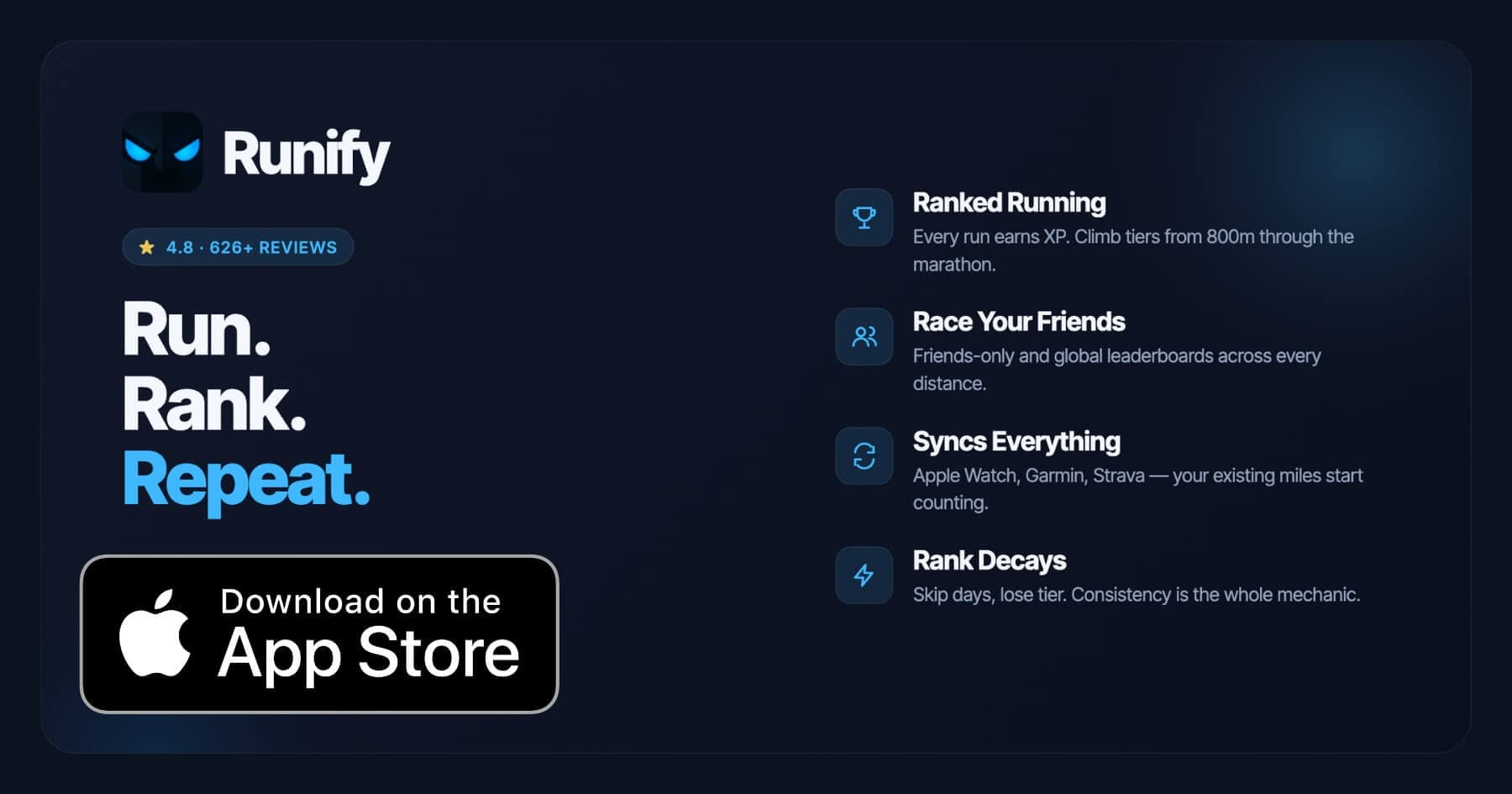
TrainingPeaks and Runalyze both focus entirely on individual performance data. Neither adds a social competitive layer to your training. Runify does something different: it takes every run you log and turns it into XP that moves you through a competitive tier system, putting you on friends-only and global leaderboards across distances from 800m through the marathon.
Runify connects directly to Apple Watch, Garmin, and Strava, so the runs you already track in either of those systems count toward your rank automatically. You do not have to abandon your existing tracking setup. Many runners keep TrainingPeaks or Runalyze for the analytical depth and add Runify for the motivation layer - the visible rank, the rank decay when you go inactive, and the stylized run recap cards that post straight to Instagram Stories.
With 4.8 stars on the App Store across 626+ reviews, Runify has built a real user base around the idea that accountability and friendly competition are the most effective long-run motivation tools. If you want to see how your weekly mileage stacks up against other runners chasing the same distances, that is where Runify fills the gap. For a broader look at how it sits in the analytics space, our best running apps for data analysis guide covers how different tools approach the metrics question.
When Runify Is the Better Pick Than Both
- You want a visible, competitive reason to keep running (XP, rank, rank decay).
- You already track on Apple Watch, Garmin, or Strava and want those miles to count toward something beyond a personal chart.
- You care about distance-specific performance (800m through marathon) on friends and global leaderboards.
- You like sharing stylized run recaps to Instagram Stories.
When Runify Is Not the Right Fit
- You're on Android. Runify is iOS only today.
- You want structured training plans, pace coaching during a run, or audio-coached workouts. Runify focuses on tracking, ranking, and social competition - not coaching.
- You need the PMC or advanced VO2max analysis. For that depth, TrainingPeaks or Runalyze are the right tools.
How to Choose Between TrainingPeaks and Runalyze
The core question is whether you need a platform that looks forward (planning, structured sessions, coach delivery) or one that looks backward (deep analysis of completed runs).
- Do you train with a coach? If yes, TrainingPeaks is likely the platform your coach uses and expects you to be on. The structured workout delivery and PMC collaboration are hard to replicate elsewhere.
- What is your budget? Runalyze free covers most analytical needs at no cost. TrainingPeaks Premium costs $134.99/year and its free tier is quite limited. If budget is a constraint, Runalyze is the obvious first choice.
- Do you need a mobile app? TrainingPeaks has full iOS and Android apps. Runalyze is web-only. If you check your training load from your phone between sessions, TrainingPeaks fits better into that habit.
- Are you a data explorer or a plan executor? Runalyze suits runners who love configuring dashboards and digging into metrics on their own. TrainingPeaks suits runners who want a structured framework to follow toward a race goal.
- Do you want to push workouts to your watch? Only TrainingPeaks syncs structured sessions directly to Garmin, Wahoo, and other devices. If having interval targets on your wrist matters, Runalyze cannot do this.
Frequently Asked Questions
Is TrainingPeaks or Runalyze better in 2026?
It depends on how you train. TrainingPeaks is better for coached athletes and anyone using structured training plans - the PMC and coach-athlete workflow are unmatched at the consumer level. Runalyze is better for self-coached runners who want deep analytics at low cost. Its free tier includes VO2max modelling, race prognosis, and TRIMP-based load tracking that outperform what TrainingPeaks offers for free. If cost matters and you self-coach, Runalyze is the stronger starting point. If you train with a coach or follow periodized plans toward a goal race, TrainingPeaks is worth the subscription.
Can I use TrainingPeaks and Runalyze together?
Yes, many runners do. Both platforms accept activity imports from Garmin, Strava, and other sources, so a run completed and synced to Garmin will show up in both tools. Use TrainingPeaks for planning and coach collaboration, and Runalyze for its more detailed post-run analytics and race prognosis. Runify also imports from Garmin and Strava, so you can layer competitive rankings on top of whichever analytical platform you prefer.
Which is cheaper, TrainingPeaks or Runalyze?
Runalyze is significantly cheaper. Runalyze's core features are free, and Premium costs €6/month or €66/year (roughly $72/year). TrainingPeaks' free tier is very limited, and Premium costs $19.99/month or $134.99/year. Even comparing paid tiers, Runalyze Premium costs roughly half of TrainingPeaks Premium. Runners who want serious analytics without a big subscription will find Runalyze delivers more value per dollar than TrainingPeaks' mid-tier offering.
Which has better tracking accuracy, TrainingPeaks or Runalyze?
Neither platform records runs directly - both rely on activity data synced from your watch or phone. The accuracy of GPS and heart rate data depends on your hardware, not the platform. Where they differ is in how they interpret that data. Runalyze's race prognosis and VO2max estimation algorithms have a strong reputation for accuracy among users, with many runners reporting its marathon finish-time predictions are more accurate than Garmin's own built-in estimates. TrainingPeaks' TSS-based load calculations are highly regarded for periodization but require accurate threshold values to be meaningful.
What is the best alternative to both TrainingPeaks and Runalyze?
For analytics and training plans, options like Intervals.icu (free, similar depth to Runalyze), Final Surge, and Today's Plan all serve different parts of this space - our TrainingPeaks alternatives guide covers the field in detail. For competitive motivation and friend leaderboards, Runify fills a gap neither platform touches: every run earns XP toward a visible rank, with decay for inactivity and distance-specific leaderboards from 800m through the marathon. It imports directly from Apple Watch, Garmin, and Strava and has a 4.8-star App Store rating with 626+ reviews.
Final Verdict
TrainingPeaks and Runalyze serve runners at different points on the coaching spectrum. TrainingPeaks is the right platform for structured, coach-guided training - the PMC framework, plan marketplace, and device sync are built for athletes who take periodization seriously and want a data model to match. Runalyze is the right platform for self-coached runners who want analytical depth without the subscription cost - its free tier punches well above its price.
Neither platform is a bad choice. They answer different questions. TrainingPeaks asks: where are you going and are you on track to get there? Runalyze asks: what happened in your last hundred runs and what does it tell you about your fitness?
If you want a platform that makes training feel competitive and social on top of the analytics, Runify works alongside either one. Your existing miles from Apple Watch, Garmin, or Strava feed directly into a ranked tier system and friend leaderboards - a motivation layer that neither TrainingPeaks nor Runalyze provides.
Ready to add a competitive edge to your training? Download Runify on the App Store and let your miles climb the ranks.

4.8 on the App Store · Built for iOS