Running Head-to-Head Race Statistics 2026
Running Head-to-Head Race Statistics 2026
Per-race participation grew 5% in 2025 across 12.2 million RunSignup registrations. Six in ten runners (61%) are considering a competitive run in 2026, climbing to 76% of Gen Z. When runners enter a head-to-head challenge in a fitness app, average activity jumps 23% versus baseline. Strava's 2025 Year in Sport tracked 1 million clubs, with running clubs alone growing 3.5x year-over-year. These 16 statistics map how head-to-head racing - in person, on apps, and across leaderboards - is reshaping how runners train, show up, and finish.
Head-to-head racing isn't only the elite finish-line photo anymore. It's the friend you chase up the hill, the rival on your group challenge, the stranger one place ahead on a virtual leaderboard. The data shows competitive matchups now drive a measurable share of the running boom, from 5K start corrals to global virtual events.
This post is for runners who want the receipts behind those trends, plus race directors, coaches, and app builders looking at where competitive running is heading. You'll find 16 sourced statistics covering participation, motivation, finish-time effects, and the social dynamics that make a head-to-head race feel different from a solo long run.
1. Per-race participation grew 5% from 2024 to 2025
RunSignup's 2025 RaceTrends report - covering more than 97,000 events and 12.2 million registrations - shows races grew an average of 5% in 2025 over 2024. That follows 8% growth in 2024 and 11% in 2023, signaling that the post-pandemic running surge is stabilizing into steady, compounding growth rather than a one-year spike.
The 5% figure looks small until you compare it to the broader fitness industry. Most race weekends are still small and local: 86% host fewer than 500 participants, and less than 1% exceed 5,000. Head-to-head competition at those community races - the friend you always beat to the finish, the rival from last spring - is what keeps the calendar full.
For runners, the takeaway is simple. The race you ran in 2024 likely had more people lined up next to you in 2025, and the field will be bigger again in 2026.
Source: RunSignup - 2025 Race Trends Report
2. 61% of runners are considering a competitive event in 2026
The SportsShoes Running Report surveyed runners worldwide and found that six in ten (61%) plan to take part in a competitive run in 2026. Among Gen Z runners, that number climbs to 76% - the highest competitive intent of any age group ever recorded in the report.
That's a structural shift. For most of the past decade, "fun" framing dominated participation marketing: charity 5Ks, costume runs, and themed events. The 2026 cohort is leaning back into competition - bib numbers, gun times, age-group rankings, and head-to-head match-ups with friends who signed up together.
If you're a recreational runner who has been training without a race on the calendar, you're now in a shrinking minority. The default mode for a 2026 runner is to be pointed at something with a finish line.
Source: SportsShoes - Running Report 2026
3. Head-to-head app challenges increase activity by 23%
A peer-reviewed analysis of nearly 2,500 physical-activity competitions, covering more than 800,000 person-days of tracked behavior, found that participants in head-to-head walking and running challenges increased their activity by an average of 23% during the competition window.
The effect held across men and women, every age group tested, and every starting fitness level - including users who had been mostly inactive before the challenge began. That makes head-to-head matchups one of the most replicable behavior-change interventions on record in mobile fitness research.
For a runner averaging 20 miles a week, a 23% lift is roughly an extra 4.6 miles. Over a 12-week training cycle, that's more than 55 additional miles you wouldn't have run alone - all driven by knowing someone is watching the scoreboard.
Source: npj Digital Medicine via PMC - Gamification and Physical Activity
4. The TCS New York City Marathon hit 56,000+ finishers in 2024
The 2024 TCS New York City Marathon recorded more than 56,000 finishers in November, becoming the largest race of any distance in the United States that year. It also extended a streak of consecutive record fields for the event.
A 56,000-runner field means roughly 56,000 head-to-head matchups happening simultaneously across the five boroughs - friends pacing each other, club teammates trading places, age-group rivals settling the year's results in Central Park. For a single afternoon, New York becomes the densest competitive running environment on earth.
The race also signals where the top of the funnel is going. Ten US races topped 25,000 finishers in 2024, and over one-third of the country's 100 largest events were half marathons, showing that long-distance head-to-head competition is no longer a niche pursuit.
Source: Running USA - 2024 Top Races Report
5. parkrun draws roughly 390,000 head-to-head 5K finishers most Saturdays
parkrun, the free weekly timed 5K series, recorded its busiest week of 2025 in April with nearly 391,000 finishers across 20 countries. On most Saturdays, between 360,000 and 390,000 runners line up at one of more than 2,200 parkrun events globally.
Every one of those finishers gets a printed time, an age-graded score, and a published finishing position - in other words, a head-to-head result against everyone else who showed up at their venue. The format has become the world's largest recurring competitive 5K and the most accessible weekly head-to-head experience in the sport.
The growth isn't slowing. Australia and South Africa host hundreds of events, and parkrun continues to expand into Germany, Poland, and Japan, adding new weekly fields every quarter.
Source: Ordinary Runners - parkrun Participation Stats 2025
6. Strava clubs nearly quadrupled in 2025
Strava's 12th annual Year in Sport report, drawn from billions of activities by 180+ million users, reported that Strava Clubs nearly quadrupled in 2025, crossing 1 million total clubs. Running clubs alone grew 3.5x year-over-year, and club events grew 1.5x.
Clubs are where head-to-head running lives day-to-day for most recreational runners. They drive weekly leaderboards, group challenges, and the small-scale rivalries that don't show up in race results but absolutely show up in next Saturday's long run. The 3.5x growth in running clubs means the average runner now has more people to chase - and be chased by - than at any point in Strava's history.
For runners building their first competitive habit, the data points one direction: find a club, get on the leaderboard, and let the matchups happen.
Source: Strava Press - 2025 Year in Sport Report
7. Kudos friends measurably change how often runners train
A 2022 University of Groningen study, published in Social Networks, analyzed an anonymized dataset of 1.1+ million runners who logged more than 359 million kilometers over five years on Strava. The researchers found that receiving kudos caused runners to run more and more often, with athletes adjusting their training to match the patterns of their kudos-friends.
The causal mechanism was confirmed using weather as a natural experiment. Good weather on one runner's day reliably affected the training behavior of their connected kudos network in the days that followed - even when those friends ran in different cities with different weather.
The counterintuitive finding: runners were more influenced by kudos-friends running slightly slower than they were, not faster. Head-to-head motivation works best when the matchup feels winnable.
Source: Social Networks - Kudos Make You Run
8. 5Ks were the most completed race type in 2025, at 20% of runners
According to the SportsShoes Running Report, the 5K remained the most popular completed event in 2025, with 20% of surveyed runners taking part. Fun runs followed at 17%, then 10Ks, half marathons, and full marathons.
The 5K's dominance matters for head-to-head racing because it's the distance where matchups are tightest. A 30-second gap in a 5K is a real head-to-head result. The same 30-second gap in a marathon is statistical noise. That's why competitive friend rivalries tend to crystallize at parkrun and local 5K series rather than around once-a-year long-distance events.
It also explains why 5K leaderboards drive the most engagement in apps that segment by distance - it's the format where head-to-head matters most and PRs come most often.
Source: SportsShoes - Running Report 2026
9. 43% of Strava users planned a big race or event in 2025
Strava's mid-year 2025 data showed that 43% of its user base planned to conquer a major race or event during the year. That figure represents tens of millions of runners and cyclists pointing their training at a single competitive moment.
The same dataset showed a +9% increase in marathon, ultra, and century-ride logs uploaded in 2024 over 2023. Long-distance head-to-head events aren't just stable - they're absorbing more of the training calendar than any other format.
For Strava's running cohort specifically, the implication is that competitive intent now sits at the center of how the median user organizes their year. The "I just run for fun" stance is becoming the exception, not the rule.
Source: Strava Press - Mid-Year 2025 Data
10. 32% of 10K runners on Strava set a PR in 2025
Strava's 2025 Year in Sport data found that among runners who logged a 10K during the year, 32% recorded a personal best at that distance. The number was higher still for the 5K cohort, lower for the marathon, and clustered in the same range for the half marathon.
That's a remarkable success rate for an inherently head-to-head event - a PR is, by definition, you beating your previous best. A one-in-three PR rate at 10K suggests that competitive infrastructure (apps, clubs, races) is working: runners aren't just showing up, they're improving relative to themselves.
The 10K is also a natural sweet spot for friendly head-to-head matchups. It's long enough to reward training, short enough that two runners can finish within seconds of each other.
Source: Strava Press - 2025 Year in Sport Report
11. Boulder produced PRs for 57% of its runners in 2025
Strava's 2025 Year in Sport report named Boulder, Colorado the global leader for personal-best rate, with 57% of Boulder-based runners earning a PR during the year. That's the highest concentration of head-to-head success - runners beating their own previous results - in any major running city.
Boulder's altitude, terrain, and unusually dense club ecosystem all play a role. But the leaderboard culture matters too. The city's elite and recreational runners share clubs, weekly workouts, and informal rivalries at a higher rate than almost anywhere else, creating constant low-stakes head-to-head training.
For runners elsewhere, Boulder's data is a useful proof of concept. When you put yourself inside a tighter competitive network, PR rates climb.
Source: Strava Press - 2025 Year in Sport Report
12. 55% of Gen Z athletes name social connection as top reason to join a fitness group
Strava's 2025 Year in Sport survey found that 55% of Gen Z athletes name social connection as their top reason for joining a fitness group, and 37% specifically view run clubs as good places to meet people. Grouped activities also collected roughly twice the kudos of solo activities.
That's a clean data signal for why head-to-head running is growing fastest in the under-30 cohort. The competition itself isn't the draw - the relationships built around the competition are. Younger runners want a leaderboard because it gives the friendship a structure.
The pattern explains another finding from the same report: 76% of Gen Z runners are considering a 2026 race event, well above the 61% overall rate. Where the social network goes, the race entries follow.
Source: Strava Press - 2025 Year in Sport Report
13. Pace setters demonstrably lower average finish times
A peer-reviewed analysis published in the Journal of Economic Behavior & Organization studied how professional pace setters (rabbits) affect marathon finishing times. The researchers found that races employing pace setters consistently produced faster average times among the lead pack, primarily by eliminating tactical early-race slowdowns.
The mechanism is straightforward. Without a pacer, head-to-head racing in elite fields tends toward slow first halves and surging finishes. With a pacer holding even splits, runners compete to hold contact rather than to outwit each other, and the finishing kicks happen from a faster baseline.
For recreational head-to-head racing, the same logic applies. Running with a friend at a steady, agreed-upon pace - rather than yo-yo-ing off each other - tends to produce a faster matchup result on the day.
Source: Journal of Economic Behavior & Organization - Peer Effects in Marathon Racing
14. Virtual race participation grew 20% in six months of 2025
Strava reported that virtual event participation grew 20% between March and September 2025 after the platform integrated Athlete Intelligence into its racing tools. NYRR Virtual Races powered by Strava have crossed 555,000 total finishers from 196 countries since launch in 2018.
That growth signals something specific about head-to-head racing: it no longer requires a shared start line. Two runners in different time zones can sign up for the same virtual event, run on the same window of days, and get a real ranked result against each other. Competitive matchups have been decoupled from geography.
The format is especially valuable for runners who can't travel to major races, runners with irregular schedules, and runners who want to test themselves against a specific rival without waiting for the next in-person event.
Source: Strava Press - 2025 Year in Sport Report
15. Sabastian Sawe broke the marathon world record at 1:59:30 in 2026
On April 26, 2026, Sabastian Sawe became the first person to run a competitive, record-eligible marathon in under two hours, winning the London Marathon in 1:59:30 and breaking Eliud Kipchoge's official record of 2:01:09 from Berlin 2022 by 99 seconds.
The performance was head-to-head racing at the absolute edge of human physiology - Sawe beat a field of the fastest marathoners on earth, in real race conditions, with no controlled pacing setup. It also reset the public ceiling for what's possible at the marathon distance and lit up registration interest at every level of the sport.
For recreational runners, elite marks like this rarely change daily training. But they do change the cultural energy around head-to-head racing, and 2026 race entries reflect it.
Source: NBC Sports - Sabastian Sawe Marathon World Record
16. Equal matchups produce significantly higher motivation than mismatched ones
Research published in the Journal of Medical Internet Research analyzing nearly 2,500 fitness challenges found that the composition of head-to-head matchups dramatically shaped outcomes. Competitions between roughly equal participants produced the largest activity increases. When participants were highly unequal in fitness, the overall effect on physical activity dropped sharply.
A second finding: competitions with an even gender mix outperformed single-gender competitions on engagement. Researchers theorize that perceived fairness is doing the work - runners commit harder when the matchup feels winnable, and disengage when it feels rigged.
The practical lesson for apps, race directors, and club organizers is to seed head-to-head competition within ability bands. A 50-minute 10K runner gets motivated by chasing a 49-minute runner. They get demotivated by chasing a 38-minute runner.
Source: npj Digital Medicine via PMC - Gamification and Physical Activity
What These Numbers Tell Runners
Head-to-head racing is no longer a niche piece of the running world - it's becoming the connective tissue. The 5% growth in per-race participation, the 76% of Gen Z runners eyeing a 2026 event, the 1 million Strava clubs, and the 23% activity bump from app-based challenges all point at the same shift. Runners want to match up against someone, and they want infrastructure that makes those matchups easy to find.
For beginners, the data is a green light. You don't need to win anything. Just signing up for a parkrun, joining a club, or entering a friend challenge produces measurable improvement, because the head-to-head structure itself does the work. For recreational runners, the takeaway is to use the rivalries you already have - club teammates, training partners, kudos friends - more deliberately. For competitive racers, the news is that the depth of fields is climbing at every distance, and 2026 will be the most crowded competitive year of the post-pandemic era. Read our breakdowns of marathon finishing-time trends and half-marathon participation data for the specific distance-by-distance picture.
The trajectory from here is clear. Virtual events are erasing geography. Apps are making matchups continuous, not annual. And the elite ceiling - Sawe's sub-two - has reset what the rest of the sport is chasing. Whether you're a five-day-a-week runner or someone working on running consistency for the first time, the competitive layer is going to keep getting closer to your daily run.
Head-to-head racing in 2026 is no longer about who shows up to the start line - it's about who shows up to the leaderboard.
Turn every run into a head-to-head matchup
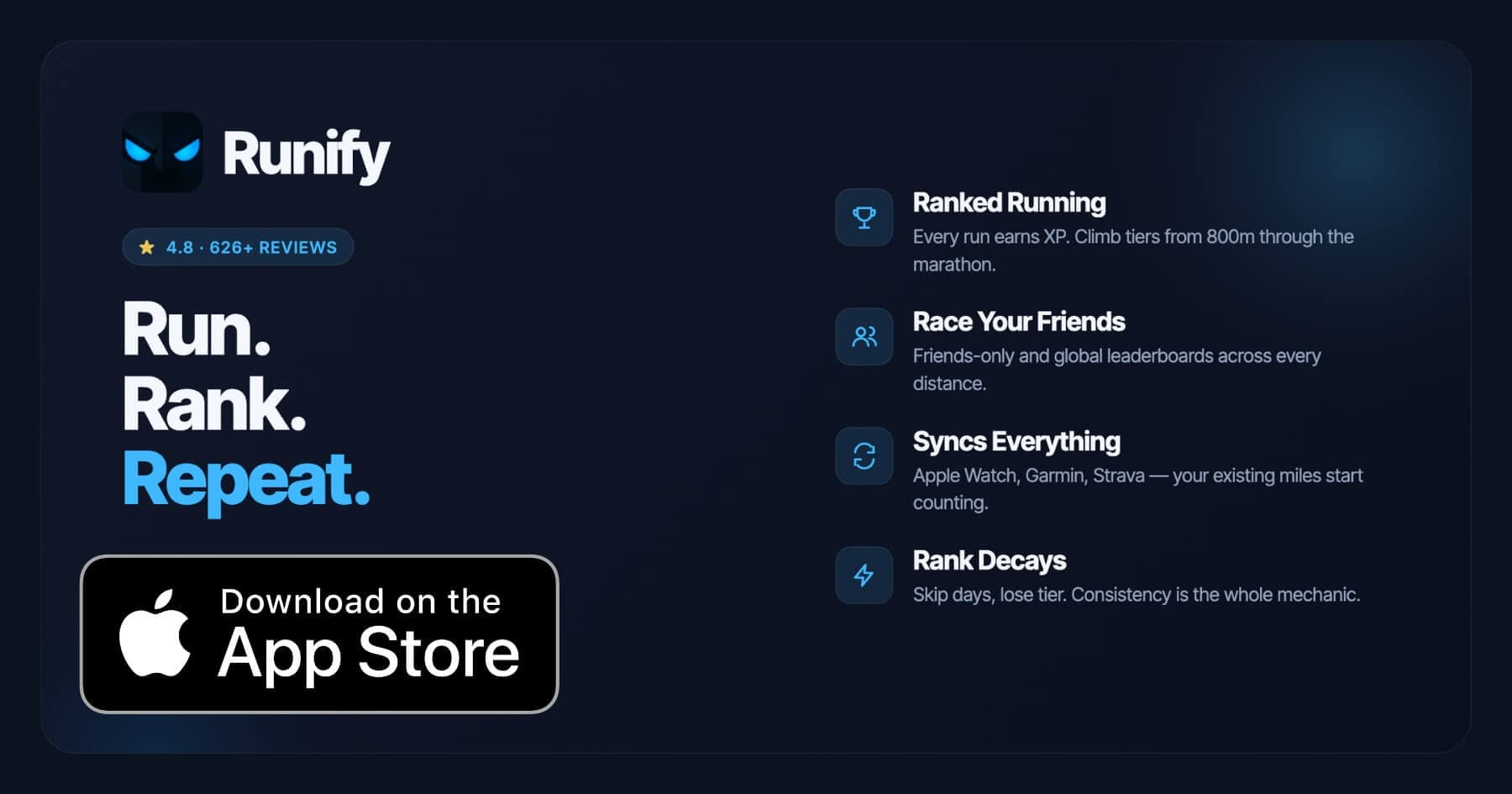
The data above keeps pointing at one thing: runners run more when there's a visible matchup waiting. Runify is built around that idea. Every run you log inside the app - or sync from Apple Watch, Garmin, or Strava - earns XP, moves you through tiers, and puts you on friends-only or global leaderboards across 800m, 1K, 5K, 10K, half marathon, and full marathon. Keep running and your rank climbs. Go quiet for a few weeks and it decays. The head-to-head is always live.
It's the same competitive structure the research keeps validating: visible progress, fair matchups, and someone right behind or right ahead of you on the board. If 32% of 10K runners on Strava are setting PRs and 23% activity bumps come from head-to-head challenges, the question isn't whether competitive structure works - it's whether you have one wired into your training week.
Ready to make your runs count? Download Runify on the App Store and turn every mile into XP across leaderboards from 800m through the marathon.
4.8 stars on the App Store, 626+ reviews worldwide.
Download Runify on the App Store

4.8 on the App Store · Built for iOS