Runkeeper vs MapMyRun: Compared in 2026
Runkeeper vs MapMyRun: The Quick Verdict
Runkeeper is the better pick for runners who want structured training plans and audio coaching built into a simple, beginner-friendly interface. MapMyRun suits runners who care most about route mapping, cross-training variety, and a large community built around challenges. Runkeeper Go costs $9.99/month or $39.99/year; MapMyRun MVP costs $5.99/month or $29.99/year. Both apps carry strong App Store ratings - Runkeeper holds 4.7 stars while MapMyRun sits at 4.8 from over 700,000 reviews. If what you actually want is a ranked competitive layer on top of your existing tracker, Runify is worth a look as a third option for runners who want XP, rank tiers, and leaderboards across distances from 800m through the marathon.
At a Glance: Runkeeper vs MapMyRun
| Feature | Runkeeper | MapMyRun |
|---|---|---|
| Best For | Beginners wanting guided training plans | Route mapping and cross-activity logging |
| Pricing | Free; Go $9.99/mo or $39.99/yr | Free; MVP $5.99/mo or $29.99/yr |
| Platform | iOS + Android | iOS + Android + Web |
| Standout Feature | Audio coaching on free tier | Route planning with 700K+ mapped routes |
| Main Limitation | Development pace slower than rivals | Premium features require MVP subscription |
What Is Runkeeper?
Runkeeper, owned by ASICS, launched in 2008 and built its reputation as one of the first smartphone running apps to get GPS tracking right. Today it runs on iPhone, Android, and Apple Watch, and pitches itself as the go-to choice for runners who want a reliable, straightforward experience without a steep learning curve.
The app is particularly strong for beginners. Its training plans walk you through building toward your first 5K, half marathon, or marathon, with guided workouts and audio cues that tell you when to speed up, slow down, or walk. It holds 4.7 stars on the App Store and has tens of millions of registered users worldwide.
Recent updates have moved more features behind the Go paywall, which has frustrated longtime free users. Development has also slowed relative to competitors like Strava and Garmin Connect.
Runkeeper Key Features
- GPS Run Tracking: Reliable tracking of pace, distance, elevation, and splits on iPhone and Apple Watch.
- Audio Coaching: Voice cues on the free tier, updating you on pace and distance at set intervals.
- Training Plans: Structured 5K, 10K, half, and full marathon plans that adapt to your current fitness level.
- Live Tracking: Share a link so others can follow your run in real time (Go subscription required).
- Apple Health Integration: Syncs workouts to HealthKit automatically, keeping your data connected.
Runkeeper Pricing
Runkeeper is free to download with GPS tracking, basic stats, and audio announcements included. The Go subscription unlocks training plans, live tracking, and in-depth performance insights. Go costs $9.99/month or $39.99/year. A 7-day free trial is available for the annual plan.
Runkeeper Strengths
- Audio cues available on the free tier, unlike most competitors
- Beginner-friendly interface with a low learning curve
- Strong training plan options for race prep across multiple distances
Runkeeper Weaknesses
- More core features moved behind the Go paywall in recent updates, frustrating longtime users
- Development has slowed significantly compared to rivals
- Social features are thin - no segments, no meaningful leaderboards, limited community tools
What Is MapMyRun?
MapMyRun was originally founded by a team of endurance athletes and later acquired by Under Armour in 2013. The app has since been reacquired by Outside Interactive, the parent company of Strava competitor MapMyFitness. It has 4.8 stars on the App Store from over 700,000 ratings and strong Google Play numbers as well.
MapMyRun distinguishes itself with its route database and cross-training scope. The app can log over 600 activity types, making it useful for runners who also cycle, swim, or lift. Its route planning tools let you build custom courses and share them with other users, which sets it apart from more narrowly focused trackers.
The MVP premium tier adds adaptive training plans, audio coaching, and advanced analytics. The free version, however, remains genuinely useful for tracking and route planning without paying.
MapMyRun Key Features
- Route Mapping: Build, save, and share custom routes; access a database of mapped courses from the community.
- GPS Tracking: Accurate distance, pace, elevation, and splits across run types.
- Cross-Activity Logging: Track 600+ activity types including cycling, swimming, and gym workouts.
- Audio Coaching: Real-time pace and performance cues during runs (MVP required for some features).
- Under Armour Connected Footwear: Pairs with UA's sensor-enabled shoes for step and foot-strike data.
MapMyRun Pricing
MapMyRun has a solid free tier that includes GPS tracking, route building, and community features. The MVP subscription costs $5.99/month or $29.99/year and unlocks adaptive training plans, audio coaching, performance analytics, live tracking, and Heart Rate Zone analysis. There is no published free trial on the MVP tier currently.
MapMyRun Strengths
- Route planning tools are among the best in class for any running app
- MVP pricing is lower than most comparable apps
- Cross-activity logging makes it a strong choice for multi-sport athletes
MapMyRun Weaknesses
- GPS can occasionally drop or lag in dense urban areas or remote trails
- Social features have not kept pace with Strava's segments and group features
- App ownership has changed hands, creating some uncertainty about long-term development direction
Runkeeper vs MapMyRun: Head-to-Head
These two apps have overlapping audiences but pull in different directions. Runkeeper leans on training plans and audio coaching. MapMyRun bets on routes and cross-activity breadth. Here is how they compare on the axes that matter most to everyday runners.
Tracking Accuracy
Both apps deliver reliable GPS accuracy for most runs in urban and suburban settings. MapMyRun's accuracy is particularly strong for distance measurement, with reviews consistently praising its consistency over long runs. Runkeeper performs comparably for standard runs but has received scattered user reports of auto-pause triggering incorrectly. For treadmill runs, both apps support manual distance input, but neither is as tightly integrated with treadmill hardware as Garmin Connect.
Training Plans and Coaching
Runkeeper edges ahead here for beginners. Its training plans are structured around your current fitness level, your goal race, and your available training time - and audio cues walk you through each session in real time. MapMyRun MVP also offers adaptive training plans with audio coaching, but the coaching experience is slightly less polished according to user reviews. If training-plan quality is your primary criterion, our best Runkeeper alternatives breakdown covers how Runkeeper stacks up against dedicated coaching apps as well.
Social and Community Features
Neither app is a social powerhouse compared to Strava. MapMyRun has challenges you can join or create, and its route-sharing creates a community layer around course discovery. Runkeeper's social features are lighter - you can follow friends and see their recent activity, but there are no segments, no competitive leaderboards, and no group run tools. MapMyRun wins this axis, though both trail Strava by a meaningful margin.
Pricing and Value
MapMyRun offers better value at every tier. Its free version is more feature-complete than Runkeeper's free offering, and MVP at $29.99/year is notably cheaper than Runkeeper Go at $39.99/year. Runkeeper's main free-tier advantage is audio announcements included without paying - a feature MapMyRun moves behind the MVP wall. For a broader look at how both apps compare to the wider field, see our best MapMyRun alternatives guide.
Hardware Integration
Both apps sync with Apple Health and support Apple Watch. Runkeeper has native Apple Watch support for standalone tracking without the phone. MapMyRun also supports Apple Watch and integrates with Garmin devices via third-party syncing. Neither app has as deep a Garmin integration as Garmin Connect itself. MapMyRun's Under Armour Connected Footwear integration is a niche but unique hardware differentiator.
Platform and Availability
MapMyRun has a web interface for reviewing your data on a desktop, which Runkeeper lacks. Both apps run on iOS and Android with comparable feature parity across platforms. MapMyRun's web route planner is genuinely useful - you can build a course on a large screen before heading out. Runkeeper is iOS and Android only.
Who Should Choose Runkeeper?
Runkeeper earns its spot for runners who value simplicity and guided structure. Its training plans are polished, and the free audio cues are a real differentiator for anyone not ready to commit to a paid subscription.
- Beginners who want a structured 5K or half marathon training plan and audio guidance built in
- Runners who prefer a clean, uncluttered interface without a lot of social noise
- iPhone users who want solid Apple Watch integration and HealthKit sync out of the box
Who Should Choose MapMyRun?
MapMyRun fits runners who run more than just road miles and want flexibility across activities and routes.
- Runners who spend time planning courses and want access to a large community route database
- Multi-sport athletes who want one app for running, cycling, and gym workouts
- Budget-conscious subscribers who want training plans and audio coaching at a lower annual price
A Third Option: Runify for Ranked, Competitive Running
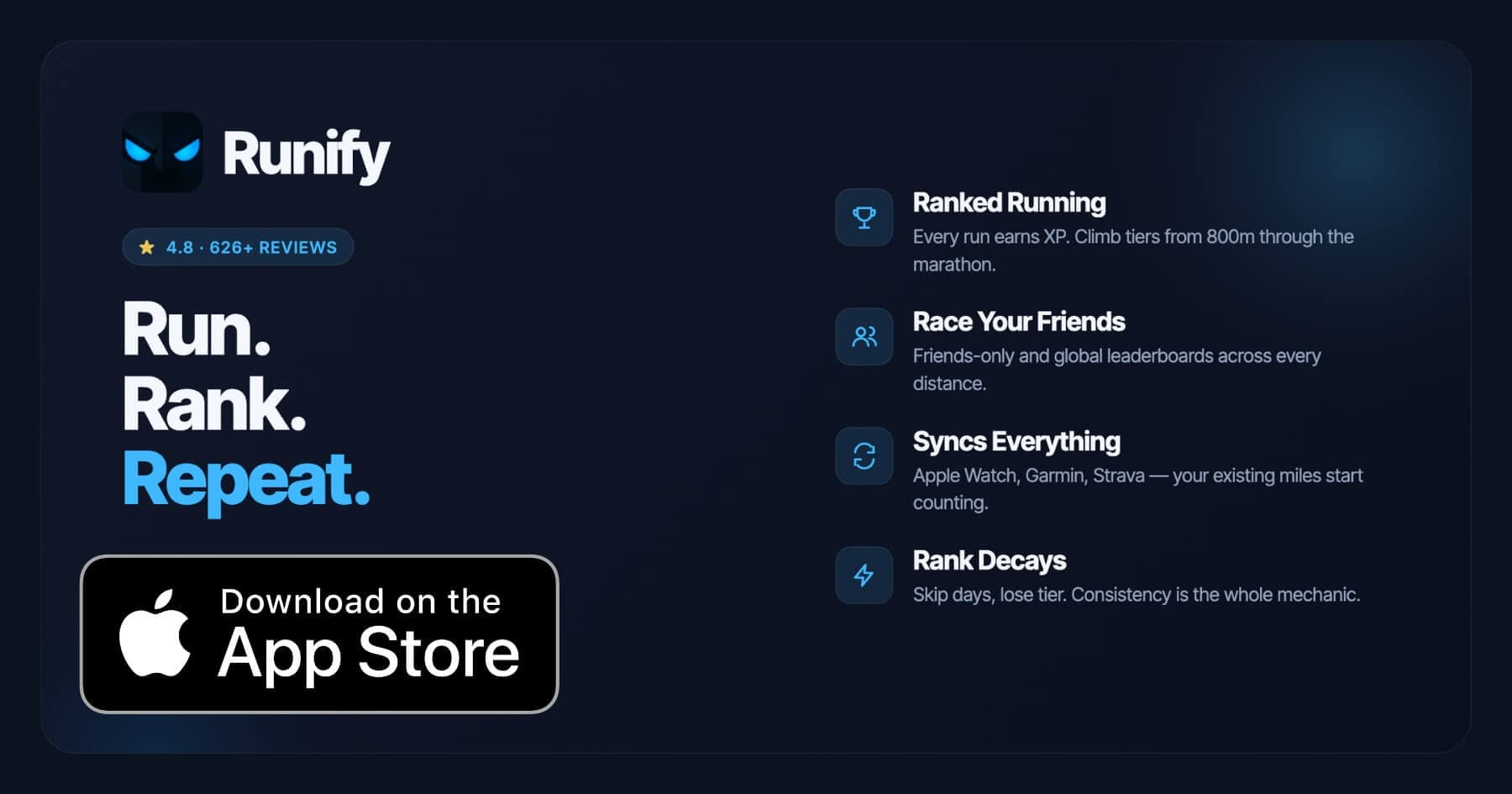
Neither Runkeeper nor MapMyRun offers a competitive tier system - and that gap is exactly what Runify fills. Runify gives every run a purpose beyond the log: XP, rank tiers, rank decay when you go inactive, and leaderboards across six race distances from 800m through the marathon.
What makes Runify practical is that you don't have to switch trackers to use it. It syncs from Apple Watch, Garmin, and Strava, so your existing miles count toward your Runify rank automatically. Runners who use Runkeeper or MapMyRun as their primary tracker often layer Runify on top purely for the ranking and social competition. The app holds 4.8 stars on the App Store with 626+ reviews.
Runify is iOS only and does not offer structured training plans, audio coaching during runs, or route discovery. It is built for runners who want to gamify their existing training - not replace it. If you're comparing the broader field of apps covering routes, social, and leaderboards, our Strava vs Runkeeper comparison and Strava vs MapMyRun breakdown add more context on where these apps each fit.
When Runify Is the Better Pick Than Both
- You want a visible, competitive reason to keep running (XP, rank, rank decay)
- You already track on Apple Watch, Garmin, or Strava and want those miles to count toward something
- You care about distance-specific performance (800m through marathon) on friends and global leaderboards
- You like sharing stylized run recaps to Instagram Stories
When Runify Is Not the Right Fit
- You're on Android. Runify is iOS only today.
- You want structured training plans, pace coaching during a run, or audio-coached workouts. Runify focuses on tracking, ranking, and social competition - not coaching.
- You want route discovery or race signup features.
How to Choose Between Runkeeper and MapMyRun
The right choice comes down to what you actually do on your runs and what you want to get back from your data.
- Training plans matter most: Go with Runkeeper. Its guided plans and audio coaching are more polished for runners building toward a specific race distance.
- Route building is your priority: MapMyRun wins. Its route database and course creation tools are genuinely best in class for a free-to-download app.
- You track multiple sports: MapMyRun handles 600+ activity types. Runkeeper is more focused on running and walking.
- Budget is a factor: MapMyRun MVP at $29.99/year undercuts Runkeeper Go at $39.99/year, and its free tier offers more without paying.
- You're on a laptop reviewing data: MapMyRun has a web interface; Runkeeper does not.
Frequently Asked Questions
Is Runkeeper or MapMyRun better in 2026?
It depends on your priorities. Runkeeper is the stronger choice for structured training and audio coaching, particularly for beginners building toward a first race. MapMyRun is better for route planning, cross-activity tracking, and value on the paid tier. If social competition and leaderboards matter to you, neither app is particularly strong - Strava and Runify serve that need better. Both apps are reliable GPS trackers, but their premium tiers push in different directions.
Can I use Runkeeper and MapMyRun together?
Yes - many runners use both. Runkeeper connects to Apple Health, and MapMyRun also syncs to HealthKit, so you can log a run in one and have it appear in the other via Apple Health. That said, managing two apps adds friction. A simpler approach is to pick one as your primary tracker and use a separate app like Runify for ranked competition, since Runify imports from Apple Watch, Garmin, and Strava automatically.
Which is cheaper, Runkeeper or MapMyRun?
MapMyRun is cheaper. MapMyRun MVP costs $5.99/month or $29.99/year. Runkeeper Go costs $9.99/month or $39.99/year. Both apps have a free tier with useful core features. If you only need GPS tracking without premium extras, both are free. If you want training plans and audio coaching, MapMyRun's annual rate saves you $10/year compared to Runkeeper.
Which has better tracking accuracy, Runkeeper or MapMyRun?
Both deliver reliable GPS accuracy for standard road running in urban and suburban environments. MapMyRun edges ahead slightly in consistent distance measurement according to user reviews and comparison testing. Runkeeper has received more complaints about auto-pause misfiring. For most runners running on known roads or paths, the difference is negligible. Both apps support Apple Watch tracking as a standalone device for more reliable lock than phone-only GPS.
What is the best alternative to both Runkeeper and MapMyRun?
For runners who want ranked, competitive running on top of their existing tracking, Runify is worth trying. It syncs from Apple Watch, Garmin, and Strava, earns XP on every run, and ranks you on distance-specific leaderboards from 800m through the marathon, with friends-only and global options. Runify holds 4.8 stars on the App Store. It is iOS only and not a training-plans app, so it complements rather than replaces Runkeeper or MapMyRun. For runners who want social segments and a large community, Strava remains the category leader.
Final Verdict
Runkeeper and MapMyRun are both solid GPS running apps that have earned their user bases over more than a decade. They solve different problems: Runkeeper guides you through training; MapMyRun helps you plan and discover where to run.
Choose Runkeeper if you're building toward a race and want a simple app that coaches you through the process with audio cues and structured plans. Choose MapMyRun if routes, cross-training variety, and a lower annual price are your priorities.
If you want your runs to feel more competitive, Runify gives you a ranked tier system, XP, and leaderboards that neither Runkeeper nor MapMyRun offer - and it plugs into the tracker you're already using.
Ready to add a competitive edge to your running? Download Runify on the App Store and see where your miles rank.

4.8 on the App Store · Built for iOS