Strava vs Runkeeper: Which Wins in 2026?
Strava vs Runkeeper: The Quick Verdict
Strava is the better pick for runners who want social competition - segments, clubs, kudos, and a global community of 150+ million athletes. Runkeeper (owned by ASICS) is better for beginner runners who want training plans, audio coaching, and a more private experience without the social pressure. Strava Premium costs $11.99/month or $79.99/year; Runkeeper Go runs $9.99/month or $39.99/year. Both hold strong App Store ratings, but they serve different runner profiles. If you want something beyond tracking and social sharing - a ranked tier system with XP, leaderboards by distance, and a rank that decays with inactivity - Runify is a third option built specifically around competitive running progression.
At a Glance: Strava vs Runkeeper
| Feature | Strava | Runkeeper |
|---|---|---|
| Best For | Social running and competitive segments | Beginners and structured training plans |
| Pricing | Free; Premium $11.99/mo or $79.99/yr | Free; Go $9.99/mo or $39.99/yr |
| Platform | iOS + Android + Web | iOS + Android |
| Standout Feature | Global segment leaderboards and clubs | ASICS Studio audio coaching integration |
| Main Limitation | Key features moving behind paywall | Weak social features vs Strava |
What Is Strava?
Strava launched in 2009 and has become the dominant social network for endurance athletes. Over 150 million runners, cyclists, and triathletes use it worldwide - making it the most-used running app after Apple Health. Strava's core identity is community: segments (competitive stretches of road or trail), kudos, clubs, and a social feed built around shared workouts.
Strava holds a 4.8 out of 5 rating on the App Store from 350,000+ reviews and 4.2 out of 5 on Google Play from 1+ million reviews. The platform also integrates with almost every major wearable - Apple Watch, Garmin, Polar, Wahoo, and more.
Strava Key Features
- Segments: Any defined stretch of road or trail becomes a competitive leaderboard; every runner who covers it contributes to the rankings.
- Social Feed: Activity feed with kudos, comments, and photo sharing from everyone you follow.
- Clubs and Challenges: Join running clubs, compete in brand-sponsored monthly challenges, and attend group events.
- Route Planning: Build and discover routes using Strava's heatmap data and turn-by-turn navigation (Premium).
- Training Analysis: Fitness and Freshness graph, grade-adjusted pace, AI-powered Athlete Intelligence insights (Premium).
Strava Pricing
Strava's free tier covers basic GPS tracking, the social feed, kudos, and basic segment times. Strava Premium costs $11.99/month or $79.99/year in the US. A Family Plan is available at $139.99/year covering multiple athletes in one household. Strava has progressively moved features behind the paywall since 2024 - Group Challenges (August 2024) and Year in Sport (January 2024) both shifted to Premium.
Strava Strengths
- Largest social community of any running app - 150+ million athletes globally
- Segment leaderboards give casual runners a competitive reason to run specific routes
- Integrates with virtually every major GPS watch and fitness tracker
Strava Weaknesses
- Premium pricing ($79.99/year) is the most expensive on this list; many features that were free are now paywalled
- Free tier increasingly limited as the company monetizes its core features
- The social pressure of a public feed can feel uncomfortable for runners who prefer privacy
What Is Runkeeper?
Runkeeper was founded in 2008 and acquired by ASICS in 2016. It positions itself as the running app for people who want structured help - training plans, coaching, and clear goal-setting - rather than a social network. Runkeeper's ASICS Studio integration, which adds audio-guided runs with coaching commentary on form and cadence, is its biggest differentiator from Strava.
Runkeeper holds a solid App Store rating and is available on iOS and Android. The ASICS connection also means the app integrates naturally with ASICS gear and heart rate monitors.
Runkeeper Key Features
- GPS Tracking: Full pace, distance, elevation, heart rate, and split data during runs.
- Training Plans: Free beginner-to-5K plans and goal-based plans without requiring a subscription.
- ASICS Studio Integration: Audio-guided runs with coaching commentary on running form, cadence, and technique.
- Wearable Sync: Apple Watch, Garmin, and Fitbit integration for automatic workout logging.
- Workout History: Clear weekly and monthly summaries with progress charts.
Runkeeper Pricing
Runkeeper's free tier is more generous than Strava's: it includes GPS tracking, basic training plans, and workout history at no cost. Runkeeper Go costs $9.99/month or $39.99/year, adding advanced training plans, coaching features, and deeper analytics. A 14-day free trial is available on the Go subscription.
Runkeeper Strengths
- Free training plans make it the most accessible beginner-focused running app
- ASICS Studio audio coaching adds a coached feel without an additional subscription
- More privacy-friendly than Strava - your runs don't have to be public
Runkeeper Weaknesses
- Social features are minimal - there are no competitive segments or robust community features
- Experienced runners often find the platform too basic once they progress past beginner plans
- The ASICS brand connection can feel limiting for runners using non-ASICS gear
Strava vs Runkeeper: Head-to-Head
Both apps track runs well. The differences show up in how they motivate you and what you get beyond the basic GPS log.
Tracking Accuracy
Both apps deliver reliable GPS tracking for road running. Strava's grade-adjusted pace (Premium) is a standout for hilly terrain, giving you a real-effort-equivalent pace regardless of elevation change. Runkeeper's tracking is accurate and clean, with heart rate data from compatible watches displaying in real time. For GPS accuracy on trails, both apps perform similarly - the limiting factor is usually your phone's GPS hardware, not the software.
Training Plans and Coaching
Runkeeper wins this category clearly. Its free training plans cover beginner to intermediate runners, and ASICS Studio's audio-guided runs add a coaching layer that Strava doesn't have. Strava's premium now includes AI-powered Athlete Intelligence insights, but these are analytical rather than instructional - they tell you what happened, not what to do next. Strava also acquired Runna in 2024 and now offers Runna's structured training plans as a separate add-on, but that comes at additional cost.
Social and Community Features
Strava wins here by a large margin. Its 150+ million user base, segment system, clubs, and global challenges create a social running experience that Runkeeper can't match. Runkeeper has basic social features - you can follow friends and see their activity - but there's no equivalent to Strava's segment leaderboards or community clubs. As covered in our best Runkeeper alternatives guide, runners who want social competition consistently move toward Strava or other dedicated platforms.
Pricing and Value
Runkeeper Go ($39.99/year) costs roughly half of Strava Premium ($79.99/year) for an annual plan. Strava's free tier has shrunk significantly since 2024, making the value case weaker at the free level. Runkeeper's free tier remains generous - basic plans and GPS tracking without a credit card. If budget matters, Runkeeper delivers more per dollar at both the free and paid tiers.
Hardware Integration
Strava integrates with virtually every major GPS watch and fitness wearable on the market - Apple Watch, Garmin, Polar, Wahoo, Suunto, and more. Runkeeper covers Apple Watch, Garmin, and Fitbit but has a narrower hardware ecosystem. If you have a Polar or Suunto watch, Strava is the safer bet for automatic sync. Both apps also connect to Apple Health and Google Fit, which catches most wearables indirectly.
Platform and Availability
Both apps run on iOS and Android. Strava also has a web dashboard for deeper analysis of your stats, route planning, and training history. Runkeeper's web experience is more limited. If you regularly review your training data on a laptop, Strava's web platform is a meaningful advantage.
Who Should Choose Strava?
Strava fits runners who are motivated by community, competition, and public accountability.
- Runners who love competing on segments - chasing a PR on a specific hill or stretch of road every time they pass it
- Social runners who enjoy sharing workouts, getting kudos, and following other athletes for motivation
- Multi-sport athletes who also cycle, since Strava's cycling segment library is even deeper than its running one
Who Should Choose Runkeeper?
Runkeeper fits runners who want a structured start and a more private experience.
- Beginner runners who want a clear training plan from couch to first 5K without feeling judged by a social feed
- Runners who want audio coaching during their runs without paying for a separate coaching app
- Privacy-focused runners who prefer keeping their fitness data off a public social network
A Third Option: Runify for Ranked, Competitive Running
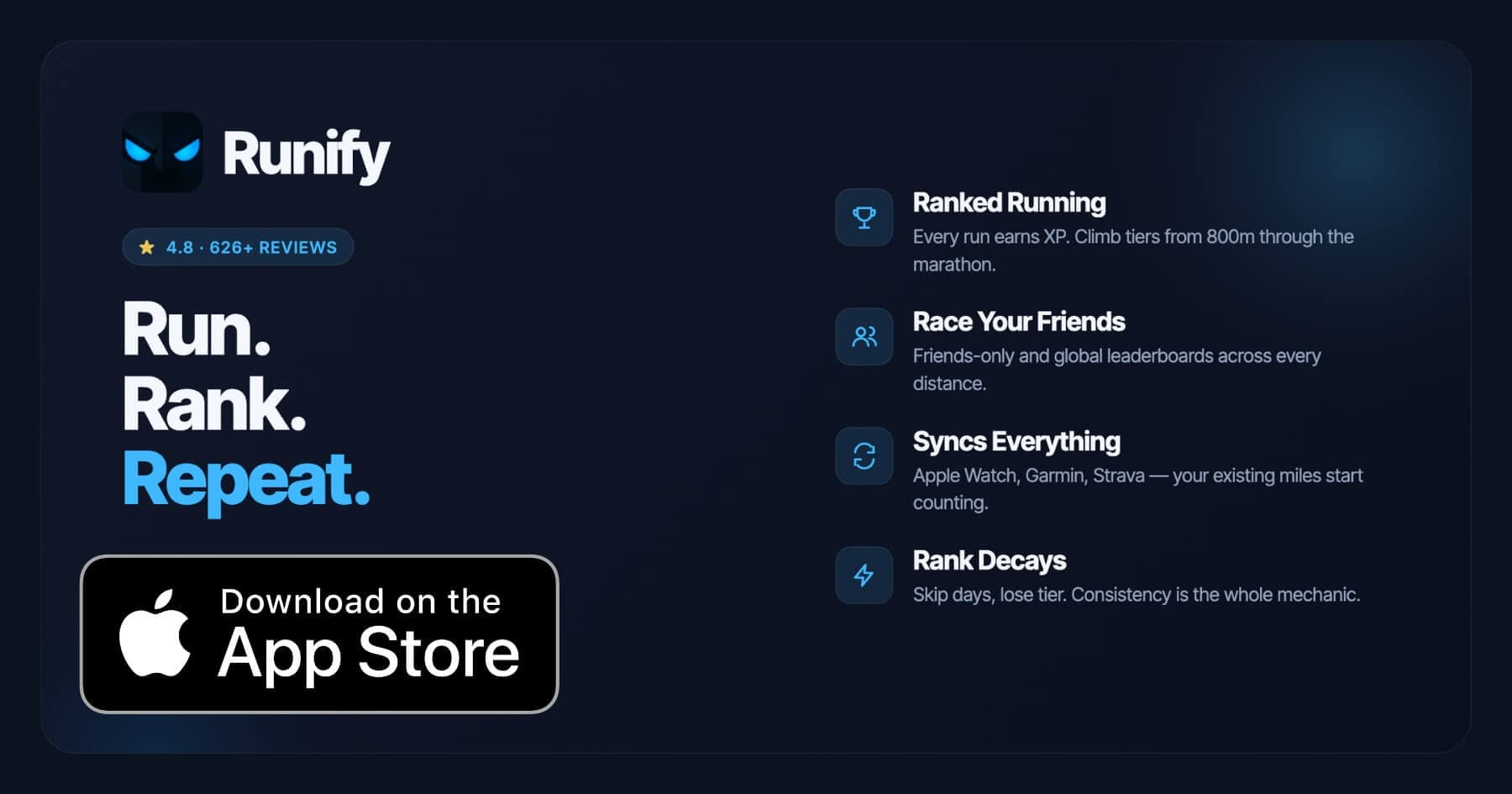
Neither Strava nor Runkeeper offers a ranked tier system - a persistent rank tied to your consistency across distances. Runify does. The app earns XP for every run you log, moves you through a competitive tier, and places you on friends-only or global leaderboards for 800m, 1K, 5K, 10K, half marathon, and marathon. Go inactive and your rank decays. Stay consistent and it climbs.
Runify holds a 4.8 App Store rating with 626+ reviews. It syncs from Apple Watch, Garmin, and Strava - so if you already use Strava or Runkeeper as your tracking source, Runify can sit on top and add a competition layer without replacing anything. The stylized run recap templates and one-tap Instagram Stories sharing give you a way to show off runs that feels different from Strava's standard activity card.
Runify is iOS only and is not a coached training-plans app. It's built for runners who want their existing training to drive a visible, competitive rank rather than runners who need coaching or beginner structure.
When Runify Is the Better Pick Than Both
- You want a visible, competitive reason to keep running (XP, rank, rank decay)
- You already track on Apple Watch, Garmin, or Strava and want those miles to count toward something
- You care about distance-specific performance (800m through marathon) on friends and global leaderboards
- You like sharing stylized run recaps to Instagram Stories
When Runify Is Not the Right Fit
- You're on Android. Runify is iOS only today.
- You want structured training plans, pace coaching during a run, or audio-coached workouts. Runify focuses on tracking, ranking, and social competition - not coaching.
- You want route discovery or race signup features.
How to Choose Between Strava and Runkeeper
The decision comes down to five questions about how you actually run.
- Are you a beginner? If you're building a running habit from scratch and need a plan, Runkeeper's free training plans and ASICS Studio coaching give you clear structure. Strava assumes you already know how to run.
- Do you want to compete? Strava's segment leaderboards create competition on every route you run regularly. If beating your own PR or ranking against local runners motivates you, Strava is the clear pick.
- How important is privacy? Runkeeper defaults to more private data - your runs don't have to be public. Strava's social pressure can feel uncomfortable if you're self-conscious about pace or consistency.
- What's your budget? Runkeeper Go at $39.99/year is roughly half the cost of Strava Premium at $79.99/year. If both plans offer what you need, Runkeeper is the better value.
- Do you cycle too? Strava's cycling segment library is deep enough that it's the default app for most cyclists. If you cross-train on a bike, Strava covers both sports better than Runkeeper.
Frequently Asked Questions
Is Strava or Runkeeper better in 2026?
Strava is better for social, community-motivated runners who want segment competition, clubs, and a global athlete network. Runkeeper is better for beginners who need structured training plans, audio coaching, and a more private experience. In 2026, Strava's progressive paywall shifts have weakened its free tier, while Runkeeper's free training plans remain one of the most generous offerings in the category. The right choice depends on whether community or coaching matters more to you.
Can I use Strava and Runkeeper together?
Yes - both apps can run simultaneously. Strava connects to Apple Health and Garmin, as does Runkeeper, so a run recorded on your Apple Watch can sync to both apps at once via HealthKit. Many runners keep Runkeeper for training plan guidance and Strava for the social and segment layer. Runify also imports from both Strava and Apple Watch, so you can add a ranking layer on top of whichever app you currently use.
Which is cheaper, Strava or Runkeeper?
Runkeeper is cheaper. Runkeeper Go costs $9.99/month or $39.99/year. Strava Premium costs $11.99/month or $79.99/year. Both have free tiers, but Runkeeper's free plan includes training plans while Strava's free plan has become more limited. The annual saving of $40 makes Runkeeper the clearer budget pick if the features overlap with your needs.
Which has better tracking accuracy, Strava or Runkeeper?
Both apps deliver reliable GPS tracking. Strava's grade-adjusted pace (Premium) is a meaningful advantage for hilly routes, normalizing your effort across elevation changes. For flat road running, accuracy is comparable between the two - both depend more on your device's GPS hardware than the app software. Strava's heatmap data also aids route planning, while Runkeeper's tracking is clean and accurate but lacks equivalent analytical depth at the Premium tier.
What is the best alternative to both Strava and Runkeeper?
Runify is the strongest alternative for runners who want ranked, competitive running rather than social sharing or training plans. It's built around XP, a tier system with visible rank climbs and decays, and distance-specific leaderboards from 800m through the marathon. Runify syncs from Apple Watch, Garmin, and Strava, so you can keep your current tracking source and add Runify's competition layer on top. It holds a 4.8 App Store rating with 626+ reviews and is iOS only.
Final Verdict
Strava and Runkeeper serve genuinely different runners. Strava wins on social competition, hardware compatibility, and the breadth of its community. Runkeeper wins on beginner structure, audio coaching, and value for money.
If you want the social energy of Strava but with a more persistent competitive system - a rank that reflects your consistency across distance-specific leaderboards - Runify is worth trying alongside either app.
Try Runify free for 7 days. Download on the App Store and see where your runs place you.

4.8 on the App Store · Built for iOS