Garmin Running Statistics 2026
Garmin Running Statistics 2026
Garmin's fitness segment grew 31% in 2024 to roughly $1.8 billion in revenue, and Garmin Connect users averaged 8,317 steps per day across the year. Garmin held about 11% of global smartwatch shipments in Q2 2024 to land third behind Apple and Samsung, while the Forerunner 245 still placed third on Strava's most-used running watches. On race day, 92% of marathon activities were recorded on a GPS watch. These 16 statistics show how Garmin sits at the center of serious running in 2026.
Garmin is the device of record for many committed runners. The Forerunner and Fenix lines anchor training for marathoners, ultrarunners, and triathletes, and the Connect ecosystem feeds data into apps across the running world. Demand grew sharply through 2024 and 2025 as runners looked for accuracy, battery life, and depth of metrics that phones cannot match.
This post pulls together the most useful Garmin numbers you can cite right now: revenue, users, accuracy benchmarks, app share, and behavior data. It is built for runners, gear shoppers, and anyone writing about wearables in 2026.
1. Garmin's fitness segment revenue grew 31% in 2024 to roughly $1.8 billion
Garmin's fitness segment, which contains the Forerunner, Venu, Vivo, and Edge cycling lines, climbed 31% year over year in 2024 to about $1.8 billion in revenue. That made fitness the fastest-growing of Garmin's five segments. In Q4 alone, fitness revenue rose 31% to $539 million with strong demand for wearables across every category.
Operating margins inside fitness ran around 30% for the quarter, producing $159 million of operating income. The number matters because it shows that running watches are not a slow-growth side bet for Garmin. They are now one of the biggest engines inside a $6.3 billion company. Strong margins also let Garmin keep investing in dual-band GPS, sensors, and on-device features that flow down from Fenix to mid-tier Forerunners.
Source: Garmin - Fourth Quarter and Fiscal Year 2024 Results
2. Garmin reported $6.30 billion in total revenue in fiscal 2024, up 20%
Garmin posted record consolidated revenue of $6,296.9 million in fiscal 2024, a 20% jump from $5.2 billion in 2023. All five segments hit full-year records, and fitness contributed roughly 28% of the total. Outdoor, which includes the Fenix and Enduro lines, grew 29% in Q4 with $251 million of operating income.
That scale is important context for any running statistic with Garmin's name on it. The brand is no longer a niche GPS specialist. Garmin now ships at volumes that compete directly with Apple in serious endurance sport, and the company's $2.05 billion outdoor segment plus $1.8 billion fitness segment together make running and adventure watches the financial core of the business. Expect that mix to keep tilting toward wearables and away from automotive in 2026.
Source: Garmin - 2024 Annual Report
3. Garmin held about 11% of global smartwatch shipments in Q2 2024
Counterpoint Research and Canalys both placed Garmin third in global smartwatch shipments in Q2 2024 with roughly 11% market share. Apple led with 49% and Samsung followed at 15%. Garmin shipments grew 16% year over year that quarter, even as the overall smartwatch market shrank 7% in 2024 in its first recorded down year.
The data reveals an important split. Garmin loses on raw volume because Apple bundles a watch with iPhone households. Garmin wins on the high end, where multisport athletes pay $500 to $1,200 for Forerunner 970 and Fenix 8 hardware. That mix protects Garmin's margin even when shipment counts trail Apple. If you look at running specifically, our running consistency data shows the Garmin user base also logs activities at much higher rates than casual smartwatch buyers.
Source: Counterpoint Research - Global Smartwatch Shipments Market Share
4. Garmin Connect users averaged 8,317 steps per day in 2024
The 2024 Garmin Connect Data Report put the global average at 8,317 steps per day, well above the 5,000 to 6,000 step average for the broader US adult population. Hong Kong users led the world at 10,340 steps per day. Indonesia trailed at 5,375. The 2025 report showed steps rose another 1.2% year over year.
That gap between Garmin owners and the general public is one of the strongest signals you can cite. People who buy a Forerunner or Fenix are already more active than average, and they get more active again once they start tracking. The number also explains why Garmin's data tends to skew toward fitter populations in any reported study or survey, which matters when you compare it to broader public health step targets.
Source: Garmin - 2024 Garmin Connect Data Report
5. Garmin Connect logged 8% more activities in 2025 than in 2024
The 2025 Garmin Connect Data Report showed an 8% rise in total activities versus 2024. Outdoor running grew 6%, with Japan leading that increase. Indoor running grew 16%, led by Norway. Track running was up 65% in the prior year's report, suggesting Garmin owners are pushing more structured workouts into rotation rather than just easy runs.
Activity volume is a useful proxy for Garmin user engagement. Even with global shipment volume declining for the wider smartwatch category, the Garmin community kept logging more sessions per person. That is the behavior pattern of buyers who treat the watch as a training tool, not a notification screen. Combined with our marathon finishing time analysis, the number lines up with a serious-runner skew across the platform.
Source: Garmin - 2025 Garmin Connect Data Report
6. The Garmin Forerunner 245 was Strava's third most-used running watch in 2024
Strava's 2024 Year in Sport Report named the Apple Watch Series first, the Apple Watch SE second, and the Garmin Forerunner 245 third on the global list of devices used to record runs. Strava buckets every Apple Watch generation into one entry, while every Garmin model is counted separately. That methodology splits Garmin's vote across Forerunner 165, 255, 265, 955, 965, and Fenix variants.
Even with the split, the 245 held its place years after Garmin stopped selling it. The pattern matches our Strava alternatives breakdown and points to a real Garmin loyalty effect. Runners hold onto a working Forerunner for five to seven years rather than upgrade annually, which is the opposite of the Apple Watch replacement cycle. Battery life and stable firmware drive that retention.
Source: Strava - Year in Sport Trend Report 2024
7. 92% of marathon activities on Strava were recorded on a GPS watch
Strava's 2024 Year in Sport Report found that 92% of marathon activities uploaded to the platform were recorded on a GPS watch rather than a phone. The figure rises with race distance: phones still capture more 5K and 10K runs, but watches dominate at the half and full. Garmin and Apple split most of that watch share, with Coros and Suunto picking up smaller pieces.
This is one of the cleanest signals that committed distance runners run with a watch. A phone bouncing in a belt or vest is a poor pacer for 26.2 miles, and most marathoners want wrist heart rate plus per-mile splits without unlocking a screen. If you are writing about gear for marathon training, this is the headline stat to lead with. It also pairs cleanly with our half marathon participation data.
Source: Strava - Year in Sport Trend Report 2024
8. Modern Garmin multiband GPS holds about plus or minus 2 meters
The Forerunner 965 and Fenix 8 both run multi-band GNSS, which uses multiple satellite frequencies on multiple constellations to filter reflected signals. Independent reviewers including DC Rainmaker and OutdoorGearLab have measured roughly plus or minus 2 meters of accuracy under open sky, versus plus or minus 3 meters on single-band GPS. One in-depth 10-mile review test scored the Forerunner 965 at 0.05 miles of error, around 0.5%.
The improvement is most visible in cities, forests, and along buildings, where reflected signals confuse single-band watches. For runners, that means cleaner GPS tracks under tree cover, more accurate splits in downtown loops, and fewer phantom turns. Multi-band does cost battery life, which is why Garmin lets you toggle between single-band, all-systems, and SatIQ adaptive modes per activity.
Source: DC Rainmaker - Garmin Forerunner 965 In-Depth Review
9. The Forerunner 245 had under 1% relative error at the Two Oceans Marathon
A peer-reviewed comparative analysis published in Measurement looked at Garmin Forerunner watches across 225 participants at the Two Oceans Marathon. The Forerunner series produced low relative error with a small range, sitting well under the 1% error mark across the 56 km course. Errors were normally distributed, suggesting the watches were not biased long or short.
That is the kind of citation you want for any "are running watches accurate" question. Real race conditions, real participants, and a peer-reviewed methodology beat any controlled treadmill study. The result also explains why race directors and elite coaches accept Garmin GPS distance as workable for training prescription, even when official courses are measured by Jones counter on a calibrated bicycle.
Source: ScienceDirect - Comparative analysis of positioning accuracy of Garmin Forerunner GNSS receivers
10. The Forerunner 165 is Garmin's entry running watch at $249.99
The Garmin Forerunner 165 launched in 2024 at $249.99, with the Music variant at $299.99. It is the cheapest AMOLED Forerunner Garmin sells and the most common entry point for new runners moving up from a phone or basic fitness band. It includes a touchscreen display, up to 11 days of battery life, training metrics, and recovery insights.
The price point matters because it sets the floor for the Garmin running ecosystem. A runner who buys a 165 at $250 gets the same Garmin Connect data, the same Connect IQ store, and the same Strava and HealthKit integrations as a Fenix 8 owner spending $1,200. That parity is a major reason Garmin holds onto serious runners once they enter the system. See our iPhone leaderboard app comparison for how those synced runs can plug into ranked competition.
Source: Garmin - Forerunner 165 Product Page
11. Garmin shipped 16.6 million total units in fiscal 2021
Garmin's most recent disclosed unit total is 16.6 million units shipped in fiscal 2021, up 8% from 15.4 million in 2020. The company stopped breaking out units publicly after that, shifting to revenue-only segment reporting. With fitness and outdoor revenue both growing 30%-plus through 2024, unit volume is almost certainly higher in 2025, even if Garmin will not confirm it.
That historical baseline is still useful as a floor. Even if you assume zero growth, Garmin has sold tens of millions of GPS-capable wearables into a global running base that re-buys every five to seven years. The installed base is one of the larger reasons Garmin Connect data carries weight. The sample is large, behaviorally selected for active users, and skewed toward people willing to spend $250 or more on a single device.
Source: GlobalData - Number of Units Sold by Garmin (FY2017 - FY2021)
12. Garmin Connect IQ enabled in-store premium app purchases in August 2024
In August 2024, Garmin opened the Connect IQ Store to paid premium watch faces and apps using Garmin Pay. Launch partners included Disney, GoPro, Porsche, and TaylorMade. New developers also became subject to a verification step starting February 2024. Connect IQ remains the open app platform for Garmin smartwatches, bike computers, and outdoor handhelds.
The shift to paid apps is the most consequential change to the Garmin running ecosystem in years. Independent developers can now monetize the run-specific apps and watch faces they used to give away for free, which should expand the depth of what is buildable on a Garmin. Expect more high-quality data fields, race pace screens, and third-party training tools to ship through 2026 as the revenue model matures.
Source: Garmin Newsroom - Premium App Purchases in the Connect IQ Store
13. Strava saw a 59% increase in running club participation in 2024
Strava's 2024 Year in Sport Report flagged a 59% global rise in running club participation and an 18% rise in group runs of 10 or more. The trend was strongest among Gen Z and millennial runners, who used clubs as a social entry point to running. Garmin watches were the most common device worn at those group runs after the Apple Watch.
The number speaks to where running is heading: more social, more group-driven, and more peer-visible. That is also the context in which Garmin is competing. Garmin's strength is depth of metrics for the lone trainer. Its weakness has always been social layer, which is why most Garmin users still pipe their runs into Strava or other community apps. Our running consistency stats post shows just how much social visibility drives logged-run frequency.
Source: Strava - Year in Sport Trend Report 2024
14. Garmin's outdoor segment grew 29% in Q4 2024 to $1.7 billion+ for the year
The outdoor segment, which contains the Fenix, Enduro, Instinct, and Tactix watches, grew 29% in Q4 2024 with $251 million of operating income at a 40% operating margin. Adventure watches led the growth. For the full year, outdoor revenue topped $1.7 billion, making it Garmin's second-largest segment behind fitness's $1.8 billion.
The Fenix line specifically dominates the high-end ultrarunning and trail community. Few competing brands offer the combination of multiband GPS, 14-plus day battery, solar charging, and topographic mapping at any price. The 40% operating margin shows Garmin can charge $700 to $1,200 for a Fenix 8 and still find buyers, which suggests pricing power that should hold through 2026 even as competitors push down from below.
Source: Garmin - Fourth Quarter and Fiscal Year 2024 Results
15. Garmin employs more than 23,000 associates across 37 countries
Garmin's 2024 Annual Report lists more than 23,000 associates working across 37 countries, up from roughly 19,000 in 2022. That headcount supports a vertically integrated company that designs, manufactures, and ships its own hardware in Taiwan and the United States, rather than outsourcing production like most consumer electronics brands.
This vertical integration is the structural reason Garmin can release the volume of new running products it does each year. Forerunner 165, 265, 570, 965, 970, plus Fenix 8 and Enduro 3 all shipped inside an 18-month window. That cadence is hard to match without owning the supply chain. It also explains why Garmin can keep selling older models like the Forerunner 245 long after their official discontinuation: the firmware team is still in-house.
Source: Garmin - 2024 Annual Report
16. Garmin's average user is 2.48 years younger in fitness age than chronological age
The 2024 Garmin Connect Data Report estimated that the average Garmin user has a fitness age 2.48 years lower than their actual age. The fitness age metric uses VO2 max, resting heart rate, body composition, and activity volume to produce a biological-fitness estimate. Net Garmin users are fitter than population norms for their age cohort.
That number, paired with the 8,317 daily step average, paints a clear picture of who buys a Forerunner or Fenix in 2026. The buyer is already in the top quartile of cardiovascular fitness for their age bracket. Most upgrade decisions are driven by training depth, not casual step counting. For brands marketing alongside Garmin, that audience profile is unusually concentrated and unusually willing to pay for performance.
Source: Garmin - 2024 Garmin Connect Data Report
What These Numbers Tell Runners in 2026
Garmin in 2026 sits at the intersection of three trends. Hardware revenue is climbing at 30% per year, the global smartwatch market is consolidating around Apple at the casual end and Garmin at the serious end, and the running community is logging more group runs and more structured workouts than at any point on record. The Forerunner and Fenix lines are the default training tools at the half marathon and longer.
For everyday runners, the practical takeaway is simple. Garmin makes running watches that are accurate to within 1% of true distance, last days on a charge, and connect to almost every popular running app. The downside is a weaker social layer, which is why most Garmin owners still rely on third-party apps for community, leaderboards, and gamification. Phones still hold the lead for casual 5K logging, but watches own the marathon.
Looking ahead to the rest of 2026, expect more multiband GPS to trickle down into mid-tier Forerunners, more paid Connect IQ apps from independent developers, and more pressure from Coros and Suunto on the high end. Apple will keep winning shipments. Garmin will keep winning the runners who care about training data.
The Garmin platform now sets the data baseline for serious running, and almost every other running app in 2026 has to talk to it.
Turn Your Garmin Runs into Rank
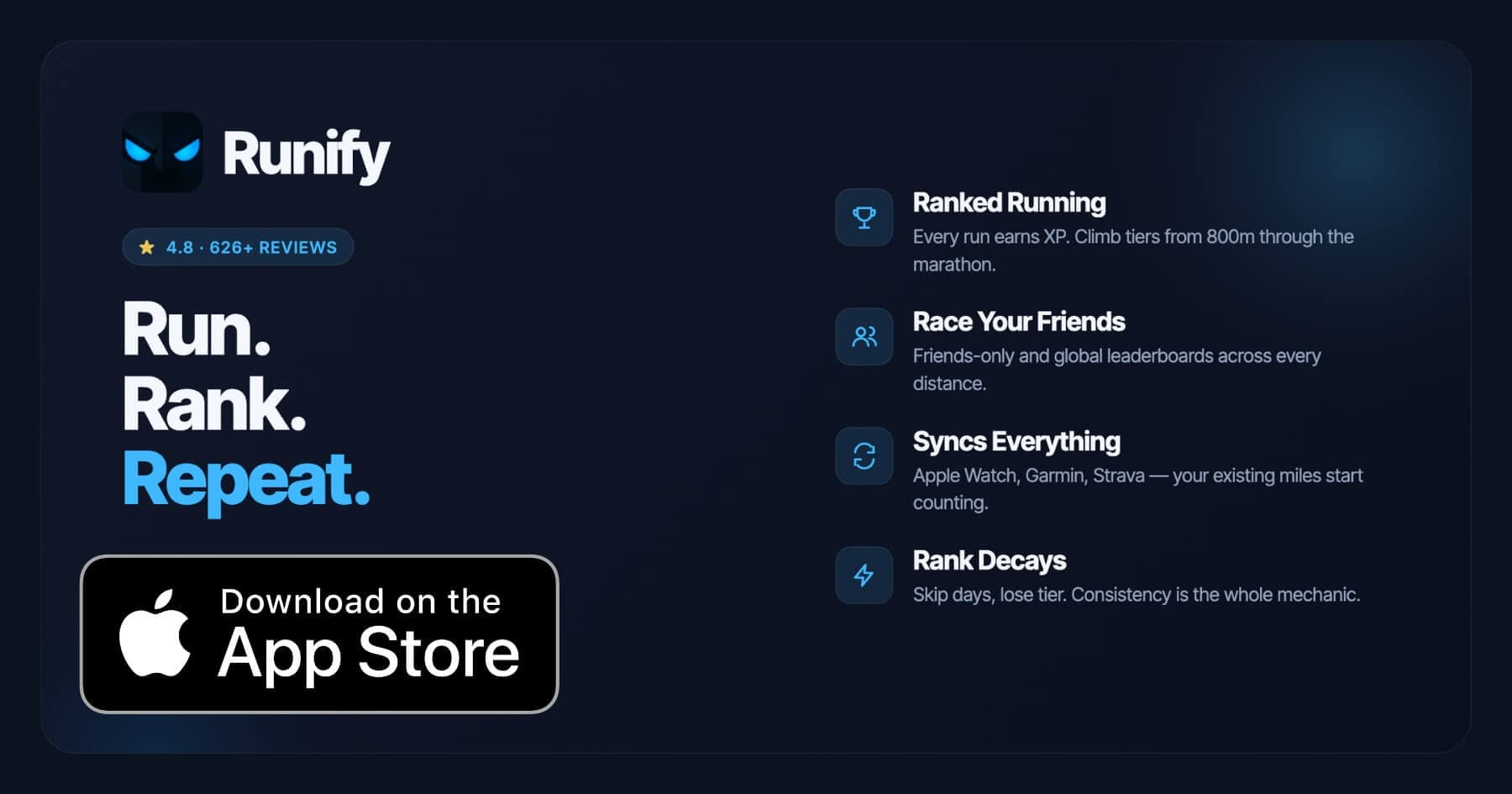
If you already train on a Forerunner or Fenix, your data should not stop at Garmin Connect. Runify imports your runs straight from Garmin, Apple Watch, and Strava and turns every mile into XP across friends-only and global leaderboards from 800m through the marathon. Your weekly long run, your lunchtime 5K, your race day half marathon, all of them earn rank on Runify.
The point is to make every logged run feel like it counts for something past the file in Garmin Connect. You keep using the watch you trust for accuracy and battery, and Runify adds a competitive layer on top. Stay consistent and your tier climbs. Go inactive and it decays. That is the loop that pulls Garmin runners back day after day.
Ready to make your runs count? Download Runify on the App Store and turn every mile into XP across leaderboards from 800m through the marathon.
4.8 stars on the App Store, 626+ reviews worldwide.
Download Runify on the App Store

4.8 on the App Store · Built for iOS