Garmin Forerunner 165 vs 265: Compared in 2026
Garmin Forerunner 165 vs 265: The Quick Verdict
The Forerunner 165 is the better buy if you want a capable, lightweight GPS running watch without a premium price tag. At $249, it covers all the essentials: accurate GPS tracking, heart rate, sleep monitoring, and Garmin's animated workout guides. The Forerunner 265 costs $449 and earns that extra $200 with a sharper AMOLED display, full Training Readiness scores, HRV Status, running power, and a longer training plan ecosystem built for structured race prep.
If you run 3-5 days a week and mostly want accurate data without advanced coaching metrics, the 165 is more than enough. If you are building toward a half marathon or marathon and want Garmin's full training load and recovery analysis toolkit, the 265 pays for itself. Both watches sync with Garmin Connect and third-party apps like Strava, and both work well with companion apps on iOS and Android.
At a Glance: Forerunner 165 vs 265
| Feature | Forerunner 165 | Forerunner 265 |
|---|---|---|
| Best For | Budget-conscious everyday runners | Structured race training |
| Pricing | $249 (Music: $299) | $449 (Music: $499) |
| Platform | iOS + Android | iOS + Android |
| Standout Feature | AMOLED display at budget price | Training Readiness and HRV Status |
| Main Limitation | No running power or race predictor | Heavier and significantly pricier |
What Is the Garmin Forerunner 165?
The Forerunner 165 launched in early 2024 as Garmin's entry point into the mid-range AMOLED watch segment. It targets runners who want a bright, always-on display and reliable GPS without paying flagship prices. The 165 weighs just 39 grams, fits a 43mm case, and delivers up to 19 hours of GPS battery life - long enough for most runners to finish a marathon in GPS mode.
Garmin positioned the 165 as a step up from the older Forerunner 55 and 45. It carries many of the health tracking and guided workout features that used to be exclusive to higher-end models. The result is a watch that suits newer runners and recreational athletes who run regularly but are not training for specific race goals.
Forerunner 165 Key Features
- AMOLED Display: Bright, always-on touchscreen at a price previously reserved for pricier Garmin models.
- GPS Tracking: Multi-band GPS with GNSS support for accurate pacing on roads and trails.
- Daily Suggested Workouts: Garmin recommends workouts based on recent training load and recovery.
- Animated Workout Guides: On-screen animations for strength and cardio exercises, useful for runners doing cross-training.
- Sleep and Health Monitoring: Sleep tracking, Pulse Ox, stress tracking, and Garmin Body Battery for recovery awareness.
Forerunner 165 Pricing
The Forerunner 165 retails at $249. The Music variant, which adds onboard music storage for Spotify and other services, costs $299. There is no subscription required to access watch features. Garmin Connect is free for the core analytics dashboard.
Forerunner 165 Strengths
- Excellent value: AMOLED display and GPS accuracy at a mid-range price
- Lightweight (39g) and comfortable for all-day wear
- Daily Suggested Workouts make it usable without a training plan
Forerunner 165 Weaknesses
- No running power metric (available on the 265)
- No Training Readiness score or HRV Status (both present on 265)
- No race predictor based on recent runs
- Shorter battery life than older LCD-display Forerunners
What Is the Garmin Forerunner 265?
The Forerunner 265 launched in early 2023 and sits in Garmin's mid-to-upper tier of the Forerunner line. It targets runners who want training analytics beyond basic heart rate and GPS - specifically those following structured plans for 5K, half marathon, or marathon goals. The 265 has a 46mm case, weighs 47 grams, and provides up to 24 hours of GPS battery life on a full charge.
The key difference over the 165 is Garmin's full suite of training intelligence features: Training Readiness (a daily score combining sleep, HRV, and training load), HRV Status (tracks heart rate variability trends over time), running power, and race time predictors for distances from 5K to marathon. These metrics give serious runners the same kind of data that coaches track manually.
Forerunner 265 Key Features
- Training Readiness Score: A daily 0-100 score factoring HRV, sleep, and recent load so you know whether to push or rest.
- HRV Status: Tracks heart rate variability trends over days and weeks to flag overtraining or illness early.
- Running Power: Measures effort adjusted for grade and conditions, not just heart rate or pace.
- Race Predictor: Estimates finish times for 5K, 10K, half marathon, and marathon based on your recent training data.
- Garmin Coach Plans: Access to structured training plans from expert coaches, built into the Garmin Connect app.
Forerunner 265 Pricing
The Forerunner 265 retails at $449. The Music variant costs $499. Like the 165, there is no subscription required for watch features or Garmin Connect's core analytics.
Forerunner 265 Strengths
- Full training intelligence: Training Readiness, HRV Status, running power, race predictor
- Brighter, larger AMOLED display than the 165
- Longer GPS battery life (24 hours vs 19 hours on the 165)
Forerunner 265 Weaknesses
- Costs $200 more than the 165 - a significant jump for casual runners
- Heavier (47g vs 39g) - noticeable on wrist during long runs
- Advanced metrics can overwhelm runners who just want pace and heart rate
Forerunner 165 vs 265: Head-to-Head
Both watches run on the same Garmin platform and share the same GPS chip, but they serve different runner types. The comparison comes down to how much training data you actually use and whether a $200 gap fits your budget.
GPS and Tracking Accuracy
Both watches use Garmin's multi-band GNSS system, so tracking accuracy is effectively identical in real-world conditions. Runners testing both in dense urban areas and wooded trails report similar distance and pace readings. Neither watch has a clear edge here - if GPS accuracy is your main concern, you can save $200 and buy the 165 without compromise.
Training Metrics and Coaching
The 265 wins clearly. Training Readiness, HRV Status, running power, and race predictors are meaningful metrics for runners building toward a goal race. These features are absent from the 165. Our Garmin Forerunner 265 app guide covers how third-party apps extend the 265's training tools further. The 165 does offer Daily Suggested Workouts, but that is a simpler recommendation engine, not a full coaching system.
Display and Design
Both watches use AMOLED displays, which was a notable upgrade for Garmin's mid-range line. The 265's screen is larger (46mm vs 43mm) and slightly brighter at peak brightness. For runners who want an always-on display during outdoor workouts, the 265 is marginally easier to read in direct sunlight. The 165 is lighter and more comfortable for smaller wrists or runners who prefer a less bulky profile.
Battery Life
The 265 offers 24 hours in GPS mode; the 165 offers 19 hours. Both are long enough for ultramarathons with the right GPS mode settings. In smartwatch mode, both last around 15 days. Runners doing back-to-back long training weeks will notice the 265 needs charging slightly less often, but it is rarely a deciding factor.
Social and Community Features
Neither watch has onboard social features beyond sharing via Garmin Connect. Both sync to Strava automatically, which is where most runners track social runs and compare segments with friends. Our Amazfit vs Garmin comparison covers how Garmin's Connect platform compares to rivals on the social side, and the same conclusions apply to both the 165 and 265.
Pricing and Value
At $249, the 165 delivers excellent value for what it offers. The 265 at $449 is only a good deal if you will actually use Training Readiness, HRV Status, and running power regularly. Runners who open their watch data once a week to check total mileage are paying for features they will ignore. Runners who review training load daily and adjust their schedule based on readiness scores will find the 265 worth the premium.
Who Should Choose the Forerunner 165?
The 165 suits runners who want reliable GPS tracking and health monitoring without advanced training analytics. It is the smarter buy for:
- Runners just getting serious about tracking - you can always upgrade later
- Recreational runners doing 3-4 runs per week without a specific race goal
- Runners with smaller wrists who prefer a lighter, 43mm case
- Budget-conscious shoppers who want an AMOLED display without paying $450
Our Garmin Forerunner 165 app guide shows which companion apps get the most out of the 165's data.
Who Should Choose the Forerunner 265?
The 265 is the right pick for runners who are actively training for races and want data to guide their decisions. It fits:
- Runners building toward a half marathon or marathon with a structured plan
- Athletes who track HRV and training load as part of their recovery routine
- Runners who want race time predictors to set realistic pace targets
- Anyone already in the Garmin ecosystem who wants the top mid-range option
A Third Option: Runify for Ranked, Competitive Running
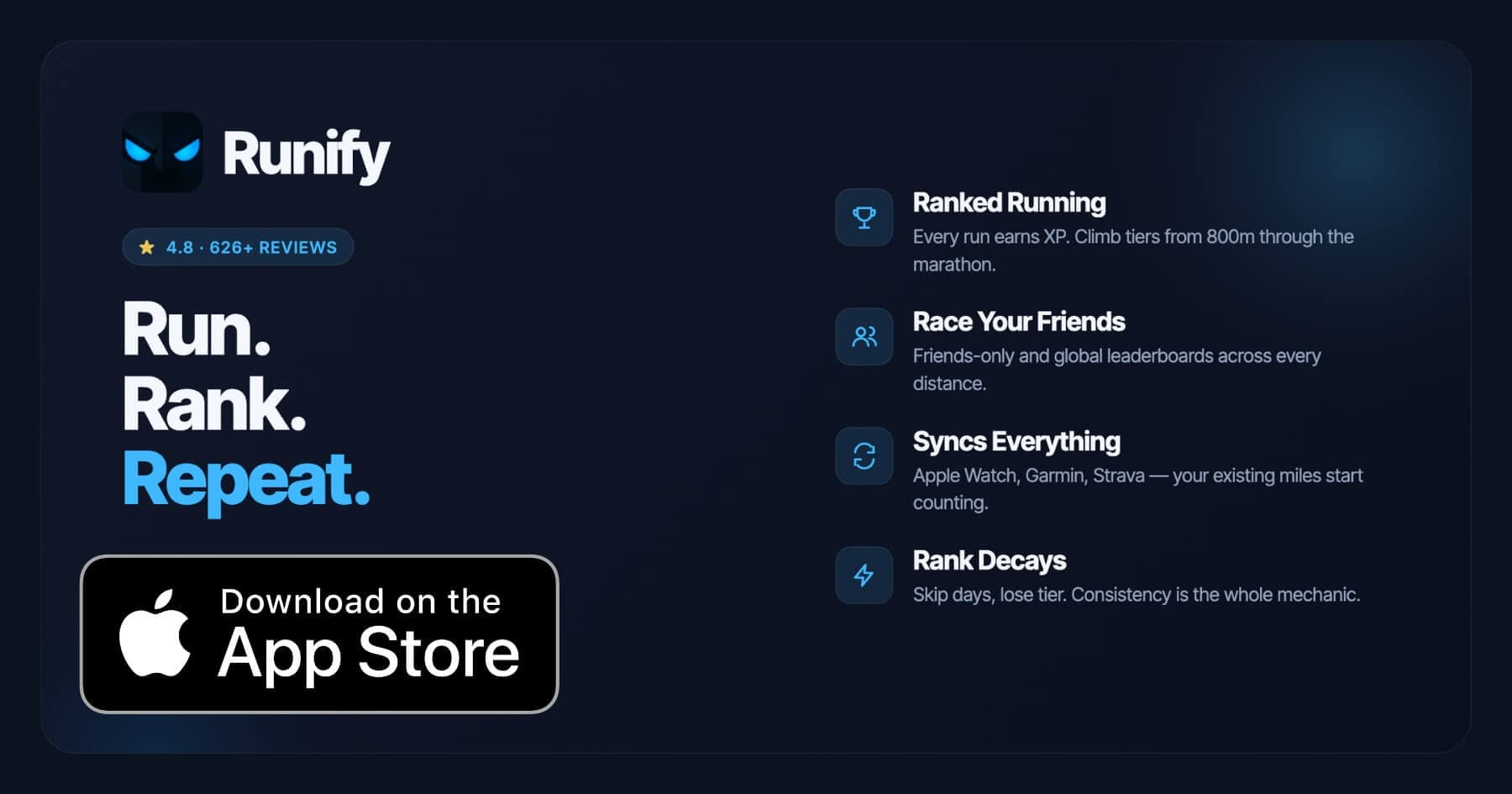
Neither the 165 nor the 265 has any way to make running feel like a competition on a leaderboard. That is where Runify comes in. Runify is an iOS app built around a ranked tier system: every run you log earns XP, moves you through competitive ranks, and places you on friends-only or global leaderboards across distances from 800m through the marathon.
Both the Forerunner 165 and 265 sync natively with Garmin Connect, and Runify connects to Garmin to pull in your runs automatically. Your existing miles count toward XP and rank progression without changing how you train or which watch you wear. Rank decay for inactivity adds accountability that no watch metric alone provides.
Runify carries a 4.8-star App Store rating from 626+ reviews. It suits runners who already track on Garmin (or Apple Watch or Strava) and want those miles to count toward a visible competitive rank. You can keep your 165 or 265 as your primary tracker and add Runify on top for the social and ranking layer.
When Runify Is the Better Pick Than Both
- You want a visible, competitive reason to keep running (XP, rank, rank decay)
- You already track on Garmin and want those miles to count toward a rank
- You care about distance-specific performance (800m through marathon) on friends and global leaderboards
- You like sharing stylized run recaps to Instagram Stories
When Runify Is Not the Right Fit
- You're on Android. Runify is iOS only today.
- You want structured training plans, pace coaching during a run, or audio-coached workouts. Runify focuses on tracking, ranking, and social competition - not coaching.
- You want route discovery or race signup features.
How to Choose Between the Forerunner 165 and 265
The decision is straightforward when you answer these questions honestly:
- Do you use training load metrics? If you already track recovery scores, HRV trends, or running power, the 265 pays for itself. If those numbers sit unread, save $200 and buy the 165.
- Are you training for a goal race? The 265's race predictor and Garmin Coach plans are built for structured marathon or half marathon prep. The 165 has guided workouts but not a full coaching ecosystem.
- Does weight matter to you? The 165 is 8 grams lighter. That sounds minor, but daily wear and long-run comfort add up, especially for runners with smaller wrists.
- How long do your runs get? Both handle most long runs fine. If you run back-to-back ultras or double marathon days, the 265's extra 5 hours of GPS battery is a meaningful safety margin.
- What is your budget ceiling? If $449 requires a trade-off elsewhere in your running budget (shoes, races, nutrition), start with the 165. It is not a compromise - it is a genuinely capable running watch.
Frequently Asked Questions
Is the Forerunner 165 or 265 better in 2026?
The 265 is the more powerful watch, but the 165 is the better value for most runners. The 265 earns its $200 premium with Training Readiness, HRV Status, running power, and race time predictors - features that matter to runners following structured plans for goal races. If you run 3-5 days a week without a specific race target, the 165 covers everything you need at $249. Both use the same GPS hardware and deliver the same tracking accuracy in real-world conditions.
Can I use both the Forerunner 165 and 265 with Strava?
Yes. Both watches sync automatically to Strava via Garmin Connect. You can set up the Garmin-Strava connection once and every run uploads within minutes of finishing. Both watches also sync to third-party apps like Runify through Garmin's data sharing system, so your miles contribute to leaderboards or other tracking apps without any manual effort.
Which is cheaper, the Forerunner 165 or 265?
The Forerunner 165 costs $249 (or $299 for the Music variant). The Forerunner 265 costs $449 (or $499 for Music). That is a $200 difference at the base level. Neither watch requires an ongoing subscription - Garmin Connect's core features are free. The gap is purely hardware: you pay more for the 265's advanced training metrics, larger display, and longer GPS battery.
Which has better GPS tracking, the Forerunner 165 or 265?
Both use Garmin's multi-band GNSS system, and real-world tracking accuracy is essentially equal. Runners comparing the two in tests on city streets, forest trails, and tracks report no meaningful difference in distance or pace readings. If GPS accuracy is your primary concern, there is no reason to choose the 265 over the 165 - the $200 premium buys training analytics, not better tracking hardware.
What is the best alternative to both the Forerunner 165 and 265?
For runners who want to add a competitive, social layer on top of their Garmin data, Runify is worth a look. Runify connects to Garmin and turns your existing runs into XP, rank progression, and leaderboard placement across distances from 800m to the marathon. It is not a replacement for either watch - it sits alongside your Garmin as a motivation and social competition layer. Runify is iOS only and focused on ranking, not coaching. It carries a 4.8-star App Store rating from 626+ reviews.
Final Verdict
The Forerunner 165 and 265 are both excellent running watches. The 165 is the right choice for everyday runners who want accurate GPS, a bright display, and health monitoring without advanced analytics or a high price tag. The 265 is the right choice for runners who are actively using training load data, HRV trends, and race predictors to guide structured preparation.
Most runners will be happier with the 165 simply because they will not use - or miss - the metrics the 265 adds. If you look at your watch data daily and adjust your training based on readiness scores, the 265 is a genuine upgrade. If you check total weekly mileage and average pace, it is not.
Whichever watch you choose, Runify works alongside it to add the one thing Garmin does not offer: a visible competitive rank that climbs with consistency and decays when you go inactive.
Ready to turn your Garmin runs into ranked competition? Try Runify on the App Store and see where your miles rank you.

4.8 on the App Store · Built for iOS