Amazfit vs Garmin: Compared in 2026
Amazfit vs Garmin: The Quick Verdict
Amazfit is the better pick for budget-conscious runners who want solid GPS tracking, long battery life, and a capable companion app without spending more than $200. Garmin is the stronger choice for serious athletes who want advanced performance metrics, adaptive training plans, and a proven ecosystem with deep Strava integration. Amazfit watches start at $78.99, with flagship models topping out around $449.99. Garmin's Forerunner and Fenix lines range from $250 to over $1,000. Both brands have loyal user bases, and neither is wrong - the right call depends on your training goals and budget. If you already own either brand's watch and want your runs to count toward competitive ranked leaderboards, Runify works with both via Garmin and Strava sync.
At a Glance: Amazfit vs Garmin
| Feature | Amazfit | Garmin |
|---|---|---|
| Best For | Budget runners wanting value | Serious athletes needing deep data |
| Pricing | $78.99 to $449.99 | $250 to $1,000+ |
| Platform | iOS + Android | iOS + Android + Web |
| Standout Feature | Long battery life at low price | Adaptive training plans via Coach |
| Main Limitation | Basic navigation, occasional app bugs | High cost; Connect+ paywall |
What Is Amazfit?
Amazfit is a smartwatch brand owned by Zepp Health, a Chinese wearables company. The brand launched in 2015 and has become one of the best-selling budget watch brands globally, with models sold in over 90 countries. The companion app is called Zepp - it replaced the older Amazfit app branding and handles all syncing, health data, and third-party integrations.
Amazfit targets runners and fitness enthusiasts who want capable hardware without the premium price tag. Recent models like the Active Max ($169.99) and Cheetah 2 Pro ($449.99) have received strong reviews from publications like Tom's Guide and Android Central, with reviewers noting competitive GPS performance for the price.
The Zepp app is fully free with every Amazfit device. No subscription is required to access core features including Zepp Coach, health tracking, and third-party integrations.
Amazfit Key Features
- Zepp Coach: Free AI-powered coaching that delivers tailored running and workout plans directly through the app.
- Dual-Band GNSS: Multi-constellation GPS with dual-band support on flagship models for improved route accuracy in urban environments.
- Health Monitoring: Continuous heart rate, HRV, stress, SpO2, sleep, and readiness tracking with an Exertion Score metric.
- Long Battery Life: Most Amazfit models offer 14-21 days in standard mode, with flagship models extending further.
- Third-Party Integrations: Syncs automatically to Strava, Apple Health, Google Fit, adidas Running, TrainingPeaks, and komoot.
Amazfit Pricing
The Zepp app is free with every Amazfit device - no subscription required. Hardware pricing ranges from $78.99 for the entry-level Bip 6 to $169.99 for the Active Max and Active 3 Premium, and up to $449.99 for the Cheetah 2 Pro launched in April 2026.
Amazfit Strengths
- Strong value proposition - hardware and app features available at a fraction of Garmin's cost
- Free Zepp Coach delivers personalized training plans without any paywall
- Long battery life across the lineup, often beating Garmin at comparable price points
Amazfit Weaknesses
- GPS accuracy lags behind Garmin, particularly on trails and hilly terrain where route tracing can drift
- The Zepp app has a history of bugs and syncing issues on Android, with fixes often delayed
- Offline maps and navigation are available but described as basic compared to Garmin's turn-by-turn routing
What Is Garmin?
Garmin is an American GPS technology company founded in 1989. Its running watches - the Forerunner, Fenix, Instinct, and Venu lines - are the default choice for serious runners, triathletes, and outdoor athletes worldwide. Garmin Connect is the companion app ecosystem, available on iOS, Android, and the web. In 2025, Garmin introduced Connect+, a paid subscription tier that layers advanced features on top of the free app.
Garmin's strength is depth. The platform offers detailed performance analytics, VO2 max estimates, training load analysis, and Garmin Coach - a free adaptive plan system for 5K, 10K, and half marathon distances. According to Strava's engineering data published in January 2026, Garmin ranks first among all connected device brands for activities uploaded to Strava.
Garmin Key Features
- Garmin Coach: Free adaptive training plans for 5K, 10K, and half marathon built into Garmin Connect - no subscription required.
- Performance Analytics: VO2 max estimates, training load, recovery advisor, and body battery across the device lineup.
- Connect+ Premium: Paid tier at $6.99/month or $69.99/year adding AI performance prompts, 3D maps, Live Activity, LiveTrack alerts, and Nutrition tracking.
- Multi-Band GPS: Premium models use multi-band GNSS with Sony or Airoha chipsets for exceptional accuracy in challenging terrain.
- Strava-First Ecosystem: Native two-way Garmin-Strava sync with an average upload time under two minutes from activity end to Strava appearance.
Garmin Pricing
Garmin Connect is free. Connect+ costs $6.99/month or $69.99/year. Hardware ranges from around $250 for the Forerunner 165 to over $1,000 for the Fenix 8 Solar. The Forerunner 265 and 965 are the most popular mid-range models for serious runners, priced around $449 and $599 respectively.
Garmin Strengths
- Industry-leading GPS and tracking accuracy across all terrain types, including multi-band performance on flagship models
- Garmin Coach provides free structured training plans that push to the watch automatically - rare at any price
- Deep data ecosystem with health metrics, training load, and recovery analytics trusted by competitive athletes
Garmin Weaknesses
- Significant cost - entry-level Garmin hardware costs more than most mid-tier Amazfit flagships
- Connect+ has drawn criticism; some reviewers note the $69.99/year tier adds features many users expected to be free
- A 2026 firmware update (version 27.09) caused heart rate tracking reliability issues on multiple Forerunner models, drawing heavy criticism on Reddit and running forums
Amazfit vs Garmin: Head-to-Head
Both brands track runs, sync data to third-party apps, and monitor daily health. Where they diverge is in accuracy depth, training intelligence, software stability, and price. Here is how they compare on the axes that matter most to runners.
Tracking Accuracy
Garmin has the edge here, particularly on trails and in GPS-challenging environments. Multi-band GPS on the Fenix 8 and Forerunner 965 consistently outperforms Amazfit in head-to-head tests, with gadgetsandwearables.com noting Amazfit watches "place users near roads they're running on rather than on them" in hilly terrain. For road and treadmill running, the gap narrows - the Amazfit Active Max showed competitive GPS performance in urban testing. If you run primarily on roads and don't need precise trail mapping, Amazfit's accuracy is usable. For off-road adventures, Garmin is more reliable.
Training Plans and Coaching
Garmin Coach is one of the strongest free training tools available on any running platform. Plans adapt to your schedule and push workouts directly to your watch. As noted in our best Garmin Coach alternatives breakdown, few competing platforms match this level of native plan integration at no cost. Amazfit's Zepp Coach also delivers free AI-generated plans, but the plans stay in the app rather than syncing as structured workouts to the watch face. Runners who want coached interval sessions delivered mid-run on their wrist will prefer Garmin.
Social and Community Features
Neither Amazfit nor Garmin leads on native social features, but Garmin has more. Garmin Connect added a follower model in 2026, activity feeds, and LiveTrack sharing. Connect+ adds exclusive badges and challenges. Amazfit's Zepp app offers basic social connectivity but relies on Strava for any meaningful community interaction. Runners who want segments, kudos, and group challenges are going to Strava regardless of which watch they own - both brands sync to it automatically.
Pricing and Value
Amazfit offers more hardware value per dollar at every price tier. The Active Max at $169.99 competes with Garmin watches costing $250-$350, and the free Zepp Coach adds coaching value without a subscription. Garmin's free tier is genuinely strong - Garmin Coach is free - but Connect+ at $69.99/year has drawn skepticism from reviewers who feel it gates features that should be standard. If budget is the primary concern, Amazfit wins. If you're willing to pay for Garmin hardware and you run seriously, the data depth justifies the cost for many athletes.
Hardware Integration
Both watches sync to Strava and Apple Health. Garmin also syncs to Garmin Connect on the web, making data accessible from any browser. Amazfit's Zepp app adds adidas Running, TrainingPeaks, komoot, and Relive to the integration list. Garmin's Strava sync is considered more reliable, with faster upload times and stronger two-way data flow. For runners who use Runify, both brands are covered - Runify accepts Garmin syncs directly and imports Strava activities automatically, so your miles count toward ranked competition regardless of which watch you wear. You can read more about setting up those connections in our Garmin Connect alternatives guide.
Platform and Availability
Both Amazfit and Garmin support iOS and Android for their companion apps. Garmin adds full web access through connect.garmin.com, allowing you to review workouts, edit training plans, and browse activity history on a desktop. Amazfit's Zepp app is mobile-only. Neither app has an offline-first mode - both require a phone connection to sync watch data. Garmin's web platform gives it an advantage for runners who do data review on a laptop.
Who Should Choose Amazfit?
Amazfit is the right choice for runners who want reliable GPS tracking and health monitoring without a high hardware or subscription cost. The Zepp Coach is genuinely free and capable.
- Runners on a tight budget who want dual-band GPS without paying $300+
- Beginners building a habit who need step tracking, heart rate, and basic run logging without complexity
- Runners who care about battery life - Amazfit consistently offers longer endurance than comparably priced Garmin models
Who Should Choose Garmin?
Garmin suits runners who are training toward specific race goals and want deep data to back their decisions. The ecosystem around Garmin Coach and Garmin Connect is mature and reliable.
- Runners training for a specific race distance who want adaptive plans pushed directly to their watch
- Trail runners and outdoor athletes who need precise GPS mapping and offline navigation in difficult terrain
- Data-driven athletes who want VO2 max estimates, training load tracking, and recovery analysis in a single platform
A Third Option: Runify for Ranked, Competitive Running
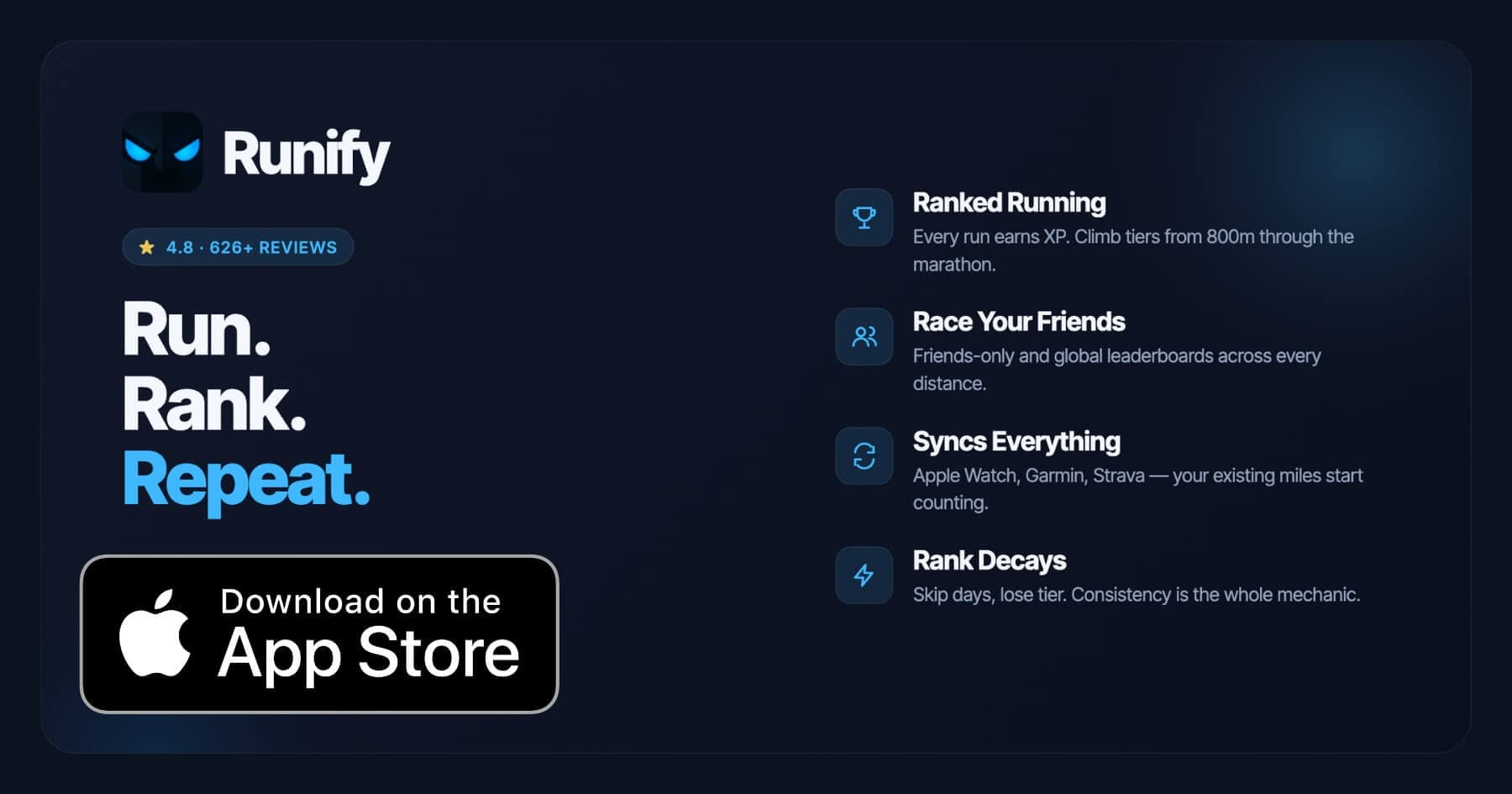
Neither Amazfit nor Garmin gives you competitive ranked running - they track your miles but don't turn those miles into something competitive you can climb. Runify does. It is the first ranked running app, built around a tier system that rewards XP for every run, shows where you stand against friends and global runners across specific distances, and decays your rank if you go inactive.
Runify works with both Amazfit and Garmin. Connect your Garmin account directly, or route Amazfit data through Strava and Runify picks it up automatically. Every run you already log on either platform counts toward your rank. You don't need to abandon your existing setup to compete. Many runners keep Garmin or Amazfit as their primary tracker and use Runify on top for the ranked layer - leaderboards across 800m, 1K, 5K, 10K, half marathon, and marathon distances on both friends-only and global boards.
Runify holds a 4.8-star App Store rating with 626+ reviews. For runners who already track on Amazfit or Garmin and want their miles to count toward something visible and competitive, it is worth a look.
When Runify Is the Better Pick Than Both
- You want a visible, competitive reason to keep running - XP, rank-up reveals, and rank decay for consistency
- You already track on Amazfit or Garmin and want those miles to count toward something beyond a personal log
- You care about leaderboard performance across specific race distances (800m through marathon) with friends and globally
- You like sharing stylized run recaps directly to Instagram Stories
When Runify Is Not the Right Fit
- You're on Android. Runify is iOS only today.
- You want structured training plans, pace coaching during a run, or audio-coached workouts. Runify focuses on ranking, social competition, and tracking - not coaching.
- You want route discovery or race event signup features.
How to Choose Between Amazfit and Garmin
The right choice depends on what you need most from your running setup. Here are the key decision factors:
- Budget: If you're spending under $200, Amazfit offers hardware that Garmin simply cannot match at that price point. If you're comfortable at $300-$600 and training seriously, Garmin's data depth starts to pay off.
- Training plans: If you want adaptive coaching plans delivered as structured workouts directly to your watch, Garmin Coach is the best free option on the market. Zepp Coach is capable but stays on your phone rather than syncing sessions to the wrist.
- GPS accuracy needs: Road runners in cities will find Amazfit's GPS accuracy acceptable. Trail runners and anyone navigating complex terrain should go with Garmin's multi-band performance.
- Platform ecosystem: If you rely on web-based data review, race analysis, or advanced analytics dashboards, Garmin's full-web access through Garmin Connect gives it a meaningful advantage over Amazfit's mobile-only setup.
- App reliability: Garmin's software has had its own issues, but the Zepp app has a documented history of Android syncing bugs that take longer to patch. If app stability matters to you, Garmin has a more consistent track record.
Frequently Asked Questions
Is Amazfit or Garmin better in 2026?
Garmin is better for serious runners who need adaptive training plans, high-precision GPS, and deep performance analytics. Amazfit is better for budget-conscious runners who want solid GPS tracking and health monitoring without spending over $200 on hardware or paying a subscription. Both sync to Strava automatically. If your primary concern is accuracy and structured coaching, choose Garmin. If you want capable running features at a lower price with long battery life, Amazfit delivers strong value in 2026.
Can I use Amazfit and Garmin together?
You cannot wear both watches at the same time, but you can use both apps simultaneously by syncing both to Strava. Strava acts as a central hub. Each watch uploads its activities to its native app, which then syncs to Strava. From Strava, data flows to other connected apps. Runify, for example, imports from Garmin directly and from Strava for Amazfit users - so runners who switch between devices or upgrade from Amazfit to Garmin mid-year can keep their history intact.
Which is cheaper, Amazfit or Garmin?
Amazfit is significantly cheaper. Hardware starts at $78.99 for the Bip 6, with flagship running models like the Active Max and Active 3 Premium at $169.99, and the top-end Cheetah 2 Pro at $449.99. The Zepp app is free with no subscription tier. Garmin hardware starts around $250 and reaches over $1,000 for the Fenix 8 Solar. Garmin Connect is free, but Connect+ costs $6.99/month or $69.99/year for premium features. At every comparable price point, Amazfit delivers more hardware for the money.
Which has better tracking accuracy, Amazfit or Garmin?
Garmin has better tracking accuracy overall, especially in GPS-challenging environments. Multi-band GPS on Garmin's Fenix and Forerunner 900 series consistently outperforms Amazfit in trail and hill testing. Amazfit's dual-band GNSS on flagship models has closed the gap significantly for road running in urban environments - the Active Max performed competitively in city tests. For everyday road running, the accuracy difference is small. For technical trail navigation or situations where route precision matters, Garmin's hardware and mapping remain the benchmark.
What is the best alternative to both Amazfit and Garmin?
For runners who want to add ranked, competitive leaderboards to their existing tracking, Runify is worth considering as a companion app. It imports directly from Garmin and via Strava for Amazfit devices, so your existing miles count toward a tier system and distance-specific leaderboards (800m through marathon). It is not a tracking replacement - it sits on top of what you already use. Runify holds a 4.8-star App Store rating with 626+ reviews, and is available on iOS only. For a full alternative hardware comparison, other running watch brands worth exploring include Polar, Coros, and Suunto.
Final Verdict
Amazfit and Garmin both make strong cases depending on what you need from a running watch. Amazfit wins on value: free coaching, capable GPS, long battery life, and hardware that punches above its price. Garmin wins on depth: precision GPS, structured adaptive training plans pushed to the watch, and a mature data ecosystem trusted by competitive athletes worldwide.
If you're building a running habit on a budget, Amazfit gives you everything you need without the premium cost. If you're training toward a race goal and want data-backed coaching on your wrist, Garmin's investment pays off over time. And if you're looking for a way to make your runs feel competitive regardless of which watch you wear, Runify layers ranked progression on top of either platform - your miles, your rank.
Ready to make your runs count toward something? Download Runify on the App Store and connect your Garmin or Strava account to start climbing the ranks.

4.8 on the App Store · Built for iOS