First Race Experience Statistics 2026
First Race Experience Statistics 2026
53% of Great Run event participants were first-timers in 2024, a 13% increase over 2023. Up to 78% of runners experience significant pre-race anxiety regardless of experience level. New runners are more likely to prefer 5Ks and 10Ks (38.1%) over longer distances, and they show higher intent to increase race participation in the following year (71.3%) compared to experienced runners (60.1%). These 15 statistics reveal what the first race experience actually looks like for new runners entering the sport.
Crossing a finish line for the first time is one of running's defining experiences. The data around it tells a clear story: first-time race participants are arriving in bigger numbers than ever, they bring high motivation to return, and the anxiety they feel before the gun is nearly universal. Understanding these patterns helps both new runners and the sport as a whole.
These numbers draw from Running USA's Global Runner Survey, RunSignup's annual RaceTrends reports, the Running Industry Alliance's Great Run data, and peer-reviewed sports psychology research.
1. 53% of Great Run Participants Were First-Timers in 2024
The Great Run Company, which hosts mass-participation events from 5Ks to half marathons across the UK, reported that 53% of its 2024 participants were racing for the first time. That share represented a 13% increase over 2023. The broader trend behind this number: overall running event popularity grew 39% year-over-year for the Great Run series, fueled significantly by Gen Z runners entering organized racing. First-timers are not a minor segment of the racing population. At events designed to be accessible, they are the majority.
Source: Running Industry Alliance - Great Run: Popularity of Running Up 39% Year on Year
2. Up to 78% of Runners Experience Significant Pre-Race Anxiety
Research on running performance consistently finds that up to 78% of runners experience notable pre-race anxiety before a race. This is not a problem unique to first-timers - it applies across experience levels. The anxiety itself is often a signal of investment: you trained for months for something that matters, and your nervous system is responding. Sports psychology research distinguishes between cognitive anxiety (self-doubt, catastrophic thinking) and somatic anxiety (tight chest, stomach nerves). First-race runners typically experience both simultaneously. The important finding is that moderate anxiety can actually improve performance, while high anxiety consistently impairs it.
Source: Runners Connect - Beat Pre Race Anxiety: The Runner's Guide to Managing Performance Nerves
3. New Runners Prefer 5Ks and 10Ks at 38.1%
Running USA's Global Runner Survey found that new runners and those who started running since 2000 prefer 5Ks and 10Ks at a rate of 38.1%, compared to 30.8% among experienced runners. The 5K is effectively the entry-level race distance for the sport. It requires minimal equipment, takes under an hour for most participants, and presents a finish line that feels achievable even for runners with only a few weeks of training. The growth of the 5K as a first-race distance has made organized running significantly more accessible to people who would never attempt a half marathon as a first event.
Source: Running USA - 2025 Global Runner Survey Findings
4. New Runners Plan to Race More in the Following Year at 71.3%
Among new runners and recent race participants, 71.3% said they planned to increase their race participation in the following year. That compares to 60.1% among experienced runners, who are more likely to maintain their current race volume rather than increase it. First-race participation appears to generate strong intent to continue. The first finish line creates a reference experience that most runners want to repeat. This data suggests that first-time race participants are not a transient cohort - they have high conversion potential to multi-year racing.
Source: Running USA - 2025 Global Runner Survey Findings
5. The Median First-Time 5K Finish Time is 30-40 Minutes
For runners completing their first 5K after a structured beginner program like Couch to 5K, finishing between 30 and 40 minutes is the typical range. The overall median 5K finish time in 2024 was approximately 36:00, with a 32:00 median for men and 39:00 for women across all race participants. Most first-timers land in this range or slightly slower. Knowing this matters because many new runners overestimate how fast they "should" run and go out too hard in the opening mile, leading to an unnecessarily difficult finish. A first race is about crossing the line, not the clock.
Source: Marathon Handbook - What Is A Good 5K Time?
6. 37.9% of Runners Name the Half Marathon as Their Favorite Distance
In Running USA's 2025 Global Runner Survey of more than 12,700 runners, 37.9% named the half marathon as their favorite race distance. The half marathon is the aspirational "next race" for most first-time 5K finishers. It requires meaningful training commitment but remains achievable without the life disruption of marathon prep. Many runners follow a trajectory from first 5K to first 10K to first half marathon within two to three years. Understanding that a first race is typically the beginning of a longer progression - not a one-time event - shifts how new runners should think about their first start line.
Source: Running USA - 2025 Global Runner Survey Findings
7. Only 17% of Runners Repeat the Same Event Year Over Year
RunSignup's 2024 RaceTrends data shows that just 17% of participants return to run the same specific race in the following year. For marathons, the repeat rate drops to 12%. This does not mean runners quit after their first race. It means most runners diversify their race calendar rather than repeating the same event annually. First-time race participants are more likely to try different events, different distances, and different courses in subsequent years. Race loyalty is lower than the industry historically assumed, which reflects a running population that is actively exploring the race calendar rather than settling into annual routines.
Source: RunSignup - The State of the Industry: 2024 RaceTrends Report
8. Reframing Anxiety as Excitement Improves First-Race Performance
Sports psychology research found that saying "I am excited" before a high-pressure performance event led to measurably better outcomes than trying to stay calm. The physiological states of anxiety and excitement are nearly identical - elevated heart rate, heightened arousal, increased cortisol - but the cognitive framing changes how athletes respond to them. For first-time race runners, this finding has direct practical value. Pre-race nerves are not a warning sign that something is wrong. They are energy that can be directed toward performance. The research suggests first-timers should lean into their excitement rather than try to suppress it.
Source: Training Peaks - How to Channel Pre-Race Anxiety
9. 47% of Great Run First-Timers Were Aged 35 and Under
Among Great Run 2024 participants, 47% were aged 35 and under, and 46% were female, up 2% year over year. These demographics directly reflect who is entering organized running as a first-time racer. Younger runners and women are driving first-race participation growth. Run crews and social running groups have been particularly influential, with research noting that group dynamics helped novice runners extend their distances and feel safer participating in organized events. First-race participation is increasingly a social experience driven by peers, not a solitary personal achievement.
Source: Running Industry Alliance - Great Run: Popularity of Running Up 39% Year on Year
10. Location and Course Are the Top Factors in Race Selection
Running USA's 2025 Global Runner Survey found that the most important factors runners use to choose a racing event are location, preferred distance, and a desirable course (fast or scenic), followed by cost and having friends or family participating. For first-time race participants, location is especially decisive. Most choose their first race close to home to reduce logistical complexity. A local 5K that a friend recommended beats a destination race on paper every time for a first-timer. This finding has implications for the race industry: accessible local events matter more to first-time participant acquisition than premium destination experiences.
Source: Running USA - 2025 Global Runner Survey Findings
11. 72% of Logged Run Goals Were Achieved in 2024
Strava's 2024 Year in Sport data found that 72% of logged run goals were met across its user base. The connection to first-race experience: having a specific race target - even a modest one like completing a 5K - dramatically increases goal-setting behavior and the likelihood of following through. Runners without a race on the calendar are more likely to drift through weeks without structured training. A first race gives new runners a concrete external deadline that drives consistency in ways that vague fitness intentions do not. The finish line exists before the race starts.
Source: Strava - 2024 Year in Sport Trend Report
12. Running Club Participation Grew 59% in 2024
Strava's global data recorded a 59% increase in running club participation in 2024. Group runs average 40% longer in duration than solo runs with more than 10 participants. For first-time race participants, this matters because most enter organized racing through a social pathway - a friend who signed them up, a run group training for an event, a coworker who did the same race last year. The growth of running clubs is directly feeding first-race pipelines. New runners who train with groups are more likely to show up on race day and more likely to sign up for a second event.
Source: Strava - 2024 Year in Sport Trend Report
13. Global Road Race Finishers Rose 17.1% in 2024
A survey of 600 established road races across 44 countries recorded 4,668,261 finishers in 2024, a 17.1% year-over-year jump. Half marathon finishers climbed 20.9% to 1,513,531 across 190 races. This broad growth creates a larger first-race opportunity every year. More races, more finishers, and a population of experienced runners who can pull friends and colleagues toward their first start line. The running race ecosystem is expanding, not contracting, which means the conditions for first-race experiences are better today than at any point in the sport's history.
Source: Road Race Management - Global Road Running Finishers Up 17% in 2024
14. 95.6% of Runners Self-Identify as Runners or Joggers
Running USA's 2025 survey found that 95.6% of respondents classify themselves as runners or joggers, with 53.3% identifying specifically as frequent or fitness runners. Only a small fraction identify primarily as competitive racers. This matters for first-race design: the overwhelming majority of people at a start line think of themselves as runners, not racers. First-time race participants want the experience of completing a distance, not a competition result. Events that emphasize participation, completion, and community over pace and placing consistently attract more first-timers and higher return rates.
Source: Running USA - 2025 Global Runner Survey Findings
15. The Half Marathon See-Again Rate Dropped from 19.7% in 2019 to 13.7% in 2024
Among first-time half marathon participants, the repeat participation rate for the same event fell from 19.7% in 2019 to 13.7% in 2024. This declining same-race loyalty rate reflects how race-hungry new runners have become: they are completing their first half marathon and immediately looking for the next different event, not returning to the same course. For race directors, this means the pipeline of new participants matters more than retaining repeaters. For first-time runners, this data validates trying new events rather than locking into one race annually.
Source: RunSignup - The State of the Industry: 2024 RaceTrends Report
What These Numbers Tell Runners
First-race participation is surging and the data shows why: new runners enter with high intent to continue, social dynamics are pulling more people toward organized events, and the anxiety most first-timers feel is near-universal rather than a personal weakness. The 78% pre-race anxiety figure is arguably the most important stat here. It tells every first-time runner that what they feel on race morning is what nearly everyone feels, including people who have run 50 races.
The distance preference data points to a clear on-ramp structure. Most new runners start with a 5K, progress to a 10K, and set a half marathon as their medium-term aspiration. This progression takes one to three years for most runners, and each race along the way reinforces the habit of showing up. As detailed in our couch-to-5K statistics, the structured beginner pipeline from first run to first race has become one of the most reliable pathways into lifelong running.
The 71.3% of new runners who plan to increase race participation next year represents the sport's clearest growth indicator. First races create runners. And runners create more races. That upward trajectory is consistent with the broader motivation data covered in our running motivation statistics, where external goals like race registration consistently rank as top drivers of training consistency.
The first finish line is less an endpoint and more the beginning of a race career that, for most runners, spans decades.
Build the Habit After the First Race
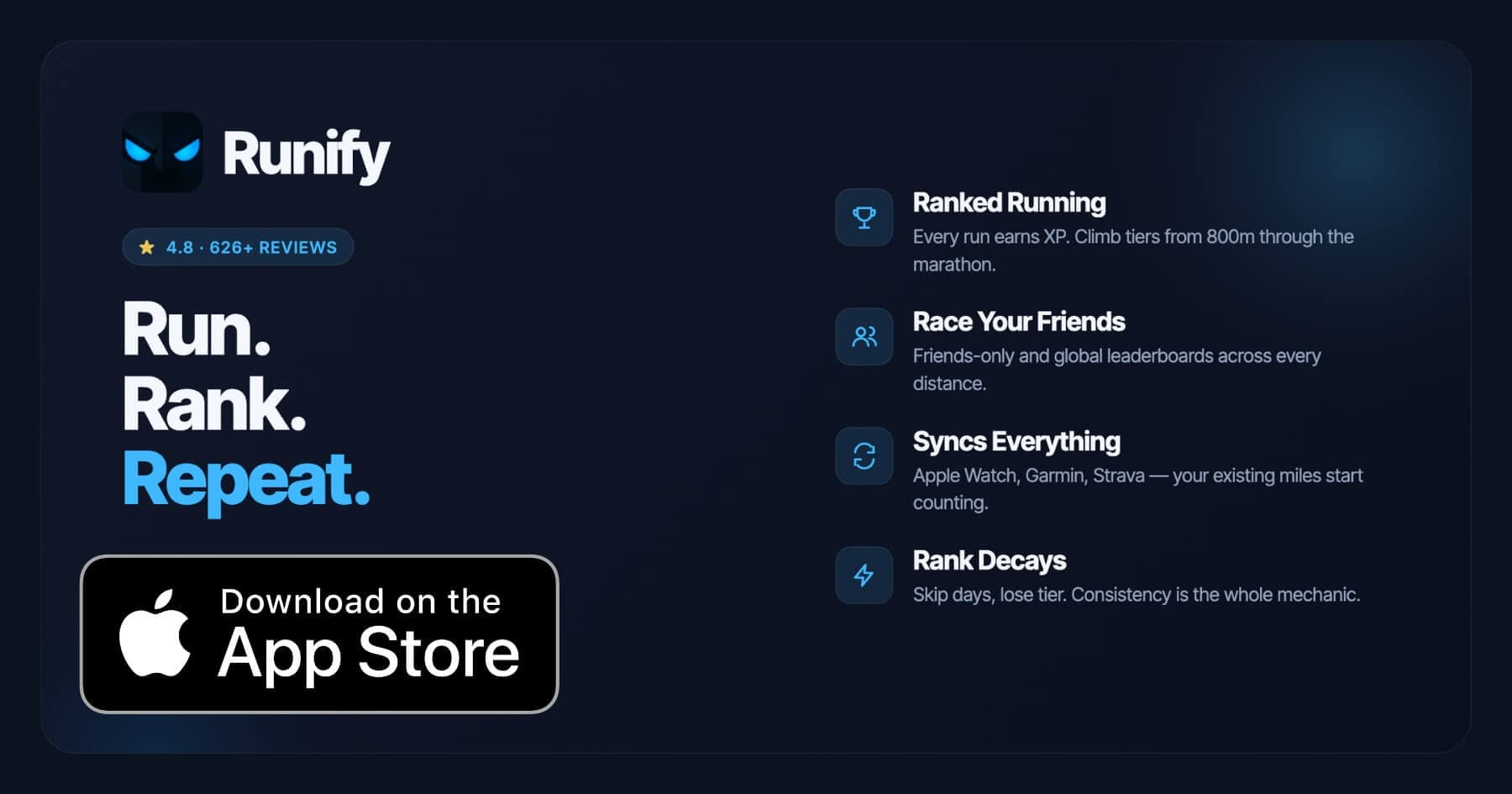
The hardest part of the first race is not the distance. It is staying motivated between races. Runify gives every logged run a visible purpose: XP, rank, and leaderboard position across distances from 800m through the marathon. Syncs directly from Apple Watch, Garmin, or Strava, so the miles you run before your next race all count toward your progression.
The runners who show up to their second race stronger than their first are typically the ones who kept training with something to show for it. Runify makes that visible.
Ready to make your training count between races? Download Runify on the App Store and turn every mile into XP across leaderboards from 800m through the marathon.
4.8 stars on the App Store, 626+ reviews worldwide.
Download Runify on the App Store

4.8 on the App Store · Built for iOS