Couch to 5K Statistics 2026
Couch to 5K Statistics 2026
The NHS Couch to 5K app recorded 8.7 million completed runs in 2024 - a new record. But 64.5% of participants quit before finishing the program, and most drop out before the halfway point. 790,000 people downloaded the NHS version in 2024 alone, representing the app's highest-ever single-year download count. These 16 statistics reveal the real performance data behind one of the world's most popular beginner running programs - who starts, who finishes, and what determines success.
Couch to 5K is a structured 9-week running program designed to take someone from no running background to completing a 5K. The concept was developed by Josh Clark in the late 1990s and later adopted by the NHS in the UK, which turned it into one of the most-downloaded government health apps in history. The program uses intervals - alternating running and walking periods that gradually shift toward continuous running - to build fitness without overwhelming beginners.
The data below draws from NHS Digital reporting, peer-reviewed research published in PMC, the British Journal of Sports Medicine, and academic studies from the UK and Ireland examining who participates and what predicts success.
1. The NHS C25K App Completed 8.7 Million Runs in 2024
Record numbers completed NHS Couch to 5K runs in 2024, with 8.7 million runs completed throughout the year - the highest annual count since the app's launch in 2016. This milestone was announced by the UK Department of Health and Social Care in late 2024 and represents a substantial increase from previous years. The 8.7 million figure counts completed individual workout sessions within the app, not unique program completions. The record total reflects both the app's growing user base and the broader trend of increased public interest in running following the pandemic period.
Source: GOV.UK - Record Numbers Complete NHS Couch to 5K App
2. 790,000 People Downloaded the NHS C25K App in 2024
790,000 people downloaded the NHS Couch to 5K app in 2024 alone - the highest single-year download count since launch. With 9.3 million runs started that year and 8.7 million completed, the completion rate per started run was approximately 94%, meaning most people who began a session finished it. The challenge lies in sustained program adherence across all 9 weeks, not single-session completion. The 790,000 new downloads in 2024 are a significant public health number, representing three-quarters of a million people attempting to start running in a single year.
Source: GOV.UK - Record Numbers Complete NHS Couch to 5K App
3. The NHS App Has Reached 7 Million+ Total Downloads Since 2016
The NHS Couch to 5K app has accumulated more than 7 million total downloads since launching in 2016, making it one of the most-downloaded government health applications in the UK. The app was developed in partnership with the BBC and features celebrity coaches who provide audio encouragement during workouts. The 7 million download milestone represents a substantial share of the UK adult population - approximately one in seven UK adults between 16 and 65 has downloaded the app. Not all downloads convert to program starts, but the reach is significant.
Source: Melton Sport and Health Alliance - Record Numbers Complete NHS Couch to 5K App
4. 64.5% of Participants Drop Out Before Finishing Couch to 5K
Research on Couch to 5K program completion found that 64.5% of participants do not finish - the majority dropping out before reaching the halfway point of the 9-week program. A separate peer-reviewed study reported that only 27.3% of program starters completed the full Couch to 5K plan. The dropout rate is not unique to C25K: it reflects the universal challenge of habit formation in new exercise behaviors. The first three weeks - when running intervals are short but the novelty has worn off - appear to be the highest-risk period for dropout.
Source: PMC - Couch-to-5K: Who Takes Part and Is Non-Completion Linked to Injury?
5. Injury Is the Primary Stated Reason for C25K Non-Completion
The PMC study on Couch to 5K non-completion found that musculoskeletal injury was the primary stated reason for dropping out. The total injury incidence rate among C25K participants was 19% (0.19 injuries per runner). Ankle, knee, and lower leg injuries were most common and occurred most frequently in runners who progressed through the program faster than recommended or who ran on consecutive days. The injury rate is notably higher than in experienced recreational runners because beginners have not yet developed the connective tissue strength that absorbs running load.
Source: PMC - Couch-to-5K: Who Takes Part and Is Non-Completion Linked to Injury?
6. May Is the Most Popular Month for C25K Runs
NHS app data shows that May is the most popular time of year for Couch to 5K activity, with more than 1 million runs completed in May 2024. November was the least popular month with approximately 500,000 runs. This seasonal pattern aligns with general running behavior - spring weather and daylight motivate new runners to start, while late autumn and winter cause dropout. The January new-year spike seen in gym memberships appears to be smaller for running than for indoor fitness, with the spring window being the primary recruitment period.
Source: GOV.UK - Record Numbers Complete NHS Couch to 5K App
7. C25K Graduates Who Join Parkrun Are 1.5x More Likely to Increase Activity
Research linking Couch to 5K graduates to parkrun found that C25K completers who subsequently joined parkrun were 1.5 times more likely to increase their physical activity level than to decrease it. 33.7% increased their activity category after joining parkrun, while 22.5% decreased and 43.8% stayed the same. This data confirms that the immediate post-C25K period is critical: graduates who connect with a structured community like parkrun maintain and build on their new fitness, while those without a next goal tend to plateau or regress.
Source: PMC - How Can UK Public Health Initiatives Support Each Other: C25K to Parkrun
8. The C25K Program Uses a 3-Run-Per-Week Structure Over 9 Weeks
The standard Couch to 5K program involves three runs per week for nine weeks - a total of 27 workout sessions. Week one begins with 60-second running intervals separated by 90-second walks. By week nine, participants are running continuously for 30 minutes. The gradual progression is designed to allow connective tissue adaptation alongside cardiovascular improvement. The 9-week timeline aligns with habit formation research: 66 days (approximately 9-10 weeks) is the average time for a new behavior to become automatic, according to Lally et al.'s landmark 2010 study in the European Journal of Social Psychology.
Source: NHS - Couch to 5K Running Plan
9. 42% of C25K Participants Are Classified as "Reluctant Runners"
Survey research on beginner runners found that 42% of beginners - a profile consistent with C25K participants - were classified as "Reluctant Runners": characterized by few social contexts for running and a primary focus on physical health outcomes rather than performance or enjoyment. This group has the highest dropout risk because their motivation is instrumental (weight management, health improvement) rather than intrinsic (enjoyment of running itself). Research shows that helping reluctant runners find a "meaningful reason" - one tied to personal identity, values, or relationships - dramatically improves long-term adherence.
Source: PMC - What Encourages Physically Inactive People to Start Running?
10. Beginner Runners Have a 2.3x Higher Injury Rate Than Experienced Runners
Peer-reviewed research in PMC found that novice runners sustain 17.8 injuries per 1,000 hours of running - 2.3 times the rate of 7.7 per 1,000 hours recorded in recreational runners. The elevated beginner injury rate reflects underdeveloped connective tissue rather than cardiovascular inadequacy: most new runners can aerobically handle the pace of C25K long before their tendons and muscles can. This mismatch between perceived fitness and structural readiness is why the program's slow progression schedule is not conservative - it is biomechanically necessary.
Source: PMC - Incidence of Running-Related Injuries Per 1000h in Different Types of Runners
11. Beyond C25K Content Was Added to the NHS App After User Demand
Following significant user demand, the NHS added "Beyond Couch to 5K" graduation content to the app - workouts designed to help graduates continue running and build the habit past the 9-week program. This extension acknowledges a structural gap in the original program: C25K graduates who finish the plan have no built-in next step and face a sharp drop in structured guidance. The graduation content bridges the gap between beginner program completion and independent runner, addressing the dropout risk that occurs immediately after finishing the 9 weeks.
Source: GOV.UK - Record Numbers Complete NHS Couch to 5K App
12. C25K Success Rates Are Higher in Group or Supported Settings
Research comparing solo C25K participation to group-supported versions found that group settings - whether in-person running groups, online communities, or app-based social features - significantly improved program completion rates. The accountability provided by others who know you are doing the program reduces dropout during the high-risk weeks 3-5, when the novelty has faded but the habit has not yet formed. This finding aligns with the broader running club research showing that social accountability is among the most powerful drivers of exercise adherence.
Source: ScienceDirect - How Do New Runners Maintain Their Running?
13. Gradual Mileage Increase Is the Primary Risk Factor for C25K Injuries
The JOSPT (Journal of Orthopaedic and Sports Physical Therapy) research on running injury found that excessive weekly mileage progression is a primary risk factor - specifically, increasing weekly distance by more than 10% is associated with elevated injury risk. C25K's structure controls this risk through the interval format, but runners who double up on sessions (running more frequently than three times per week) or who supplement C25K with additional walking or gym work on rest days sometimes exceed the program's intended adaptation rate. Rest days are not optional in the program design.
Source: JOSPT - Excessive Progression in Weekly Running Distance and Risk of Injury
14. Interest in Starting Running Among Brits Rose to 18% in 2025
Interest in starting running among non-runners in the UK rose from 8% in 2023 to 13% in 2024 and 18% in 2025 - more than doubling in two years. 6% of Brits who don't already run said they wanted to start in 2026, equating to approximately 4.6 million people. This growing intent-to-start pool is a large potential audience for programs like Couch to 5K. The fact that interest is rising suggests the post-pandemic running wave has not fully dissipated and that C25K will continue to see strong demand through the late 2020s.
Source: SportsShoes - Running Report: Running Statistics 2026
15. Most C25K Completers Run Their First 5K in 35-45 Minutes
Typical Couch to 5K graduates who complete their first 5K after the program finish in 35-45 minutes for women and 30-38 minutes for men. These times reflect the program's focus on continuous running at a comfortable pace rather than speed. Most C25K programs aim to get participants running for 30 continuous minutes, which may or may not cover a full 5K depending on pace. Runners who want to specifically hit the 5K distance target sometimes need to run a bit faster than their training pace in week 9 to cover 3.1 miles in 30 minutes.
Source: Healthline - Average 5K Time by Age, Sex, and Tips to Get Faster
16. C25K Programs Are the Leading First-Race Prep Tool in the UK
Research data and NHS statistics confirm that Couch to 5K - particularly the NHS app version - is the single most commonly used first-race preparation tool in the UK. It sits at the top of search results for "how to start running" and is the recommended starting point from NHS GPs, physiotherapists, and public health bodies. Its ubiquity means that a substantial portion of UK 5K field starters have used some version of C25K to train. This population dominates the 30-45 minute beginner finish time range documented in our parkrun statistics and 5K race statistics.
Source: NHS - Get Running with Couch to 5K
What These Numbers Tell C25K Runners
The most important number in Couch to 5K statistics is the 64.5% dropout rate. Most people who start do not finish. But the inverse is also true: over a third of starters do complete the program, and those who do are disproportionately likely to continue running long-term. The data on C25K graduates who join parkrun is particularly encouraging - 1.5 times more increase their activity than decrease it. The program does not just create 5K finishers; it creates ongoing runners.
The injury data should be read as a caution against rushing the process. The beginner injury rate is 2.3 times higher than for experienced runners not because beginners are weaker, but because the load is new. Following the three-run-per-week schedule - including the rest days - is the single most protective thing a C25K starter can do.
The growing interest numbers are encouraging for the future of the program. With 18% of non-runners in the UK now expressing interest in starting and 790,000 NHS app downloads in a single year, C25K's pipeline of new starters is as full as it has ever been.
C25K's 64.5% dropout rate is the challenge; the 35.5% who finish represent millions of runners who would not otherwise have started - and the data shows they tend to keep going.
Give Your C25K Journey a Rank
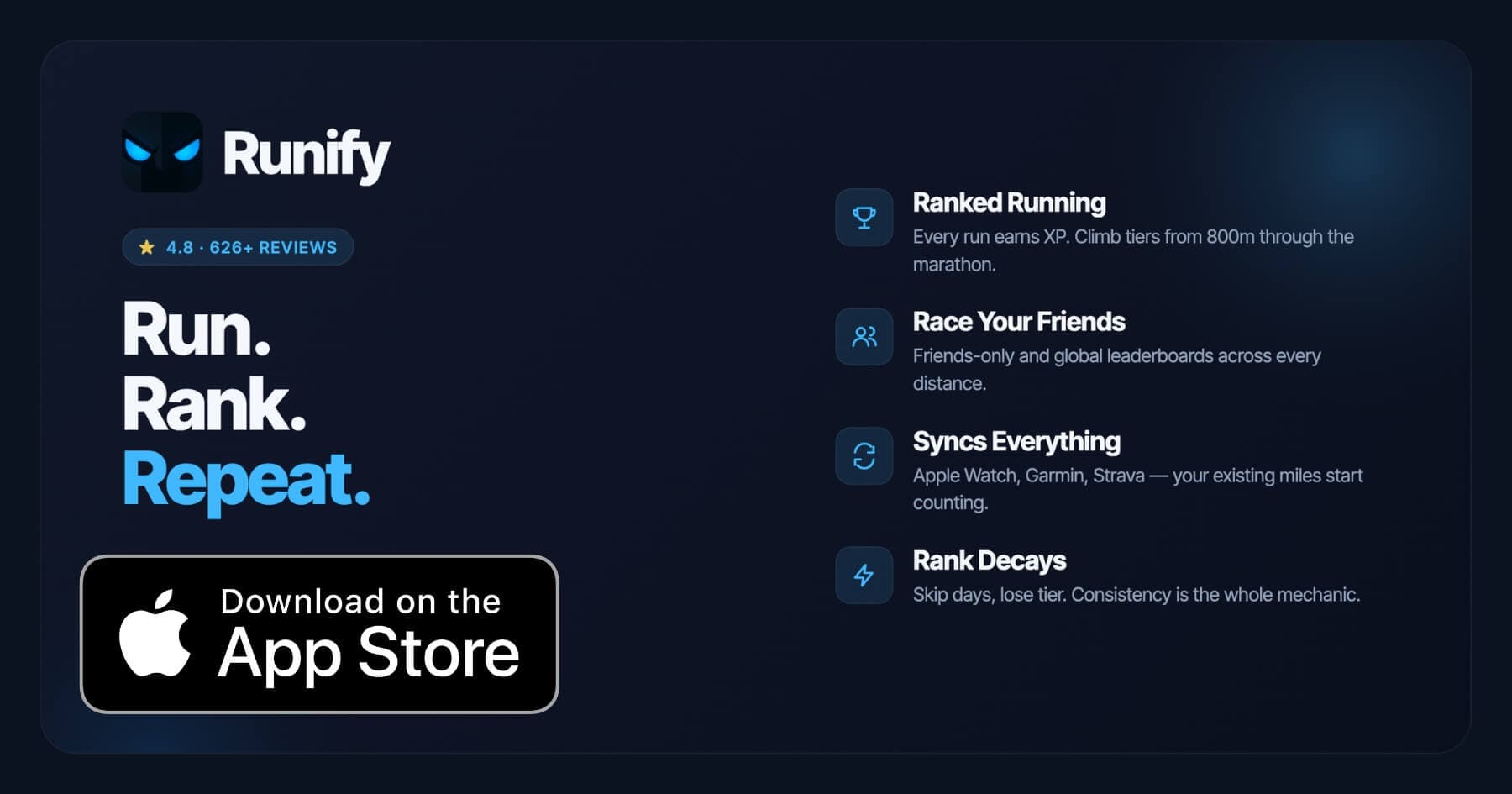
Once you finish Couch to 5K, the question is: what next? Runify gives your new running habit a competitive context from day one. Every run you log earns XP and moves you through a ranked tier system - whether you are still doing walk/run intervals or you have graduated to continuous 5Ks. Sync from Apple Watch, Garmin, or Strava or log directly in the app.
The ranked leaderboards across 5K and other distances give every run a number that means something beyond the clock. For runners in those critical weeks after finishing C25K, that visible progress is exactly the kind of motivation that turns a 9-week program into a lifelong habit.
Ready to make your runs count? Download Runify on the App Store and turn every mile into XP across leaderboards from 800m through the marathon.
4.8 stars on the App Store, 626+ reviews worldwide.
Download Runify on the App Store

4.8 on the App Store · Built for iOS