Best Running Apps for Ultra Training 2026
Best Running Apps for Ultra Training 2026
You signed up for your first 50K. Or maybe you're six weeks out from a 100-miler and you need to know your fueling windows, manage cutoff times at aid stations, and log 20-hour training weeks without your phone dying mid-run. The apps built for 5K and marathon prep weren't designed for this. Ultra training demands long-battery GPS, offline navigation, structured multi-week plans from coaches who actually know what back-to-back long runs feel like, and a community of runners who don't think 30 miles is "a lot."
We researched and compared the top options across plan quality, GPS endurance, route navigation, hydration/fueling tools, and community. Here are the 6 best apps for ultra training in 2026.
The best apps for ultramarathon training in 2026 are: 1) TrainingPeaks for coached ultra plans with TSS and PMC tracking, 2) Garmin Connect for long-battery GPS and on-watch course planning with aid station alerts, 3) Runna for structured week-by-week ultra plans with strength and recovery, 4) Strava for trail segment competition and the largest ultra running community, 5) Final Surge for affordable coached ultra plans and HRV readiness, and 6) Runify for logging and ranking every training run from your Apple Watch, Garmin, or Strava. The separation at the top comes from plan depth and GPS endurance - ultra runners need more than a mileage log.
1. TrainingPeaks - Best for Coached Ultra Plans
TrainingPeaks is the platform most serious ultra coaches use to deliver training. The marketplace lists hundreds of ultra-specific plans - 50K, 50-mile, 100K, and 100-mile - written by coaches with finisher credentials. The Performance Management Chart (PMC) tracks your Training Stress Score and fitness curve across a full build cycle, which matters when you're periodizing 18-20 weeks for a 100-miler.
Why TrainingPeaks Stands Out
The PMC is the clearest picture of whether your body is adapting or breaking down. Ultra training requires sustained load over months, and the TSS-based fitness tracking gives you a number to defend your taper to a skeptical training partner. Structured workouts sync directly to Garmin, Apple Watch, and most major GPS devices - you see the workout on your wrist.
The plan marketplace is genuinely deep. You can filter by race distance, weekly mileage cap, back-to-back long run structure, and coach credentials. Many plans include strength and recovery guidance alongside the running.
Key Features
- Performance Management Chart: Tracks fitness (CTL), fatigue (ATL), and form (TSB) in one view. Designed for multi-month ultra build cycles.
- Ultra Plan Marketplace: Hundreds of 50K, 50mi, 100K, and 100mi plans from credentialed coaches. Average plan $20-$80 one-time purchase.
- Structured Workout Sync: Pushes workouts to Garmin, Apple Watch, Wahoo, and most GPS devices.
- Nutrition and Fueling Notes: Coaches can annotate plans with fueling windows and race-day hydration targets.
- iOS App: Full calendar view, workout execution, and post-run analysis on iPhone.
Pricing
Free tier: basic logging and 1-week calendar view. Premium: $19.99/month or $119.99/year. Individual ultra training plans sold separately - typically $20-$80 one-time.
Best For
- Runners working with a coach or buying a coach-designed ultra plan
- Data-focused athletes who track TSS, CTL, and PMC curves
- Garmin or Apple Watch users who want structured workouts pushed to their device
Limitations
- Premium subscription cost stacks on top of plan purchase cost
- Interface is dense - new users need a few weeks to understand the PMC
- No offline maps or route navigation
2. Garmin Connect - Best for Long-Battery GPS and On-Watch Course Planning
Garmin Connect is the companion app for Garmin watches, and those watches are the default choice for ultra runners for one reason: battery life. The Garmin Fenix 7X Pro Solar runs 37+ hours in GPS mode. The Enduro 3 stretches to 120 hours. When your race takes 24-30 hours, battery anxiety is a real race factor - not an inconvenience.
Key Features
- Course Planner with Aid Station Alerts: Build your race course in Garmin Connect with checkpoints, cutoff times, and rest plans. The watch displays a countdown timer at each aid station and fires a cutoff alert 10 minutes before each checkpoint. A printed aid station card you no longer need to carry.
- Training Plans on Watch: Garmin's tiered plans (Beginner, Challenger, Achiever) cover up to ultramarathon distances and sync directly to your watch as structured workouts.
- Garmin Connect+: The optional upgrade ($6.99/month or $69.99/year) adds HRV Status, Training Readiness, and advanced recovery metrics.
- Body Battery and Sleep: Multi-day tracking that matters when you're running on limited recovery during peak training weeks.
- Free Core Features: The base Garmin Connect app is free. Most health, training, and activity tracking features work without Connect+.
Pricing
Garmin Connect app: free. Garmin Connect+: $6.99/month or $69.99/year. Garmin watch required (sold separately - Fenix series starts around $600).
Best For
- Runners who own or plan to own a Garmin watch
- Ultra runners who need 24-37+ hours of GPS battery on race day
- Athletes who want aid station checkpoint management on their wrist
Limitations
- Full value requires owning a Garmin watch - the app alone is limited without the hardware
- No social community or leaderboards
- Route discovery is basic compared to dedicated navigation apps
3. Runna - Best Structured Weekly Ultra Plans
Runna builds week-by-week training plans personalized to your goal race, current fitness, and weekly schedule. Since Strava acquired Runna in 2025, you can subscribe to both platforms together. Ultra plans cover 50K through multi-day events, with strength, mobility, and recovery sessions built into the weekly structure alongside the running.
The "Not Feeling 100%" feature adjusts your plan when you flag illness or fatigue - rather than leaving you to skip sessions and improvise. That's meaningful over a 20-week ultra build where missing a back-to-back weekend can derail your whole cycle.
Key Features
- Ultra Marathon Plans: Personalized plans from 50K to multi-day ultra distances. Strength and mobility included weekly.
- Adaptive Adjustment: Flag tiredness or illness and the plan adapts instead of sticking rigidly to the schedule.
- Apple Watch Sync: Structured workouts push directly to Apple Watch for on-wrist guidance.
- Strava Integration: Strava + Runna combined subscription available at a discounted rate.
- Coaching Briefings: Pre-workout audio and text briefings tailored to the specific session.
Pricing
Runna standalone: approximately $19.99/month or $107.99/year (US pricing). Combined Strava + Runna subscription also available - check current rates at runna.com.
Best For
- Runners who want a structured ultra plan but don't have a personal coach
- Athletes who already use Strava and want coaching built in
- Apple Watch users who want guided workouts on their wrist
Limitations
- No offline maps or navigation
- Plan personalization is good but not the same as a real human coach who knows your history
4. Strava - Best for Ultra Running Community and Trail Segments
120 million athletes, the largest trail running segment library in the world, and a social feed that understands a 30-mile training run is not unusual. Strava's community is where ultra runners live. If you run a trail that other ultra runners use, Strava Segments let you race your own PR and the local leaderboard on every repeat.
For training overlap with tools like TrainingPeaks or Runna, Strava acts as the social layer. Most GPS watches and running apps sync to Strava automatically - it's where your training becomes visible to your crew, pacer, and training partners.
The app now includes training plans up to 50K, which are a useful starting point for first-time ultra finishers. If you want deeper ultra coaching, pair Strava with TrainingPeaks or Runna (see our breakdown of the best running apps for training plans for how these tools stack up).
Key Features
- Trail Segments: Compete on Strava Segments across any trail. Filter segment leaderboards by age group, weight, and gear. Live Segments show real-time comparison to your PR.
- Training Plans to 50K: Built-in plans from 5K to 50K with structured week-by-week progression.
- Community and Clubs: Ultra running clubs on Strava are active. Peer accountability from a group who understands your training volume.
- Route Builder: Map and save trail routes. View elevation, surface type, and estimated time.
- Universal Sync: Syncs with Garmin, Apple Watch, Wahoo, and most devices.
Pricing
Free tier: basic activity tracking and social feed. Premium (Strava Summit): $7.99/month or $59.99/year. Combined Strava + Runna subscription available at a discount.
Best For
- Runners who want the largest ultra running community and segment competition
- Athletes who use multiple devices and need a central social hub
- First-time ultra runners following a 50K plan
Limitations
- Training plans stop at 50K - no 50mi, 100K, or 100mi plans
- No structured workout push to Apple Watch or Garmin for free users
- No aid station planning or cutoff time tools
5. Final Surge - Best Budget Option for Coached Ultra Plans
Final Surge is a lower-cost alternative to TrainingPeaks for runners who want a coach-delivered training plan without the $119/year platform fee. The free tier includes workout logging, calendar view, and stats. Athlete Premium adds HRV readiness, route builder, and Apple Health sync for $6.58/month.
The iOS app includes a Morning Readiness Score using your phone's camera to take an HRV reading - useful during high-mileage ultra training weeks when your body is absorbing a lot of load and you need a daily check-in before committing to a hard session.
Key Features
- Ultra Training Plans: Coach-designed plans available in the marketplace at $12-$35/month on average.
- Apple Health Sync: Imports workouts, sleep, resting heart rate, and HRV from Apple Health. Sends structured workouts to Apple Watch.
- HRV Morning Readiness: Camera-based HRV reading with a readiness score to guide daily training decisions.
- Route Builder: Plan and save training routes within the app.
- Free Core Features: Full logging and analysis available without a paid subscription.
Pricing
Free: full logging and analysis. Athlete Premium: $6.58/month. Training plans sold separately at $12-$35/month average.
Best For
- Budget-conscious ultra runners who want coach-designed plans
- Athletes who want HRV-based readiness without buying a separate device
- Runners who want a TrainingPeaks-style platform at a lower platform cost
Limitations
- Smaller plan marketplace than TrainingPeaks - fewer ultra-specific options
- Less community and social features than Strava
- No offline navigation or long-battery GPS management
6. Runify - Best for Logging and Ranking Every Ultra Training Run
Runify is not an ultra coaching app. It has no offline maps, no aid station tools, no fueling timers, and no ultra-specific training plans. If that's what you need, TrainingPeaks or Garmin Connect belong at the top of your list.
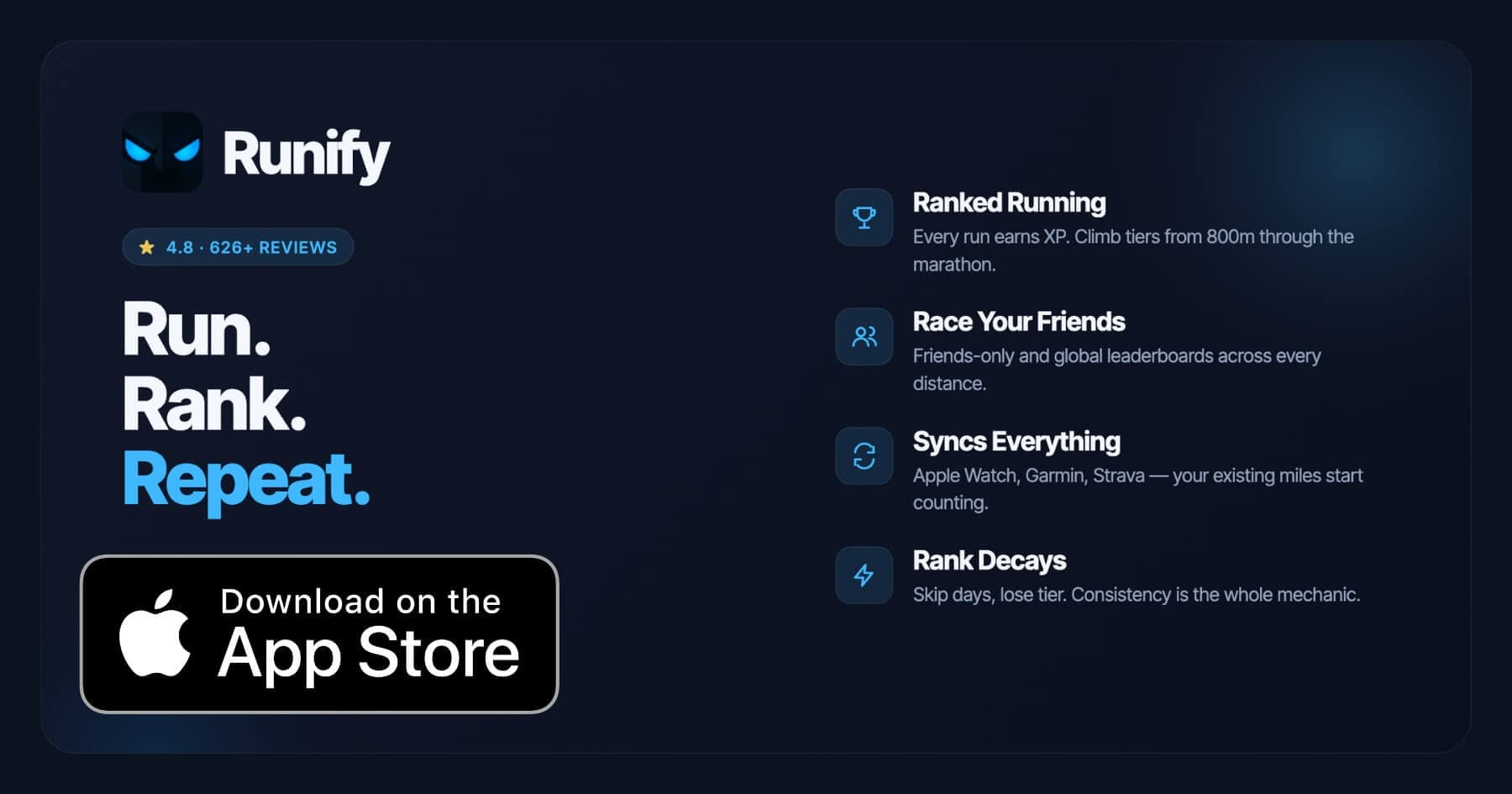
What Runify does is make every run you log count toward something visible. Every mile you run - whether tracked live in the app or imported from Apple Watch, Garmin, or Strava - earns XP and moves you through a competitive tier system. Distance-specific leaderboards cover 800m through marathon, with friends-only and global rankings. When you're deep in a 20-week ultra build and grinding long slow runs week after week, the ranked progression system gives you a reason to care about every session, not just the A-race.
For ultra runners who already use Garmin or Strava to log training, Runify layers competitive ranking and social accountability on top without replacing your existing setup. Your Garmin records it. Strava shares it. Runify ranks it.
Key Features
- Apple Watch, Garmin and Strava Sync: Bulk-import past runs from HealthKit/Apple Watch, Garmin Connect, or Strava. New runs auto-detect going forward.
- Ranked Progression System: XP from every run, post-run rank-up reveals, and rank decay when you go inactive. Consistency has a visible cost.
- Friends and Global Leaderboards: Race your training partners across 800m, 1K, 5K, 10K, half, and marathon distances (Pro). Overall Runify Rank available on all plans.
- In-App GPS Tracking: Live GPS with time, distance, pace, and route. 99.5% GPS routing accuracy. Post-run summary with splits and photos.
- Shareable Run Recaps: Auto-filled recap templates with one-tap Instagram Stories sharing.
- Streaks and Reminders: Streak tracking and motivational push notifications for consistency during long training cycles.
For the social side of long runs and a ranked layer on top of your training log, see how Runify compares to other tracking options in our best running apps for long runs breakdown.
Pricing
Monthly: $4.99/month (no free trial). Annual: $39.99/year with a 7-day free trial. Pro unlocks distance-specific leaderboards and expanded profile/history views.
Best For
- Garmin, Apple Watch, or Strava users who want competitive ranking on top of their existing logging
- Ultra runners who want streak accountability during a long training cycle
- Runners who want to compete with friends on a leaderboard across training distances
Limitations
- iOS only. No Android.
- No ultra-specific features: no offline maps, no aid station planning, no fueling timers, no ultra training plans.
- Distance-specific leaderboards are Pro-gated ($39.99/year).
How to Choose the Best Ultra Training App
Ultra training is not one problem - it's several. The right app depends on which problem is your biggest gap.
-
Coaching and plan quality: If you don't have a human coach, TrainingPeaks or Runna give you the deepest ultra-specific plans. TrainingPeaks is better for data-focused athletes with TSS tracking. Runna is better if you want a more adaptive weekly structure.
-
GPS battery and hardware: If your race runs 24+ hours, Garmin Connect paired with a long-battery Garmin watch (Fenix, Enduro, or Vertix) is the most direct solution. The aid station checkpoint tools inside Garmin Connect are unique.
-
Community and trail segments: Strava's trail segment library and 120M-strong community is unmatched. If training motivation comes from competing with local runners and sharing epic routes, Strava is your social layer.
-
Budget: Final Surge gives you a TrainingPeaks-style coaching platform at a lower cost. The free tier covers most logging needs and the premium tier stays under $7/month.
-
Accountability and gamification: If your goal is consistency across a long training cycle and you want every run to feel like it counts toward something, Runify's ranked progression system adds a motivation layer that pure logging apps don't have. It works alongside whichever GPS or coaching app you already use.
Frequently Asked Questions
What is the best app for ultra training in 2026?
TrainingPeaks is the strongest single app for ultramarathon training in 2026 because it has the deepest library of coach-designed plans for 50K, 50-mile, 100K, and 100-mile races, plus TSS-based load tracking across a full build cycle. Garmin Connect is the best hardware-companion app for race day itself, especially for aid station cutoff management and long-battery GPS. Runna is the best option if you want a fully structured weekly plan without buying a separate plan or hiring a coach. Most serious ultra runners use two tools: one for planning and one for GPS execution on the watch.
Is there a free app for ultra training?
Strava and Final Surge both have meaningful free tiers. Strava's free plan covers activity logging, segment comparison, and the full social feed - enough to follow a 50K plan and stay connected to the ultra running community. Final Surge's free plan covers workout logging, calendar view, and stats with no ads. Garmin Connect is also free if you own a Garmin watch, and covers core training load and health metrics at no cost. Runify offers a 7-day free trial on its annual plan ($39.99/year), which is enough time to connect your Garmin or Strava and see how the ranked progression works before committing.
Can I sync my Apple Watch or Garmin runs with ultra training apps?
Yes. TrainingPeaks syncs with both Apple Watch (via Apple Health) and Garmin, and pushes structured workouts to your watch. Garmin Connect is native to Garmin hardware and also syncs to Apple Health. Runna pushes structured workouts to Apple Watch and syncs with Strava. Final Surge syncs with Apple Health for workouts, sleep, and HRV. Strava syncs with virtually every GPS watch on the market. Runify imports from Apple Watch via HealthKit, Garmin Connect, and Strava - it works alongside whichever watch you already own.
What features should I look for in an ultra training app?
The features that matter most for ultra training are: structured plans that cover your specific race distance (50K through 100mi), TSS or load tracking to manage fatigue across a long build, GPS battery compatibility with your watch for race day (especially 24-37+ hours), route navigation or at minimum offline map access for remote trails, and community or coaching accountability to survive a 20-week training cycle. Fueling and hydration tracking is a bonus - some apps let coaches annotate plans with aid station notes, and Garmin Connect has race-day checkpoint management built into the watch. For trail running context, our best running apps for trail running covers navigation tools in more depth.
Do ultra runners really need a paid app, or will a free option work?
For 50K training, a free Strava plan and a solid base of trail running experience will get most runners to the start line. For 50-mile, 100K, and 100-mile distances, the structure and load management that paid platforms like TrainingPeaks or Runna provide becomes genuinely valuable - the risk of overtraining or under-tapering is real, and having TSS curves or adaptive weekly plans reduces that risk. If you already own a Garmin watch, Garmin Connect's free tier covers a lot of what you need. The runners most likely to overpay are those who subscribe to multiple platforms without a clear role for each one.
Final Verdict
Ultra training is specialized enough that no single app does everything well. The runners who perform best tend to combine a plan platform (TrainingPeaks or Runna) with a hardware-native GPS app (Garmin Connect) and a social layer (Strava). That sounds like a lot of apps, but in practice each one has a distinct job.
TrainingPeaks is the clearest #1 for coached ultra plans, TSS tracking, and the depth of its plan marketplace. Garmin Connect is indispensable if you run on a Garmin watch and want aid station checkpoint management on race day. Runna is the most approachable structured option if you want weekly guidance without building your own plan from scratch.
Runify sits at #6 on this list because it's honest to put it there. It's not an ultra coaching app. But if you're putting in 20-hour training weeks and you want every run - your long runs, your recovery jogs, your back-to-back weekends - to count toward a rank and show up on a leaderboard with your training partners, it does that job well. It works alongside whatever GPS or coaching app you already use.
Start logging your ultra training runs today. Download Runify on the App Store and connect your Garmin, Apple Watch, or Strava to earn XP from every mile of your build.

4.8 on the App Store · Built for iOS