Apple Watch vs Polar Vantage: Compared in 2026
Apple Watch vs Polar Vantage: The Quick Verdict
Apple Watch is the better pick for runners who live in the Apple ecosystem and want a watch that handles all of daily life alongside their training. Polar Vantage is the stronger choice for serious runners and triathletes who prioritize advanced training metrics, long battery life, and data-deep recovery tools.
Apple Watch Ultra 2 starts at $799 and holds a 4.8 App Store rating; Polar Vantage V3 retails at $599 and earns consistent praise on running forums for its heart rate accuracy and training load tools. At the mid-range, Apple Watch Series 10 ($399) and Polar Vantage M3 ($279) serve different masters - one covers your whole digital life, the other focuses almost entirely on athletic performance.
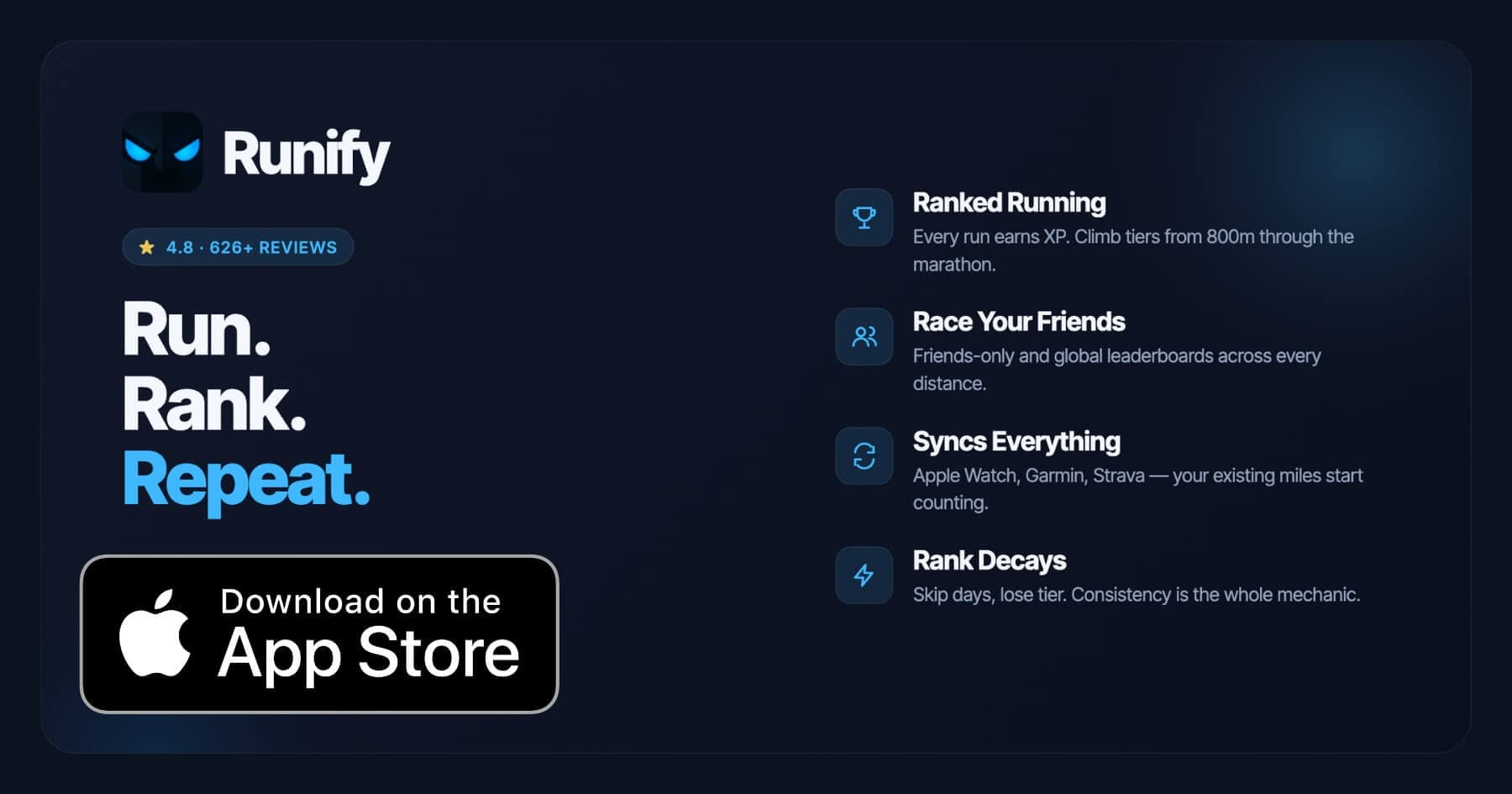
If neither fits perfectly, Runify is a third option worth knowing about. It adds a competitive tier system and distance-specific leaderboards on top of whichever tracker you already use, including Apple Watch and Garmin (which syncs via Strava or HealthKit).
At a Glance: Apple Watch vs Polar Vantage
| Feature | Apple Watch | Polar Vantage |
|---|---|---|
| Best For | Apple ecosystem runners | Serious runners and triathletes |
| Pricing | From $249 (SE) to $799 (Ultra 2) | From $279 (M3) to $599 (V3) |
| Platform | iOS only | iOS + Android |
| Standout Feature | Deep Apple ecosystem and app store | Advanced training load and recovery tools |
| Main Limitation | Battery life is 18 hrs to 60 hrs max | Limited smartwatch and notification features |
What Is Apple Watch?
Apple Watch is Apple's flagship wearable, launched in 2015 and now in its tenth-plus generation. It sits at the center of the iPhone ecosystem - notifications, payments, fitness rings, and a full app store all on your wrist. For runners, it offers GPS tracking, heart rate, blood oxygen, and (on Ultra) dual-frequency GPS for trail and technical running.
The lineup spans SE, Series, and Ultra tiers. Series 10 brought slimmer hardware and faster charging. Ultra 2 targets endurance runners and triathletes who need longer battery and more rugged build quality. Apple Watch is the best-selling smartwatch in the world, holding roughly 23% of global smartwatch shipments.
Apple Watch is iOS-only. You cannot pair it with an Android phone.
Apple Watch Key Features
- GPS Tracking: Built-in GPS with optional L1/L5 dual-frequency on Ultra for precision in challenging terrain.
- Activity Rings: Daily move, exercise, and stand goals with streak tracking and social sharing via the Fitness app.
- Heart Rate Monitoring: Optical heart rate with high and low heart rate alerts; ECG on Series 4 and later.
- Workout App: Native tracking for running, cycling, swimming, HIIT, and 80+ workout types with splits and maps.
- App Store: Thousands of third-party apps including Strava, Nike Run Club, and Runify for richer data.
Apple Watch Pricing
- Apple Watch SE (2nd gen): $249
- Apple Watch Series 10: $399
- Apple Watch Ultra 2: $799
No subscription is needed for core fitness features. Apple Fitness+ (coaching content) costs $9.99/month or $79.99/year and is separate.
Apple Watch Strengths
- Seamless iPhone integration for notifications, payments, and Siri
- Large third-party app ecosystem with constantly updated running apps
- Strong health features (ECG, crash detection, temperature, blood oxygen)
Apple Watch Weaknesses
- Battery life is a real constraint - Series 10 tops out at 18 hours, Ultra 2 at 60 hours in low-power GPS mode
- iOS-only locks out Android users entirely
- Training load and recovery analytics are shallow compared to dedicated running watches
What Is Polar Vantage?
Polar Vantage is Polar's premium multisport watch line, built specifically for athletes who want deep training analysis. The Vantage M3 targets everyday runners with accurate metrics at a lower price; the Vantage V3 competes at the top of the endurance sports watch market with optical and ECG heart rate, a barometric altimeter, and Polar's full suite of training intelligence tools.
Polar has been making heart rate training tools since the 1970s. The Vantage line distills decades of sports science research into wrist-based tools: Training Load Pro, Nightly Recharge, Running Performance Test, and FuelWise fueling reminders. Polar Flow, the companion app, is available on both iOS and Android.
Polar Vantage works with iOS and Android, making it a strong option for runners who are not in the Apple ecosystem.
Polar Vantage Key Features
- Precision Prime Heart Rate: Optical sensor with ECG support (V3) for accurate heart rate even at high intensities.
- Training Load Pro: Tracks cardiovascular, muscle, and perceived load separately to prevent overtraining.
- Nightly Recharge: Sleep and autonomic nervous system analysis to gauge readiness each morning.
- Running Power: Built-in running power measurement without an external pod.
- Polar Flow: Full training calendar, detailed analytics, and FTP and VO2max estimates via the companion app.
Polar Vantage Pricing
- Polar Vantage M3: $279
- Polar Vantage V3: $599
Polar Flow app is free. Some advanced features (like Polar Club) carry separate fees, but core training analytics are included with the watch at no ongoing cost.
Polar Strengths
- Among the most accurate optical heart rate sensors in the smartwatch category
- Training Load Pro gives a detailed picture of stress across three physiological systems
- Multi-day battery life - Vantage V3 lasts up to 140 hours in GPS + heart rate mode
Polar Vantage Weaknesses
- Smartwatch functionality is limited - no native payments, narrow app ecosystem
- Polar Flow's interface feels dated compared to Garmin Connect or Apple Fitness
- No LTE or cellular option on any Vantage model
Apple Watch vs Polar Vantage: Head-to-Head
Both watches track runs accurately, but they are built for different kinds of runners. Apple Watch does everything, but running is one of many jobs. Polar Vantage does very few things, and running is the main one.
GPS Accuracy
Polar Vantage V3 edges Apple Watch Series 10 in dense urban canyons and forested trails, largely due to its dedicated SatIQ multi-constellation technology and smarter satellite-switching. Apple Watch Ultra 2 closes the gap with dual-frequency L1/L5 GPS and performs comparably to Polar V3 in most testing. For everyday road running, both are accurate enough that you will rarely notice a difference.
Training Load and Recovery
Polar Vantage wins this category clearly. Training Load Pro separates cardiovascular, muscle, and perceived strain - a nuance that matters for runners building base or tapering before a race. Nightly Recharge gives a daily readiness score backed by heart rate variability and sleep stage analysis. Apple Watch's Activity rings and Fitness app offer far less analytical depth; you get workout history and trend charts, but not the structured load-versus-recovery picture Polar provides.
Social and Community Features
Apple Watch leads here. The native Fitness app supports Activity Sharing with friends, ring comparisons, and monthly challenges. Third-party apps like Strava and Nike Run Club layer on segments, kudos, and group leaderboards. Polar Flow's social features are thin - you can follow other Polar users and share sessions, but the community is much smaller and the feed is bare-bones by comparison. If you want competitive social running on top of either watch, our Apple Watch running statistics breakdown shows just how dominant Apple Watch is on Strava uploads.
Battery Life
Polar Vantage wins decisively. Vantage V3 lasts up to 140 hours in GPS + heart rate mode, making it the obvious choice for ultramarathons, long triathlons, and multi-day adventures. Apple Watch Series 10 offers 18 hours of workout GPS; Ultra 2 stretches to 60 hours in low-power mode. For daily training runs under two hours, battery is rarely a real issue on either watch. For races over six hours, Apple Watch Ultra 2 is the only viable Apple option - and Polar still has a comfortable margin.
Hardware Integration and App Ecosystem
Apple Watch syncs natively with HealthKit, which means every major running app - Strava, Nike Run Club, Garmin Connect via manual export, and Runify - can pull in your data automatically. The App Store gives you thousands of running apps to choose from. Polar Vantage syncs to Polar Flow and then pushes to Strava and TrainingPeaks via official integrations; the ecosystem is narrower but covers the apps serious runners actually use. For a deeper look at Apple Watch app options, our best running apps for Apple Watch guide covers the top picks across every runner type.
Platform Availability
Polar Vantage pairs with iPhone or Android. Apple Watch requires an iPhone. If you or someone you are buying for uses an Android phone, Polar Vantage is the only option between the two. This is not a minor detail - iPhone dependency is the single most common deal-breaker mentioned in Apple Watch reviews by non-Apple users.
Who Should Choose Apple Watch?
Apple Watch suits runners who want one device that handles everything: calls, texts, payments, fitness, and health monitoring. If your phone is an iPhone and you want a watch that disappears into daily life, Apple Watch is the easiest, most polished choice.
- Runners who want seamless iPhone integration and notification management
- Casual to moderate runners (under two-hour efforts) who value everyday versatility as much as athletic performance
- Runners who rely on a broad app ecosystem, including Strava, Nike Run Club, and third-party training apps
Who Should Choose Polar Vantage?
Polar Vantage suits athletes who train seriously and want the watch to help them train smarter, not just harder. If you want to see whether Tuesday's workout loaded your muscles too hard before you schedule Thursday's tempo, Polar gives you the tools to answer that question.
- Dedicated runners, triathletes, and multisport athletes who track training load over weeks and months
- Runners logging long efforts - marathons, ultras, or long-course triathlon - where battery life is a safety consideration
- Android phone users who want a premium running watch with no platform compromise
A Third Option: Runify for Ranked, Competitive Running
Neither Apple Watch nor Polar Vantage is a running app - they are hardware platforms that capture your data. Runify does something neither of them does: it turns that data into a competitive rank across friends and global leaderboards.
Runify is the first ranked running app. Every run you log earns XP, advances you through a tier system, and places you on distance-specific leaderboards covering 800m, 1K, 5K, 10K, half marathon, and marathon. Rank decays if you go inactive, which keeps the motivation real across weeks, not just during a good training block. Runify holds 4.8 stars on the App Store with 626+ reviews.
The connection to both watches is straightforward. If you run with Apple Watch, your runs sync automatically through HealthKit. If you train with a Polar watch, you can push runs to Strava and connect Strava to Runify, so your existing miles count toward your rank without changing how you train. A lot of Runify users keep their main tracker - Apple Watch, Garmin, or Polar via Strava - and use Runify as the competitive layer on top. For more on how Polar companion apps compare, our best Polar Flow alternatives overview covers the full ecosystem.
When Runify Is the Better Pick Than Both
- You want a visible, competitive reason to keep running (XP, rank, rank decay)
- You already track on Apple Watch, Garmin, or Strava and want those miles to count toward something
- You care about distance-specific performance (800m through marathon) on friends and global leaderboards
- You like sharing stylized run recaps to Instagram Stories
When Runify Is Not the Right Fit
- You're on Android. Runify is iOS only today.
- You want structured training plans, pace coaching during a run, or audio-coached workouts. Runify focuses on tracking, ranking, and social competition - not coaching.
- You want route discovery or race signup features.
How to Choose Between Apple Watch and Polar Vantage
The right choice depends on four practical factors more than specs.
- Your phone: If you use Android, Apple Watch is off the table. Polar Vantage M3 at $279 becomes one of the best-value precision running watches available.
- How long your runs are: If you regularly run or race for four-plus hours, battery life is a genuine safety and convenience issue. Polar Vantage V3's 140-hour GPS mode is a real advantage over everything except Apple Watch Ultra 2.
- How deeply you analyze training: If you want Training Load Pro, Nightly Recharge, and physiological strain broken out by system, Polar Vantage is built for you. If workout history and trend charts are enough, Apple Watch serves that need.
- How much you want from a smartwatch: If you take calls, use Apple Pay, or rely on your watch for calendar alerts and messages throughout the day, Apple Watch does all of this better than any Polar device.
- Budget: Polar Vantage M3 at $279 offers serious running features at a price that undercuts even Apple Watch SE. If running metrics are the priority and budget matters, Polar's entry point is compelling.
Frequently Asked Questions
Is Apple Watch or Polar Vantage better in 2026?
It depends on your priorities. Apple Watch is better if you want a true smartwatch that handles daily life alongside running, especially on iPhone. Polar Vantage is better if you want advanced training load analysis, long battery life, and precise heart rate for serious endurance training. Most runners choosing between the two are really choosing between smartwatch versatility (Apple Watch) and athletic depth (Polar Vantage). Neither is universally better - the right pick is the one that matches how you train and how you use your watch outside of running.
Can I use Apple Watch and Polar Vantage together?
Technically yes, but in practice most runners pick one. Apple Watch syncs to HealthKit; Polar syncs to Polar Flow and from there to Strava. You cannot pair both watches to the same phone simultaneously for live tracking. Some athletes use Polar for training and switch to Apple Watch for races because of LTE support, or the reverse. If you use Runify, both sources feed in - Apple Watch via HealthKit directly, Polar via the Strava connection - so your ranked leaderboard data comes through regardless of which watch you run with that day.
Which is cheaper, Apple Watch or Polar Vantage?
Polar Vantage has the lower entry price. Polar Vantage M3 starts at $279 with no required subscription. Apple Watch SE starts at $249, but the comparison is closer than it looks - SE is more smartwatch than running watch, while Vantage M3 is a dedicated running device at that price. At mid-range, Series 10 ($399) versus Vantage V3 ($599) gives Polar a larger gap. At the top, Apple Watch Ultra 2 ($799) and Polar Vantage V3 ($599) are both premium products aimed at serious athletes.
Which has better tracking accuracy, Apple Watch or Polar Vantage?
Both are accurate for the vast majority of daily road runs. Polar Vantage V3's Precision Prime heart rate sensor and SatIQ GPS are rated slightly ahead in independent testing for high-intensity efforts and dense environments. Apple Watch Ultra 2 with dual-frequency L1/L5 GPS matches Polar in GPS accuracy on most courses and edges ahead on technical trails where multi-band becomes critical. For moderate runners doing road or track work, the difference is rarely detectable in practice - both produce splits and distances within a few seconds and meters of each other.
What is the best alternative to both Apple Watch and Polar Vantage?
For runners who want competitive motivation on top of their existing tracker, Runify is the strongest alternative complement. It adds a ranked tier system, XP, and distance-specific leaderboards across 800m through marathon to whatever watch you already use - Apple Watch via HealthKit or Polar via Strava sync. Runify is rated 4.8 stars on the App Store with 626+ reviews. It does not replace either watch for hardware tracking, but it gives your miles a competitive purpose that neither Apple's Activity rings nor Polar Flow's training calendar provides. Runify is iOS only and does not include coaching or training plans.
Final Verdict
Apple Watch and Polar Vantage are strong at opposite ends of the spectrum. Apple Watch wins on ecosystem integration, everyday smartwatch utility, and app variety. Polar Vantage wins on training depth, battery endurance, and cross-platform compatibility.
Choose Apple Watch if your iPhone is the center of your digital life and you want one device for everything from runs to payments to health monitoring. Choose Polar Vantage if running is the priority and you want the watch to help you train smarter with detailed load and recovery data across weeks of training.
If you already use either watch and want your miles to mean something competitive, Runify layers a ranked progression system and distance-specific leaderboards on top - no hardware swap required.
Ready to see where your runs rank? Download Runify on the App Store and connect your Apple Watch or Strava in minutes.

4.8 on the App Store · Built for iOS