Apple Watch Running Statistics 2026
Apple Watch Running Statistics 2026
Apple Watch crossed 200 million lifetime units sold and now powers an active install base of more than 170 million wrists worldwide. In 2025, Apple shipped roughly 23% of all smartwatches globally, posting 8% year-over-year growth and outpacing the broader market. Among iPhone owners who use a smartwatch or fitness tracker, 79% choose Apple Watch. On Strava, Apple Watch is once again the most popular wearable for tracking workouts across 180 million plus athletes. These 16 statistics show how Apple Watch shapes the way runners log miles, sync data, and benchmark performance in 2026.
Running is one of the fastest growing use cases for a wrist computer that started life as a notification screen. Health, GPS, and workout features now drive most of the upgrade story, and Apple has leaned hard into that. The 2025 lineup refresh, with Watch Series 11, Ultra 3, and SE 3, was the first full simultaneous overhaul in three years.
This post breaks down the latest install base, market share, runner-specific usage, GPS and heart rate accuracy, and demographic data. It is built for runners who already wear an Apple Watch, runners deciding between Apple Watch and a Garmin, and anyone curious about where wearables are headed. Below you will find 16 numbers worth remembering.
1. Apple Watch active install base passed 170 million users
Apple Watch active users surpassed 170 million globally, with an estimated 92% retention rate among existing owners. The lifetime install base of devices ever sold is now estimated above 200 million units. That means roughly one in seventeen people on Earth has worn an Apple Watch at some point. The retention figure matters as much as the headline number. A 92% retention rate signals that most owners replace their Apple Watch with another Apple Watch rather than switching to Garmin, Samsung, or a fitness band. For runners, this scale is why most fitness apps prioritize Apple Watch first when they ship a wearable companion.
Source: Telecoms.com - Smartwatch market bounces back as Apple Watch user base hits 100 million
2. Apple captured 23% of global smartwatch shipments in 2025
Apple held 23% of global smartwatch shipments in 2025, gaining one percentage point versus 2024 and extending its lead at the top of the market. The broader smartwatch category grew 4% year-over-year, while Apple grew 8%. That outperformance ended a three-year shipment slump for the company. The recovery was credited to a full lineup refresh covering the Series 11, Ultra 3, and SE 3, which Counterpoint Research said hit a wider price band than any prior Apple Watch release. For runners, the practical effect is more new hardware on more wrists, with deeper GPS and heart rate sensors trickling down to the entry-level SE.
Source: Counterpoint Research - Global Smartwatch Shipments Market Share Quarterly
3. Apple Watch shipments grew 12% year-over-year in Q3 2025
Apple Watch shipments grew 12% year-over-year in the third quarter of calendar 2025, the strongest quarterly growth Apple had recorded for the product since 2021. The bump came directly after the September launches of Series 11, Ultra 3, and SE 3. It also reversed a stretch of mid-single-digit declines that started in 2023. Quarterly growth at this scale matters because Q3 is when most pre-marathon-season buyers upgrade. Many runners refresh their watch ahead of fall race blocks, and the data suggests the new lineup converted more of them than any year since the Series 7 cycle.
Source: MacTech - Apple Watch shipments grew 12% year-over-year in Q3 2025
4. 79% of iPhone smartwatch owners wear an Apple Watch
Among iPhone owners who use a smartwatch or fitness tracker, 79% wear an Apple Watch. Among Android users with a wearable, only 22% pick Apple Watch, since the device is iPhone-only. The number is striking because the smartwatch category has more competition than ever, with Garmin, Samsung, Huawei, Google, and Xiaomi all pushing aggressively. Inside the iPhone ecosystem, no rival has cracked one in five. This near-monopoly on iPhone wrists is why running apps that sync over HealthKit, including Runify, treat Apple Watch as the default first-party data source for iOS runners.
Source: Business Standard - Nearly 80% of iPhone users own Apple Watch
5. Apple Watch was Strava's most-used wearable in 2025
Apple Watch was again the single most-used wearable on Strava in 2025, according to Strava's 2025 Year in Sport report covering more than 180 million athletes. Strava credited Apple Watch with the top device share among uploaded activities tied to a wearable, ahead of every Garmin and COROS model individually. For 5K runners specifically, Apple Watch was the most common device, while the Garmin Forerunner pulled ahead at marathon distance. Women on Strava were 70% more likely than men to log activities from an Apple Watch in 2025. The runner-by-runner data lines up with the broader market share story.
Source: Wareable - Apple Watch most popular fitness tracker on Strava 2025
6. Apple wearables generated $35.69 billion in fiscal 2025
Apple's Wearables, Home, and Accessories segment generated $35.69 billion in revenue in fiscal year 2025, equivalent to about 8.6% of total Apple revenue. The segment dipped 3.6% year-over-year from $37.01 billion in fiscal 2024, but the Q4 quarter ending September 27, 2025 returned to growth at $11.49 billion. Apple Watch is the largest single product line inside that bucket, ahead of AirPods and Beats. The financial scale is worth highlighting because it is what funds dual-frequency GPS chips, custom S-series silicon, and the on-watch ML used to estimate running power and stride length.
Source: Six Colors - Apple's fiscal 2025 in charts
7. Apple Watch Ultra 3 starts at $799 and runs 42 hours per charge
Apple Watch Ultra 3 launched in September 2025 at $799 with up to 42 hours of normal battery life and up to 72 hours in Low Power Mode. Series 11 starts at $399 with 24 hours of battery, while SE 3 starts at $249. Ultra 3 is the first Apple Watch with two-way satellite messaging for emergencies, and it features the largest screen in the lineup with LTPO3 wide-angle OLED. For ultrarunners, the 42-hour figure is the headline metric. It clears most 100K finish times and gets close to 24-hour ultra ranges without an external battery pack.
Source: Apple Newsroom - Introducing Apple Watch Ultra 3
8. Dual-frequency GPS cuts route error from 5 meters toward sub-meter
Apple Watch Ultra was the first Apple Watch to ship dual-frequency L1 and L5 GPS, a feature that has since spread up the lineup. Single-frequency consumer GPS typically resolves position to about 5 meters in open terrain. Dual-frequency receivers like the L1 plus L5 chip can drop that error toward the sub-meter range and reduce noise from multipath reflections by roughly tenfold. Independent testing by CCS Insight and DC Rainmaker found Ultra traces hugged the actual road far closer than older Series watches, especially among tall buildings and trees. For runners chasing accurate splits in cities, dual-frequency is the single biggest GPS upgrade of the past decade.
Source: DC Rainmaker - Apple Watch Ultra 3 vs Apple Watch Series 11 Detailed Review
9. Apple Watch heart rate hit a 0.96 concordance with ECG in athletes
In a peer-reviewed Apple Watch validation study published in JAMA Cardiology, the device hit a concordance correlation coefficient of 0.96 versus chest-strap ECG across treadmill speeds from 4 to 9 mph in 50 athletic adults. That made it the most accurate wrist heart rate monitor in the test. A more recent 2025 systematic review in npj Digital Medicine reported a mean absolute percent error of 4.43% for Apple Watch heart rate across pooled studies. Both numbers are inside the threshold most coaches consider usable for zone-based training. Accuracy still drops at very high intensities like 8 to 9 mph, where wrist optical sensors struggle in any brand.
Source: NIH PMC - Validity and Reliability of the Apple Watch for Measuring Heart Rate During Exercise
10. Apple Watch GPS distance error sits within meters on outdoor runs
A JMIR mHealth and uHealth instrument validation study tested eight GPS-enabled sport watches, including Apple Watch, across walking, running, and cycling in urban, forest, and track environments. Recorded systematic distance errors ranged from +3.7 meters to roughly minus 101 meters depending on conditions and speed. On open outdoor routes, Apple Watch routinely lands inside a 1 to 2% distance error, which is typical of premium GPS sport watches. Indoor and treadmill runs are a different story, with reported distance gaps of 10 to 15% versus the treadmill's own readout. That is a sensor problem, not an Apple problem, since wrist GPS cannot see satellites under a roof.
11. Apple Watch active retention is roughly 92%
Industry analysts estimate Apple Watch active user retention at around 92%, far ahead of any other smartwatch brand. That figure is calculated from active devices reporting back to Apple's services compared to historical sales. By contrast, the broader smartwatch category sees retention closer to 50 to 60%, with Fitbit and lower-cost Android watches commonly drifting into drawers within two years. For Apple Watch, the combination of HealthKit lock-in, paired iPhone setup, and trade-in incentives keeps owners on the platform. For runners, that retention is a reason long-term training data is more usable on Apple Watch than on most other wrist hardware.
Source: SQ Magazine - Apple Statistics 2026
12. Smartwatch users skew younger, with Gen Z hitting 41% adoption
Smartwatch use among Gen Z reached 41% in 2025, ahead of older cohorts. Adults aged 45 to 64 came in at 27% adoption, and the global average smartwatch user age fell to 35.8 years. The gender gap is also closing fast. The smartwatch user base in 2025 was 52% male and 48% female. Apple Watch in particular skews more female than the category average. On Strava, women in 2025 were 70% more likely than men to record activities from an Apple Watch. The shifting demographic profile matters because newer runners are more likely to start with a wrist tracker than with a chest strap or dedicated GPS watch.
Source: SQ Magazine - Smartwatch Statistics 2025
13. Garmin sits below Apple in shipments but leads premium running
Apple holds 23% of global smartwatch shipments and Garmin does not break the global top five by volume. By contrast, Garmin dominates serious endurance shipping channels and posted growth in Q3 2025 thanks to satellite messaging features. The Garmin Forerunner family ranks first by share among marathon and ultra runners on Strava, while the Apple Watch leads at 5K and shorter distances. The split is becoming a genuine two-tier market. Apple Watch is the default for casual and intermediate runners, while Garmin remains the default for runners doing 50K and longer ultras. If you want a deeper apples-to-apples breakdown, see our Strava alternatives roundup for how third-party apps fit on each platform.
Source: Counterpoint Research - Global Smartwatch Market Set to Swing to Growth in 2025
14. Apple Watch Series 11 added blood pressure trend detection
Apple Watch Series 11 and Ultra 3, both released September 2025, became the first Apple Watches with hypertension trend detection. The system uses the optical heart sensor to analyze how blood vessels respond to heartbeats, then reviews 30-day windows to flag chronic patterns. It does not replace a clinical cuff, but it does push wrist health monitoring beyond heart rate, ECG, and SpO2. Sleep tracking also gained a new Sleep Score in watchOS 26. For runners, both features fit into the broader recovery and load story. Resting heart rate plus sleep score plus a hypertension flag now lives on a single wrist without any external accessory.
Source: TechCrunch - Apple unveils Apple Watch Series 11, Watch Ultra 3, and Watch SE 3
15. The Strava mobile app still records 72% of activities, even with Apple Watch dominant
The Strava 2025 Year in Sport report found that 72% of all recorded activities still came from the Strava mobile app rather than a dedicated wearable. Apple Watch was the most popular wearable, but it sat behind the phone for raw recording volume. That gap matters because it shows most runners still pocket their phone or strap it to their arm even when they own a smartwatch. For training data quality, the implication is mixed. A phone in a pocket can deliver decent GPS, but it is a worse heart rate source than the watch on your wrist. If you care about leaderboards across distances, our running leaderboard guide for iPhone covers the cleanest setup.
Source: Strava Press - Strava Releases 12th Annual Year in Sport Trend Report 2025
16. Apple Watch grew 70% faster among women than men on Strava
Strava's 2025 Year in Sport found that women were 70% more likely than men to record an activity using an Apple Watch in 2025. That is a clear reversal of the older "wrist GPS is for serious male runners" pattern that dominated the Garmin era. Combined with the broader closing of the smartwatch gender gap, with 48% of users now female, the data points to a more diverse running tech base in 2026 than in any previous year. For first-time and returning runners, the cultural normalization of an Apple Watch as a beginner-friendly running tool is now backed by hard usage numbers, not just marketing. Consistency is the variable that turns new runners into long-term ones, as our running consistency deep dive explores.
Source: 9to5Mac - Apple Watch scores first place for Strava users
What These Numbers Tell Runners in 2026
Apple Watch is now the default wrist computer for most runners on iPhone, full stop. The combination of a 23% global shipment share, a 79% attach rate inside the iPhone smartwatch base, and the top spot on Strava means most new runners in 2026 will start their first race block wearing one. That changes how training data flows. The wrist is now the sensor and the phone is the screen, instead of the other way around.
For real-world runners, the takeaway depends on distance and goal. If you race 5K, 10K, or half marathon, the current Apple Watch GPS and heart rate accuracy is well inside the margin you need for pacing and zones. If you race ultras, the Ultra 3 closes most of the historical Garmin battery gap, but the Forerunner ecosystem still leads at 100K and beyond. If you are new to running, the more interesting number is the gender split. With women now 70% more likely to log Apple Watch activities, the cultural assumption that "real" runners use a chest strap and a dedicated multisport watch is finally fading.
The trajectory is clear. Wrist hardware is getting more accurate, batteries are stretching toward triple-digit hours, and dual-frequency GPS is no longer a luxury feature. The next two cycles will likely bring blood pressure as a standard reading, more on-watch ML for stride and power, and tighter integration with iPhone-side training apps. Where Apple Watch goes, most of the running app ecosystem follows.
Apple Watch is no longer just a smartwatch with a workout mode. It is the largest connected running platform in the world.
Connecting Apple Watch Data to Your Running Progress
Apple Watch is excellent at recording the run. The harder problem is making the run feel like progress. Splits, pace, and heart rate are useful, but they do not by themselves answer the question every runner eventually asks: am I actually getting better, and how do I stack up against last month, last season, or my friends?
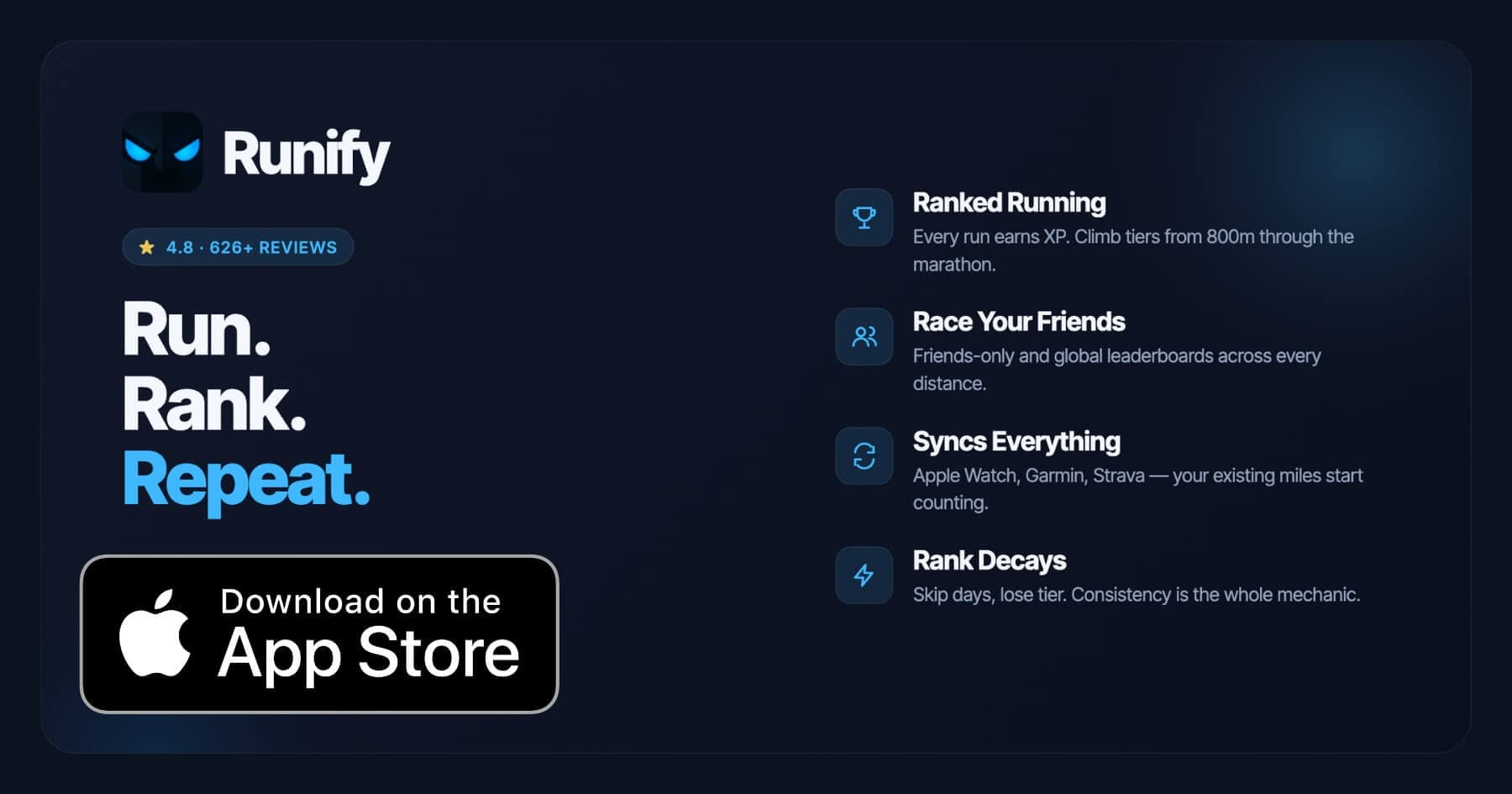
Runify is built for that exact gap. Every run you sync from Apple Watch through HealthKit, plus runs imported from Garmin or Strava, earns XP and feeds into a tier system and leaderboards from 800m through the marathon. Your wrist already has the data. Runify gives the data a scoreboard. It works for the runner who races 5Ks, the runner stacking miles toward a first marathon (see our marathon finishing time benchmarks), and the runner who just wants a visible reason to lace up tomorrow.
Ready to make your runs count? Download Runify on the App Store and turn every mile into XP across leaderboards from 800m through the marathon.
4.8 stars on the App Store, 626+ reviews worldwide.
Download Runify on the App Store

4.8 on the App Store · Built for iOS