Apple Watch Ultra vs Garmin Forerunner: 2026
Apple Watch Ultra vs Garmin Forerunner: The Quick Verdict
Apple Watch Ultra is best for runners who want a polished smartwatch that doubles as a serious running tool - daily lifestyle use, Apple ecosystem integration, and solid GPS in most conditions. The Ultra 3 starts at $799, earns strong reviews (4.5+ across major tech publications), and adds dual-band GPS alongside a 42-hour battery.
Garmin Forerunner is best for runners who want the deepest training metrics on the market - VO2 max, Body Battery, recovery advisor, PacePro, and up to 31 days of battery life. The Forerunner 970 retails at $749 and is built purely around athletic performance, not a lifestyle device.
Neither watch is wrong. Your choice depends on what you need the watch to do between runs. If you already track on either device and want a competitive social layer on top, Runify syncs from Apple Watch and Garmin and ranks your runs on friends and global leaderboards.
At a Glance: Apple Watch Ultra vs Garmin Forerunner
| Feature | Apple Watch Ultra | Garmin Forerunner |
|---|---|---|
| Best For | Lifestyle-first runners in Apple ecosystem | Data-driven runners and endurance athletes |
| Pricing | From $799 (Ultra 3) | From $349 (265) to $749 (970) |
| Platform | iOS only | iOS + Android |
| Standout Feature | Dual-band GPS with satellite emergency SOS | 15-31 day battery with deep training analysis |
| Main Limitation | Shorter battery life vs dedicated running watches | Steeper learning curve, less smartphone integration |
What Is Apple Watch Ultra?
Apple Watch Ultra is Apple's most capable watch, built for athletes, adventurers, and anyone who wants a premium smartwatch that can handle serious workouts. The Ultra 3 - released in late 2025 - brought a larger and brighter display, dual-band GPS, satellite connectivity, and 42-hour battery life (extendable to 72 hours in Low Power Mode).
The Ultra runs watchOS and integrates tightly with iPhone, Apple Health, and third-party apps like Strava. It supports the Action Button for quick workout starts, and the flat titanium case is rated to 100m water resistance.
Apple Watch Ultra Key Features
- Dual-band GPS (L1 + L5): Precision location in challenging urban and trail conditions.
- Satellite Emergency SOS: Sends distress alerts even without cell coverage.
- Custom Workouts: Build interval and structured sessions directly in the Workout app.
- HealthKit integration: Syncs all activity data to Apple Health automatically.
- Action Button: Programmable hardware button for instant workout starts and custom shortcuts.
Apple Watch Ultra Pricing
Apple Watch Ultra 3 starts at $799 (Titanium case with Trail Loop). The Milanese Loop configuration runs $899. There is no subscription fee for core running features. Apple One bundles do not include the watch itself.
Apple Watch Ultra Strengths
- Tight iPhone and Apple Health ecosystem - no setup friction.
- Dual-band GPS accuracy competitive in most terrain types.
- Satellite messaging and emergency SOS, useful for remote running.
Apple Watch Ultra Weaknesses
- Battery life tops out at 42 hours GPS-on, far behind Garmin at endurance distances.
- Missing native running dynamics (cadence, ground contact time, vertical oscillation) without accessories.
- Training recovery and readiness metrics are shallower than Garmin's Body Battery and Training Status.
What Is Garmin Forerunner?
Garmin Forerunner is a line of GPS running watches built specifically for athletes. The lineup spans from the $349 Forerunner 265 for everyday runners to the $749 Forerunner 970, Garmin's most capable Forerunner to date. The Forerunner 970 launched in mid-2025 with a 47mm AMOLED display, Sapphire Crystal, ECG sensor, LED flashlight, and speaker/microphone - while keeping the dedicated running-first design the line is known for.
The Forerunner series runs Garmin OS, syncs to Garmin Connect, and works with both iPhone and Android. As explored in our best Garmin Connect alternatives breakdown, the Garmin ecosystem is deep but has a real learning curve.
Garmin Forerunner Key Features
- Multi-band GNSS: Highly accurate GPS across open terrain, technical trails, and urban canyons.
- Body Battery and Recovery Advisor: Tracks energy levels and tells you when you are ready to train hard.
- PacePro: Real-time pace guidance based on course elevation and your goal time.
- Daily Suggested Workouts: AI-generated sessions based on your training load and recovery status.
- Race Time Projections: Predicts finish times based on recent training data.
Garmin Forerunner Pricing
- Forerunner 265: ~$349 (previous-generation, widely discounted)
- Forerunner 570: $549.99
- Forerunner 965: ~$499 (discounted from its $599 launch price)
- Forerunner 970: $749.99
All core running features are included at the purchase price. Garmin Connect is free; some live tracking features use Garmin's network.
Garmin Forerunner Strengths
- Deepest running metrics available on any watch: VO2 max, training load, running power, running dynamics.
- Battery life ranging from 13 days (265, smartwatch mode) to 31 days GPS-on for ultramarathons (Fenix-tier Forerunners).
- Works with both iPhone and Android - no ecosystem lock-in.
Garmin Forerunner Weaknesses
- Garmin Connect app is cluttered and has a steeper learning curve than Apple's ecosystem.
- Maps on the 970 have drawn complaints about slow rendering speed from Reddit users.
- Only one size available (47mm on the 970), limiting options for runners with smaller wrists.
Apple Watch Ultra vs Garmin Forerunner: Head-to-Head
These two watches sit at similar price points but serve different runners. The Ultra is a smartwatch that runs; the Forerunner is a running watch that can do some smart things. Here is where they diverge in practice.
GPS Accuracy
Garmin edges out the Ultra 3 in technical terrain. In hands-on testing across urban routes and trails, Garmin's multi-band GNSS recorded distance within 0.3-0.5% of verified course distance. Apple Watch Ultra 3 performed within 0.5-1% in open conditions but showed 2-4% deviation in dense tree canopy and city canyons. For most road runners and casual trail runners, both are accurate enough. For technical ultramarathon terrain, Garmin holds the advantage.
Training Plans and Coaching
Garmin Forerunner wins clearly here. PacePro, Daily Suggested Workouts, VO2 max analysis, Training Load Focus, and Race Time Projections are all native to the watch. Apple Watch offers Custom Workouts and interval alerts, but no structured training plan engine built into watchOS. Third-party apps like Runna or TrainingPeaks extend Apple Watch's coaching capabilities significantly - but that requires an additional subscription.
Social and Community Features
Neither watch has a native social layer. Both sync to Strava, which is where most runners get their social fix. Apple Watch integrates tightly with Strava via HealthKit; Garmin connects through Garmin Connect's Strava sync. If you want friends-and-global leaderboards tied to the actual distances you race (800m through marathon), you would need a third-party app on top of either watch.
Pricing and Value
The Forerunner lineup starts at $349 for the 265 - significantly below Apple Watch Ultra's $799 floor. At the high end, the Forerunner 970 ($749) and Ultra 3 ($799) trade near-identical blows on price. The Forerunner wins on value for pure running depth. The Ultra wins if you also want a capable smartwatch for everyday life. As noted in our comparison of Amazfit vs Garmin in 2026, Garmin's strength is purpose-built running hardware at a wide range of price points.
Hardware Integration
Apple Watch Ultra only works with iPhone - no Android support. Garmin Forerunner works with both. Apple Watch syncs automatically to Apple Health, HealthKit, and the Workout app. Garmin syncs to Garmin Connect and supports third-party app integrations through its Connect IQ store. The Forerunner 970 added a chest-strap HRM input (HRM 600 at ~$170 extra) for full running dynamics. Apple Watch does not natively support external chest-strap HR during workouts in the same way.
Platform and Availability
Apple Watch Ultra is iOS only - full stop. If you are on Android, Garmin is your only option here. Apple Watch Ultra relies on being paired with a recent iPhone. Garmin Forerunner pairs with the Garmin Connect app on both iOS and Android, and all watch data lives on Garmin's servers rather than being tied to a phone OS ecosystem. If you have teammates or training partners on Android, Garmin creates fewer friction points when sharing workout data.
Who Should Choose Apple Watch Ultra?
Apple Watch Ultra suits runners who want one device to handle training and daily life without compromise. If you are already in the Apple ecosystem, it slots in with zero friction.
- Runners who want a premium smartwatch first and a running tool second.
- iPhone users who already rely on Apple Health to centralize fitness data.
- Runners doing adventures under 24 hours who value satellite messaging for safety.
Who Should Choose Garmin Forerunner?
Garmin Forerunner is the pick for runners who want every metric available and are willing to learn how to use them. The Forerunner lineup also serves Android users who have no Apple Watch option.
- Runners training for marathons or ultramarathons who need detailed coaching feedback.
- Endurance athletes who need 15+ day battery life for multi-day events and expeditions.
- Android users or runners who don't want to be locked into the Apple ecosystem.
A Third Option: Runify for Ranked, Competitive Running
Neither Apple Watch Ultra nor Garmin Forerunner gives you a competitive rank system. They track your runs and show your stats - but they don't put you on a leaderboard against friends or measure how your 5K or 10K time stacks up globally.
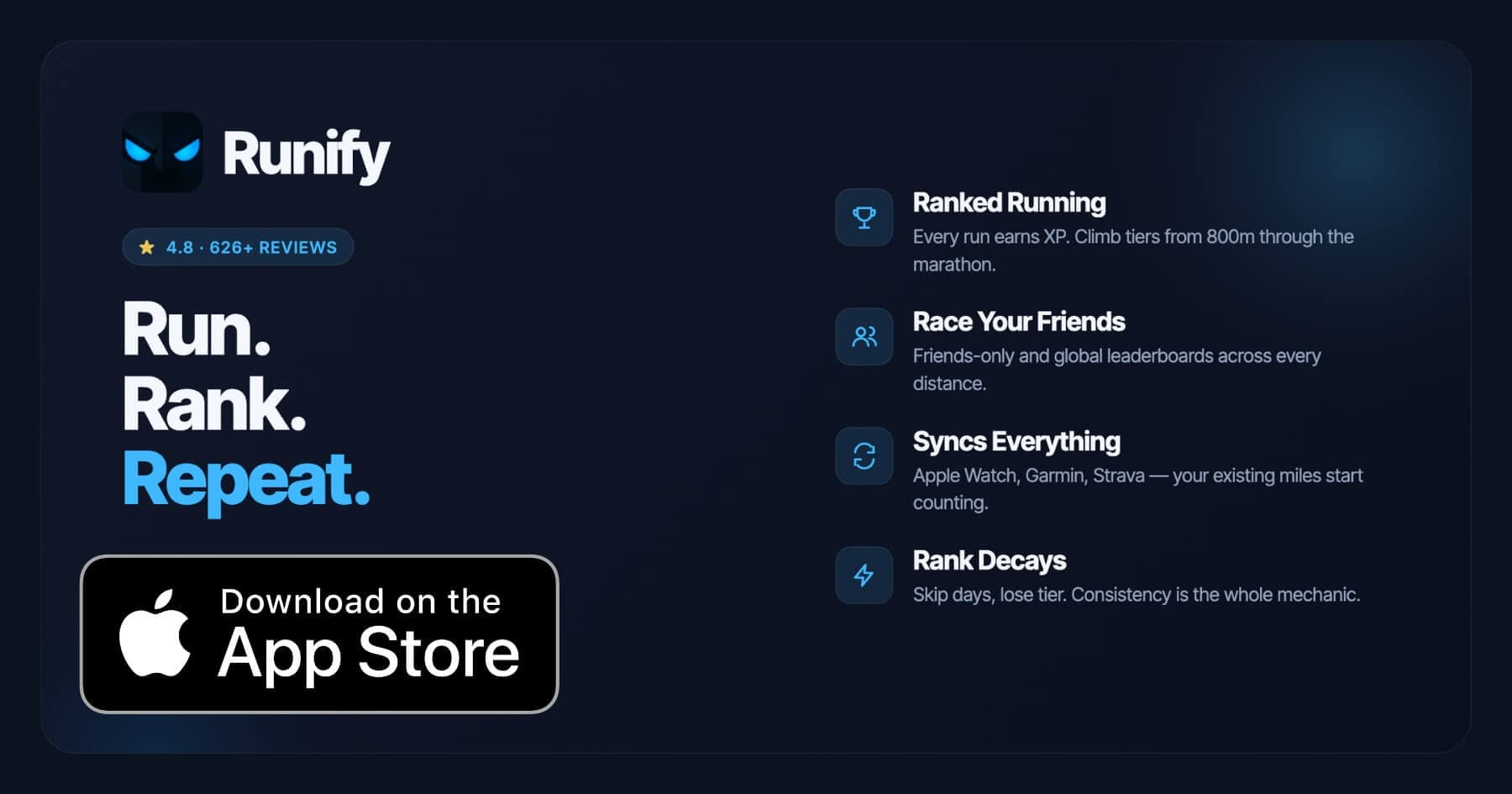
Runify does. It is the first ranked running app, built around XP, competitive tiers, and leaderboards across actual race distances: 800m, 1K, 5K, 10K, half marathon, and full marathon. Every run you sync from Apple Watch or Garmin earns XP and moves you through the rank system. Go inactive and your rank decays, which keeps consistency visible and stakes real.
You do not have to switch watches. Runify imports from Apple Watch via HealthKit, from Garmin directly, and from Strava - so your existing miles count from day one. The best running apps for Apple Watch Ultra guide covers this in more detail, but Runify's social layer sits on top of your current setup rather than replacing it. It holds 4.8 stars on the App Store across 626+ reviews.
Runify is iOS only and not a coached training-plans app. It does not offer audio coaching, route discovery, or race event signup. It is built for runners who want to gamify their existing mileage and compete - not for runners seeking structured plans.
When Runify Is the Better Pick Than Both
- You want a visible, competitive reason to keep running (XP, rank, rank decay).
- You already track on Apple Watch, Garmin, or Strava and want those miles to count toward something.
- You care about distance-specific performance (800m through marathon) on friends and global leaderboards.
- You like sharing stylized run recaps to Instagram Stories.
When Runify Is Not the Right Fit
- You're on Android. Runify is iOS only today.
- You want structured training plans, pace coaching during a run, or audio-coached workouts.
- You want route discovery or race signup features.
How to Choose Between Apple Watch Ultra and Garmin Forerunner
Here are the five questions that usually decide the answer.
- Are you on iPhone or Android? If Android, Apple Watch Ultra is off the table entirely. Go Garmin.
- How long are your longest runs? Sessions under 6 hours work fine on both. Anything longer - ultras, multi-day adventures - needs Garmin's battery life.
- Do you want coaching built into the watch? Garmin Forerunner's PacePro, Daily Suggested Workouts, and VO2 max feedback are native and rich. Apple Watch leans on third-party apps to match that depth.
- Do you want one device for life and running? Apple Watch Ultra handles payments, messages, and everyday notifications more smoothly. Garmin is a running watch that can also do those things, not a smartwatch that happens to track runs.
- What is your budget? The Forerunner 265 starts at ~$349. Apple Watch Ultra starts at $799. If price matters, Garmin's mid-range Forerunners deliver strong running features at half the Ultra's cost.
Frequently Asked Questions
Is Apple Watch Ultra or Garmin Forerunner better in 2026?
For pure running performance and training analysis, Garmin Forerunner leads in 2026. Its battery life, GPS accuracy in technical terrain, and coaching depth (PacePro, Daily Suggested Workouts, VO2 max, Body Battery) are unmatched for serious runners. Apple Watch Ultra 3 is the stronger choice if you want a premium smartwatch that handles running well - great for everyday wearers who also train. The right answer depends on whether your watch needs to do life-things as well as running things.
Can I use Apple Watch Ultra and Garmin Forerunner together?
Most runners pick one. That said, some athletes wear a Garmin for runs and an Apple Watch for daily life. Data does not automatically flow between the two ecosystems. Strava is the common layer - both watches sync to Strava, and from Strava you can funnel data elsewhere. Runify imports from both Apple Watch (via HealthKit) and Garmin directly, so if you use either watch for running, Runify can pull those miles into the rank system without you changing anything.
Which is cheaper, Apple Watch Ultra or Garmin Forerunner?
Garmin Forerunner is considerably cheaper across most of the lineup. The Forerunner 265 runs around $349, the Forerunner 570 is $549.99, and even the flagship Forerunner 970 comes in at $749 - just below the Apple Watch Ultra 3's $799 starting price. If you do not need the Ultra's smartwatch capabilities, Garmin offers comparable or better running performance at a lower price point.
Which has better GPS accuracy, Apple Watch Ultra or Garmin Forerunner?
Both use dual-band (L1 + L5) GNSS, and both perform well on roads and clear trails. In comparative testing, Garmin recorded distance within 0.3-0.5% of verified course distance in technical terrain; Apple Watch Ultra 3 landed within 0.5-1% in open conditions but showed 2-4% deviation in urban canyons and dense canopy. For most recreational runners, the difference is negligible. For trail runners and urban runners in high-rise areas, Garmin holds a consistent edge.
What is the best alternative to both Apple Watch Ultra and Garmin Forerunner?
If you already own either watch and want to add competitive social running to your stack, Runify is worth checking out. It imports runs from Apple Watch via HealthKit and from Garmin directly, then ranks them on friends and global leaderboards across 800m, 1K, 5K, 10K, half, and full marathon. Your XP accumulates, your rank rises with consistency, and decays if you go inactive. It holds 4.8 stars on the App Store with 626+ reviews and is available at $4.99/month or $39.99/year (7-day free trial on annual).
Final Verdict
Apple Watch Ultra and Garmin Forerunner are genuinely excellent at different things. If you want one device to cover your life and your running, Apple Watch Ultra 3 is a well-rounded choice for iPhone users with serious training demands. If your watch is purely a training tool and you want the deepest metrics available - especially at distances that test battery life - Garmin Forerunner delivers.
Garmin Forerunner for data-driven runners, endurance athletes, and anyone on Android. Apple Watch Ultra for iPhone users who want a premium smartwatch that can handle serious running without switching devices.
If you want ranked, competitive running on top of either watch, Runify sits on top of both ecosystems. Your existing miles count from day one.
Ready to put your runs on a leaderboard? Download Runify on the App Store and start climbing the ranks.

4.8 on the App Store · Built for iOS