TrainingPeaks vs Smashrun: Compared in 2026
TrainingPeaks vs Smashrun: The Quick Verdict
TrainingPeaks suits serious, goal-driven runners and triathletes who want structured training plans, coach-athlete workflows, and performance management charts. Smashrun suits data-curious runners who want beautiful analytics and gamified badge systems at a much lower price. TrainingPeaks Premium costs $19.99/month (or $119.99/year) with a solid free tier; Smashrun Pro runs around $4.99/month (or $49.99/year), with a generous free plan that covers most runners. Neither app focuses on competitive ranking or leaderboards - if that is what you want, Runify is worth a look as a third option built entirely around friends and global leaderboard competition.
At a Glance: TrainingPeaks vs Smashrun
| Feature | TrainingPeaks | Smashrun |
|---|---|---|
| Best For | Coached, goal-driven endurance athletes | Data-curious runners wanting analytics |
| Pricing | Free; Premium $19.99/mo or $119.99/yr | Free; Pro $4.99/mo or $49.99/yr |
| Platform | iOS + Android + Web | Web only (no official mobile app) |
| Standout Feature | Performance Management Chart and CTL/ATL | Fun data visualizations and badge system |
| Main Limitation | Expensive; steep learning curve | No mobile app; limited social features |
What Is TrainingPeaks?
TrainingPeaks is a training platform built for endurance athletes - runners, triathletes, cyclists, and swimmers who want structured, coach-guided preparation. Founded in 2000 and now trusted by 35+ national sports federations, TrainingPeaks centers on the Performance Management Chart, which tracks Chronic Training Load (CTL), Acute Training Load (ATL), and Training Stress Balance (TSB) over time.
The platform connects with virtually every major GPS watch and cycling computer on the market. Athletes can load structured workouts directly onto their Garmin or Wahoo devices, then review compliance and analytics the moment the session syncs back. Coaches can monitor every athlete in a shared dashboard.
TrainingPeaks is available on iOS, Android, and web. It has 4+ million athletes and is widely regarded as the gold standard for data-driven endurance training.
TrainingPeaks Key Features
- Performance Management Chart: Visualizes CTL, ATL, and TSB to help you avoid overtraining and peak at the right time.
- Structured Workouts: Build or import workouts with precise targets (power, pace, HR) that sync directly to compatible devices.
- Training Plan Marketplace: Browse and buy plans from professional coaches, loaded directly to your calendar.
- Multi-Sport Logging: Tracks running, cycling, swimming, strength, and more in one calendar view.
- Device Sync: Native integration with Garmin, Polar, Wahoo, Zwift, Coros, Suunto, and Strava.
TrainingPeaks Pricing
- Free: Basic activity logging, 7-day training calendar, limited analytics.
- Premium: $19.99/month or $119.99/year. Unlocks the Performance Management Chart, structured workout files, the full plan marketplace, and multi-sport analysis.
- Coaches pay a separate subscription starting at $21.99/month, plus $9/athlete/month for premium athletes.
TrainingPeaks Strengths
- The Performance Management Chart is unmatched for tracking training load and peaking for races.
- The plan marketplace gives you access to professional coaching without hiring a personal coach.
- Deep device ecosystem - syncs automatically with almost every GPS watch and head unit available.
TrainingPeaks Weaknesses
- Premium pricing is high relative to casual running apps, and coach + athlete subscriptions stack up quickly.
- The free tier restricts access to only 7 days of calendar history, which frustrates many users.
- No built-in real-time messaging; coach-athlete communication happens through comments, not a chat system.
What Is Smashrun?
Smashrun is a web-based running analytics platform built for runners who love data visualization. Launched in 2013, Smashrun imports your GPS run data and turns it into colorful, interactive charts covering pace trends, heart rate zones, elevation profiles, training consistency, and more. The platform handles only running - no cycling, swimming, or other sports.
Smashrun's free plan is unusually generous for a data-focused tool. You get access to a solid set of charts, a badge system that rewards consistency and milestones, and a personalized run history without paying anything. The Pro tier unlocks more advanced analytics like Training Bands, Pace Trends across all distances, and detailed map breakdowns.
Smashrun operates as a web-first platform with no official iOS or Android app. A third-party iOS app called LongRun provides some mobile access, but Smashrun itself does not maintain a native mobile experience.
Smashrun Key Features
- Interactive Data Visualizations: Charts for pace, heart rate, elevation, cadence, and training consistency presented in a clear, visual format.
- Badge and Achievement System: Earn quirky, gamified badges for milestones like longest run, most consistent month, and fastest splits.
- Pace Trend Analysis (Pro): Compare performance across all distances and see a personal performance curve over time.
- Training Bands (Pro): Visualize training intensity distribution across pace, heart rate, and hill grade.
- Pro Map: A detailed breakdown of custom laps, heart rate zones, pace buckets, and your fastest segments within any run.
Smashrun Pricing
- Free: Activity log, interactive charts, badge system, and basic run history.
- Pro: Approximately $4.99/month or $49.99/year. Unlocks pace trends, training bands, pro maps, progress-toward-goal tracking, and additional analytics.
Smashrun Strengths
- The free plan is genuinely useful for casual runners, not just a preview.
- Data visualizations are some of the most visually appealing in the running-analytics space.
- Badges and milestones add a light layer of gamification that keeps casual runners engaged.
Smashrun Weaknesses
- No official mobile app, which limits how runners interact with their data day-to-day.
- Social features are minimal - no real-time competition, friend leaderboards, or community feeds.
- Data import from some platforms (like older Runkeeper exports) can require manual work.
TrainingPeaks vs Smashrun: Head-to-Head
Both apps are built for runners who care about data, but they solve different problems. TrainingPeaks is a planning and coaching tool first, analytics second. Smashrun is a visualization and motivation tool with no planning layer at all.
Tracking Accuracy
Neither app does its own GPS tracking - both rely on data imported from your device or third-party app. TrainingPeaks accepts structured workout data with power, pace, and HR targets and shows compliance against plan. Smashrun focuses on visualizing the GPS data you already have. For accuracy, both are only as good as your source device (Garmin, Apple Watch, etc.).
Training Plans and Coaching
TrainingPeaks wins this axis clearly. Its plan marketplace has hundreds of professionally designed programs for 5K through ironman, and structured workouts push directly to Garmin and Wahoo devices. Smashrun offers no training plans and no coaching tools whatsoever - it is a retrospective analytics platform, not a planning one.
Social and Community Features
Neither app has strong social features, but Smashrun's badge system adds a light social layer. You can share badge achievements and see milestone rankings within Smashrun's community. TrainingPeaks has a coach-athlete communication layer but nothing resembling a social feed or friend leaderboard. If you're looking for a running app with leaderboard competition, our best Smashrun alternatives breakdown covers options built specifically for that use case.
Pricing and Value
Smashrun delivers significantly more value on a per-dollar basis for the casual runner. Its free plan beats TrainingPeaks' free tier by a wide margin, and Pro at roughly $49.99/year is less than half the $119.99/year TrainingPeaks charges for Premium. TrainingPeaks justifies its price for runners working with a coach or training for a specific race with a structured plan - but for someone who just wants to understand their running data, Smashrun costs far less.
Hardware Integration
TrainingPeaks has the deeper integration story. It syncs natively with Garmin, Polar, Wahoo, Zwift, Coros, Suunto, and Strava, and supports workout delivery to compatible devices pre-run. Smashrun accepts imports from Garmin, Strava, Polar, Fitbit, Suunto, and others, but the workflow is import-only - you log on your device, then Smashrun analyzes the result. For a broader view of how analytics tools handle device integrations, the best TrainingPeaks alternatives post goes deeper on platform support.
Platform and Availability
TrainingPeaks is available on iOS, Android, and web - you can review your calendar, log workouts, and view your performance chart from your phone on the go. Smashrun is web-only by design. The third-party iOS app LongRun offers some mobile Smashrun access, but it is not an official Smashrun product. If a mobile app matters to your daily routine, this difference is significant.
Who Should Choose TrainingPeaks?
TrainingPeaks makes sense when your running has a specific goal attached - a race date, a target time, or a structured build - and you want tools to manage that preparation properly.
- Runners training for a marathon or half marathon who want a day-by-day structured plan synced to their watch.
- Athletes working with a remote coach who needs visibility into training compliance and load.
- Multi-sport athletes (triathletes, duathletes) who need a single platform for swim, bike, and run.
Who Should Choose Smashrun?
Smashrun fits runners who are more interested in reviewing where their training has been than planning where it is going.
- Data-curious runners who want to understand their pace trends, heart rate zones, and consistency patterns in a visual, accessible way.
- Budget-conscious runners who want useful analytics without paying a premium price.
- Runners who already use another app for daily logging (Strava, Garmin Connect, Apple Watch) and want a richer analysis layer on top.
A Third Option: Runify for Ranked, Competitive Running
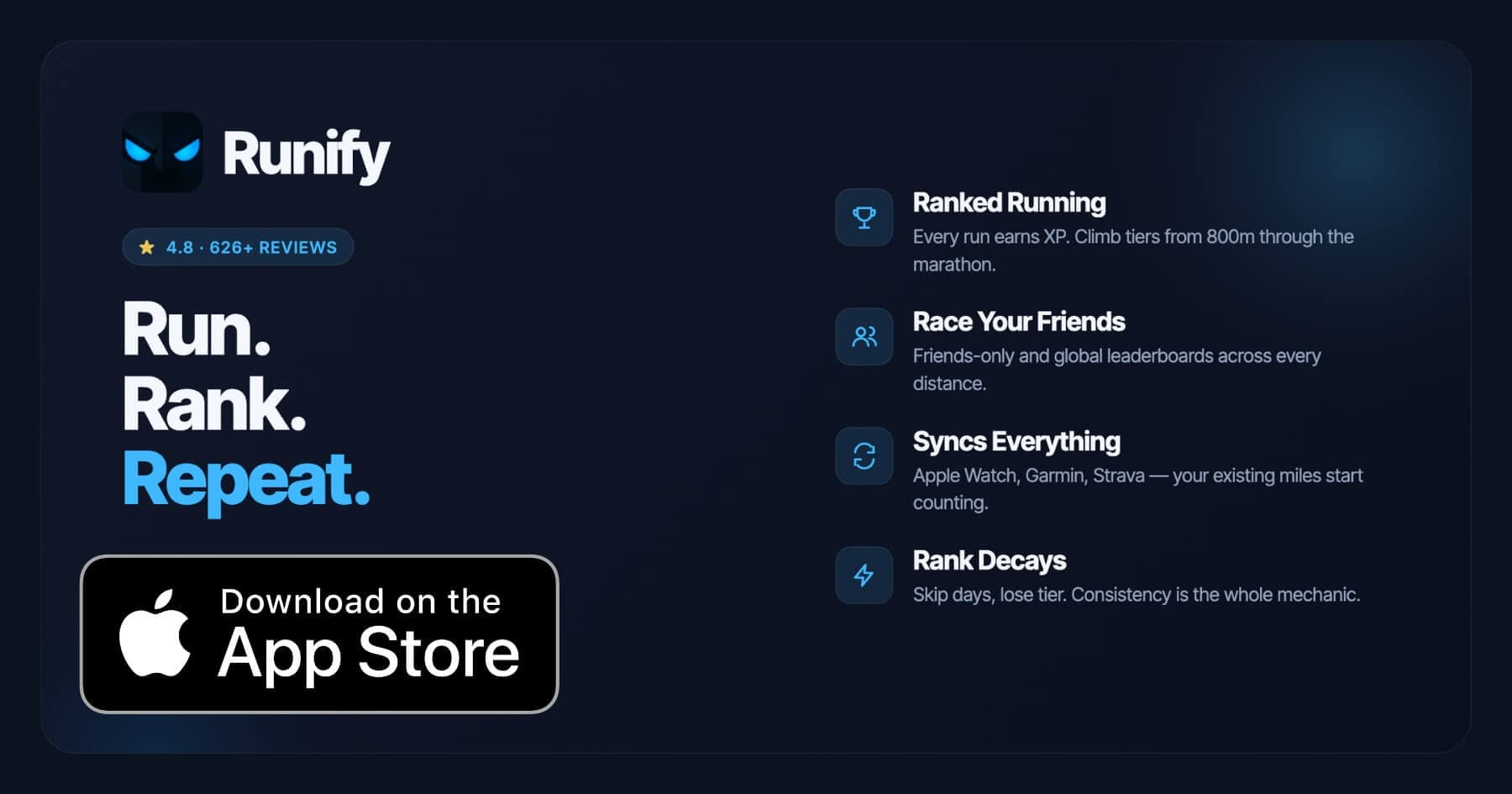
Neither TrainingPeaks nor Smashrun does what Runify does - turn every run into a rank competition. Runify is the first running app built around a full tier system: every run earns XP, your rank climbs across friends-only and global leaderboards, and going inactive causes rank decay that keeps you accountable.
If your existing runs already live in Apple Watch, Garmin, or Strava, Runify imports them without requiring you to switch trackers. Your past miles count toward your rank immediately. Distance-specific leaderboards cover 800m, 1K, 5K, 10K, half marathon, and full marathon, and you can switch between overall rank and distance-specific ladders anytime.
Runify also has shareable stylized run recaps - useful for posting to Instagram Stories or sharing with friends - and streak tracking that celebrates consistency. The app holds a 4.8-star rating on the App Store with 626+ reviews. For runners who already log data in Smashrun or use TrainingPeaks for plans, Runify layers competitive ranking on top without displacing either tool. The best running apps for running logs comparison covers how Runify fits alongside log-focused platforms.
When Runify Is the Better Pick Than Both
- You want a visible, competitive reason to keep running (XP, rank, rank decay).
- You already track on Apple Watch, Garmin, or Strava and want those miles to count toward something.
- You care about distance-specific performance on friends and global leaderboards.
- You like sharing stylized run recaps to Instagram Stories.
When Runify Is Not the Right Fit
- You're on Android. Runify is iOS only today.
- You want structured training plans, pace coaching during a run, or audio-coached workouts. Runify focuses on tracking, ranking, and social competition - not coaching.
- You need advanced analytics like CTL/ATL, training load modeling, or pace zone breakdowns. For that, TrainingPeaks or Smashrun are better fits.
How to Choose Between TrainingPeaks and Smashrun
The decision usually comes down to one question: are you planning forward or analyzing backward?
-
You're training for a specific race: Choose TrainingPeaks. The plan marketplace, structured workouts, and Performance Management Chart are purpose-built for this. Smashrun has no planning tools.
-
You want analytics without a high cost: Choose Smashrun. Its free tier is genuinely useful, and Pro at $49.99/year is less than half what TrainingPeaks charges. For runners who already have a tracker they love, Smashrun adds a great analysis layer.
-
You need a mobile app: Choose TrainingPeaks. Smashrun is web-only, which limits how you can access your data on the go. If mobile access matters to your daily routine, this alone may decide the choice.
-
You work with a coach: Choose TrainingPeaks. The coach-athlete dashboard, compliance tracking, and structured workout delivery are designed specifically for remote coaching relationships. Smashrun has no coach workflow at all.
-
You want social competition: Neither app is the right fit. TrainingPeaks is for training management; Smashrun is for retrospective analysis. For friends leaderboards and rank-based competition, look at apps built specifically for social running.
Frequently Asked Questions
Is TrainingPeaks or Smashrun better in 2026?
TrainingPeaks is better for runners following structured training plans and working toward a specific race. Smashrun is better for runners who want affordable, visual analytics on their existing data without paying premium prices. Neither app is universally superior - the right choice depends entirely on whether you need planning tools (TrainingPeaks) or retrospective analytics (Smashrun). If price is a deciding factor, Smashrun's free plan and $49.99/year Pro subscription are hard to beat for what they offer.
Can I use TrainingPeaks and Smashrun together?
Yes - and many runners do. TrainingPeaks handles structured planning, coaching, and workout delivery to your watch. Smashrun handles visual analytics of your completed runs. Since both import from Garmin, Strava, and other devices, you can run your training through TrainingPeaks and pipe completed activities into Smashrun for additional analysis. Runify also imports from Garmin and Strava, so adding rank-based competition on top requires no change to your existing setup.
Which is cheaper, TrainingPeaks or Smashrun?
Smashrun is significantly cheaper. Smashrun Pro costs approximately $4.99/month or $49.99/year, and the free plan covers most casual runners. TrainingPeaks Premium costs $19.99/month or $119.99/year, with no free access to the Performance Management Chart. For coaches, TrainingPeaks stacks additional per-athlete fees on top. If budget is a priority, Smashrun delivers useful analytics at a fraction of the cost.
Which has better tracking accuracy, TrainingPeaks or Smashrun?
Both platforms rely on data imported from your GPS watch or tracking app - neither does its own GPS recording. Accuracy depends entirely on your source device (Garmin, Apple Watch, Coros, etc.). TrainingPeaks shows more detailed metrics around compliance with structured workouts, including power and pace targets. Smashrun focuses on visualizing your recorded data with elevation, HR zone breakdowns, and pace charts. Neither platform improves or degrades the GPS accuracy of your original device.
What is the best alternative to both TrainingPeaks and Smashrun?
For runners who want competitive, ranked running rather than training plans or analytics, Runify is a strong option. Runify's tier system awards XP for every run, advances you through friends and global leaderboards across race distances (800m through marathon), and applies rank decay if you go inactive. It imports existing runs from Apple Watch, Garmin, and Strava, so you keep your current tracker and add competition on top. Runify holds a 4.8 App Store rating with 626+ reviews. It is iOS only and does not offer structured training plans or coaching features.
Final Verdict
TrainingPeaks and Smashrun serve different types of runners. TrainingPeaks is the right choice for athletes who want structured plans, coach oversight, and a clear view of training load over time - it earns its premium price for runners with specific race goals. Smashrun is the right choice for data-curious runners who want to understand their training history through beautiful charts without the cost or complexity of a full coaching platform.
Neither app is built for competitive social running or leaderboard-based motivation. If that is the missing piece, Runify layers ranked competition on top of whatever tracker you already use, with a rank system, decay-based accountability, and distance-specific leaderboards across 800m through the marathon.
Try Runify free for 7 days with an annual plan. Download on the App Store.

4.8 on the App Store · Built for iOS