Stryd vs Garmin Running Power: Compared in 2026
Stryd vs Garmin Running Power: The Quick Verdict
Stryd is the better choice for runners who want the most accurate, hardware-dedicated power metric available and are willing to pay for it. Garmin Running Power suits runners who already own a Garmin watch and want a usable power number without buying extra hardware.
Stryd is a footpod that costs $249 one-time and uses on-foot inertial sensors to calculate power in watts. Garmin calculates power natively on many Forerunner, Fenix, and Epix models using GPS, wrist-based sensors, and an HRV algorithm - no extra hardware required.
The two power numbers are not directly comparable: Stryd power tends to run 10-15% higher than Garmin power, and the methodologies differ enough that switching between platforms mid-training cycle resets your training zones. Pick one and stay consistent.
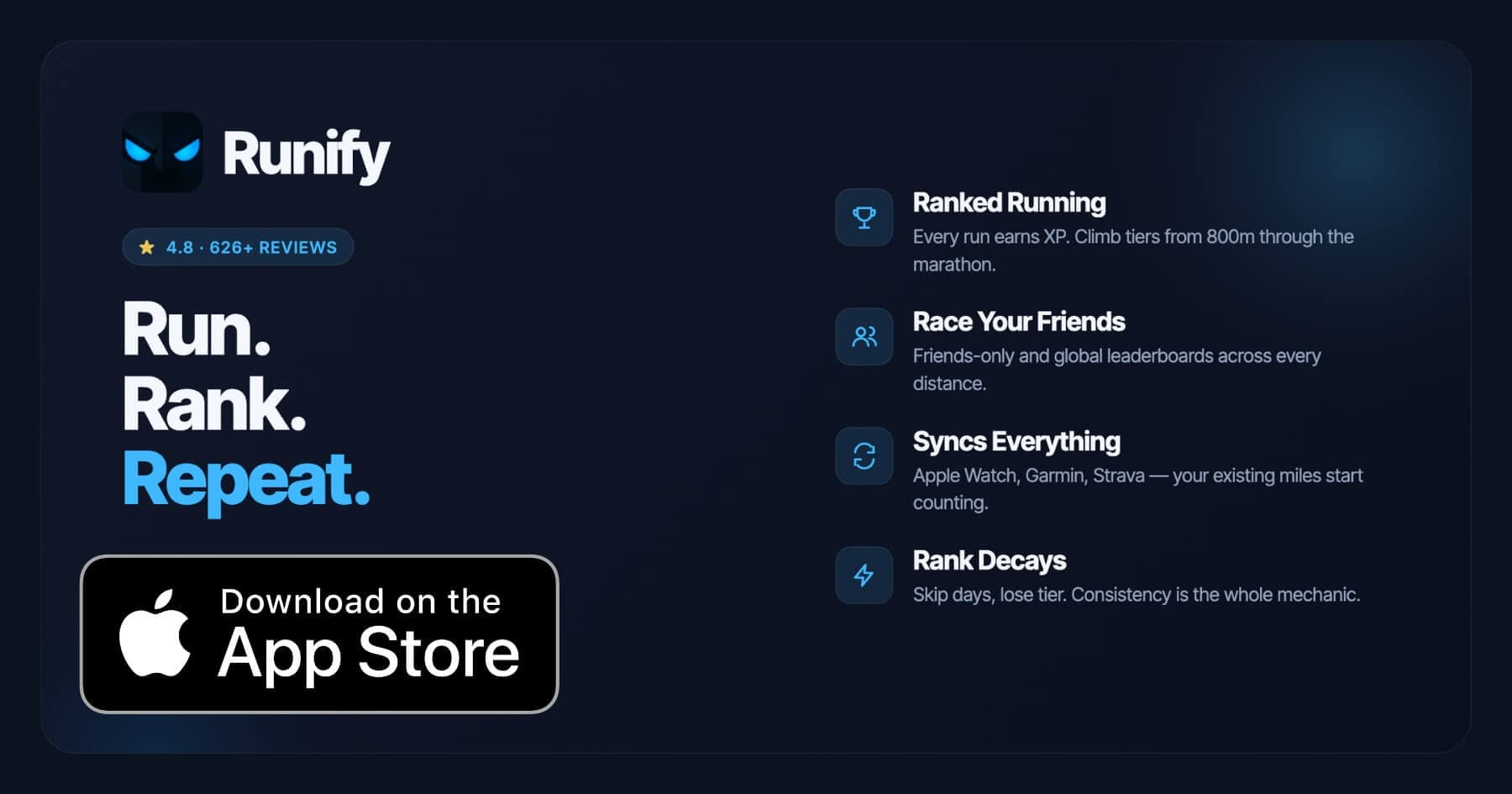
For runners who want to add ranked competitive running on top of either platform, Runify syncs from both Garmin and Strava and turns your existing runs into ranked XP on friends and global leaderboards.
At a Glance: Stryd vs Garmin Running Power
| Feature | Stryd | Garmin Running Power |
|---|---|---|
| Best For | Precise power-based training at all paces | Garmin watch owners wanting built-in power |
| Pricing | $249 one-time + $8/mo app subscription | Free with compatible Garmin watch |
| Platform | iOS + Android + Web | Garmin devices + Garmin Connect (iOS + Android + Web) |
| Standout Feature | Footpod accuracy in wind and on hills | No extra hardware needed |
| Main Limitation | Requires purchasing and wearing a footpod | Less accurate outdoors vs Stryd footpod |
What Is Stryd?
Stryd is a running power meter made by Stryd Inc., launched in 2015. The device clips onto your shoe lace or attaches to a shoe pod mount and uses a six-axis inertial measurement unit to calculate the power output of your legs with each stride.
The footpod connects to your watch via Bluetooth or ANT+ and broadcasts a real-time watts number that your watch can display during a run. Stryd also pairs with its own companion app, which hosts your run history, auto-calculated power zones, and race power targets.
As of 2026, Stryd has sold over 200,000 units worldwide and is widely regarded as the most research-backed independent running power meter available.
Stryd Key Features
- Footpod running power: Measures power in watts from on-foot inertial sensors - not GPS or wrist pulse.
- Wind power correction: The Stryd Pod with Wind variant adds a barometric wind sensor that adjusts power for headwind and tailwind resistance.
- Auto-calculated power zones: Stryd computes your Critical Power (CP) from recent runs and sets five training zones automatically.
- Race power calculator: Suggests a target race power for 5K through marathon based on your CP.
- Third-party watch support: Connects to Garmin, Apple Watch, Coros, Polar, Suunto, and Wahoo via open ANT+ and Bluetooth.
- Run form metrics: Reports cadence, ground contact time, leg spring stiffness, and vertical oscillation alongside power.
Stryd Pricing
The Stryd footpod costs $249 one-time. The Stryd Wind variant (adds wind measurement) costs $299 one-time. The Stryd app is free to download, but the Stryd Power Center subscription costs $8/month or $60/year and unlocks race planning, detailed training log, and historical analysis. Core power display during runs is available without the subscription.
Stryd Strengths
- Consistent accuracy across conditions: hills, treadmills, and wind do not distort the power number the way GPS-based metrics can
- Works with virtually any modern GPS watch, not just Garmin
- Critical Power is backed by peer-reviewed exercise science
Stryd Weaknesses
- $249 is a significant upfront investment before you know whether power-based training suits you
- The app subscription adds recurring cost on top of hardware
- Footpod must be worn, charged, and remembered - one more device to manage
What Is Garmin Running Power?
Garmin Running Power is a native data field available on most Forerunner 255 and newer, Fenix 7 and newer, and Epix devices. No extra hardware is required: Garmin estimates running power using GPS speed, elevation change, wrist-based HR data, HRV, and its proprietary FirstBeat Analytics algorithm.
The feature launched in 2018 as a free IQ Connect data field, then became deeply integrated into higher-end watches with the Forerunner 965, Fenix 7 Pro, and Epix Pro releases. You enable it in your watch settings, add power as a data field on a run screen, and it reads watts in real time.
Garmin's power metric is also available as training load context inside Garmin Connect, which tracks how running power contributes to your overall weekly stress score.
Garmin Running Power Key Features
- No hardware required: Power appears on screen the moment you enable the data field on a compatible watch.
- Garmin Connect integration: Power history syncs directly to Garmin Connect and populates training load and recovery time estimates.
- Grade-adjusted power: Garmin adjusts the watts number for elevation, so uphill effort reflects higher power than flat running at the same pace.
- Training readiness integration: Running power feeds into Garmin's overall Training Readiness score alongside sleep and HRV.
- Real-time power zones: Define five or seven zones inside the Garmin Connect app and receive alerts when you drift outside the target range during a run.
- Power-based structured workouts: Garmin Coach and manually built workouts can target a watts range instead of pace, useful for racing on hilly courses.
Garmin Running Power Pricing
Garmin Running Power is free on any compatible Garmin watch. Compatible watches start at around $349 (Forerunner 255) and go up to $999+ (Epix Pro). Garmin Connect - where data syncs and is analyzed - is free with no subscription required for core features. Garmin Connect+ (the premium tier) is $6.99/month and adds some coaching features, but power data is fully accessible without it.
Garmin Running Power Strengths
- Zero marginal cost if you already own a compatible Garmin watch
- Seamless integration with Garmin Connect training load, recovery, and sleep data
- Available natively on your wrist without a paired accessory
Garmin Running Power Weaknesses
- Less accurate than a dedicated footpod on hills, in wind, and during interval pacing changes
- Only works within the Garmin ecosystem - cannot broadcast to Apple Watch or third-party apps
- Power numbers are not compatible with Stryd zones, making cross-platform comparisons misleading
Stryd vs Garmin Running Power: Head-to-Head
Both tools display watts on your wrist during a run. The differences show up in how that number is computed, how accurate it is in real-world conditions, and how deeply it integrates with your other tools.
Measurement Accuracy
Stryd is more accurate, particularly on hills and in wind. The footpod measures the actual mechanical power your legs produce with each stride, so a 10% grade climb registers as a real jump in output. Garmin uses GPS elevation change, which can lag 5-10 seconds behind actual terrain, causing power to spike or dip after you've already crested a hill.
A 2022 peer-reviewed study in the International Journal of Sports Physiology and Performance found Stryd power more closely matched laboratory metabolic power than GPS-derived estimates. In controlled flat conditions, the gap narrows, but Stryd still shows more stride-to-stride variability that reflects actual effort rather than smoothed GPS averages.
Training Zone Setup
Stryd's Critical Power (CP) test and auto-zone calculation are purpose-built for running power training. You run a 9-minute all-out effort, Stryd fits a curve to the data, and five zones appear automatically. Garmin requires you to manually set zones inside Garmin Connect, which means most runners copy a rough percentage of their max HR or max pace rather than a validated CP.
If you are serious about power-based training plans and periodization, Stryd gives you a more structured foundation. If you just want a secondary reference metric alongside pace, Garmin's built-in approach is easier to set up.
Ecosystem Integration
Garmin Running Power wins here for Garmin watch owners. Power syncs automatically to Garmin Connect, feeds training load, and appears in post-run summaries without any extra setup. Stryd requires the Stryd app running alongside your existing tracking app, and syncing to Garmin Connect (possible but fiddly) or Strava adds steps.
Stryd's advantage is cross-ecosystem reach. If you switch from a Garmin watch to an Apple Watch, a Coros, or a Polar, your Stryd footpod travels with you and your training history stays intact. Garmin power is tied to Garmin hardware. As highlighted in our best running apps for Garmin watch owners guide, Garmin's platform is powerful but largely self-contained.
Pricing and Value
Garmin wins on price if you already own a compatible watch. The running power feature costs nothing extra. Stryd requires $249 upfront for the footpod, plus $60/year if you want the full app experience.
The value equation tips toward Stryd if you:
- Train seriously with structured power workouts
- Race on hilly courses where accuracy matters most
- Use a non-Garmin watch
The value equation tips toward Garmin if you:
- Already own a Garmin and primarily use power as a secondary check
- Run mostly flat routes at a steady effort
- Are new to power-based training and want to try it without a hardware commitment
Third-Party App and Data Export
Stryd exports to Strava, TrainingPeaks, Final Surge, and Garmin Connect via API. Power data travels with the FIT file. Garmin Running Power is embedded in FIT files from Garmin's own export and shows up in Strava and TrainingPeaks when you sync from Garmin Connect. Both platforms support open data export. Neither locks your data away.
The key difference: Stryd power in a Garmin-exported FIT file shows as an external device power metric and will appear in third-party tools. Garmin internal power may not populate the same fields recognized by non-Garmin software. For Strava users managing both, our best Stryd app alternatives breakdown covers which third-party tools handle each power source cleanly.
Platform Availability
Garmin Running Power is exclusive to Garmin watches. The data lives in Garmin Connect (iOS, Android, and web). Stryd pairs with virtually any ANT+ or Bluetooth Smart watch, including Garmin, Apple Watch, Coros, Polar, Suunto, and Wahoo. Stryd's companion app is available on iOS, Android, and web.
Who Should Choose Stryd?
Stryd fits runners who take power-based training seriously and want the most accurate data available across any hardware they use.
- Runners who train on hilly terrain or in variable wind conditions where GPS-derived power is unreliable
- Multi-watch athletes or those likely to switch watch brands in the next few years
- Runners following structured power-based training plans (Critical Power intervals, race power targets) and need validated zones
- Triathletes or cross-sport athletes who want one consistent power metric across running, cycling, and treadmill training
Who Should Choose Garmin Running Power?
Garmin Running Power suits runners who want a useful power reference without buying extra hardware - especially if they already live in the Garmin ecosystem.
- Garmin watch owners who are curious about running power but not yet committed to buying a dedicated meter
- Runners who do most of their training on relatively flat terrain where GPS accuracy is less of a factor
- Runners who primarily use power as a secondary metric alongside pace and heart rate, not as the primary guide for intervals
- Beginners to power-based running who want to experiment with the concept before investing in dedicated hardware
A Third Option: Runify for Ranked, Competitive Running
Neither Stryd nor Garmin Running Power addresses what motivates many runners day to day - the social and competitive element that keeps you consistent over months. Runify fills that gap.
Runify is a ranked running app that turns every run into XP, moves you through a competitive tier system, and puts you on friends-only and global leaderboards across 800m, 5K, 10K, half marathon, and marathon distances. It syncs from Garmin via Strava or direct Garmin Connect integration, so if you already track on your Garmin Forerunner or Fenix, your existing miles automatically count toward your rank.
The app has a 4.8-star rating on the App Store across 626+ reviews. Runners who use Stryd through Garmin Connect or Strava can also pull those runs into Runify - the power data lives in your existing tracker, and Runify layers the competitive progression on top. As covered in our best running apps for Stryd users guide, Runify is one of the strongest social complements to a power-based setup.
When Runify Is the Better Pick Than Both
- You want a visible, competitive reason to keep running (XP, rank, rank decay)
- You already track on Garmin or Strava and want your existing miles to count toward something
- You care about distance-specific performance on friends and global leaderboards
- You like sharing stylized run recaps to Instagram Stories after a strong workout
When Runify Is Not the Right Fit
- You're on Android. Runify is iOS only today.
- You want structured training plans, power-based coaching during a run, or audio-coached workouts. Runify focuses on tracking, ranking, and social competition - not coaching.
- You want route discovery or race signup features.
How to Choose Between Stryd and Garmin Running Power
The decision comes down to how seriously you want to use running power and how much of your training budget you want to allocate to it.
-
Already own a compatible Garmin watch? Start with Garmin Running Power first. It costs nothing, gives you a genuine feel for how power-based metrics affect your training, and may be all you need if you run mostly flat routes.
-
Train on hilly terrain? Stryd's footpod accuracy on elevation changes is noticeably better than GPS-derived estimates. If hills are a consistent part of your training, Stryd's precision pays off in more reliable intervals.
-
Plan to follow structured power-based plans? Stryd's Critical Power test and five-zone structure are purpose-built for power training. Garmin's manual zone setup is workable but less validated out of the box.
-
Use a non-Garmin watch? Stryd works with Apple Watch, Coros, Polar, Suunto, and Wahoo. If you aren't on Garmin hardware, Stryd is your only option for real-time running power.
-
Have a budget for extra hardware? If $249 would stretch your gear budget, start free with Garmin. If you're already spending on race entries and quality shoes, Stryd's one-time cost pays back over years of training.
Frequently Asked Questions
Is Stryd or Garmin Running Power more accurate in 2026?
Stryd is more accurate in most real-world conditions, especially on hills and in wind. The footpod measures on-foot inertial data with each stride, while Garmin's algorithm relies on GPS speed and elevation that can lag terrain changes by several seconds. On flat treadmill or road running at steady pace, the gap narrows but Stryd still produces a more stride-level precise number. For casual power use, Garmin is accurate enough. For structured interval training tied to Critical Power zones, Stryd's measurement quality matters more.
Can I use Stryd and a Garmin watch together?
Yes, and many runners do. Stryd broadcasts power via ANT+ or Bluetooth, and your Garmin watch can display Stryd power as an external device field during a run. Post-run, Stryd data syncs to the Stryd app and can also push to Garmin Connect via Strava or direct integration. The main thing to note: Garmin will display both Stryd power and its own internal power estimate, and they will differ. Most runners set their Garmin to show Stryd power and disable the internal estimate to avoid confusion.
Which is cheaper, Stryd or Garmin Running Power?
Garmin Running Power is free on compatible Garmin watches, which start at around $349 for the Forerunner 255. Stryd costs $249 for the footpod plus an optional $60/year app subscription. If you already own a compatible Garmin, the choice is straightforward on price: use Garmin first. If you don't own a Garmin watch, comparing total cost requires factoring the watch price into the equation. Stryd works with cheaper mid-range watches from other brands.
Do Stryd and Garmin use the same power scale?
No, they do not. Stryd power readings tend to run 10-15% higher than Garmin's internally computed power for the same effort. The two metrics use different algorithms and different data inputs. This means you cannot mix Stryd zones and Garmin zones, and you should not compare your Stryd watts from one training cycle to Garmin watts from another. Pick one platform, establish your zones on that platform, and stay consistent throughout your training block.
What is the best alternative to both Stryd and Garmin Running Power?
For runners primarily interested in social competition and ranked progression rather than pure power data, Runify is a compelling alternative layer. It does not replace a power meter, but it turns your existing Garmin or Strava runs into XP, competitive rank, and leaderboard placement across 800m through marathon distances - which addresses the motivation gap that power metrics alone cannot fill. Runify is iOS only, costs $4.99/month or $39.99/year with a 7-day free trial on annual, and holds a 4.8-star rating on the App Store.
Final Verdict
Stryd and Garmin Running Power are solving slightly different problems. Stryd is a dedicated precision tool for runners who want the most reliable power data available, regardless of watch brand or terrain. Garmin Running Power is a convenient, free-with-your-watch feature that gives Garmin users a useful reference metric without any extra hardware.
If you own a Garmin watch and run mostly flat courses, start with Garmin Running Power - there is no reason to spend $249 before you know how power fits your training. If you train on hills, follow structured power plans, or use a non-Garmin watch, Stryd's accuracy and cross-ecosystem flexibility justify the investment.
For runners who want their existing miles to fuel something beyond just raw data - rankings, competitive progression, friends leaderboards - Runify works alongside both platforms and gives every run a result that matters.
Ready to make your runs count toward something? Download Runify on the App Store and turn your Garmin or Strava miles into competitive rank.

4.8 on the App Store · Built for iOS