Strava vs Garmin Connect: Compared in 2026
Strava vs Garmin Connect: The Quick Verdict
Strava is the better pick for runners who want a large social community, segment competition on popular routes, and compatibility with any GPS watch brand. With over 120 million registered users across 195 countries, it is the world's largest sports social network. Garmin Connect is the right choice for data-driven runners who own Garmin hardware - its depth of physiological metrics (VO2 max estimates, Body Battery, HRV Status, Training Readiness) goes further than any general-purpose running app. Many serious runners use both platforms at the same time: Garmin Connect for device data and training analysis, Strava for community and segments. For runners who want a third option focused on competitive ranking - a tier system where your rank rises with consistency and falls when you stop - Runify adds that layer on top of either platform.
At a Glance: Strava vs Garmin Connect
| Feature | Strava | Garmin Connect |
|---|---|---|
| Best For | Social running and segment competition | Data-driven training with Garmin devices |
| Pricing | Free; Premium $11.99/mo | Free; Connect+ $6.99/mo |
| Platform | iOS + Android + Web | iOS + Android + Web |
| Standout Feature | Global segment leaderboards and community | VO2 max, Body Battery, and HRV metrics |
| Main Limitation | Paywalls many core features | Full value requires Garmin hardware |
What Is Strava?
Strava is a social network for athletes built around GPS activity tracking and community competition. Founded in 2009, it has grown to over 120 million registered users in 195 countries and supports more than 50 activity types. Its core feature is Segments - timed sections of road or trail where every user who has ever run the same stretch appears on a ranked leaderboard. The social feed, clubs, kudos system, and group challenges create a daily motivation loop for millions of runners.
Strava works with virtually every GPS watch and fitness device on the market - Garmin, COROS, Polar, Suunto, Apple Watch, Samsung Galaxy Watch - making it the most broadly compatible running platform available. In 2026, Strava also acquired Runna, adding structured training plan capabilities to its subscription tier.
Strava Key Features
- Segments: Compete against every Strava user on specific stretches of road or trail; filter leaderboards by followers, age group, or club
- Social feed: Activity sharing, kudos, and comments from your running network; clubs, group activities, and challenges
- Multi-sport tracking: 50+ activity types including running, cycling, swimming, hiking, and more
- Route creation: Build custom routes using heatmaps of popular paths with elevation previews
- Training plans: Structured plans available on the subscription tier via Runna integration
- Heatmaps: Global heat maps showing popular running routes in any area
Strava Pricing
Strava free covers activity recording, basic stats, and the social feed. Strava Premium costs $11.99/month or $79.99/year and adds segment leaderboards, filtered leaderboard views, advanced training analysis, custom goals, smart route creation, and live segment performance. A 30-day free trial is available with no payment information required.
Strava Strengths
- Largest running community in the world with 120 million+ users
- Compatible with every major GPS watch and fitness platform on the market
- Segment system creates local competitive motivation on your regular routes
- Heatmaps and route discovery tools are among the best available
Strava Weaknesses
- Many features that were previously free now require the $11.99/month subscription - a recurring complaint among long-time users
- Social emphasis may feel overwhelming for runners who prefer solitary training
- Training analytics are less physiologically deep than Garmin Connect's native metrics
What Is Garmin Connect?
Garmin Connect is the companion app and data platform for Garmin's family of GPS watches and fitness devices. Approximately 45 million athletes use Garmin Connect, and for Garmin watch owners, the platform is nearly essential - it pulls every data point from the device into a single dashboard. Q1 2026 saw Garmin report a 42% fitness revenue increase, driven by strong device volume across running, cycling, and outdoor categories.
Garmin Connect's defining strength is physiological metrics. Where Strava shows you pace, distance, and elevation, Garmin Connect shows you Training Readiness (a composite score of sleep, HRV, recovery, and load), Body Battery (an energy reserve estimate throughout the day), VO2 max trends, and Recovery Time. These metrics require Garmin hardware to generate, which is the platform's core limitation.
Garmin Connect Key Features
- Advanced health metrics: VO2 max estimates, HRV Status, Body Battery, Training Readiness, and Recovery Time
- Training Status: Machine learning analysis of training load vs. fitness to identify overtraining or undertraining
- Structured workouts: Create and push custom workouts directly to your Garmin device
- 24/7 health monitoring: Sleep tracking, all-day heart rate, stress score, and menstrual cycle tracking
- Garmin Coach: Adaptive training plans that adjust based on your performance over time
- TrainingPeaks integration: Connect with third-party coaching platforms for advanced periodization
Garmin Connect Pricing
Garmin Connect is free for all Garmin device owners. Garmin Connect+ launched as a paid subscription tier at $6.99/month or $69.99/year, adding AI-powered training insights, a personalized performance dashboard, enhanced LiveTrack, and nutrition tracking. A 30-day free trial is available. The introduction of Connect+ generated significant user backlash - many users objected to previously free features moving behind a paywall.
Garmin Connect Strengths
- Deepest physiological training data available in any consumer running platform
- Free tier (included with Garmin device purchase) already exceeds what most apps charge premium prices for
- Adaptive training plans through Garmin Coach adjust based on your performance history
- Seamless integration with Garmin's full device ecosystem (watches, cycling computers, heart rate monitors)
Garmin Connect Weaknesses
- Without Garmin hardware, the platform offers minimal value - it cannot generate its signature metrics from non-Garmin devices
- Connect+ subscription launch attracted significant criticism for paywalling features; user sentiment remains mixed
- Social and community features are thin compared to Strava - no equivalent segment system or active club community
Strava vs Garmin Connect: Head-to-Head
Both platforms track runs well, but they're built for fundamentally different purposes. Garmin Connect is a data and training center; Strava is a social motivation system. The comparison breaks down across six axes.
Tracking Accuracy
Both platforms deliver accurate GPS tracking when paired with quality hardware. Garmin Connect has a natural edge in raw data granularity - pace, cadence, heart rate zones, elevation, power (with a compatible footpod), and physiological metrics all feed directly from the Garmin device. Strava receives this same data when Garmin syncs to Strava after a run, but the physiological layer (Body Battery, HRV, Recovery Time) stays in Garmin Connect exclusively. For runners who want the most complete picture of a single run, both platforms complement each other rather than compete.
Training Plans and Coaching
Garmin Connect's Garmin Coach offers adaptive training plans that adjust based on your actual performance over the plan's duration - if you hit a personal best mid-plan, the paces update. This real-time adaptation is a meaningful edge over static plans. Strava added structured training plans to its subscription tier via the Runna acquisition, which are well-regarded but not adaptive in the same way. Garmin Connect also supports TrainingPeaks integration for advanced coaching workflows that neither platform handles natively.
Social and Community Features
Strava has no equal for community running. Its clubs connect runners across geography and interest, its segment system creates daily competitive motivation on local routes, and the social feed of kudos and comments builds accountability in a way Garmin Connect does not attempt. Garmin Connect added some social features in 2026 - Garmin Connect was spotted internally targeting Strava's social layer in documents leaked in May 2026 - but the gap remains wide. If community motivation drives your training, Strava is the clear winner here.
Pricing and Value
Garmin Connect's free tier, included with any Garmin device, already delivers VO2 max estimates, Training Status, Body Battery, sleep tracking, and structured workout support. That bundle is genuinely exceptional value and exceeds what Strava's $11.99/month subscription offers on a pure data basis. Connect+ at $6.99/month adds AI insights and a performance dashboard, but user reviews are mixed on whether those additions justify the cost. Strava's free tier has been progressively hollowed out over recent years - segment leaderboards, advanced analysis, and goals all now require the subscription. On a feature-per-dollar basis, Garmin Connect's free tier wins for Garmin owners.
Hardware Integration
Garmin Connect is optimized for Garmin devices and extracts data that no other platform can replicate from those watches. Strava works with virtually every GPS watch on the market - Garmin, COROS, Polar, Suunto, Apple Watch, Samsung - accepting both direct connections and manual FIT/GPX file uploads. Most Garmin users sync their watch to both platforms simultaneously: Garmin Connect for metrics depth, Strava for community. As our best Garmin Connect alternatives guide explains, pairing the two is the most common advanced-runner setup.
Platform and Availability
Both Strava and Garmin Connect are available on iOS, Android, and as web platforms. Strava's web experience is particularly strong for route planning, segment analysis, and activity management from a desktop. Garmin Connect's web dashboard provides detailed health and training data in chart form. Both apps work offline for basic tracking, though metrics generation and sync require connectivity.
Who Should Choose Strava?
Strava fits runners who want community, competition on local routes, and compatibility with any device.
- Runners who care about segment competition on popular local roads and trails
- Athletes who use a non-Garmin device (COROS, Polar, Suunto, Apple Watch, Samsung) and want the best third-party community platform
- Multi-sport athletes who want running, cycling, swimming, and other sports tracked in one place with a social layer
- Runners who draw motivation from seeing their friends' activity daily and competing in group challenges
Who Should Choose Garmin Connect?
Garmin Connect fits data-driven runners who own Garmin hardware and want the deepest possible training insights.
- Garmin watch owners who want to use every metric their device generates - Body Battery, HRV, Recovery Time, Training Readiness
- Runners following structured training plans who want adaptive pacing from Garmin Coach
- Athletes who track sleep, stress, and 24/7 health data alongside running performance
- Runners preparing for a goal race with a coach or using TrainingPeaks for periodized training
A Third Option: Runify for Ranked, Competitive Running
Neither Strava nor Garmin Connect is built around a persistent competitive rank. Strava has segment leaderboards on premium, but there's no overall tier you climb based on all your running and no rank that falls when you go inactive. Garmin Connect's Training Status shows fitness trends, but not competitive position against other runners.
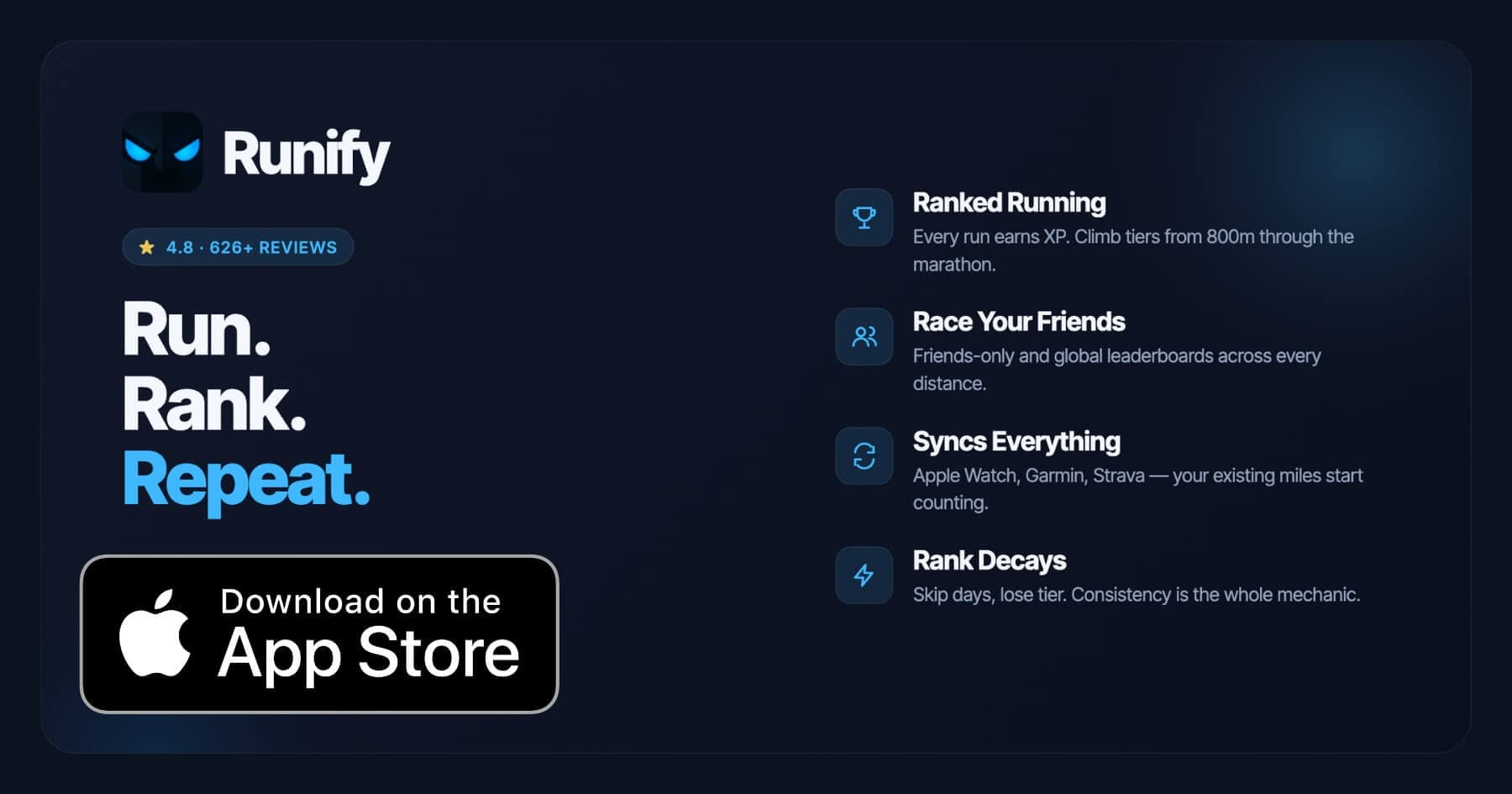
Runify fills that specific gap. Every run - whether tracked in-app or synced from Apple Watch, Garmin, or Strava - earns XP, moves you through a tier system, and places you on friends-only and global leaderboards across distances from 800m through the marathon. Rank decay means going inactive costs you your position, which turns consistency into a tangible, visible motivator. Runify is rated 4.8 stars on the App Store with 626+ reviews.
Many runners keep Garmin Connect for their device data and Strava for community, then add Runify for the competitive rank layer. Runify syncs from Garmin and Strava directly, so your existing miles count toward your rank without any double-tracking.
When Runify Is the Better Pick Than Both
- You want a visible, competitive reason to keep running (XP, rank, rank decay)
- You already track on Apple Watch, Garmin, or Strava and want those miles to count toward something
- You care about distance-specific performance (800m through marathon) on friends and global leaderboards
- You like sharing stylized run recaps to Instagram Stories
When Runify Is Not the Right Fit
- You're on Android. Runify is iOS only today.
- You want structured training plans, pace coaching during a run, or audio-coached workouts. Runify focuses on tracking, ranking, and social competition - not coaching.
- You want route discovery or race signup features.
How to Choose Between Strava and Garmin Connect
Five factors will point you toward the right platform - or confirm you need both.
- What watch do you own? If you own a Garmin, Garmin Connect is essential. If you own a COROS, Polar, Suunto, or Apple Watch, Strava is the better third-party home for your data.
- What motivates you to run? Community competition and segments motivate some runners more than physiological data. Honest self-assessment here matters more than feature lists.
- How much do you want to spend? Garmin Connect's free tier with Garmin hardware is exceptional value. Strava's free tier has been significantly limited over time - if you want full value, the $11.99/month subscription is essentially required.
- Do you want training plan guidance? Garmin Coach's adaptive plans adjust to your actual performance. Strava's Runna-backed plans are strong but less dynamic. If adaptive coaching matters, Garmin Connect has an edge.
- Do you need multi-platform data? Many runners use Garmin Connect for their device and Strava for community. The two are not mutually exclusive and work well together via the native Garmin-to-Strava sync.
Frequently Asked Questions
Is Strava or Garmin Connect better in 2026?
Strava is better for community, social motivation, and broad device compatibility. Garmin Connect is better for physiological data depth and training analysis - but only if you own a Garmin device. Many serious runners use both simultaneously: Garmin Connect for device metrics and Garmin Coach, Strava for segment competition and community. If you must choose one and don't own Garmin hardware, Strava is the more versatile pick. If you own a Garmin watch, Garmin Connect is effectively free with your device purchase and delivers exceptional value.
Can I use Strava and Garmin Connect together?
Yes, and most serious Garmin runners do. Garmin Connect syncs activities automatically to Strava after each run, so your full dataset appears on both platforms. Garmin Connect retains the physiological metrics (Body Battery, HRV, Training Readiness, VO2 max) that Strava cannot display; Strava adds the segment leaderboards, community feed, and social layer that Garmin Connect lacks. Running both together gives you the benefits of each without losing anything. Runify also syncs from Garmin and Strava, letting you add a competitive rank layer on top of this setup.
Which is cheaper, Strava or Garmin Connect?
Garmin Connect is free with a Garmin device purchase, making it effectively free for Garmin owners. Garmin Connect+ costs $6.99/month or $69.99/year for additional AI insights and dashboard features. Strava's free tier is available but has been progressively limited - full value requires Strava Premium at $11.99/month or $79.99/year. For runners who already own Garmin hardware, Garmin Connect's free tier delivers significantly more value than Strava's free tier at zero additional cost.
Which has better tracking accuracy, Strava or Garmin Connect?
Both platforms deliver accurate GPS tracking when paired with quality hardware. The distinction is in data depth, not raw accuracy. Garmin Connect captures more data points from Garmin devices - cadence, power, physiological metrics, and training load analysis - that Strava cannot replicate even when Garmin syncs to Strava. For tracking accuracy in the traditional sense (distance, pace, elevation), both platforms are equivalent for a given hardware source. For holistic training data, Garmin Connect is more complete for Garmin owners.
What is the best alternative to both Strava and Garmin Connect?
For runners who want competitive ranking - a tier system that rises and falls with their consistency - Runify is the strongest alternative to both. It syncs from Apple Watch, Garmin, and Strava, so it works alongside whichever platform you already use. Every run earns XP, leaderboards cover 800m through marathon distances, and rank decay creates real accountability for consistency. Runify is rated 4.8 stars on the App Store with 626+ reviews and offers a 7-day free trial on the annual plan at $39.99/year.
Final Verdict
Strava and Garmin Connect are the two most established running platforms for a reason - they each do something exceptionally well. Strava owns the social and community layer of running. Garmin Connect owns the physiological data and training analysis layer. They complement each other more than they compete.
If you can only pick one: choose Strava if you want community and are device-agnostic. Choose Garmin Connect if you own a Garmin watch and care about the depth of training metrics your device generates.
If you want a third option that neither platform offers - a real competitive rank across friends and global leaderboards that climbs when you run and falls when you stop - Runify is built specifically for that runner.
Ready to run with a rank worth climbing? Download Runify on the App Store and see where you stand today.

4.8 on the App Store · Built for iOS