Runna vs Hal Higdon: Compared in 2026
Runna vs Hal Higdon: The Quick Verdict
Runna is best for runners who want a personalized, coach-built plan that adapts to their schedule and fitness. Hal Higdon (via the Run With Hal app) is best for beginners and budget-conscious runners who trust a proven, time-tested framework. Runna charges $17.99/month or $112.99/year and has attracted 2 million monthly users. Run With Hal is free to start, with Hal+ unlocking full personalization for $6.99/month or $59.99/year. If your goal is competitive motivation on top of your existing training - XP, rank, and leaderboards across race distances - Runify is a third option worth considering.
At a Glance: Runna vs Hal Higdon
| Feature | Runna | Hal Higdon (Run With Hal) |
|---|---|---|
| Best For | Personalized coaching for all levels | Beginners following proven free plans |
| Pricing | $17.99/mo or $112.99/yr | Free; Hal+ $6.99/mo or $59.99/yr |
| Platform | iOS + Android | iOS + Android |
| Standout Feature | Adaptive plans built by certified coaches | Decades of proven marathon frameworks |
| Main Limitation | High price; plans can be overly aggressive | Limited adaptability; no Apple Watch app |
What Is Runna?
Runna is a subscription-based running coaching app founded in 2021 and acquired by Strava in April 2025. It builds personalized training plans for every distance - Couch to 5K through ultramarathon - based on your goal, schedule, current fitness level, and target race date. With 2 million monthly users across 180+ countries, it was named a finalist for Apple's App of the Year in 2024.
The app pushes workouts directly to your wrist via Garmin, Apple Watch, COROS, Suunto, and Fitbit, so you run with pace targets and intervals without needing your phone. Plans are built by certified coaches, including England Athletics professionals, and the app added Runna AI Analysis (beta) for post-run review in 2025.
Runna suits beginner-through-advanced runners who want structured progression and detailed session guidance - not just a calendar of miles.
Runna Key Features
- Personalized plan builder: Generates a plan around your goal race, weekly availability, and recent 5K time.
- Watch sync with pace targets: Pushes sessions to Garmin, Apple Watch, COROS, Suunto, and Fitbit with live pace guidance.
- Coach access: Ask certified coaches in-app about training, pacing, or plan adjustments.
- Adaptive scheduling: Shifts workouts when your week changes without losing your overall plan structure.
- Runna AI Analysis (beta): Post-run analysis that reviews effort, pacing, and training load.
Runna Pricing
Runna costs $17.99/month or $112.99/year. A joint Strava + Runna annual bundle is available for roughly £119.99/year in the UK - saving around 60% versus two separate monthly subscriptions. There is no permanent free tier; you need a subscription to access any personalized plan features.
Runna Strengths
- Plans are coach-built and adapt to your real-world schedule, not just a static template.
- Deep wearable integration means you can leave your phone at home mid-run.
- Covers every distance from Couch to 5K through ultramarathon, with strength and mobility sessions included.
Runna Weaknesses
- The monthly price ($17.99) is high compared to most running apps, and some users feel the value is harder to justify for casual runners.
- Default plans can be aggressive for beginners, and physical therapists report seeing injury cases from runners who follow the plan without pulling back when fatigued.
- Plan pausing for injury or illness has historically been limited - the app doesn't always reschedule easily around a complex injury scenario.
What Is Hal Higdon?
Hal Higdon is a running author and coach who has been publishing marathon training plans since the 1960s. His plans - Novice 1, Novice 2, Intermediate, and Advanced variants - have guided millions of first-time marathoners and are freely available on his website, halhigdon.com. The Run With Hal app, built by Peaksware, brings his plans into a mobile format with adaptive features and GPS tracking.
Run With Hal is free to download and lets you follow a basic training plan without paying. The Hal+ subscription ($6.99/month or $59.99/year) unlocks full personalization: adaptive pacing based on race results, blackout dates, flexible scheduling, and personal record tracking from 5K to 50K. The app is available on both iOS and Android, with a 14-day free Hal+ trial.
Hal Higdon's approach emphasizes consistency, gradual mileage increases, and building aerobic base - particularly suited to first-time marathon and half-marathon runners.
Hal Higdon Key Features
- Proven plan library: Novice through Advanced marathon and half-marathon plans, plus 5K, 10K, and base-building options.
- Adaptive pacing with Hal+: Workouts scale to your recent race result or "normal" self-reported pace.
- GPS workout tracking: Log runs directly in the app with pace, distance, and effort data.
- Flexible scheduling: Set blackout dates, adjust daily availability, and reschedule around travel or missed workouts.
- Multi-race training: Blend plans when preparing for several target races in a season.
Hal Higdon Pricing
Run With Hal is free to download and includes basic plan access. Hal+ costs $6.99/month or $59.99/year and includes adaptive features, GPS tracking, blackout dates, flexible day assignment, and personal record tracking. A 14-day free Hal+ trial is available.
Hal Higdon Strengths
- Free entry point gives real training structure without committing money upfront.
- Plans are time-tested across decades and millions of marathoners - especially reliable for first-timers targeting a comfortable finish.
- Lower Hal+ price ($59.99/year vs. $112.99/year for Runna) makes the premium tier accessible for budget-conscious runners.
Hal Higdon Weaknesses
- No native Apple Watch app, and no voice cues or audio feedback during runs - features that are now standard on most competing apps.
- The algorithm doesn't factor in heart rate, elevation, altitude, or age - it relies mainly on self-reported effort and pace, which limits its usefulness for data-driven runners.
- Plans are less suited for runners targeting specific finish times or Boston Qualification - they emphasize completion over performance.
Runna vs Hal Higdon: Head-to-Head
Both apps solve the same core problem - giving you a structured training plan - but they approach it from very different angles. Here's how they stack up on the axes that matter most.
Training Plans and Adaptability
Runna wins on adaptability. Its coach-built plans respond to your real schedule, current fitness, and goal race, and include strength and mobility work alongside runs. Hal Higdon's plans are more static by design - even the Hal+ adaptive version relies on self-reported difficulty rather than real workout data. If your life is unpredictable, Runna's flexibility is a real advantage.
Coaching Access
Runna includes access to certified coaches via in-app messaging, so you can ask about pacing, plan adjustments, or a nagging ache. Hal Higdon provides daily motivational tips from Hal himself and a large archive of articles and advice on his website, but no direct coach interaction through the app. For runners who want human expert input, Runna has the edge.
Pricing and Value
Hal Higdon is the clear winner on price. Free plans are available on the website, and Hal+ is $59.99/year - less than half of Runna's $112.99/year. Runna's higher price is justified by deeper personalization and coach access, but for a first-time marathon runner following a proven template, the Hal+ value is hard to beat. Our best running apps for marathon training breakdown has more detail on what each tier gets you across the top apps.
Tracking Accuracy and Hardware Integration
Runna integrates with Garmin, Apple Watch, COROS, Suunto, and Fitbit, pushing pace targets and intervals directly to your wrist. Run With Hal lacks an Apple Watch app entirely and has no voice coaching or live cues - a gap that users frequently flag in reviews. For runners who rely on wearable guidance during workouts, Runna is the stronger choice.
Plan Range and Distance Coverage
Runna covers Couch to 5K through ultramarathon, with strength and mobility sessions integrated throughout. Hal Higdon covers 5K through marathon with year-round base plans, plus cross-training guidance in some programs. Both apps handle the core marathon and half-marathon training well. For runners chasing very specific time goals or shorter track distances, neither app specializes in that niche.
Platform and Availability
Both apps are available on iOS and Android. Runna edges ahead with its native Apple Watch support and Strava integration (particularly now that Strava owns Runna). Run With Hal supports GPS tracking but lacks a dedicated watch app, which is a practical gap for runners who prefer running without a phone.
Who Should Choose Runna?
Runna suits runners who want a structured, coach-backed plan and are willing to pay for it. You'll get the most from Runna if you match one of these profiles:
- You're training for a specific goal race and want a personalized plan that adjusts to your schedule, not a fixed template.
- You run with a Garmin, Apple Watch, COROS, or Suunto and want sessions pushed to your wrist with live pace targets.
- You're an intermediate or advanced runner who has outgrown generic plans and wants session-level coaching structure.
Who Should Choose Hal Higdon?
Hal Higdon's plans - free and through the Run With Hal app - are best for runners who trust a proven, straightforward framework. You're a good fit if:
- You're training for your first marathon or half-marathon and want a structured, manageable plan that prioritizes finishing healthy.
- Budget is a real factor - free plans are available without any subscription, and Hal+ at $59.99/year is the more affordable premium option.
- You prefer a simpler, no-frills approach: miles on the schedule, consistent weekly structure, no complexity.
A Third Option: Runify for Ranked, Competitive Running
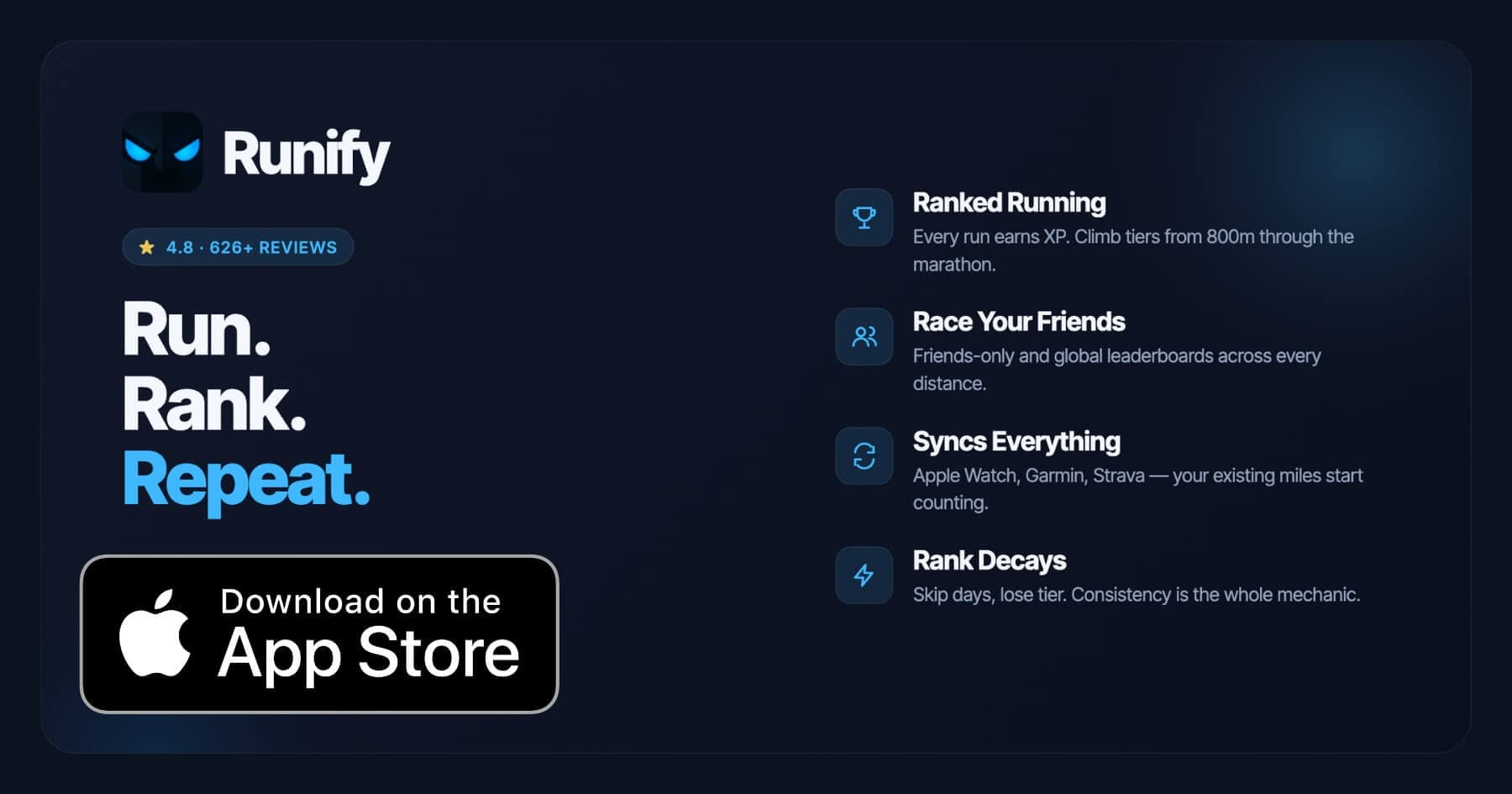
Neither Runna nor Hal Higdon offer competitive motivation. Both apps give you a training framework to follow - but once the run is done, the data sits in a log. Runify does something different: every run you complete earns XP, moves you through a competitive tier system, and puts you on friends-only or global leaderboards across distances from 800m through the marathon.
Runify imports runs from Apple Watch/HealthKit, Garmin, or Strava, so your Runna or Hal Higdon training miles count toward your rank. You don't have to switch your tracking app - you keep running with whatever plan you're on, and Runify adds the competitive layer on top. The rank decay mechanic means going inactive costs you rank, making consistency something you can actually see and feel.
The app holds a 4.8 App Store rating from 626+ reviews. As noted in our Runna alternatives breakdown and the Hal Higdon training alternatives guide, Runify consistently appeals to runners who want their logged miles to mean something beyond a training log entry.
When Runify Is the Better Pick Than Both
- You want a visible, competitive reason to keep running - XP, rank, and rank decay that reflects consistency.
- You already track with Apple Watch, Garmin, or Strava and want those miles to count toward a leaderboard.
- You care about distance-specific performance (800m through marathon) on friends and global leaderboards.
- You like sharing stylized run recaps to Instagram Stories.
When Runify Is Not the Right Fit
- You're on Android. Runify is iOS only today.
- You want structured training plans, pace coaching during a run, or audio-coached workouts. Runify focuses on tracking, ranking, and social competition - not coaching.
- You want route discovery or race signup features.
How to Choose Between Runna and Hal Higdon
The right choice depends on four practical factors. Work through them in order and you'll have your answer.
-
Budget: If price is the deciding factor, Hal Higdon wins. Free plans are available on the website, and Hal+ at $59.99/year is significantly cheaper than Runna's $112.99/year. Runna's coach access and deep wearable integration may justify the cost for serious runners, but for casual or first-time marathoners, the Hal Higdon free tier is hard to argue with.
-
Experience level: First-time marathon runners finishing their first race healthy respond well to Hal Higdon's conservative mileage build. Intermediate and advanced runners who want session-level coaching detail and adaptive structure tend to see more value from Runna.
-
Wearable setup: If you train with a Garmin, Apple Watch, COROS, or Suunto and want sessions pushed to your wrist, Runna is the clear choice. Run With Hal has no Apple Watch app and no live audio cues, which is a real gap for wearable-first runners.
-
Plan flexibility: Runna's adaptive plans handle schedule changes and missed workouts more gracefully. Hal Higdon's app has improved with Hal+, but users still report rigidity around day-swapping and injury accommodation. If your week rarely goes to plan, Runna's flexibility matters.
-
Coaching access: Runna includes access to certified coaches via in-app messaging. Hal Higdon offers extensive written resources but no direct coach interaction through the app. If you want a human coach to review your plan, Runna is the only option of the two.
Frequently Asked Questions
Is Runna or Hal Higdon better in 2026?
Runna is better for runners who want personalized, adaptable coaching and are training for a specific goal with a real target time. Hal Higdon is better for first-time marathon runners on a budget who want a proven, straightforward framework. Runna's $112.99/year price is justified when you use the coach access and wearable sync features. Hal Higdon's free plans and $59.99/year Hal+ tier are the stronger choice for beginners who need structure without complexity.
Can I use Runna and Hal Higdon together?
Most runners pick one training plan and follow it - mixing both would create conflicting schedules. That said, you can use Hal Higdon's free website plans alongside the Run With Hal app, and use Runna for a separate training cycle. If your goal is adding competitive motivation on top of either plan, Runify imports runs from Apple Watch, Garmin, and Strava, so your training miles from either app can feed into its ranking system.
Which is cheaper, Runna or Hal Higdon?
Hal Higdon is significantly cheaper. Free training plans are available at no cost on halhigdon.com. The Hal+ premium subscription costs $6.99/month or $59.99/year. Runna costs $17.99/month or $112.99/year - nearly double the Hal+ annual price. For budget-conscious runners, Hal Higdon offers strong value, especially at the free tier.
Which has better tracking accuracy, Runna or Hal Higdon?
Runna integrates with Garmin, Apple Watch, COROS, Suunto, and Fitbit, pushing sessions directly to your wrist with live pace targets and interval guidance. Run With Hal offers GPS tracking within the app but lacks a native Apple Watch app and has no voice coaching or live cues. Users frequently flag the absence of real-time wearable guidance in Run With Hal reviews. For tracking accuracy and wearable-first runners, Runna is the stronger option.
What is the best alternative to both Runna and Hal Higdon?
For runners who want competitive motivation rather than coaching structure, Runify is worth a look. It earns you XP and rank for every run you log, with friends-only and global leaderboards across distances from 800m through the marathon. It imports from Apple Watch, Garmin, and Strava, so your training miles from Runna or Hal Higdon count toward your rank. Runify holds a 4.8 App Store rating and is iOS only. It doesn't replace a training plan - it adds a competitive layer on top of one.
Final Verdict
Runna and Hal Higdon are both strong options, and the right pick comes down to what you need from your training app. Runna is the better choice if you want a coach-built, adaptive plan with wearable integration and access to certified coaches - especially if you're an intermediate or advanced runner with a specific goal. Hal Higdon is the better choice if you're training for your first marathon and want a proven, structured approach at a lower price point.
For runners who want to add a competitive layer on top of either plan - XP, ranks, and leaderboards across race distances - Runify is the third option that neither app offers.
Try Runify free for 7 days with an annual subscription. Download on the App Store

4.8 on the App Store · Built for iOS