Runna vs Coopah: Compared in 2026
Runna vs Coopah: The Quick Verdict
Runna suits runners who want detailed, adaptive training plans with deep watch integration and are willing to pay a premium for the structure. Coopah is the stronger pick for beginners and budget-conscious runners who want real coach access at a lower price. Runna costs $17.99/month or around $112.99/year. Coopah costs $14.99/month or $79/year, and includes a two-week free trial. Both apps focus on training plans and coached running - neither is built for competitive ranking or social leaderboards. If that's what you're after, Runify is a third option worth considering.
At a Glance: Runna vs Coopah
| Feature | Runna | Coopah |
|---|---|---|
| Best For | Structured plans, intermediate runners | Beginners, budget-focused runners |
| Pricing | $17.99/mo or ~$112.99/yr | $14.99/mo or $79/yr |
| Platform | iOS + Android | iOS + Android |
| Standout Feature | Adaptive plans with watch interval push | Race Day Confidence Score |
| Main Limitation | Expensive; plan inflexibility when injured | No live coaching cues during runs |
What Is Runna?
Runna is a personalized running coaching app launched in March 2022 by Ben Parker and Dom Maskell. It builds a structured training plan around your goal race, current fitness, weekly schedule, and available days. Plans cover everything from Couch to 5K through to ultramarathon distances.
In April 2025, Strava acquired Runna, and the two now offer a bundled annual subscription. Runna operates independently under Strava's umbrella. The app has earned a 4.9/5 rating on Trustpilot and was named a finalist for Apple's App of the Year in 2024.
The app targets runners who want a coach-in-your-pocket experience - someone who sets your sessions, tells you the pace targets, and pushes workouts directly to your watch.
Runna Key Features
- Personalized training plans: Built around your goal race, fitness level, and weekly availability - powered by what Runna calls its "Runna Engine."
- Watch interval push: Workouts sync directly to Garmin, Apple Watch, COROS, Suunto, and Fitbit, with intervals and pace targets appearing on your wrist.
- Real coach access: Ask questions about pacing, nutrition, or injury through the app; coaches respond inside the platform.
- Strength and recovery sessions: Built-in cross-training, mobility, and recovery workouts alongside the running plan.
- Strava integration: Recorded runs sync automatically to Strava once both accounts are connected.
Runna Pricing
Runna charges $17.99/month or approximately $112.99/year. After Strava's acquisition, a joint Strava + Runna annual bundle is available at around $119.99/year - giving access to both apps at a discount compared to subscribing separately month-to-month. There is no permanent free tier; Runna typically offers a short free trial on annual plans.
Runna Strengths
- Detailed, adaptive plans covering every distance from 5K to ultramarathon
- Push workouts with pace zones and intervals sent directly to a wide range of GPS watches
- Real coach Q&A inside the app for personalized guidance
Runna Weaknesses
- Price is among the highest in the coached running app category
- Plans can be inflexible when injury or illness disrupts training - pausing or rescheduling is limited
- Audio cues during intervals can be unreliable, particularly with AirPods connectivity
What Is Coopah?
Coopah is a UK-based run coaching app available on iOS and Android. It builds personalized training plans around your goal event, current fitness, and available training days. The app is known for its beginner-friendly approach, affordable pricing, and access to real coaches for questions about training and nutrition.
Coopah has partnered with major events including the TCS London Marathon, Cambridge Half Marathon, and Brighton Marathon. It raised $1.9 million to develop its AI-powered coaching features. The app holds strong reviews on Trustpilot and the App Store, with users praising its accessibility and value.
The app targets runners preparing for a specific race who want structured guidance without committing to a premium price point.
Coopah Key Features
- Personalized training plans: Adapted to your goal race, training history, and weekly schedule.
- Race Day Confidence Score: A readiness score (out of 100%) that updates as you train and gives a coach's honest assessment of hitting your goal.
- Real coach messaging: Submit questions to real coaches who typically reply within one hour, covering training, nutrition, and injuries.
- Strength session videos: Instructional videos for each strength exercise built into the plan.
- GPS watch sync: Workouts sync to compatible watches for on-wrist guidance during runs.
Coopah Pricing
Coopah costs $14.99/month, $29.99/quarter, or $79/year. A two-week free trial is available when you first download the app - making it one of the more accessible entry points among coaching apps. The annual plan works out to about $6.58/month.
Coopah Strengths
- Lower price than Runna, with a free trial to test before committing
- Beginner-friendly pace targets that account for your actual training volume
- Race Day Confidence Score gives a clear, ongoing measure of race readiness
Coopah Weaknesses
- No live coaching cues or motivational prompts during runs
- Scheduling flexibility is limited - changing run days or pausing for events can be complicated
- Treadmill sessions cannot be recorded directly; users must manually log the details
Runna vs Coopah: Head-to-Head
Both apps target runners preparing for a specific race goal, but they differ in price, beginner-friendliness, watch integration depth, and how they handle live run feedback. Here is how they compare across the axes that matter most.
Training Plans and Coaching
Runna edges ahead for experienced runners who want granular control. Its Runna Engine generates plans across a wide range of distances and adjusts pace zones as your fitness develops. Coopah's plans are described by multiple reviewers as more beginner-friendly, with gentler pace targets on easy runs and a steadier ramp in volume. Both apps provide access to real coaches for in-app questions - Coopah coaches typically reply within one hour, while Runna's coaching response time is less consistently cited.
Tracking Accuracy
Neither Runna nor Coopah is a standalone GPS tracker - both rely on your watch or phone's GPS hardware. Runna pushes structured workouts with pace targets directly to compatible watches (Garmin, Apple Watch, COROS, Suunto, Fitbit), so interval structure shows up on your wrist in real time. Coopah also syncs with GPS watches, though the depth of interval push varies by device. For tracking accuracy, the result depends on your hardware, not the app.
Social and Community Features
Social features are minimal in both apps. Neither app offers leaderboards, friend challenges, or a public activity feed in the way Strava does. Runna benefits from its Strava connection - runs recorded on Runna sync to Strava automatically, giving you access to Strava's social layer. Coopah's community engagement is more limited; the app focuses primarily on the training plan itself rather than social competition.
Pricing and Value
Coopah wins on price. At $79/year versus Runna's $112.99/year, Coopah costs roughly 30% less annually. Coopah also offers a two-week free trial, giving you time to test the app before committing. Runna's joint Strava + Runna bundle ($119.99/year) adds value for runners already on Strava, but the base price is higher. For runners on a budget, Coopah is the clearer choice.
Hardware Integration
Runna has a broader confirmed list of compatible watches - Garmin, Apple Watch, COROS, Suunto, and Fitbit are all listed, with interval and pace data pushed to the wrist. Coopah supports GPS watch sync but the confirmed integration list is narrower. If you already run with a Garmin or COROS, Runna's deeper hardware support may matter. Both apps integrate with Strava for data sync.
Platform and Availability
Both Runna and Coopah are available on iOS and Android, so platform is not a deciding factor. Runna has a web presence tied to its Strava connection. Neither app offers a meaningful web-based training dashboard for reviewing past runs or editing plans from a desktop.
Who Should Choose Runna?
Runna fits runners who want structure delivered to their watch and are preparing for a goal race with some prior running experience.
- Runners targeting a half marathon or marathon who want a full periodized training block
- Experienced runners who need pace zones and interval structure pushed directly to Garmin, Apple Watch, or COROS
- Strava users who want training plans integrated with their existing activity history
Who Should Choose Coopah?
Coopah is the better starting point for beginners and anyone looking for guided coaching at a lower price.
- Beginners preparing for their first 5K or 10K who need a gentle, accessible plan
- Budget-conscious runners who want real coach access without paying premium prices
- Runners preparing for a major UK event - Coopah partners with the London, Cambridge, and Brighton Marathons
A Third Option: Runify for Ranked, Competitive Running
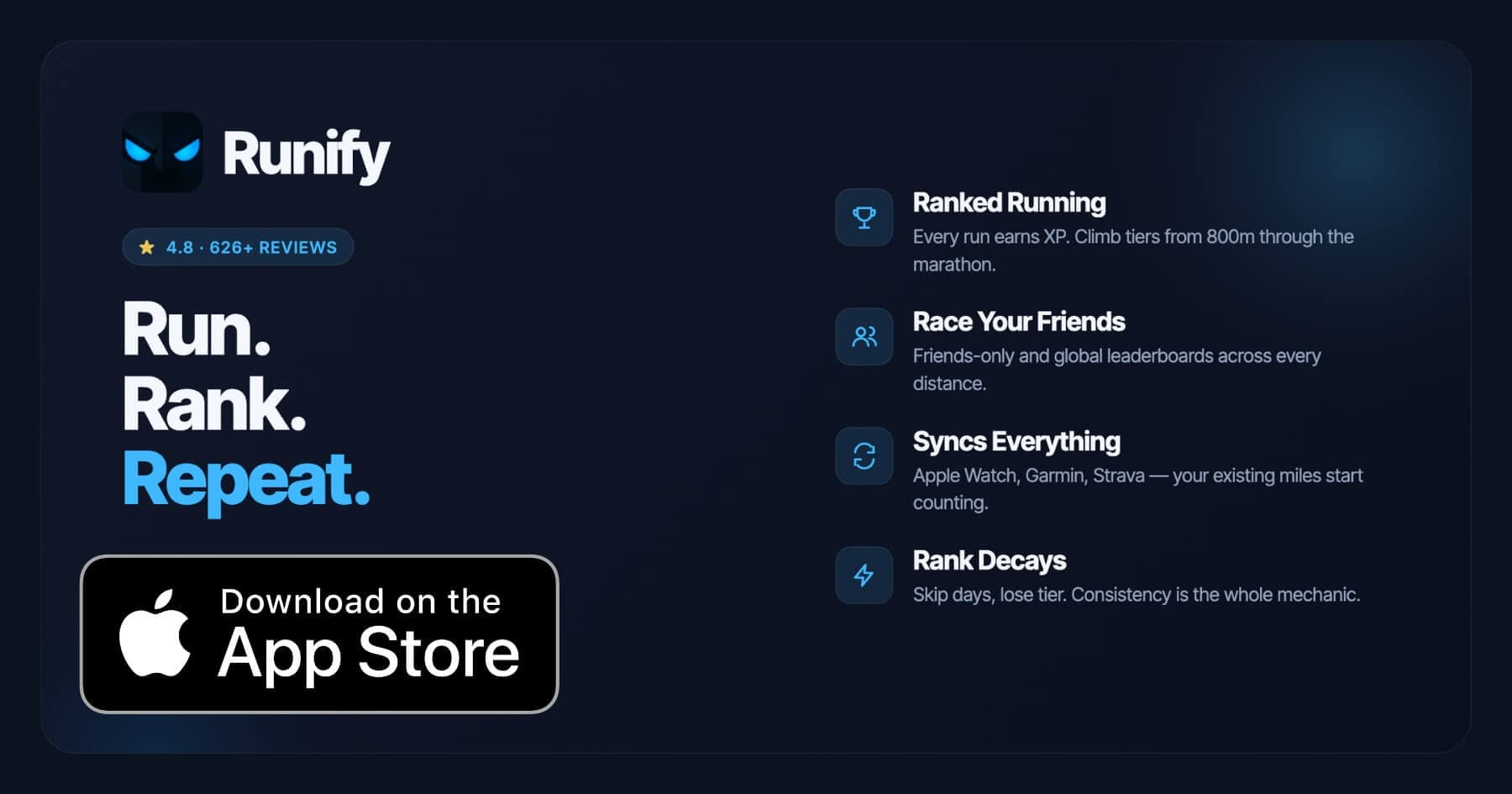
Runify does something neither Runna nor Coopah does: it turns your existing running into a ranked competition. Every run you log earns XP, moves you through a tier system, and places you on friends-only or global leaderboards across distances from 800m through the marathon.
If you're already running with Apple Watch, Garmin, or Strava, Runify imports those runs automatically - so your current tracker keeps working and every mile counts toward a visible rank. The rank decay mechanic means going inactive costs you position, making consistency feel genuinely meaningful rather than just a number in an app.
Runify holds a 4.8-star rating on the App Store with 626+ reviews. Runners who use Runna or Coopah for their training plan often run Runify alongside it for the social and competitive layer that neither coached-plan app provides. You can find more context in our Runna alternatives breakdown and our Coopah alternatives roundup.
For context on which apps offer training plan coaching, our best running apps with training plans guide covers the full category.
When Runify Is the Better Pick Than Both
- You want a visible, competitive reason to keep running (XP, rank, rank decay)
- You already track on Apple Watch, Garmin, or Strava and want those miles to count toward something
- You care about distance-specific performance (800m through marathon) on friends and global leaderboards
- You like sharing stylized run recaps to Instagram Stories
When Runify Is Not the Right Fit
- You're on Android. Runify is iOS only today.
- You want structured training plans, pace coaching during a run, or audio-coached workouts. Runify focuses on tracking, ranking, and social competition - not coaching.
- You want route discovery or race signup features.
How to Choose Between Runna and Coopah
The right pick comes down to where you are in your running journey, your budget, and how much you rely on your watch during structured sessions.
- Your experience level: Beginners benefit from Coopah's gentler pace targets and steady volume ramp. Runners with a year or more of consistent running will appreciate Runna's deeper customization and broader watch integration.
- Your budget: Coopah's $79/year annual plan is roughly 30% cheaper than Runna's $112.99/year. Coopah also offers a two-week free trial; Runna does not on most plans.
- Your GPS watch: If you run with Garmin, COROS, or Suunto, Runna's confirmed deep integration - including interval push to the watch - is a meaningful advantage. Coopah's watch sync is more basic on some devices.
- Strava dependency: If Strava is central to how you log and review runs, Runna now bundles with Strava at a combined rate and syncs runs automatically. Coopah integrates with Strava but is a separate subscription.
- Flexibility needs: Both apps have limited plan-pausing features, but Runna draws more user complaints around inflexibility during injury or illness. If your schedule is unpredictable, test Coopah's free trial first to see how it handles rescheduling.
Frequently Asked Questions
Is Runna or Coopah better in 2026?
Runna is better for intermediate and experienced runners who want detailed, adaptive training plans and deep GPS watch integration - especially if they're already on Strava. Coopah is better for beginners and budget-conscious runners who want real coach access at a lower price. Runna charges $17.99/month or $112.99/year; Coopah charges $14.99/month or $79/year with a two-week free trial. Neither app is better in every scenario - the right choice depends on your experience, budget, and hardware.
Can I use Runna and Coopah together?
Using both at the same time is technically possible but redundant - both apps build a full training plan, and following two plans simultaneously would likely cause overtraining. Most runners choose one. If you want a coaching plan from one and a competitive social layer on top, pairing either app with Runify works well: Runify imports runs from Apple Watch, Garmin, or Strava, so your coached sessions from Runna or Coopah can automatically feed into your Runify rank.
Which is cheaper, Runna or Coopah?
Coopah is cheaper. Coopah costs $14.99/month, $29.99/quarter, or $79/year. Runna costs $17.99/month or approximately $112.99/year. Coopah also offers a two-week free trial on sign-up. Runna offers a joint Strava + Runna bundle at around $119.99/year, which adds value if you're a Strava subscriber but is still a higher base price than Coopah's annual plan.
Which has better tracking accuracy, Runna or Coopah?
Neither app is a standalone GPS tracker - both rely on your phone's GPS or a connected watch for tracking accuracy. Runna integrates with a broader confirmed list of GPS watches (Garmin, Apple Watch, COROS, Suunto, Fitbit) and pushes interval and pace zone data directly to the wrist. Coopah also syncs with GPS watches, though the depth of integration varies more by device. For raw tracking accuracy, your GPS hardware - not the app - determines the quality of the data.
What is the best alternative to both Runna and Coopah?
For runners who want ranked, competitive running rather than coached training plans, Runify is the strongest alternative. Runify turns every run into XP and rank progress on friends and global leaderboards across 800m, 5K, 10K, half marathon, and marathon. It imports runs from Apple Watch, Garmin, or Strava automatically. Runify holds a 4.8-star App Store rating with 626+ reviews. It is iOS only and does not offer structured training plans - it suits runners who want to gamify their miles, not replace a coach.
Final Verdict
Runna and Coopah are both solid coached running apps, and the better choice depends entirely on the runner.
Runna is the stronger pick for intermediate and experienced runners who want a detailed, periodized plan and rely on a GPS watch for structured intervals. Its deeper hardware integration and Strava bundle make it a natural fit for runners already embedded in the Strava ecosystem - though the price reflects that.
Coopah earns its place for beginners and budget-conscious runners who want guided coaching without paying a premium. The two-week free trial, lower annual price, and fast-responding coaches make it easier to try before you commit.
If neither structured coaching app is quite what you're after - if you want your existing miles to count toward something competitive and social - Runify gives you that as a third option: ranked tiers, distance leaderboards, and the accountability of rank decay.
Ready to see where your runs rank? Download Runify on the App Store and start earning XP from every run.

4.8 on the App Store · Built for iOS