Relive vs Strava: Compared in 2026
Relive vs Strava: The Quick Verdict
Strava is the better pick for serious runners who want deep analytics, segment leaderboards, and a massive social community. Relive is the better pick for runners and cyclists who want to turn their routes into shareable 3D video stories. Strava has over 130 million users and charges $11.99/month for its full feature set. Relive sits at around 4.6 stars across 21,000+ reviews and charges $59.99/year for its Club tier. The two apps no longer share data directly - Strava cut off Relive's API access - so you have to pick a primary tracker or connect both through Garmin or Apple Health. If you want your miles to count toward a visible competitive rank and global leaderboards, Runify is a third option worth considering.
At a Glance: Relive vs Strava
| Feature | Relive | Strava |
|---|---|---|
| Best For | 3D route videos and memory sharing | Social running with segments and analytics |
| Pricing | Free; Club $59.99/yr or $10.99/mo | Free; Premium $79.99/yr or $11.99/mo |
| Platform | iOS + Android | iOS + Android + Web |
| Standout Feature | Animated 3D flyover video of every route | Segments with KOM/QOM leaderboards |
| Main Limitation | Limited social community and run analytics | Many useful features locked behind paywall |
What Is Relive?
Relive is a Dutch activity-tracking app that turns your runs, rides, and hikes into animated 3D video stories. You record an activity, and Relive converts the GPS route into a cinematic flyover video you can share on Instagram, WhatsApp, or the app's own feed. The app launched as a Strava plug-in before adding its own GPS tracking.
Relive supports running, cycling, hiking, skiing, and more. It pulls data from Garmin, Suunto, Apple Health, and other sources. It holds a 4.6-star average across 21,000+ combined App Store and Google Play reviews. The app appeals most to outdoor adventurers who want a fun, visual way to look back on where they went.
It is not a performance-analysis tool. If you want pace zones, VO2max estimates, or structured training data, you will need something else alongside it.
Relive Key Features
- 3D Route Videos: Automatically generates an animated flyover of your GPS route after each activity.
- Photo Embedding: Add photos taken during your activity and they appear on the map at the right location in the video.
- Multi-Sport Support: Tracks runs, rides, hikes, skiing, paddle sports, and more from one app.
- Device and App Sync: Connects with Garmin, Suunto, Apple Health, Wahoo, and several other platforms.
- Social Feed: Follow friends and share your 3D videos; comment and react on others' activities.
Relive Pricing
Relive offers a free tier that lets you create one 3D video per activity with basic features. The paid Club tier costs $10.99/month or $59.99/year and unlocks HD video quality, music, more photos per activity, customizable playback speed, and priority video processing.
The free tier is genuinely usable. You still get the core 3D video for every activity; the Club tier mainly adds polish and extras rather than locking core functionality.
Relive Strengths
- The 3D flyover video format is unique and genuinely fun to share with non-runners
- Multi-sport support covers cycling, hiking, and snow sports in the same app
- Free tier gives you real value without paying
Relive Weaknesses
- Very limited run analytics - no pace zones, cadence charts, or training load
- Strava removed API access in 2019, so Strava-tracked runs no longer auto-sync
- Some users report GPS stats discrepancies after Relive applies its own filtering to uploaded routes
What Is Strava?
Strava is one of the longest-running activity tracking platforms, founded in San Francisco in 2009. It has grown to over 130 million users and built its reputation on two pillars: GPS tracking for runners and cyclists, and a social layer that lets you compete on segments, join clubs, and follow athletes around the world.
The app covers running, cycling, swimming, and dozens of other activities. Its segment feature lets you race any mapped stretch of road or trail against every other Strava user who has ever covered it. Strava runs on iOS, Android, and the web, and syncs with nearly every major wearable on the market. For a deeper look at Strava's user base, our Strava alternatives breakdown covers why many runners eventually look beyond it despite its scale.
Strava Key Features
- GPS Tracking: Records pace, distance, heart rate, elevation, and splits from your phone or connected wearable.
- Segments: Race any mapped stretch of road or trail and earn KOM/QOM rankings against other Strava users.
- Social Feed and Kudos: Follow athletes, give kudos, comment on runs, and join clubs with shared goals.
- Training Analysis: Heart rate zones, pace analysis, power data (cycling), and weekly/monthly mileage totals.
- Route Building: Plan routes on the web and send them to your device or phone for navigation.
Strava Pricing
Strava's free tier covers basic tracking, the social feed, and segment results. The Premium subscription costs $11.99/month or $79.99/year. A Family Plan runs $139.99/year. Students with a verified email get 50% off.
Premium unlocks live segment performance, advanced analytics, custom goals, and integrations with training plans through Runna. Strava has pushed more features behind the paywall over the past two years, which has frustrated long-time free users.
Strava Strengths
- The largest running and cycling community with 130 million+ users worldwide
- Segments turn any route into a competitive race against real times
- Deep wearable integration with Garmin, Apple Watch, Wahoo, and more
Strava Weaknesses
- Significant features moved behind the paywall in 2024-2025, including Group Challenges
- $79.99/year is steep if you mainly want basic tracking and a social feed
- The app can feel overwhelming for casual runners who just want simple logs
Relive vs Strava: Head-to-Head
These two apps overlapped historically as partners but split in 2019. Now they serve meaningfully different runners. Here is how they stack up across the axes that matter most.
Tracking Accuracy
Strava wins on tracking depth. It records pace, cadence, heart rate zones, power (for cyclists), elevation gain, and split data in detail. Relive records basic GPS data - distance, time, route - but applies its own filtering after the fact, which some users report causes small discrepancies in final stats. For runners who care about accurate splits and lap data, Strava's tracking is more reliable and far more detailed.
Social and Community Features
Strava has one of the largest fitness communities in the world. Segments, kudos, clubs, and the global feed give it a competitive social layer that Relive simply does not match. Relive's social feed is smaller and video-focused - you see your friends' routes as 3D video clips rather than data cards. Both let you follow friends; only Strava lets you compete against thousands on named segments. If you're curious how Strava stacks up against other community-focused apps, our best Strava alternatives guide digs into the options.
Route Visualization and Memories
Relive wins this axis without much contest. Its 3D flyover videos are the reason people download it. Strava has a flyover feature for subscribers, but Relive's version is the original and still more polished. If you want to share a video of your morning trail run with your family or post it to Instagram Stories, Relive is the better tool. Strava shows you a flat map and a stats card - less cinematic, more functional.
Training Plans and Coaching
Strava offers connections to Runna for personalized training plans (at a discount for subscribers), custom weekly goals, and a structured training log. Relive has no training plan features at all. For runners following a schedule toward a race, Strava is the clear pick here. Relive is purely an activity visualizer and does not pretend otherwise.
Pricing and Value
Relive's Club tier at $59.99/year is cheaper than Strava's $79.99/year. Relive's free tier is genuinely functional - you get the core 3D video on every activity. Strava's free tier has become increasingly limited as features have moved behind the paywall. For pure value, Relive offers more on the free plan. For analytics value, Strava's $79.99 unlocks tools Relive does not have at any price point.
Hardware Integration
Strava connects with practically every major device: Garmin, Apple Watch, Wahoo, Polar, Suunto, Fitbit, and more. It acts as a hub for syncing activity data from any source. Relive also connects with Garmin, Suunto, Apple Health, and a handful of others - but notably not Strava anymore. If your primary tracker is a Garmin watch, both apps can receive your runs independently. If you track with Strava itself as your source of truth, you cannot auto-sync that data into Relive.
Who Should Choose Relive?
Relive fits a specific type of active person: someone who cares as much about the memory and story of an activity as the performance data.
- Runners and hikers who want to share their routes as fun, visual stories with friends and family
- Multi-sport athletes who want one app to cover runs, rides, hikes, and ski days without switching platforms
- Casual trackers who want solid free-tier access without paying for analytics they will never use
Who Should Choose Strava?
Strava fits runners who are serious about performance, competitive against others, or embedded in a running community.
- Competitive runners who want to race segments, track PRs, and see how their times compare globally
- Runners following structured training who need weekly mileage tracking, heart rate zones, and goal-setting tools
- Social runners who want a large, active community around their hobby - clubs, kudos, and group challenges
A Third Option: Runify for Ranked, Competitive Running
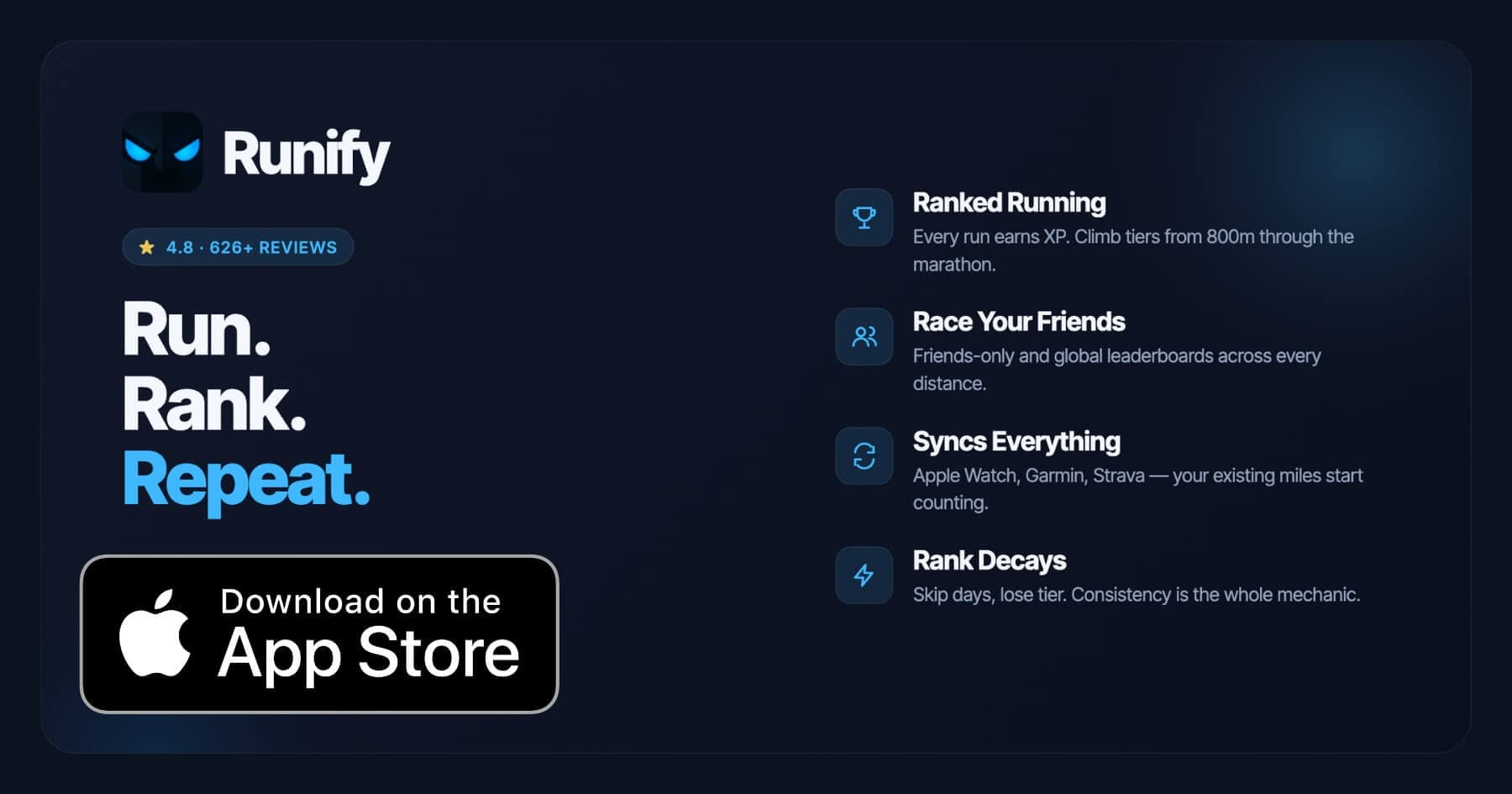
Runify does something neither Relive nor Strava does: it turns every run into a ranked competition. Every run you log earns XP, moves you through a competitive tier system, and places you on leaderboards across real race distances - 800m, 1K, 5K, 10K, half marathon, and full marathon. Your rank climbs when you run consistently and decays when you go inactive, which makes it a real accountability tool, not just a badge cabinet.
Unlike Relive, Runify is built specifically for runners who want to feel the competitive pressure of a rank on the line. Unlike Strava's segment leaderboards (which require you to be on the exact mapped route), Runify's leaderboards are built around your best performances at each distance - wherever you run them. You can check how Relive stacks up against other memory-sharing options in our best Relive alternatives guide.
Runify syncs from Apple Watch, Garmin, and Strava, so your existing miles already count. If you track with Strava and want a competitive rank layer on top of it, you do not have to change how you run. The app holds a 4.8-star rating on the App Store with 626+ reviews. Monthly is $4.99/month; annual is $39.99/year with a 7-day free trial.
When Runify Is the Better Pick Than Both
- You want a visible, competitive reason to keep running - XP, rank, and rank decay make consistency matter
- You already track on Apple Watch, Garmin, or Strava and want those miles to count toward something more
- You care about your best performances at specific distances on friends and global leaderboards
- You like sharing stylized run recaps to Instagram Stories
When Runify Is Not the Right Fit
- You're on Android. Runify is iOS only today.
- You want structured training plans, pace coaching during a run, or audio-coached workouts. Runify focuses on tracking, ranking, and social competition - not coaching.
- You want route discovery, 3D videos, or race signup features.
How to Choose Between Relive and Strava
The right pick depends on what you actually want from a running app.
-
If you want performance analytics: Strava. Pace zones, heart rate, splits, and segment times are Strava's core strength. Relive does not offer meaningful run analytics at any price tier.
-
If you want to share your adventures visually: Relive. The 3D flyover videos are unique, engaging, and easy to post to social media. Strava's map cards are functional but not cinematic.
-
If budget matters: Relive's free tier gives you more than Strava's. If you need paid features, Relive Club at $59.99/year undercuts Strava Premium at $79.99/year.
-
If you run with a community: Strava. With 130 million users, the social layer is far more active. Relive's community is smaller and less competition-oriented.
-
If you track with Garmin or Apple Health: Both apps accept data from these sources, so you can use both simultaneously with a single GPS source - you just cannot use Strava itself as the bridge into Relive.
Frequently Asked Questions
Is Relive or Strava better in 2026?
Strava is better for performance-focused runners who want analytics, segment competition, and a large community. Relive is better for runners and cyclists who want to turn their routes into shareable 3D video stories. The two apps no longer share data directly, so most users pick one as their primary tracker. Strava holds the edge on depth and community size; Relive holds the edge on visualization and its more generous free tier. Your best choice depends on whether you care more about data or memories.
Can I use Relive and Strava together?
You can use both simultaneously, but not directly. Strava cut off Relive's API access in 2019, so activities tracked in Strava will not auto-generate Relive videos. If you use a Garmin watch or Apple Health as your data source, both apps can receive data independently from that same source. Some runners track with Garmin, let it push to Strava for analytics and community, and also sync to Relive for videos.
Which is cheaper, Relive or Strava?
Relive is cheaper. Relive Club costs $59.99/year or $10.99/month. Strava Premium costs $79.99/year or $11.99/month. Relive's free tier is also more generous - it gives you the core 3D video on every activity without paying. Strava's free tier has shrunk over time as more features moved behind the paywall, making Relive the better value for casual users who do not need advanced analytics.
Which has better tracking accuracy, Relive or Strava?
Strava tracks more accurately for running metrics. It captures pace, heart rate zones, cadence, splits, and elevation data in detail and displays them cleanly. Relive records GPS routes and basic stats but applies post-activity filtering that can cause small discrepancies between what your device recorded and what Relive reports. For runners who need reliable split data and training analysis, Strava is the more dependable tracking tool. Relive's tracking is adequate for knowing where you went, not for optimizing how you ran.
What is the best alternative to both Relive and Strava?
Runify is a strong third option for runners who want competitive motivation rather than route videos or pure analytics. Runify uses XP, a ranked tier system, and global leaderboards across distances from 800m through the marathon to make every run matter in a new way. It syncs from Apple Watch, Garmin, and Strava, so you do not have to change how you currently track. Runify holds a 4.8-star App Store rating with 626+ reviews and is available for $4.99/month or $39.99/year. It is iOS only.
Final Verdict
Relive and Strava are not really competing for the same runner. Strava is a full-featured performance and social platform for runners who want to track data, compete on segments, and stay connected to a community. Relive is a visualization tool that turns any GPS-tracked activity into a 3D video story worth sharing.
If you want to improve as a runner and see your data clearly, choose Strava. If you want your adventures to look as good to others as they felt to you, choose Relive. If you want your miles to earn a visible rank in a competitive tier system, take a look at Runify as a complement to either.
Start your ranked running journey with Runify - Download on the App Store

4.8 on the App Store · Built for iOS