Polar Flow vs Suunto App: Compared in 2026
Polar Flow vs Suunto App: The Quick Verdict
Polar Flow is the better pick for runners who live inside the Polar ecosystem and want deep heart rate analytics, training load data, and sleep tracking tied to Polar's hardware. Suunto App suits trail runners and adventurers who want offline maps, route planning, and a growing library of outdoor navigation tools - all tied tightly to Suunto watches. Polar Flow is free (with a €9.99/month optional Fitness Program subscription); Suunto App is free with any Suunto watch. Neither is a strong fit for runners who want ranked, competitive running across friends or global leaderboards - that is where Runify comes in as a third option.
At a Glance: Polar Flow vs Suunto App
| Feature | Polar Flow | Suunto App |
|---|---|---|
| Best For | Heart-rate-focused training analytics | Trail running and outdoor navigation |
| Pricing | Free; Fitness Program €9.99/mo | Free with Suunto watch |
| Platform | iOS + Android + Web | iOS + Android |
| Standout Feature | Polar Training Load and Recovery metrics | Offline maps and 3D route planning |
| Main Limitation | UI feels dated; weak without Polar hardware | Limited social features; sync reliability issues |
What Is Polar Flow?
Polar Flow is the official companion app and web platform for Polar sports watches and fitness trackers. It launched alongside Polar's modern watch lineup and serves as both a mobile app and a full browser-based dashboard, giving runners access to their full activity history on any device.
Polar has been making heart rate monitors since 1982, and that heritage shows in Polar Flow. The app centers on training analytics: heart rate zones, training load, recovery status, and sleep quality. It connects to Polar's own ecosystem of wearables and syncs outward to Strava, TrainingPeaks, and Adidas Running. Polar Flow is available on iOS and Android, plus a web portal at flow.polar.com.
The app carries a 4.1-star App Store rating and works best when paired with a Polar device - the analytics depth drops significantly without one.
Polar Flow Key Features
- Training Load and Recovery: Tracks accumulated strain over days and flags when your body needs rest based on heart rate and session data.
- Sleep Plus Stages: Monitors REM, light, and deep sleep and gives a nightly sleep score with comparison to your usual patterns.
- Heart Rate Zone Customization: Lets you define custom HR zones and view time-in-zone breakdowns for each workout.
- Strava and TrainingPeaks Sync: Automatically pushes completed workouts to connected platforms with no manual export step.
- Web Dashboard: Full browser-based portal for reviewing training history, planning, and detailed dive into individual sessions.
Polar Flow Pricing
Polar Flow is free to download and use. The core tracking, analytics, and sync features carry no cost. Polar introduced a Fitness Program subscription in late 2025 at €9.99 per month (roughly $11 USD). That subscription unlocks a four-week adaptive training plan that uses your recovery, goals, and activity history to build a personalized schedule with 20 progression levels. The subscription is optional - the free tier is fully functional for most runners.
Polar Flow Strengths
- Heart rate and training load analytics are among the most detailed of any free companion app
- Free web portal gives full access on any browser, not just a phone
- Syncs cleanly to Strava, TrainingPeaks, and other major platforms
Polar Flow Weaknesses
- The UI design feels dated and has not had a significant visual refresh in years
- Treadmill tracking is unreliable; no stride calibration option to correct distance errors
- Sync requires users to manually restart the app at times; data loss during watch upgrades has been reported by multiple users
What Is Suunto App?
Suunto App is the official companion for Suunto GPS watches, targeting trail runners, hikers, adventure racers, and endurance athletes. The app has evolved significantly since 2024, with major firmware and feature updates rolling out through 2025 and into 2026.
The April 2026 update added offline routing, Varia radar support, clearer turn guidance, better elevation insights, and richer map layers. Suunto App connects to 200+ partner services including Strava, TrainingPeaks, and komoot. It is available on iOS and Android.
Suunto has been on an accelerated development cadence - reviews note the company has shipped more meaningful feature updates in the past 12 months than in the prior three years combined. The app still shows rough edges, particularly around sync reliability, but the trajectory is clearly upward.
Suunto App Key Features
- Offline Maps and Routing: Download maps for use without a cell connection; offline routing added in April 2026 at no extra cost.
- 3D Route Planning: Build and preview routes in three dimensions before heading out, with elevation and terrain detail.
- SuuntoPlus Store: An open ecosystem of training tools built by the community and Suunto, available inside the app.
- Third-Party Sync: Automatic post-workout sync to Strava, TrainingPeaks, komoot, and 200+ other services.
- Activity and Health Tracking: Step counting, sleep tracking, calorie logging, and daily activity summaries alongside sports data.
Suunto App Pricing
Suunto App is free. There is no paid subscription tier within the app itself. Offline maps and offline routing are free for all users as of the April 2026 update. Some SuuntoPlus sports features are free; third-party partner apps in the SuuntoPlus store may carry their own costs. The hardware (a Suunto watch) is the primary purchase, not the software.
Suunto App Strengths
- Offline maps and routing at no extra cost is a strong value proposition for trail runners
- Rapid development cadence with meaningful features shipping every quarter
- Open SuuntoPlus ecosystem lets community developers add niche training tools
Suunto App Weaknesses
- Sync reliability problems persist for some users - reports of runs not reaching Strava after updates
- Social and community features are minimal compared to Polar Flow or Strava
- Knowing whether to adjust a setting in the app or on the watch itself remains confusing for new users
Polar Flow vs Suunto App: Head-to-Head
Both apps serve runners who own the respective brand's hardware. The key question is which ecosystem better serves your running style. Here is how they compare on the axes runners actually care about.
Tracking Accuracy
Polar Flow edges ahead on heart rate accuracy. Polar's optical HR sensors and algorithms have been validated in peer-reviewed research, and the app reflects that precision with fine-grained HR zone breakdowns. GPS tracking quality depends on the watch hardware, not the app, so GPS accuracy varies by watch model on both sides. For treadmill runners, Polar Flow falls short - it cannot calibrate for stride, and indoor distance data is often unreliable.
Training and Analytics
Polar Flow goes deeper on training analytics. The Training Load and Recovery feature combines session strain data with sleep quality and HRV-derived recovery to tell you how hard you can push today. Suunto App does offer recovery and training load metrics on supported watches, but the implementation feels less polished. If your priority is understanding long-term training load and avoiding overtraining, Polar Flow holds the edge. Our Polar Flow alternatives breakdown covers other apps that match or exceed Polar's analytics depth.
Navigation and Route Planning
Suunto App wins this category clearly. Offline maps, 3D route previewing, offline routing, Strava route sync, and terrain heatmaps are all features Polar Flow does not match. For trail runners who plan routes in advance and run in areas with unreliable cell coverage, Suunto App is meaningfully better. Polar Flow's route support is basic - you can create and follow routes, but the map tools are far less capable.
Social and Community Features
Neither app is a social platform in the way Strava is. Polar Flow has a basic activity feed where you can see friends' workouts and leave reactions. Suunto App's social layer is thinner still - the focus is on personal data and navigation, not community. Runners who want friends leaderboards, competitive segments, or a genuine social feed will find both apps limited. Our Suunto App alternatives breakdown includes apps that fill this gap.
Pricing and Value
Both apps are free for the core running experience. Polar introduced its optional Fitness Program at €9.99/month, which adds adaptive training plans. Suunto App has no paid tier at all - every feature, including offline maps, is included at no cost beyond buying a Suunto watch. For runners who want a full-featured companion app without a subscription, Suunto App wins on pure value. Polar Flow's free tier is also capable, but the training plan subscription adds a recurring cost that Suunto does not.
Hardware Integration and Ecosystem
Polar Flow is built for Polar hardware and works best with it. The deeper analytics (like Nightly Recharge and Running Index) only appear with compatible Polar watches. Suunto App is similarly designed for Suunto watches. Both apps sync to Strava and TrainingPeaks, which is where the hardware ecosystems overlap. Runners with Polar watches who want third-party app recommendations can check our guide to running apps for Polar watches. Neither app plays well with the other brand's hardware.
Who Should Choose Polar Flow?
Polar Flow suits runners who own a Polar watch and want to squeeze the most out of its analytics. If you care deeply about training load, recovery metrics, and heart rate zone precision, the Polar ecosystem delivers.
- Runners who log high mileage and want daily recovery guidance before deciding how hard to train
- Heart rate training devotees who want a clean breakdown of time spent in each zone across every session
- Runners who prefer a full web dashboard for reviewing their season-long training history on a desktop
Who Should Choose Suunto App?
Suunto App is the stronger pick for trail runners and anyone who spends time in areas without reliable cell coverage. The navigation toolset is genuinely best-in-class for a free companion app.
- Trail runners and hikers who need offline maps and 3D route planning built into the same app as their running data
- Runners who dislike paying subscription fees and want every feature included in a free app
- Adventure racers or ultra runners who need terrain detail, elevation data, and turn-by-turn guidance without cell service
A Third Option: Runify for Ranked, Competitive Running
Runify does something neither Polar Flow nor Suunto App does: it turns every run into a competitive event, regardless of which device or platform you track on.
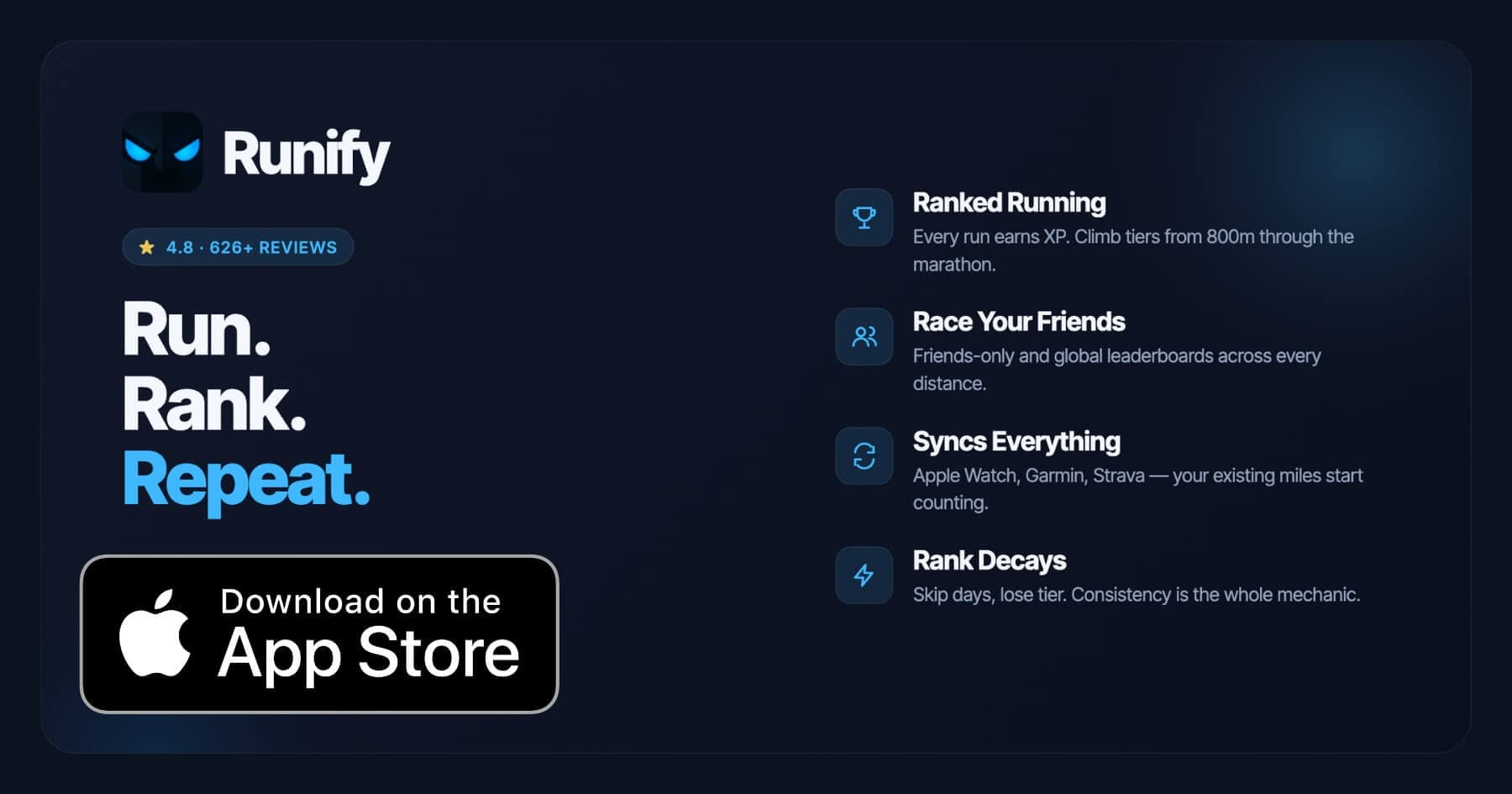
Runify is built around a ranked tier system. Every run earns XP, moves you through tiers, and puts you on friends and global leaderboards across actual race distances - 800m, 1K, 5K, 10K, half marathon, and marathon. Your rank climbs when you run consistently. Go inactive and it decays. That accountability mechanic is what makes Runify feel different from a standard tracking app.
Because Runify syncs with Apple Watch, Garmin, and Strava, you do not have to change your existing tracking setup. Polar watch users who already sync their runs to Strava can connect that Strava account to Runify and have those miles count toward their rank automatically. The same applies to Garmin users. Runify has 4.8 stars on the App Store across 626+ reviews.
It is worth being clear about what Runify does not do: it is iOS only, it does not offer structured training plans, audio coaching, or route discovery. It is built for runners who want competitive motivation on top of their existing tracking - not a replacement for Polar Flow or Suunto App as a data platform.
When Runify Is the Better Pick Than Both
- You want a visible, competitive reason to keep running (XP, rank, rank decay)
- You already track on Apple Watch, Garmin, or Strava and want those miles to count toward something
- You care about distance-specific performance (800m through marathon) on friends and global leaderboards
- You like sharing stylized run recaps to Instagram Stories
When Runify Is Not the Right Fit
- You're on Android. Runify is iOS only today.
- You want structured training plans, pace coaching during a run, or audio-coached workouts. Runify focuses on tracking, ranking, and social competition - not coaching.
- You want offline route navigation or terrain maps.
How to Choose Between Polar Flow and Suunto App
Your choice comes down to the hardware you already own and the type of running you do most.
-
Check your watch brand first: Both apps are designed around their own hardware. If you own a Polar watch, Polar Flow is the natural home for your data. If you own a Suunto, the Suunto App is where your watch syncs natively. Switching apps does not help if your watch only talks to one ecosystem.
-
Trail vs. road: Suunto App has offline maps and 3D route planning that Polar Flow cannot match. Road runners tracking pace and heart rate in the city will find Polar Flow's analytics equally useful with no need for offline navigation.
-
How much you care about training load: Polar Flow's recovery and training load features are more developed and easier to act on day to day. If you structure your training around hard/easy day cycles, Polar Flow gives you clearer guidance.
-
Budget: Both apps are effectively free. Polar's optional Fitness Program adds €9.99/month if you want adaptive training plans. Suunto App charges nothing beyond the watch itself.
-
Social motivation: If you want friends leaderboards, competitive segments, or a social feed, neither app satisfies that need well. Consider whether a third app like Runify or Strava makes sense alongside whichever companion app you use.
Frequently Asked Questions
Is Polar Flow or Suunto App better in 2026?
Polar Flow is better for runners who prioritize heart rate analytics, training load tracking, and recovery guidance. Suunto App is better for trail runners who want offline maps, 3D route planning, and outdoor navigation - all at no additional cost. Neither is "better" in every category. The right answer depends on the watch you own and the type of running you do. Polar Flow suits data-driven road runners; Suunto App suits trail and adventure runners. Both apps are free to use with their respective hardware.
Can I use Polar Flow and Suunto App together?
Not practically - both apps are designed to sync with their own brand's hardware, and a single watch can only pair to one. However, both apps can push completed workouts to Strava. If you own watches from both brands (or switch brands), Strava becomes the common hub. Runify also imports from Strava, so runners using either Polar or Suunto can connect Strava to Runify and have those miles count toward their rank without changing their primary tracking setup.
Which is cheaper, Polar Flow or Suunto App?
Both apps are free. Suunto App has no paid tier - offline maps, routing, and all in-app features are included at no cost beyond buying a Suunto watch. Polar Flow is also free for core tracking and analytics. Polar offers an optional Fitness Program subscription at €9.99 per month (roughly $11 USD) that adds adaptive training plans. If avoiding any subscription is a priority, Suunto App has the edge on pricing.
Which has better tracking accuracy, Polar Flow or Suunto App?
GPS tracking accuracy depends primarily on the watch hardware, not the app. For heart rate specifically, Polar has a long research-backed reputation for accuracy - Polar's optical HR sensors have been used in clinical studies and are consistently rated highly in independent tests. Suunto watches also deliver solid HR readings, but Polar is generally considered the benchmark for optical HR precision among running watch brands. For treadmill running, both apps have limitations, but Polar Flow's lack of stride calibration is a specific complaint from indoor runners.
What is the best alternative to both Polar Flow and Suunto App?
For runners who want ranked, competitive running on top of their existing tracking, Runify is the strongest alternative to both. Runify syncs with Apple Watch, Garmin, and Strava - meaning Polar and Suunto users who already push workouts to Strava can bring those miles into Runify's competitive tier system. It holds a 4.8-star App Store rating with 626+ reviews. For runners who want a broader social platform with segments and group features, Strava is the most common addition. For coaching and training plans, Garmin Coach and TrainingPeaks are worth evaluating.
Final Verdict
Polar Flow and Suunto App serve different runners well - the choice comes down to what you track and where you run. Polar Flow is the stronger platform for heart-rate-focused training analytics and recovery guidance, backed by Polar's decades of HR research. Suunto App is the better tool for trail runners and adventurers who need offline maps and route planning without paying extra.
Neither app is designed to make running feel competitive or social in the way a dedicated leaderboard platform does. If that motivation gap matters to you - and your runs already sync to Apple Watch, Garmin, or Strava - Runify adds a competitive tier system on top of whichever tracking platform you already use.
Ready to make your miles count toward something? Try Runify on the App Store and see where you rank.

4.8 on the App Store · Built for iOS