Hoka App vs On Running App: Compared in 2026
Hoka App vs On Running App: The Quick Verdict
Neither Hoka nor On Running offers a dedicated GPS run tracker. Hoka's official app is a shopping and product companion. On Running's digital presence centers on a product portal at on.com - also not a tracker. Both brands have deliberately stayed out of the consumer fitness software space.
For runners who want real GPS tracking, training data, and community, both "apps" fall short in the same way. Hoka runners tend to rely on Strava, Garmin Connect, or Apple Health. On runners do the same. The real decision is which brand's companion app better serves your shopping, gear tracking, and brand experience needs - and which third-party tracker to use alongside either.
If you also want ranked, competitive running across friends and global leaderboards, Runify is a third option worth knowing about: it works on top of whatever GPS tracker you already use.
At a Glance: Hoka App vs On Running App
| Feature | Hoka App | On Running App |
|---|---|---|
| Best For | Hoka shoppers and brand fans | On shoppers and style-focused runners |
| Pricing | Free | Free |
| Platform | iOS + Android | iOS + Android |
| Standout Feature | Shoe finder and event race companion | Product portal and brand content |
| Main Limitation | No GPS run tracking at all | No GPS run tracking at all |
What Is the Hoka App?
Hoka is a California-born running shoe brand, now owned by Deckers Brands, that has grown into one of the most recognized names in road and trail running. The brand built its reputation on maximally cushioned shoes with a distinctive rocker geometry - and as of 2026, that focus on footwear is reflected in how Hoka approaches digital products.
Hoka does not have a general-purpose consumer running tracker. What exists instead is a small collection of event-specific companion apps and a shopping app. The HOKA Semi de Paris app, for example, was built around a specific race weekend and offers training guides tied to that event. The HOKA Hackney Moves app was created for another branded race. Outside of those narrow use cases, the Hoka digital footprint is thin.
Most Hoka runners use Strava, Garmin Connect, or Apple Watch as their primary tracker - none of which are made by Hoka.
Hoka App Key Features
- Shoe Finder: Helps users identify the right Hoka model based on foot type and intended use.
- Product Browsing: Browse the full Hoka shoe and apparel lineup with size filters and product detail pages.
- Event Companion Apps: Race-specific apps (like HOKA Semi de Paris) provide training plans and session monitoring for sponsored events.
- New Release Alerts: Notifications about upcoming Hoka shoe drops and colorway releases.
- Fit Advice Content: Editorial guides on Hoka categories - road, trail, walking, recovery - to aid purchase decisions.
Hoka App Pricing
The Hoka app and its event companion apps are free to download and use. There is no paid tier, no subscription, and no premium unlocks. The app is a brand and retail tool, not a software product.
Hoka App Strengths
- Free with no paywalls or ads
- Event-specific apps offer training guides tied to Hoka-sponsored races
- Useful as a shopping tool for runners already committed to the Hoka ecosystem
Hoka App Weaknesses
- No GPS run tracking, pace monitoring, or training log whatsoever
- Event apps are one-off releases tied to specific races, not ongoing products
- Does not connect to wearables, Strava, or any fitness platform
What Is the On Running App?
On Running - the Swiss brand founded in 2010 and known for its CloudTec outsole design - has taken a similarly footwear-first approach to digital. On's app presence is primarily a product and shopping experience. The on.com web app and mobile apps function as a brand portal: you can browse Cloud shoes, filter by activity, and manage orders, but you cannot log a run or check your weekly mileage.
On Running has grown rapidly, surpassing CHF 2 billion in annual revenue by the mid-2020s, and has cultivated a strong aesthetic identity. But the company's software investment has gone into its e-commerce infrastructure, not consumer fitness software. According to our On Running app alternatives breakdown, most On runners already track with Strava, Apple Watch, or Garmin - none of which On produces.
On Running App Key Features
- Product Catalog: Full shoe and apparel range with filtering by activity, support type, and gender.
- Order and Returns Management: Track purchases, initiate returns, and manage account details.
- Brand Content: Editorial and campaign content tied to On's performance and lifestyle brand identity.
- New Arrivals and Restocks: Notifications for new colorways and limited edition drops.
- Fit and Style Guides: Advice on pairing On shoes with On apparel and gear for specific use cases.
On Running App Pricing
The On app is free to download on iOS and Android. There is no paid subscription, no premium membership, and no in-app purchases. Like Hoka's app, it is a retail and brand tool, not a fitness software product.
On Running App Strengths
- Free with no subscription required
- Clean, well-designed interface consistent with On's brand aesthetics
- Useful for managing On orders and staying current on new releases
On Running App Weaknesses
- No GPS tracking, run logging, or training data of any kind
- No integration with Apple Watch, Garmin, or Strava
- No social or competitive layer - no leaderboards, challenges, or community features
Hoka App vs On Running App: Head-to-Head
Both apps serve the same purpose - helping fans of each brand shop and stay connected to the brand. The differences between them are more about brand personality than functional capabilities. Here is how they compare across the axes that actually matter to runners.
Tracking Accuracy
Neither app tracks anything. Hoka's event companion apps offer basic session monitoring tied to specific race partnerships, but they are not GPS trackers and not available as everyday tools. On Running's app has no tracking capability at all. If GPS accuracy, pace, splits, or heart rate data matter to you, both brands point you toward the same conclusion: use a third-party tracker. Strava, Garmin Connect, and Apple Watch are the platforms where Hoka and On runners actually log their miles.
Training Plans and Coaching
Hoka's event-specific apps include training guides adapted to particular race distances - the HOKA Semi de Paris app, for example, offers preparation plans for the 21.1km distance. These are functional for runners preparing for that specific event, but they are not ongoing or personalized. On Running's app offers no training plans or coaching content. For structured training across any distance, both brands leave runners to choose third-party apps like Runna, Nike Run Club, or Garmin Coach.
Social and Community Features
Neither app has a social layer. No leaderboards, no friend connections, no kudos, no segments. Hoka's brand community lives mostly on Instagram and at sponsored race events. On Running's community presence is similar - brand-driven content on social media, not in-app social running. Runners who want community features around their miles need to look elsewhere, whether that's Strava's global segments or a competitive tier system like Runify. Our subscription running apps comparison covers apps that do offer this layer well.
Pricing and Value
Both apps are free. Neither offers a paid tier, so there is no value differential based on price. The value comparison here is about what you get for free: Hoka provides a functional shoe-finding tool plus event companion apps. On Running provides a clean shopping and order management experience. Both deliver what a brand retail app should deliver, and neither overreaches into fitness software.
Hardware Integration
Neither app connects to Apple Watch, Garmin, Polar, or any fitness wearable. Neither imports from Strava or HealthKit. Hoka's event apps may connect to connected watches for session monitoring during race events, but this is not a general-purpose integration. On Running's app has no wearable connectivity. Both brands expect their customers to use independent fitness ecosystems for tracking. As noted in our Hoka app alternatives guide, the best approach for Hoka runners is to use Apple Watch or Garmin for GPS, then a separate app for community and ranking.
Platform and Availability
Both apps are available on iOS and Android. On Running's app is also accessible via the web at on.com. Both are available in major markets globally. Neither app requires a login to browse, though account creation is needed for order management or event registration.
Who Should Choose the Hoka App?
The Hoka app suits a specific type of runner: someone who buys Hoka shoes regularly and wants one place to browse new models, track releases, and access Hoka-branded race content.
- Runners who frequently purchase Hoka shoes and want to track their order history in one place
- Runners registered for Hoka-sponsored events like HOKA Semi de Paris or HOKA Hackney Moves, where the event app provides race-week training and logistics content
- Runners building a Hoka collection who use the shoe finder tool to match models to their running style
Who Should Choose the On Running App?
The On app suits runners who are fans of On's aesthetic and product line and want a clean, brand-native shopping experience.
- Runners who buy On shoes regularly and want to manage orders, returns, and wish lists in one place
- Runners drawn to On's style-forward brand identity who engage with campaign content and new colorway drops
- Runners who pair On shoes with On apparel and want product recommendations across both categories
A Third Option: Runify for Ranked, Competitive Running
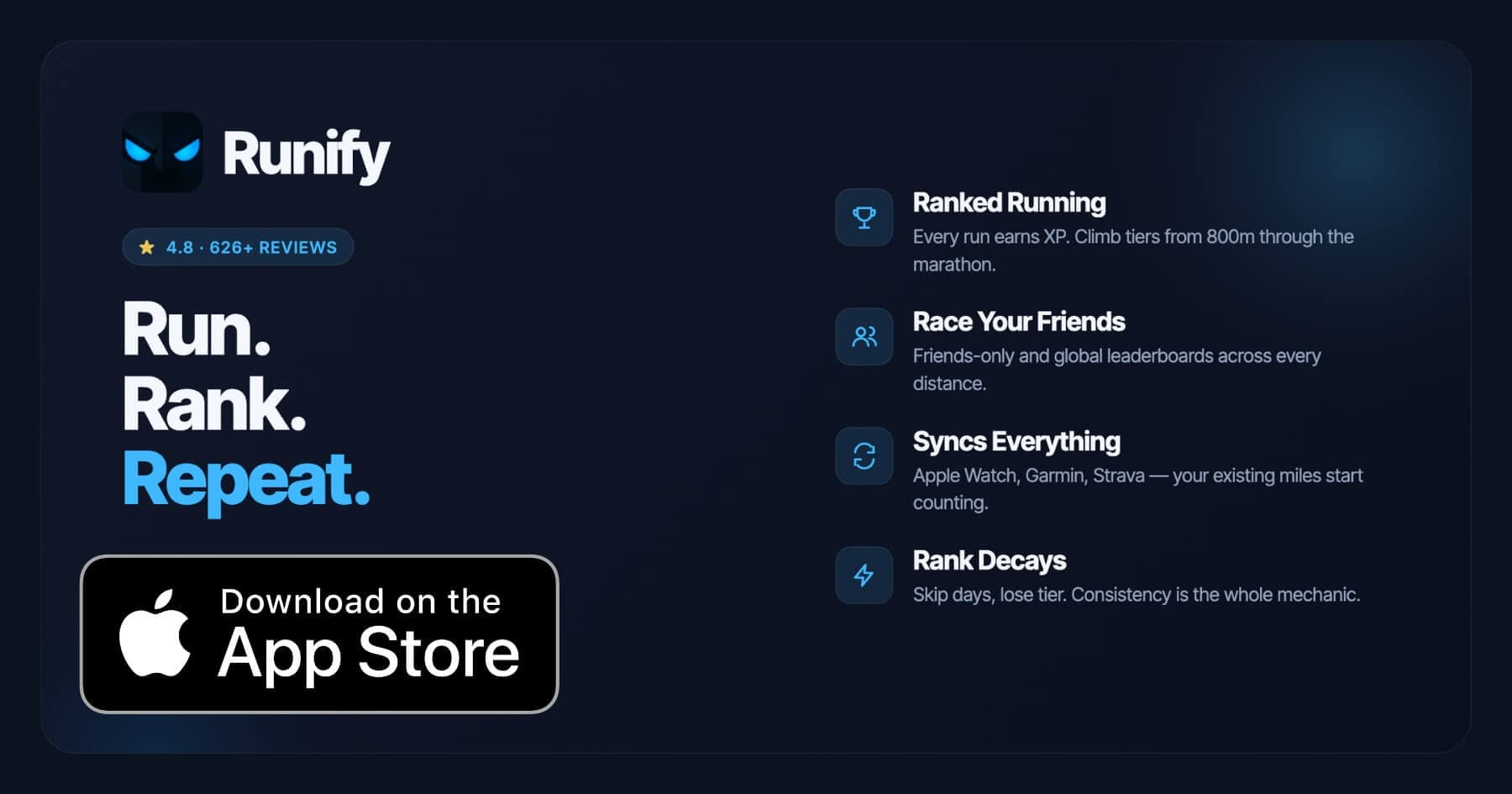
Runify does what neither the Hoka app nor the On Running app does: it turns your runs into a ranked progression system. Every run earns XP, moves you through a competitive tier structure, and puts you on friends-only and global leaderboards across distances from 800m through the marathon. Rank decay means going inactive costs you rank - making consistency feel urgent in a way that a shopping app never could.
The important context: Runify does not replace your GPS tracker. It works on top of whatever you already use. If you run in Hokas or On shoes and track with Apple Watch, Garmin, or Strava, Runify connects to all three and bulk-imports your run history. Your existing miles start counting toward a rank the moment you sign up. It holds a 4.8-star rating on the App Store with 626+ reviews.
Runify is iOS only and is not a coached training-plans app. It suits runners who want to gamify their existing training, not replace it. Many users keep Strava or Garmin Connect as their GPS source and use Runify on top for the competitive and social layer.
When Runify Is the Better Pick Than Both
- You want a visible, competitive reason to keep running (XP, rank, rank decay)
- You already track on Apple Watch, Garmin, or Strava and want those miles to count toward something
- You care about distance-specific performance (800m through marathon) on friends and global leaderboards
- You like sharing stylized run recaps to Instagram Stories
When Runify Is Not the Right Fit
- You're on Android. Runify is iOS only today.
- You want structured training plans, pace coaching during a run, or audio-coached workouts. Runify focuses on tracking, ranking, and social competition - not coaching.
- You want route discovery or race signup features.
How to Choose Between the Hoka App and On Running App
The honest answer is that the choice is almost never between these two apps. You will likely use both brands' apps only as shopping tools, and run your actual training through Strava, Garmin Connect, or Apple Watch. But if you are deciding which brand's digital ecosystem to invest in, here are the factors that matter.
-
Which shoes do you buy? Use the app that matches your shoe brand. Both apps are most useful as post-purchase management tools - order tracking, return management, release notifications. If you buy Hokas, the Hoka app makes sense. If you buy On shoes, the On app does.
-
Are you registered for a Hoka-sponsored event? If yes, Hoka's event-specific apps offer race-week companions with training guides and session monitoring that On does not match. On has no equivalent product.
-
Do you care about brand content and community? On Running's aesthetic-forward brand identity is reflected in its app's editorial content. Hoka's brand content is more race-performance focused. Neither app builds in-app running community; that layer has to come from elsewhere.
-
Do you want a competitive running layer on top? If ranking, XP, and leaderboards across race distances sound motivating, neither brand's app addresses this need. Runify fills that gap for iOS users.
-
Do you need hardware or data integration? Neither app connects to wearables or imports fitness data. If data integration matters to you, your choice of GPS tracker (Apple Watch, Garmin, Strava) is far more important than which shoe brand's app you download.
Frequently Asked Questions
Is the Hoka app or On Running app better in 2026?
Neither app functions as a running tracker, so the comparison is mostly between shopping and brand companion tools. The Hoka app has a slight edge for runners attending Hoka-sponsored events, where event-specific apps provide training guides and race-week content. On Running's app is cleaner as a retail experience. For actual run tracking, pace data, or community features, both apps fall short - runners in both brands' ecosystems typically use Strava, Garmin Connect, or Apple Watch as their primary tracker.
Can I use the Hoka app and On Running app together?
Yes, and many runners do - if they own shoes from both brands. Since neither app tracks runs or manages fitness data, there is no overlap or conflict. You might use the On app to manage an On order and the Hoka app to browse new Hoka releases simultaneously. Neither app connects to the other or to any shared fitness platform. Your actual running data lives in whichever GPS tracker you choose.
Which is cheaper, the Hoka app or the On Running app?
Both apps are completely free with no paid tiers or in-app purchases. There is no cost difference. The only spending involved with either app is purchasing the brand's shoes or apparel through the app itself.
Which has better tracking accuracy, the Hoka app or the On Running app?
Neither app tracks anything. Hoka's event-specific apps offer basic session monitoring during sponsored race events, but this is not GPS tracking for everyday use. On Running's app has no tracking functionality. For GPS accuracy, pace splits, and training data, both brands' runners rely on third-party apps: Strava, Garmin Connect, and Apple Watch are the most common choices among Hoka and On Running shoe wearers.
What is the best alternative to both the Hoka app and the On Running app?
For GPS tracking and training data, Strava, Garmin Connect, and Apple Watch are the most widely used options among runners wearing either brand. For a competitive ranking layer on top of those trackers, Runify is worth considering - it connects to Apple Watch, Garmin, and Strava, earns XP from every run, and puts you on friends and global leaderboards across distances from 800m to the marathon. It holds a 4.8-star rating on the App Store with 626+ reviews. Runify is iOS only and does not offer coaching or training plans.
Final Verdict
Hoka and On Running are two of the best shoe brands in running right now. But as app makers, both are firmly in "brand companion" territory - not fitness software companies. The Hoka app and On Running app both serve their purpose well as shopping and brand tools. The Hoka app has a narrow edge for runners participating in Hoka-sponsored race events. The On Running app wins on visual design and retail polish.
For actual run tracking, you need something else entirely. Strava and Garmin Connect are the default answers. If you also want a competitive ranked layer that turns every run into a climb through a tier system, Runify layers on top of either.
Download Runify and let your runs climb a real rank: Run Tracker: Runify on the App Store

4.8 on the App Store · Built for iOS