Hal Higdon vs Pfitzinger: Compared in 2026
Hal Higdon vs Pfitzinger: The Quick Verdict
Hal Higdon is the go-to for runners training for their first or second marathon. His plans are free, widely available, and deliberately approachable - peak weeks rarely exceed 55 miles, and the structure is consistent enough that beginners can follow without coaching. Pfitzinger (Pete Pfitzinger's Advanced Marathoning) is built for experienced runners chasing a PR or a Boston qualifier. Plans start at 55 miles per week and climb as high as 85+, with structured periodization and a scientific approach to lactate threshold, VO2max, and recovery.
The short version: Higdon gets you to the finish line. Pfitz gets you to a faster finish line, but only if you can handle the volume safely.
For runners who want their training runs to count toward a competitive rank - not just a finished plan - Runify is a third option worth knowing about. It sits alongside either plan and turns your logged miles into XP, leaderboard placement, and rank progression across distances from 800m through the marathon.
At a Glance: Hal Higdon vs Pfitzinger
| Feature | Hal Higdon | Pfitzinger |
|---|---|---|
| Best For | First and second-time marathoners | Experienced runners chasing a PR |
| Pricing | Free plans; Hal+ $6.99/mo or $59.99/yr | Book ~$25-30 one-time purchase |
| Platform | Web + iOS + Android (Run With Hal app) | Book-based; no dedicated app |
| Standout Feature | Dozen+ free plans for every experience level | Periodized phases with VO2max and LT workouts |
| Main Limitation | Limited value for runners targeting fast times | High mileage raises injury risk for many |
What Is Hal Higdon?
Hal Higdon is one of the most recognized names in marathon training. A former competitive runner and long-time contributing editor at Runner's World, Higdon has been publishing training plans since the 1960s. His marathon plans have helped millions of runners, from complete beginners to repeat finishers, cross a starting line prepared.
Higdon's website offers more than a dozen free marathon plans, organized from Novice 1 through Advanced 2. Each plan is 18 weeks long, built around consistent weekly structures with three or four weekday runs, one long run, and one rest-heavy day. The philosophy is simple: run consistently, build gradually, and trust the long run.
The Run With Hal app brings his plans into an adaptive format - workouts adjust if you miss a day, and the app includes GPS tracking and pace scaling. The app is available on both iOS and Android.
Hal Higdon Key Features
- Multiple plan tiers: Novice 1 through Advanced 2 covers first-timers to sub-3:30 runners with 12+ distinct plans.
- Free base plans: All standard marathon plans are available free on halhigdon.com with no signup required.
- Run With Hal app: Adaptive scheduling, GPS tracking, pace scaling based on recent race results, and blackout date support.
- 18-week structure: Consistent weekly cadence with predictable long run progression - easy to follow without coaching.
- Cross-training options: Many plans include walking, cross-training, and rest days to reduce injury risk for newer runners.
Hal Higdon Pricing
Higdon's training plans are free to access on his website in PDF and web formats. The Run With Hal app is free to download; full adaptive features unlock with a Hal+ subscription at $6.99/month or $59.99/year. All subscriptions include a 2-week free trial.
Hal Higdon Strengths
- Free plans are genuinely complete - no paywall for the core schedule
- Beginner-friendly structure that doesn't require coaching knowledge to follow
- Multiple plan options let runners progress from one training cycle to the next without switching systems
- The app adds adaptive scheduling and GPS tracking that the PDF plans lack
Hal Higdon Weaknesses
- Limited value for experienced runners targeting fast times or Boston qualification
- No periodization - every week follows the same structure from start to finish
- Over-reliance on long slow runs, with minimal focus on aerobic development or lactate threshold work
- App reviews have been mixed, with some users reporting that the PDF plan performed better than the adaptive version
What Is Pfitzinger?
Pete Pfitzinger is a two-time U.S. Olympic Marathon Trials qualifier and a sport scientist. His book Advanced Marathoning, co-authored with Scott Douglas, is a staple on the shelves of serious recreational runners and competitive athletes alike. The 4th edition was published in 2025 in full color, with updated content covering heart rate variability, super-shoes, and revised VO2max workouts.
Unlike Higdon's plans, which live online for free, Pfitzinger's marathon plans exist inside a book. You buy the book, study the science behind the structure, and build your training around the weekly schedules it contains. Plans are available in 18-week and 12-week formats, covering peak mileage ranges of 55, 55-70, 70-85, and 85+ miles per week. For shorter distances, Faster Road Racing (co-authored with Philip Latter) covers 5K through half marathon with the same periodized approach.
Pfitzinger Key Features
- Four plan tiers: Designed for runners already running 55-85+ miles per week, with 18- and 12-week versions of each.
- Periodized structure: Plans move through distinct physiological phases - lactate threshold focus early, VO2max work in the middle, marathon-pace and taper later.
- High long run volume: Depending on the plan, runners complete 10-16 runs of 16 miles or more, including 3-8 runs of 20+ miles.
- Science-backed content: Each plan is supported by detailed chapters on physiology, nutrition, hydration, tapering, and recovery.
- Medium-long runs: Higher mileage versions include a second weekly long effort (13-15 miles mid-week) in addition to the weekend long run.
Pfitzinger Pricing
Advanced Marathoning (4th edition) retails at approximately $25-30 for the paperback through Human Kinetics, Amazon, and major booksellers. A Kindle version is also available. There is no ongoing subscription cost - the book is a one-time purchase. Plans from the book have been uploaded to TrainingPeaks by Pfitzinger, where they can be imported directly for a fee.
Pfitzinger Strengths
- Scientific rigor - every workout type is explained with the physiology behind it
- Periodized phases produce measurable gains in lactate threshold and VO2max
- Proven track record among competitive amateur and masters runners chasing PRs and Boston qualifiers
- The book doubles as a coaching education resource, not just a schedule
Pfitzinger Weaknesses
- Mileage ramp-up is aggressive - plans assume a strong aerobic base before week one begins
- High injury risk at 70+ miles per week, especially for runners not accustomed to that volume
- No flexibility for life - missing workouts is difficult to manage without coaching knowledge
- No dedicated app; runners must self-manage pacing, tracking, and scheduling
Hal Higdon vs Pfitzinger: Head-to-Head
Both systems have helped thousands of runners finish marathons and set personal bests. The right choice depends less on which plan is "better" and more on which matches where you are right now as a runner.
Training Volume and Structure
Pfitzinger wins on volume for runners who need it. His 55-70 mile plan totals roughly 1,100 miles across 18 weeks, compared to Higdon's Advanced 2 plan at around 750 miles. Higdon peaks around 55 miles per week; Pfitzinger's higher tiers peak at 70-85. The difference isn't just mileage - Pfitz uses periodization (distinct training phases), while Higdon follows the same weekly formula from week one to week eighteen.
Training Plans and Coaching
Pfitzinger's plans are more sophisticated. They sequence lactate threshold work early, add VO2max intervals mid-cycle, and taper with marathon-pace runs - each phase building on the last. Higdon keeps it simpler: steady easy runs, one medium-long midweek effort, and one long run per weekend. For a first marathoner, Higdon's simplicity is a feature. For a runner who has already run two or three marathons and wants a faster time, Pfitzinger's structure gives the body different stimuli across the cycle.
Injury Risk and Accessibility
Higdon's plans carry lower injury risk for most runners. The moderate mileage, built-in rest days, and beginner-friendly pacing guidance make them manageable for runners who train 30-40 miles per week. Pfitzinger's higher-mileage plans (70+) have been linked to a higher injury rate in runners who were not adequately prepared for the volume. If your current weekly mileage is within 10 miles of the plan's peak, you have a reasonable chance of staying healthy; if you're starting well below, the risk climbs.
Pricing and Value
Higdon's free plans are genuinely complete - you can train for a marathon from the website without paying anything. The Hal+ subscription adds adaptive scheduling, GPS tracking, and pace scaling for $6.99/month. Pfitzinger requires a one-time book purchase of approximately $25-30, but that cost covers the entire training philosophy, not just a schedule. There is no ongoing subscription fee. For serious runners who will run multiple marathon cycles, the book pays for itself quickly.
Hardware and Platform Integration
Higdon's Run With Hal app integrates GPS tracking and connects to external data, and it's available on both iOS and Android. Pfitzinger offers no dedicated app; runners typically import his plans into TrainingPeaks, Garmin Connect, or their tracker of choice manually. If app-based tracking is important to you, Higdon's ecosystem is more ready-made. If you already use TrainingPeaks or a GPS watch with training plan imports, Pfitzinger's book-based plans adapt well to those tools.
Community and Social Features
Neither Higdon nor Pfitzinger offers a built-in social or competitive layer. Higdon's website has a community forum and Higdon himself is known for responding to runner questions. Pfitzinger's community lives in places like Reddit's r/AdvancedRunning, where the plans are widely discussed and users help each other modify workouts. Social accountability comes from external tools in both cases.
Who Should Choose Hal Higdon?
Higdon's plans suit runners who want a reliable, low-pressure path to the finish line. If any of the following describes you, his plans are a strong match.
- You're running your first or second marathon and want a proven beginner-to-finisher structure
- You currently run 20-40 miles per week and want to build gradually without a major mileage jump
- You want free plans without committing to a subscription or book
- You prefer a consistent, predictable weekly format rather than shifting phases and workout types
- You're not chasing a specific time goal - you want to finish healthy and enjoy the experience
Who Should Choose Pfitzinger?
Pfitzinger's plans fit runners who are ready to treat their marathon training seriously and have the aerobic base to handle it.
- You've finished two or more marathons and want to run meaningfully faster
- You currently run 50+ miles per week comfortably and can handle an 18-week plan that starts near that volume
- You want to understand the science behind your training, not just follow a schedule
- You're targeting a Boston qualifier time or a specific finishing time under 3:30
- You're comfortable self-managing your training without an app or adaptive plan
A Third Option: Runify for Ranked, Competitive Running
Neither Higdon nor Pfitzinger addresses one thing a growing number of runners want from their training: a visible, competitive reason to keep showing up. That's where Runify fits.
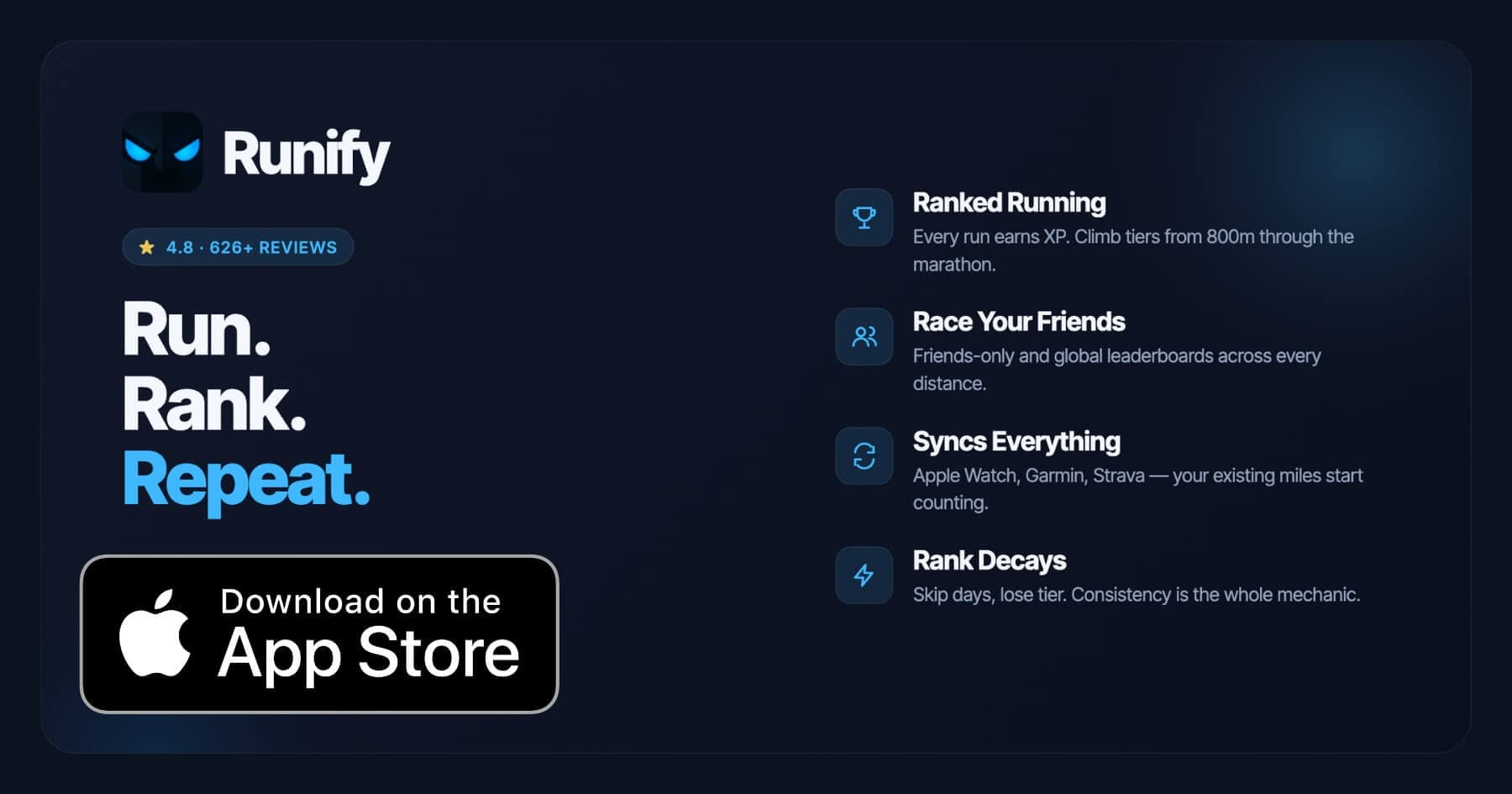
Runify is a ranked running app that turns every logged run into XP, moving you through a competitive tier system and putting you on friends and global leaderboards across distances from 800m through the marathon. It syncs natively with Apple Watch via HealthKit, Garmin, and Strava - meaning if you're already logging runs inside Higdon's app or a Garmin paired to a Pfitzinger plan, those same miles flow directly into Runify and count toward your rank.
The rank decay mechanic is worth noting. If you go inactive, your rank drops. That makes consistency tangible in a way that a training calendar alone doesn't. For runners who find motivation in visible progress and competition, the rank-up reveal after a tough workout lands differently than a checkmark on a plan.
Runify holds a 4.8-star rating on the App Store with 626+ reviews worldwide. Many users keep their existing training plan as-is and layer Runify on top for the social and competitive elements.
Runify is iOS only and is not a training-plans app - it won't tell you what paces to hit or what workouts to do. It ranks and competes around the runs you're already doing, which makes it complementary to both Higdon and Pfitzinger rather than a replacement for either. If you want to understand more about how different marathon training approaches compare, our marathon training app breakdown covers the digital tools that pair well with structured plans.
When Runify Is the Better Pick Than Both
- You want a visible, competitive reason to keep running (XP, rank, rank decay)
- You already track on Apple Watch, Garmin, or Strava and want those miles to count toward something
- You care about distance-specific performance (800m through marathon) on friends and global leaderboards
- You like sharing stylized run recaps to Instagram Stories
When Runify Is Not the Right Fit
- You're on Android. Runify is iOS only today.
- You want structured training plans, pace coaching during a run, or audio-coached workouts. Runify focuses on tracking, ranking, and social competition - not coaching.
- You want route discovery or race signup features.
How to Choose Between Hal Higdon and Pfitzinger
Your current fitness, marathon experience, and goals are the deciding factors. Here's a practical framework.
- Check your current weekly mileage: If you're running under 45 miles per week, Pfitzinger's starting volume will likely lead to injury. Start with Higdon and build your base first.
- Count your marathons: First or second marathon? Higdon's structure is proven for this. Third marathon and beyond, chasing a time goal? Pfitzinger's periodization offers more room to improve.
- Decide how much structure you want: Higdon gives you a schedule. Pfitzinger gives you a schedule plus a coaching education. If you want to understand the "why" behind each workout, the book pays dividends.
- Set your time goal: Running to finish? Higdon works. Running to qualify for Boston or set a major PR? Pfitzinger's plans are built for that pursuit, though they require honest self-assessment of your readiness for the mileage.
- Factor in injury history: If you've dealt with overuse injuries from high mileage, Higdon's lower-volume approach is safer. Pfitzinger's higher-mileage plans demand a body that has adapted to consistent running over time.
For runners who want to explore more plan options alongside either approach, our Hal Higdon alternatives guide and Pfitzinger alternatives guide cover additional structured training options worth considering.
Frequently Asked Questions
Is Hal Higdon or Pfitzinger better in 2026?
Neither is universally better - the right pick depends on your experience and goals. Hal Higdon is better for beginners and intermediate runners who want a proven, low-risk path to the finish line, with free plans and a supportive structure. Pfitzinger is better for experienced runners with a solid aerobic base who want periodized, science-backed training and a meaningful shot at a PR or Boston qualifier. If you've run two or more marathons and currently hit 50+ miles per week, Pfitzinger is worth the step up. If you're earlier in your marathon journey, Higdon is the smarter starting point.
Can I use Hal Higdon and Pfitzinger together?
Not easily - they represent opposite ends of the complexity spectrum, and blending the two typically undermines both. A common progression is to run two or three Higdon marathon cycles to build consistent mileage and experience, then transition to Pfitzinger once your base supports his starting volume. Some runners also use Higdon for a lower-key spring marathon and Pfitzinger for a fall goal race. Running both simultaneously is not recommended.
Which is cheaper, Hal Higdon or Pfitzinger?
Hal Higdon's plans are free on his website - no purchase required for the core schedules. The Run With Hal app adds adaptive features for $6.99/month or $59.99/year. Pfitzinger's Advanced Marathoning book costs approximately $25-30 as a one-time purchase, with no ongoing subscription. For a single training cycle, Higdon is free. For multiple cycles, Pfitzinger's one-time cost is competitive with a few months of Hal+. Both are among the most affordable marathon training options available.
Which has better tracking accuracy, Hal Higdon or Pfitzinger?
Tracking accuracy is a function of the device and app you use, not the training plan itself. Hal Higdon's Run With Hal app includes built-in GPS tracking on iOS and Android. Pfitzinger has no dedicated tracking app - runners pair his book plans with GPS watches (Garmin, Apple Watch) or apps like Strava, TrainingPeaks, or Runify. If you want the most accurate tracking, the hardware matters more than the plan name. Garmin devices and Apple Watch are both highly accurate for marathon training runs.
What is the best alternative to both Hal Higdon and Pfitzinger?
For runners who want a different kind of running motivation - competitive ranking rather than a structured plan - Runify layers on top of either approach. For runners seeking an alternative plan-based system, other respected options include Hanson's Marathon Method (cumulative fatigue approach, no 20-miler), Jack Daniels' Running Formula (VDOT-based pacing), and coached digital platforms like Runna. Our best running apps for marathon training covers several of these in detail for runners deciding between digital and book-based approaches.
Final Verdict
Hal Higdon and Pfitzinger serve different runners at different stages of the marathon journey. Choosing between them isn't a matter of quality - both are legitimate, time-tested systems with strong track records. The question is whether your current fitness matches the demands of the plan.
Higdon is the right pick if you're building your marathon foundation, want free and accessible plans, and prioritize finishing safely over chasing a specific time. Pfitzinger is the right pick if you've done the base work, understand the science, and want a plan that pushes you toward a genuine PR.
For runners who want their training miles to mean something beyond the finish line - XP earned, a rank that climbs or decays, and distance-specific leaderboards shared with friends and global competitors - Runify adds a competitive layer that neither plan provides on its own.
Ready to make your runs count toward something more? Download Runify on the App Store and start ranking your miles from 800m through the marathon.

4.8 on the App Store · Built for iOS