GPS Running Watch Statistics 2026
GPS Running Watch Statistics 2026
Apple Watch leads the global smartwatch market with roughly 23% share, while Garmin's fitness segment grew 33% year over year and now drives a record-breaking revenue line. Apple Watch became the top dedicated device on Strava in 2025, and COROS was the fastest-growing brand. Dual-band GPS watches now hold within two meters of the actual path, but peer-reviewed studies still place median distance error at 0.6% to 1.9% over a marathon-length course. The global GPS running watch segment is projected at $2.5 billion in 2025 with an 8% CAGR through 2033. The numbers below show how the GPS watch landscape is reshaping how runners record, compare, and trust their data.
The GPS running watch is no longer a niche tool for serious racers. More than 500 million people wear a smartwatch worldwide in 2025, and a large slice of them use it primarily for fitness. Brand competition between Apple, Garmin, COROS, Polar, and Suunto has pushed accuracy, battery life, and price into runner-friendly territory.
This guide pulls together 16 verified statistics on market share, accuracy, battery norms, owner demographics, and growth. It is built for runners deciding what to wear, what to trust, and what to expect from the data on their wrist.
1. Apple holds about 23% of the global smartwatch market in 2025
Apple shipped enough Apple Watches in 2025 to hold roughly 23% of the global smartwatch market, keeping its top-vendor position despite stronger competition. Apple grew 18% year over year on the back of a refreshed lineup that included the Apple Watch SE and Ultra updates. In the United States specifically, Apple's national share runs above 55%, making it the default running watch for most American iPhone owners. That dominance matters for runners because Apple Watch syncs natively into Apple Health and Strava, with no extra adapter or cable. It also explains why so many running apps build around HealthKit first.
Source: Counterpoint Research - Global Smartwatch Shipments Market Share
2. Garmin's fitness segment grew 33% year over year in 2025
Garmin reported a 33% year-over-year jump in its fitness segment in 2025, with around 25 percentage points of that representing pure share gain. Earlier in the cycle, Garmin's Q1 2024 fitness revenue rose 40% to $343 million, a first-quarter record at the time. The fitness segment includes the Forerunner, Venu, and Vivo lines that runners actually buy. Garmin posted record annual revenue for 2025 and 17% growth in Q4, signaling that runner-focused watches are pulling weight inside a much broader product portfolio. The takeaway is simple. Running watches are still the engine of Garmin's growth story, not a side bet.
Source: Bicycle Retailer - Garmin posts record revenue for 2025
3. Apple Watch was the top dedicated device on Strava in 2025
Apple Watch was the most-uploaded dedicated device across Strava in 2025, ranking ahead of every Garmin model. Strava's 12th annual Year in Sport report, drawn from over 180 million athletes between September 2024 and August 2025, placed Apple Watch first in the watch category. Garmin came in second across all device types, and women were 70% more likely than men to log activities with an Apple Watch. The shift matters because Strava's device leaderboard is the closest thing the running world has to a global running-watch census. For an in-depth look at the Strava ecosystem and where it falls short, read our Strava alternatives breakdown.
Source: Strava Press - 12th Annual Year in Sport Trend Report
4. COROS was the fastest-growing watch brand on Strava in 2025
COROS was named the fastest-growing watch brand year over year on Strava in 2025, helped by the Pace Pro and NOMAD models. The brand still trails Apple and Garmin in raw uploads, but the growth curve is the steepest in the segment. COROS watches typically sit between $200 and $500, and the company leans hard on long battery life and runner-specific software. The signal here is that runners are willing to leave the Apple-Garmin duopoly when a brand offers better battery, lower price, or both. COROS's rise also explains why Garmin and Apple keep pushing dual-band GPS and longer training-load features into their entry tiers.
Source: Strava Press - 12th Annual Year in Sport Trend Report
5. The global GPS running watch market is projected at $2.5 billion in 2025
The dedicated GPS running watch segment is projected to reach $2.5 billion in 2025 and grow at an 8% compound annual rate through 2033. The wider running watch market sat at roughly $9.8 billion in 2024 and is forecast to climb past $17 billion by 2031, a CAGR of about 8.6%. Apple, Garmin, Suunto, Fitbit, and Samsung together hold close to 50% share. The growth driver is not new runners alone. It is also runners upgrading from a phone-only setup to a wrist device, plus existing watch owners replacing two-year-old models with multi-band GNSS units.
Source: Valuates Reports - Global Running Watches Market
6. Dual-band GPS watches stay within two meters of the actual path
Dual-band, multi-frequency GPS watches stay within roughly two meters of the runner's true path in tested conditions, while older single-band watches can drift 30 meters or more in dense urban canyons. DC Rainmaker's New York City accuracy gauntlet showed dual-frequency Garmin and Apple Watch Ultra 2 units holding the correct lane on Manhattan streets, while non-multi-band watches treated entire roads as a margin of error. The reason is physical. Multi-band receivers read two satellite frequencies and cancel out reflections from buildings and tree cover. For city runners and trail runners under canopy, the upgrade is the single biggest accuracy gain available without a chest strap or footpod.
Source: DC Rainmaker - Apple Watch Ultra 2 vs Garmin Epix Pro NYC Test
7. GPS sport watches show 0.6% to 1.9% median distance error in peer-reviewed testing
A peer-reviewed validation study at the 56-kilometer Two Oceans Marathon found GPS sport watches reported distance with median errors between 0.6% and 1.9%, depending on the brand and model. Researchers compared device-reported distance against timing-mat ground truth across 255 runners using eight different watch categories. Garmin Forerunner, Garmin XT, Suunto, and TomTom watches all stayed below 1% relative error. Cell phones and entry activity trackers ran higher. The takeaway for runners is that mid-range and premium GPS watches are accurate enough to trust marathon splits, but a 1% error still means roughly 420 meters of drift across 42.2 kilometers, slightly more than a single track lap.
Source: Johansson et al. - Accuracy of GPS sport watches in an ultramarathon (SAGE Journals)
8. Apple Watch Ultra 3 delivers up to 14 hours of GPS workout battery
Apple Watch Ultra 3 is rated for up to 14 hours of outdoor workout with full GPS and continuous heart-rate tracking, or 20 hours in Low Power Mode. Apple Watch Ultra 2 hits 12 hours in standard GPS mode, and the original Ultra also runs 12 hours, dropping to 10 with LTE. The numbers are honest enough for a marathon and most ultras under 50 kilometers, but they still trail dedicated multisport watches by a wide margin. Battery life is the single largest reason a runner picks a Garmin or COROS over an Apple Watch for a 100-mile race or a multi-day mountain effort.
Source: Apple Support - Apple Watch Ultra 3 Tech Specs
9. Garmin Forerunner 945 reaches 36 hours in GPS mode
The Garmin Forerunner 945 delivers up to 36 hours in standard GPS-tracking mode, more than triple what most smartwatches offer. The Forerunner 745 is rated at around 16 hours, the 645 at roughly 13 hours, and the budget Forerunner 55 at up to 20 hours. Newer flagship models like the Forerunner 965 push the GPS-only ceiling even further with multi-band trade-offs. The pattern is clear. Dedicated multisport watches treat 24-plus hours of GPS battery as table stakes. That is what makes them the default on a 100-kilometer trail or a multi-day adventure where charging is impossible.
Source: Garmin - Forerunner 945 Battery Life
10. Smartwatch GPS battery runs 7 to 12 hours, dedicated watches run 25 to 100-plus
Smartwatches built around full app ecosystems, including Apple Watch, Samsung Galaxy Watch, and Google Pixel Watch, typically deliver 7 to 12 hours of GPS tracking. Dedicated running and multisport watches from Garmin, COROS, and Suunto routinely deliver 25 to 100-plus hours of GPS in standard mode. The split explains the buying choice runners face. A smartwatch covers a marathon and a typical training week. A dedicated multisport watch covers an ultra, a long bike-pack, or a week-long backcountry trip without needing a charger. Most runners only need the first. Ultra and adventure runners almost always need the second.
Source: OutdoorGearLab - Best GPS Watches 2026
11. 26% of US adults and 20% of UK adults own a smartwatch
Smartwatch ownership now sits at roughly 26% of adults in the United States and 20% in the United Kingdom. That works out to about 80.9 million Americans wearing a connected wrist device. Norway leads at 24%, Finland at 19%, and Germany at 17%. Among UK consumers who own a smartwatch or eHealth tracker, 46% pick Apple and 27% pick Fitbit. Adoption is no longer the early-tech minority. It is now mainstream behavior for runners, walkers, and commuters alike. That mainstream base is also why running apps are designed around watch sync first and phone-only second.
Source: Statista - Smartwatch ownership and brand use UK
12. Average smartwatch user is 35.8 years old, with 41% Gen Z adoption
The average smartwatch user globally is now 35.8 years old in 2025, and adoption among Gen Z (ages 11 to 26) reached 41%. Among adults aged 35 to 44, ownership tops out at 49%, the highest of any age band. Adults 45 to 64 sit at 27%, and seniors 65-plus reach 14%. The gender split is roughly 52% male, 48% female. The data tells two stories at once. Younger users are adopting watches as wellness-and-social devices first. Mid-life adults are buying them to replace older fitness trackers and chest straps. Both groups end up running with them.
Source: Demandsage - Smartwatch Statistics 2026
13. 92% of smartwatch users track health and fitness, and running tracking is 43% of the fitness segment
Across global surveys, 92% of smartwatch owners say they use the device to track and improve their health and fitness. Inside the dedicated fitness-tracker market, running tracking holds the largest application share at 43%. Smartwatches alone accounted for 51.5% of fitness-tracker revenue in 2024, with the broader wearable fitness-tracker market valued at roughly $63 billion. The signal is straightforward. Running is the single biggest reason people buy these devices, even when the marketing emphasizes sleep, heart, or stress metrics. If you are training for a 10K or marathon, you fit the largest user persona for the entire industry. Our 10K race statistics deep-dive shows what that audience is racing.
Source: News.market.us - Fitness Tracker Statistics 2026
14. Garmin users average 8,317 daily steps, with regional swings from 5,375 to 10,340
Garmin Connect users worldwide averaged 8,317 daily steps across 2024, with Hong Kong leading at 10,340 and Indonesia trailing at 5,375. Average users came out 2.48 years "younger" than their real ages on Garmin's fitness-age metric, and average daily stress sat at 30, classified as low. The dataset spans tens of millions of devices and 37 countries. The number to lock in is the 8,317 daily-step baseline. It puts most active runners well above the global average and helps explain why 92% of users say they wear a watch for health, not just for runs.
Source: Garmin Blog - 2024 Garmin Connect Data Report
15. Optical wrist heart rate runs 5 to 15 bpm off chest straps during interval work
Wrist-based optical heart-rate sensors on running watches typically run 5 to 15 beats per minute off the reading from a chest strap during intense or variable activity. In one validated study, the Polar H7 chest strap showed near-perfect agreement with ECG (rc=0.98), while the Apple Watch was the most accurate wrist option at rc=0.96. During hard sprint starts, optical sensors can lag 5 to 15 seconds and read 20 to 30 bpm low for the first surge. For steady-state aerobic running, wrist optical is generally fine. For interval workouts and threshold sessions, a chest strap is still the gold standard. Heart-rate accuracy also feeds directly into running form risk, which we cover in running injury statistics.
Source: PMC - Accuracy of commercially available heart rate monitors in athletes
16. Modern running watches now track 4 or more global GNSS constellations
Modern running watches routinely receive signals from four or more global navigation satellite systems at once, including GPS (United States), GLONASS (Russia), Galileo (European Union), and BeiDou (China), plus regional systems like QZSS over Japan. Polar's flagship watches use all five simultaneously. Multi-constellation reception increases visible satellites, shortens lock time, and improves precise point positioning, especially in cities and forests. A decade ago, "GPS watch" meant one US-operated network and a long lock time. Today it means a hybrid receiver pulling from over 100 satellites, often on two frequency bands. That is the unsung reason your watch finds signal in 5 seconds instead of 90.
Source: Polar - What is GNSS
What These Numbers Tell Runners
The GPS watch market in 2026 is splitting cleanly into two camps. One side is the smartwatch-as-running-watch, led by Apple, with 23% global share, top device on Strava, and 7 to 14 hours of GPS battery. The other side is the dedicated multisport watch, led by Garmin and chased by COROS, with 25 to 100-plus hours of GPS battery and richer training data. Both work for the median runner. Only one works for the ultra runner.
Accuracy is the second axis worth watching. Dual-band GPS now lands within two meters of the true path in city tests, and peer-reviewed marathon studies put median distance error under 2%. Wrist heart rate is good for easy and moderate runs and shaky for hard intervals. The runner who knows where their watch is strong and where it lags makes better training decisions and trusts the data they should trust.
Where this all goes is steady, not explosive. The running watch market keeps growing 8% per year, smartwatch ownership keeps climbing toward 30% in mature markets, and watch makers keep adding satellites and battery hours. The next two years will likely make multi-band the default and 24-hour GPS battery normal even on mid-range models.
The GPS running watch is no longer a luxury accessory. It is the single most-used training tool in running, and the data it produces is now accurate enough to run training plans on.
Make Every Watch-Logged Run Count
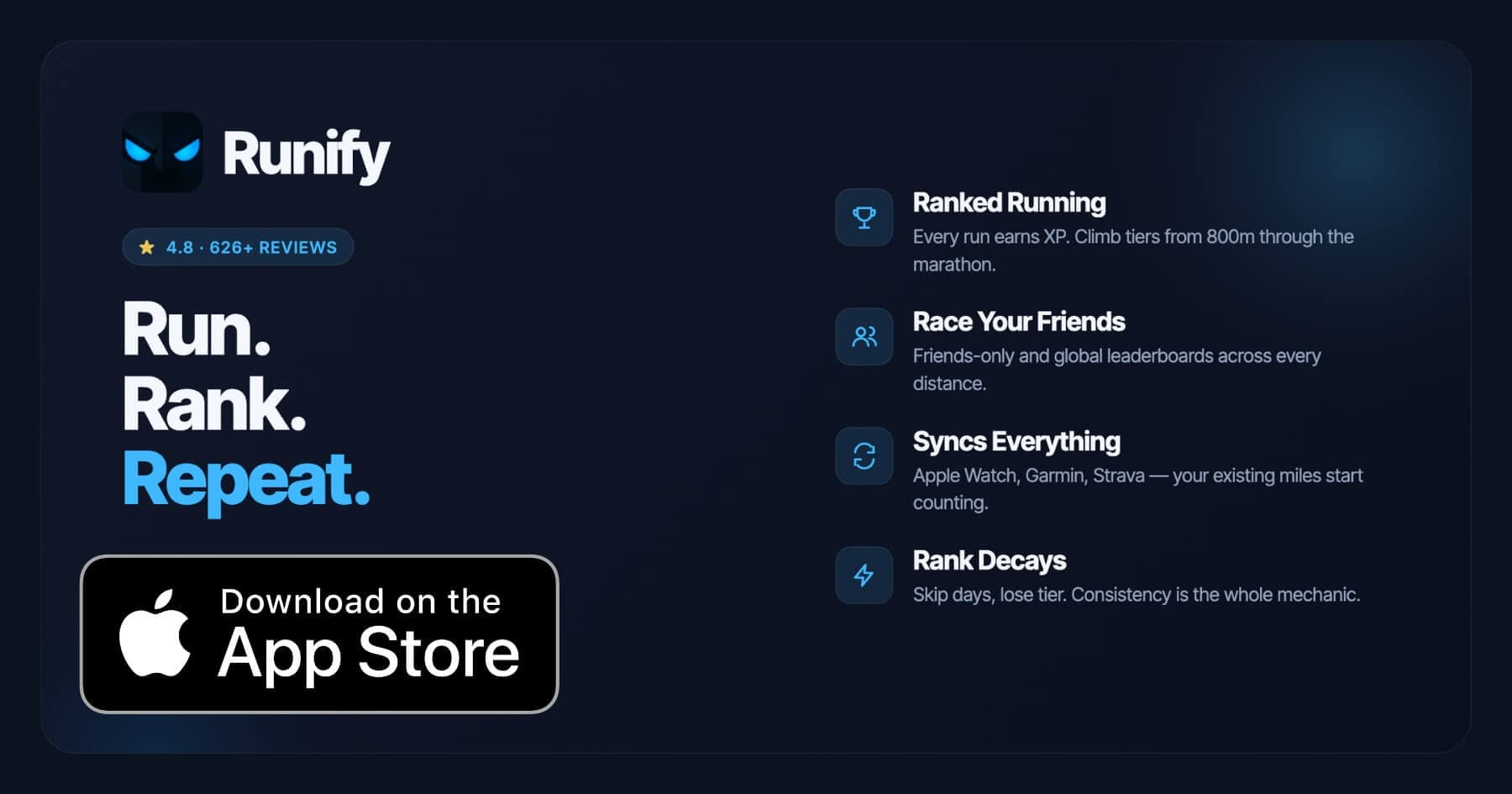
Most runners already wear a watch. The harder problem is making each run feel like progress, not just another data point. Runify takes the runs you already record on Apple Watch, Garmin, or Strava, syncs them in, and turns each one into XP and a moving rank. You see your tier climb when you train and decay when you go quiet. That is consistency you can feel, on top of the watch you already trust.
Whether you train on an Apple Watch Ultra, a Garmin Forerunner, or a COROS Pace, the numbers from those watches power the leaderboards in Runify. Mile splits, race-distance bests, and weekly volume show up automatically across friends-only and global leaderboards from 800m through marathon.
Ready to make your runs count? Download Runify on the App Store and turn every mile into XP across leaderboards from 800m through the marathon.
4.8 stars on the App Store, 626+ reviews worldwide.
Download Runify on the App Store

4.8 on the App Store · Built for iOS