Garmin Connect vs Polar Flow: Compared in 2026
Garmin Connect vs Polar Flow: The Quick Verdict
Garmin Connect suits runners who want a feature-rich ecosystem covering navigation, social challenges, multi-sport tracking, and a growing suite of AI-powered insights. Polar Flow is the better pick for runners who want laser-focused training analysis, detailed heart rate zone breakdowns, and cleaner recovery data tied to their Polar device. Garmin Connect's core app remains free, with a Connect+ subscription at $6.99/month unlocking training programs and advanced AI features. Polar Flow is free with any Polar device, though Polar's own premium tier adds $11/month for personalized training plans. Neither app was built with social competition at its core - if you want your runs to earn XP and climb a visible rank on global leaderboards, Runify is worth a look as a third option.
At a Glance: Garmin Connect vs Polar Flow
| Feature | Garmin Connect | Polar Flow |
|---|---|---|
| Best For | Multi-sport runners and GPS power users | Heart rate focused and data-driven runners |
| Pricing | Free; Connect+ $6.99/mo or $69.99/yr | Free; Premium ~$11/mo |
| Platform | iOS + Android + Web | iOS + Android + Web |
| Standout Feature | Broad ecosystem with navigation and courses | Deep heart rate zone and recovery analysis |
| Main Limitation | Connect+ backlash; cluttered interface | Dated UI; limited social features |
What Is Garmin Connect?
Garmin Connect is the official companion app for Garmin GPS watches and fitness devices. Launched alongside Garmin's wearable lineup, it serves as the central hub for logging, analyzing, and syncing activity data across Garmin's broad device ecosystem. Garmin estimates tens of millions of active users across its platform.
The app covers running, cycling, swimming, hiking, golf, and more - making it a fit for athletes who train across multiple disciplines. In March 2025, Garmin introduced Connect+, a premium subscription tier that adds personalized training programs, expanded AI summaries, Trails+, 3D Maps, and nutrition tracking on top of the free base app.
The core features that were free before Connect+ launched remain free. Garmin has committed to that on public earnings calls.
Garmin Connect Key Features
- Activity Tracking: Syncs runs, rides, swims, and 40+ other activities from any Garmin device.
- Training Status and Load: Daily readiness score, training load focus, and VO2 max estimates for planning your next session.
- Navigation and Courses: Build or import routes, view turn-by-turn navigation, and browse publicly shared courses.
- Social Challenges and Badges: Friend leaderboards, step challenges, and milestone badges for motivation.
- Connect+ AI Insights: Personalized daily summaries, sleep analysis, and nutrition tracking (Connect+ subscribers only).
Garmin Connect Pricing
The base Garmin Connect app is free with any Garmin device purchase. Connect+ is $6.99/month or $69.99/year (saving about $14 annually). A 30-day free trial is available for new Connect+ users. All features available before Connect+ launched remain accessible without a subscription.
Garmin Connect Strengths
- The widest device compatibility in the running/sports wearable market
- Robust free tier - navigation, training status, and course-building cost nothing
- Strong multi-sport coverage for triathletes and cross-trainers
Garmin Connect Weaknesses
- Connect+ subscription launch drew significant user backlash over perceived weak value for the price
- The interface is feature-dense and can feel cluttered compared to more focused apps
- Apple Health integration is limited, frustrating iPhone users who rely on HealthKit
What Is Polar Flow?
Polar Flow is the companion app for Polar sports watches and fitness trackers. Finland-based Polar Electro has a decades-long reputation for heart rate monitoring accuracy, and Polar Flow reflects that focus - training analysis, heart rate zones, and recovery feedback are the app's core strengths.
The app is free with any Polar device. Polar introduced its own premium subscription in 2025, adding personalized four-week training plans built around your recovery data for around $11/month. Unlike Garmin, Polar's hardware business remains its primary revenue model, and the app feels designed for device owners rather than standalone app users.
The Polar Flow interface is functional but visually dated. Polar announced a roadmap for a Polar OS 5 refresh and a renewed training analysis view rolled out in early 2026.
Polar Flow Key Features
- Heart Rate Zone Analysis: Five configurable heart rate zones with detailed session breakdowns showing time-in-zone for every run.
- Training Load and Recovery: Cardio load, recovery status, and nightly recharge scores to prevent overtraining.
- Sleep Tracking: Sleep stages, sleep score, and Polar's Nightly Recharge metric combining ANS recovery and sleep quality.
- Sport Profile Customization: Create multiple run profiles with custom data fields, heart rate targets, and auto-lap settings.
- Third-Party Sync: Connects to Strava, TrainingPeaks, and komoot for athletes who use multiple platforms.
Polar Flow Pricing
Polar Flow is free with any Polar device purchase. Polar's premium subscription tier costs approximately $11/month (€9.99/month) and adds personalized four-week training plans that adapt weekly based on your recovery, lifestyle, and goals. The premium tier does not add any features that affect basic tracking or heart rate analysis - those remain free.
Polar Flow Strengths
- Best-in-class heart rate zone analysis for runners who train by feel and HR data
- Clean recovery stack - sleep, ANS recovery, and cardio load presented together
- Third-party sync to Strava and TrainingPeaks without needing a subscription
Polar Flow Weaknesses
- The app UI has not received a full redesign in years; users consistently call it dated
- Limited social features - no friend challenges, leaderboards, or sharing within the app
- Treadmill distance tracking has known inaccuracy issues; no in-app calibration option
Garmin Connect vs Polar Flow: Head-to-Head
These two apps compete on the same fundamental job - helping dedicated runners get more from their wearable data. Their philosophies differ enough that picking the right one often comes down to what you want your data to do for you.
Tracking Accuracy
Both apps rely on their respective hardware for GPS and heart rate data, so raw tracking accuracy depends more on which device you own than which app you use. That said, Polar's optical heart rate technology and the OHR algorithms in its mid-to-high-end watches have consistently ranked among the most accurate in independent tests on sites like DC Rainmaker. Garmin's top-tier hardware (Forerunner 965, Fenix, Epix) is competitive, but Polar holds a traditional edge in chest-strap-equivalent wrist HR accuracy for hard intervals and tempo runs.
Training Plans and Coaching
Garmin Connect's free training programs were expanded under Connect+ with Garmin running and cycling coaches, exclusive educational content, and structured multi-week plans. Polar's premium tier adds four-week adaptive training plans built around your actual recovery data - if your Nightly Recharge is low, the plan adjusts. Polar's plan adapts; Garmin's plan follows a schedule. For runners who want training that responds to recovery, Polar's premium approach is more sophisticated. For runners who want a fixed plan with coach content, Garmin has the edge in breadth.
Social and Community Features
Garmin Connect is the clear winner here. It supports friend leaderboards, step challenges, badge milestones, and activity feeds where friends can leave comments and kudos. Polar Flow has almost no social layer - there's no public feed, no friend challenges, and no way to compare performance against other Polar users inside the app. Runners who get motivation from friendly competition will find Garmin Connect significantly more engaging. If you want more than Garmin Connect offers for social running, check out our breakdown of best Garmin Connect alternatives for social-first options.
Pricing and Value
Garmin Connect's free tier is generous - full navigation, training status, VO2 max, and course-building at no cost. Connect+ at $6.99/month adds AI summaries and training programs for those who want more. Polar Flow's free tier is also solid for core tracking and HR analysis. Polar's premium at $11/month focuses narrowly on adaptive training plans. If you own a Garmin device and don't need training plans, the free tier delivers excellent value. If you own a Polar device and train by heart rate, Polar Flow free covers most of what you need. Garmin's $69.99/year annual pricing is cheaper than Polar's monthly-only premium at $132/year.
Hardware Integration
Both apps are tightly locked to their own ecosystems. Garmin Connect works best with Garmin devices; Polar Flow works best with Polar watches. Neither supports direct import from the other brand's hardware without third-party workarounds. Garmin Connect syncs to Strava, and from there data can flow to other platforms. Polar Flow connects to Strava, TrainingPeaks, and komoot natively. For runners who want data to flow freely between platforms, the best Polar Flow alternatives post covers apps with more open sync options.
Platform and Availability
Both apps run on iOS, Android, and web. Garmin Connect's web app is more feature-complete than Polar Flow's, though Polar has been progressively improving its web training analysis view through 2025 and 2026. Offline logging works through the watch directly in both cases - the companion app is for post-run analysis rather than active tracking. Neither app has meaningful smartwatch independence from the paired hardware.
Who Should Choose Garmin Connect?
Garmin Connect fits runners who want a single app to handle a broad range of training and daily tracking needs. Its strength is breadth - it does a lot of things well rather than one thing exceptionally.
- Runners who train across multiple sports (triathlon, cycling, swimming) and want one app for all of it
- GPS power users who build custom courses, use turn-by-turn navigation, or rely on route discovery via their watch
- Social runners who want friendly challenges, step competitions, and activity feeds with friends
Who Should Choose Polar Flow?
Polar Flow fits runners who take heart rate-based training seriously and want detailed, honest recovery feedback without noise.
- Runners who structure their training by heart rate zones and want time-in-zone data for every session
- Athletes who track recovery closely and want Polar's Nightly Recharge and cardio load stack
- Runners who already use Strava or TrainingPeaks and want a Polar device to feed data into those platforms
A Third Option: Runify for Ranked, Competitive Running
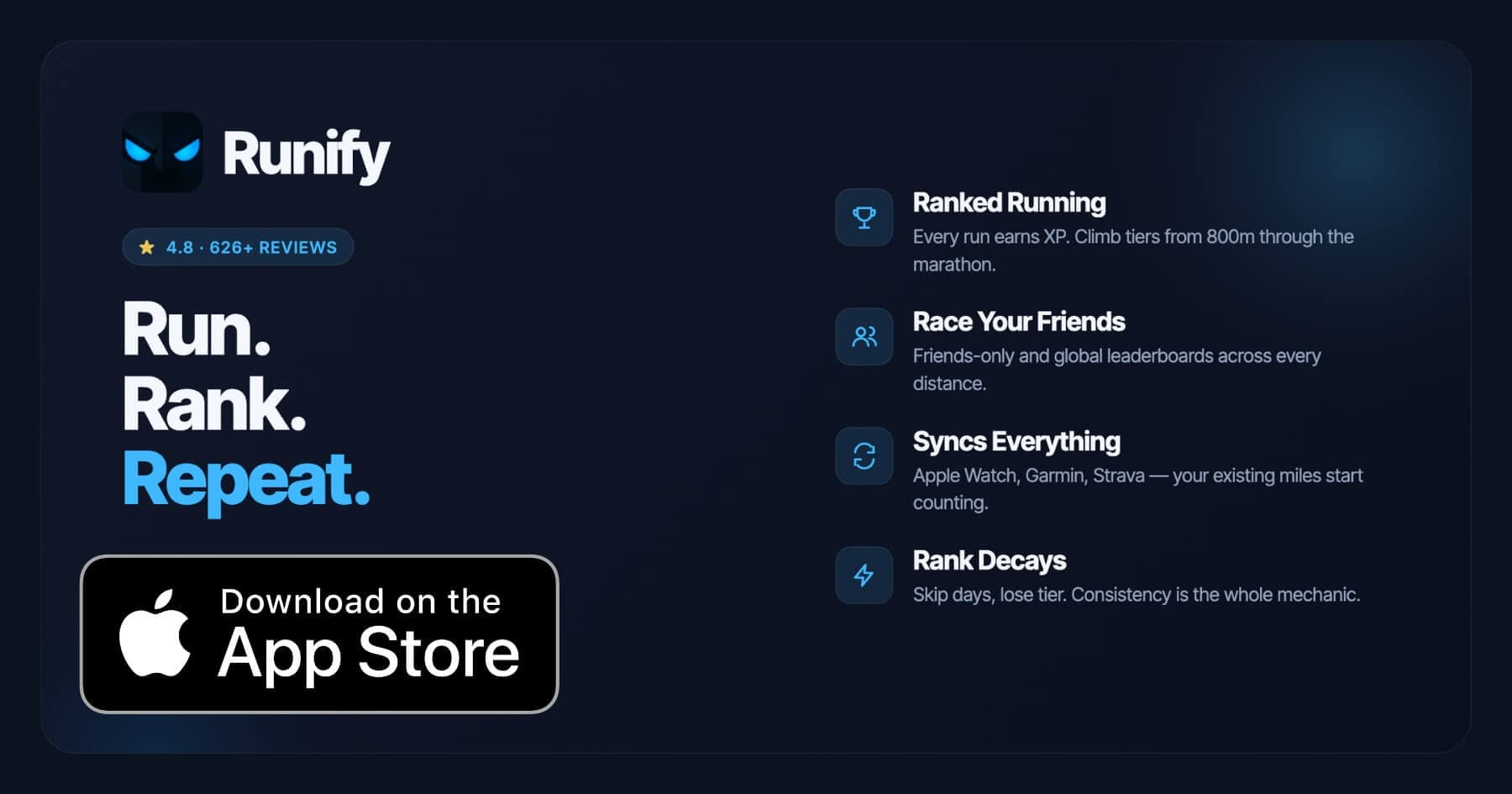
Neither Garmin Connect nor Polar Flow was designed around social competition and rank-based motivation. Runify fills that gap - it's the first running app built around a competitive tier system where every run earns XP, moves you through ranks, and puts your miles on friends and global leaderboards across actual race distances (800m through marathon).
Runify syncs directly from Apple Watch/HealthKit, Garmin, and Strava. If you already log on Garmin, your runs can flow into Runify automatically - so you keep Garmin Connect for its analysis and use Runify for the competitive layer on top. The rank decay mechanic means going inactive costs you rank, making consistency feel tangible rather than abstract. Runify holds a 4.8-star rating on the App Store with 626+ reviews.
Runify is iOS only. It's not a training-plans app - it doesn't offer coached workouts, audio guidance, or structured periodization. It suits runners who want to gamify their existing training rather than replace either Garmin Connect or Polar Flow.
For runners considering options beyond these two platforms, our best running apps for Polar watches post covers six companion app options including what Runify adds on top.
When Runify Is the Better Pick Than Both
- You want a visible, competitive reason to keep running - XP, rank-up reveals, and rank decay for accountability
- You already track on Apple Watch, Garmin, or Strava and want those miles to count toward a visible rank
- You care about distance-specific performance (800m through marathon) on friends and global leaderboards
- You like sharing stylized run recaps to Instagram Stories
When Runify Is Not the Right Fit
- You're on Android. Runify is iOS only today.
- You want structured training plans, pace coaching during a run, or audio-coached workouts. Runify focuses on tracking, ranking, and social competition - not coaching.
- You want route discovery or race signup features.
How to Choose Between Garmin Connect and Polar Flow
The right call depends on four things: your device, your training philosophy, how much social motivation matters, and your budget.
-
Start with your hardware: If you own a Garmin watch, Garmin Connect is the natural fit - the integration is deep and the free tier is strong. If you own a Polar watch, Polar Flow is where your data lives. Switching apps without switching devices works only through Strava as a bridge.
-
Consider how you train: If you train by heart rate zones, Polar Flow's zone analysis is more detailed and easier to act on. If you want navigation, multi-sport tracking, and AI insights, Garmin Connect's broader toolset fits better.
-
Factor in social motivation: If friend challenges and activity leaderboards keep you consistent, Garmin Connect has a real social layer. Polar Flow has almost none. Runners who want competitive social features should look beyond both apps.
-
Compare the true cost: Both free tiers are genuinely useful. If you want extras, Garmin Connect+ at $69.99/year is cheaper than Polar's premium at roughly $132/year. Evaluate what you'll actually use before subscribing to either.
-
Check platform needs: Both apps cover iOS, Android, and web. Neither offers independent smartwatch apps worth using without the companion phone app for configuration and sync.
Frequently Asked Questions
Is Garmin Connect or Polar Flow better in 2026?
Garmin Connect is better for runners who want breadth - multi-sport tracking, navigation, social challenges, and a large device ecosystem. Polar Flow is better for runners who prioritize heart rate-based training analysis and recovery feedback. If tracking accuracy and zone data matter most to you, Polar has the edge. If you want features like course-building, friend leaderboards, and AI summaries, Garmin Connect pulls ahead. Neither is universally superior - the right choice depends on your device and training style.
Can I use Garmin Connect and Polar Flow together?
Not directly, since each app is designed for its own hardware ecosystem. The most common workaround is syncing both devices to Strava as a neutral hub, which aggregates data from multiple sources. You cannot sync a Garmin watch to Polar Flow or a Polar watch to Garmin Connect natively. If you own both brands, running both apps separately and using Strava as a bridge is the practical approach. Runify imports from Garmin and Strava, so runners who use either device can bring their miles into Runify's ranking system.
Which is cheaper, Garmin Connect or Polar Flow?
The free tiers of both apps are comparable in value. For premium subscriptions, Garmin Connect+ costs $6.99/month or $69.99/year. Polar's premium plan runs approximately $11/month with no annual option confirmed at this time. On an annual basis, Garmin Connect+ ($69.99/year) is meaningfully cheaper than Polar's premium tier (approximately $132/year). Both free tiers offer solid tracking without a subscription.
Which has better tracking accuracy, Garmin Connect or Polar Flow?
Raw tracking accuracy depends more on the watch hardware than the app. That said, Polar's optical heart rate technology has a long-standing reputation for precision, particularly for high-intensity runs where wrist HR can stray. Garmin's top-tier hardware (Forerunner 965, Epix) is competitive in GPS accuracy and increasingly capable in HR tracking. For most recreational runners, both brands track accurately enough that the difference will not affect training decisions. Polar historically holds the edge for pure HR analysis; Garmin holds the edge for GPS route fidelity in dense urban environments.
What is the best alternative to both Garmin Connect and Polar Flow?
For runners who want ranked, competitive running on top of their existing tracking, Runify is the strongest third option. It imports from Apple Watch, Garmin, and Strava, so you keep whichever tracker you already use and add Runify's XP system, tier progression, and leaderboards on top. For runners seeking a social and data-rich alternative with broader hardware support, Strava covers most use cases. For structured training plans, TrainingPeaks integrates with both Garmin and Polar hardware. The best alternative depends on what you feel is missing from your current setup.
Final Verdict
Garmin Connect and Polar Flow serve genuinely different runners. Garmin Connect is the better fit for athletes who want a broad ecosystem, social features, navigation, and multi-sport coverage in a single app. The free tier is strong, and Connect+ adds value for runners who want personalized coaching content.
Polar Flow is the better fit for runners who train by heart rate and want detailed zone analysis, recovery tracking, and a clean data-first experience. The UI is dated, but the underlying analysis is among the best available from any companion app.
If neither feels like the complete picture - especially if social competition and visible rank progression are what keep you running consistently - Runify is worth trying alongside your existing tracker. It works with the runs you're already logging on Garmin or Strava, and adds a competitive layer neither app offers.
Ready to make your runs count toward something? Download Runify on the App Store and see where your miles put you on the global leaderboard.

4.8 on the App Store · Built for iOS