Best RunSignup Alternatives 2026
What Are the Best RunSignup Alternatives?
RunSignup is the largest race registration platform in the US, used by thousands of race directors to manage entries and events. But runners who sign up through RunSignup often find it lacks one thing: a compelling reason to keep training and racing consistently. If you want ranked competition, leaderboards, and a tracking app that makes every mile count toward something, Runify fills that gap directly. For race directors looking to move away from RunSignup's fee structure, strong alternatives include Race Roster, RedPodium, ACTIVEWorks Endurance (ACTIVE Network), and haku. Each serves a different slice of the market - from budget-first organizers to large-scale endurance events.
At a Glance: RunSignup Alternatives Compared
| App | Best For | Pricing | Standout Feature | Main Limitation |
|---|---|---|---|---|
| Runify | Ranked running and training motivation | $4.99/mo or $39.99/yr | Ranked tier system + leaderboards 800m-marathon | iOS only; no race registration |
| Race Roster | Mid-size races with marketing tools | Custom pricing (~$1.75 + 6% per reg) | ASICS-backed with strong marketing suite | Less transparent pricing |
| RedPodium | Budget-conscious race directors | 99c per registrant + 2.9% + 30c | Lowest fees in the US market | Fewer advanced features |
| ACTIVEWorks Endurance | Large events needing global reach | Custom pricing | ACTIVE.com listing with 8.1M monthly visitors | Expensive for smaller events |
| haku | All-in-one event management + CRM | Free for organizers (card fees apply) | Only native CRM in the race registration space | Newer platform, smaller user base |
Why Look for RunSignup Alternatives?
RunSignup dominates the US race registration market - but it is not the right fit for every situation. Here are the most common reasons runners and race directors look elsewhere.
- Fee structure complexity: RunSignup charges around $0.80 per transaction plus 4.8%, which adds up quickly for high-volume events. Some directors find the math opaque compared to flat-rate competitors.
- Feature overload for smaller events: RunSignup is a comprehensive platform with extensive menus. Smaller race directors report difficulty finding specific settings because the system does so much.
- No competitive tracking for runners: RunSignup handles registration. Once a runner signs up and crosses the finish line, there's no ongoing motivation layer - no XP, no rank, no leaderboards to keep training sharp.
- Account verification friction: Some users report immediate account verification requirements after sign-up, with delays that put race timelines at risk.
Runners who use RunSignup to enter races and then want a training and competition app alongside it will find the two categories don't overlap. That's where apps like Runify come in - as a complement, not a replacement, for the registration side.
Alternative #1: Runify - Best for Ranked, Competitive Running
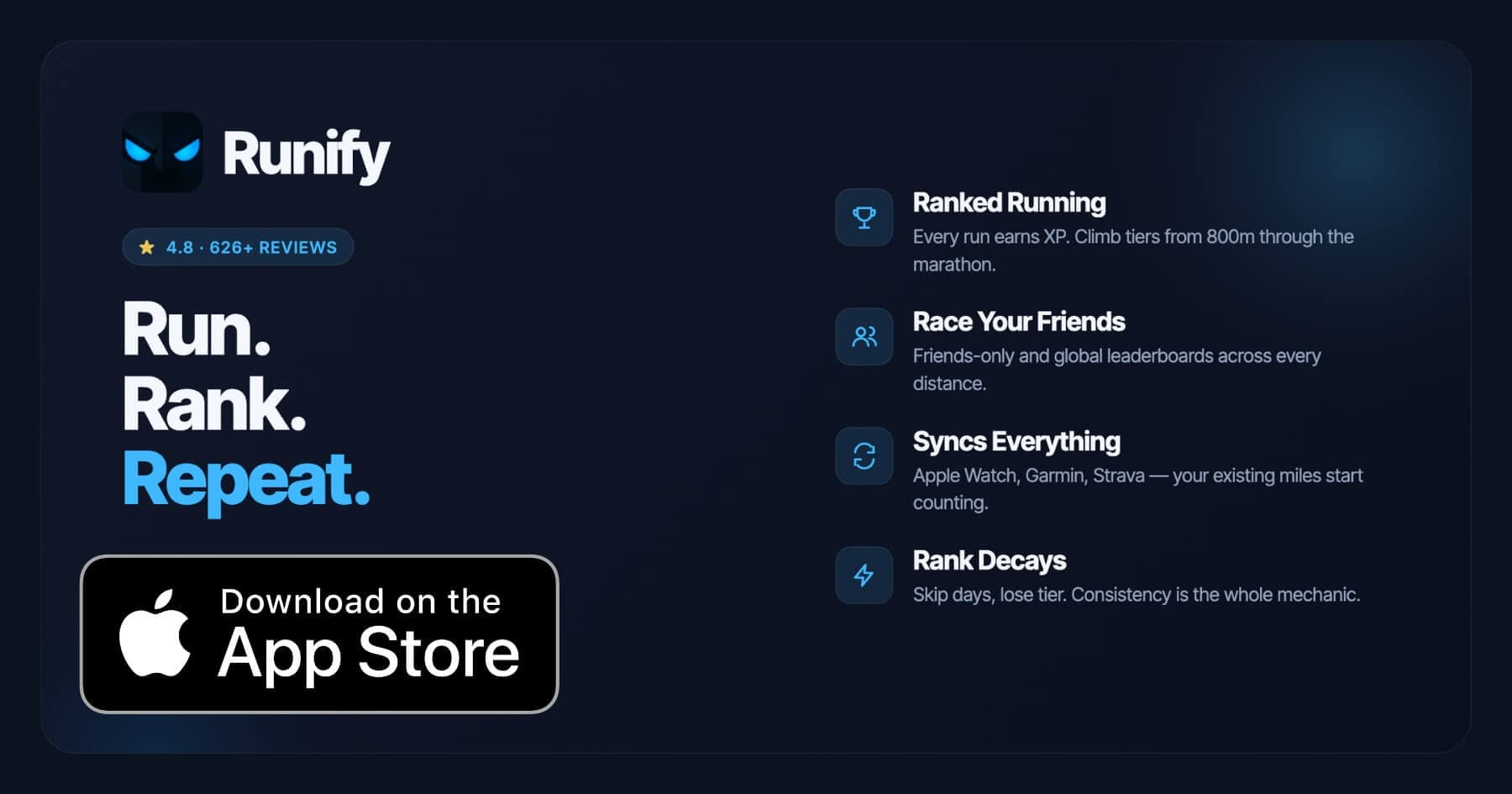
Runify is the first ranked running app, rated 4.8 stars on the App Store with 626+ reviews. Every run you log - whether tracked in-app via GPS or synced from Apple Watch, Garmin, or Strava - earns XP and moves you through a competitive tier system. Leaderboards span distances from 800m through the marathon, with both friends-only and global views. If you're signing up for races through RunSignup and want an app that turns your training between race days into something competitive, Runify is built exactly for that.
Runify isn't a race registration tool - that's not what it does. But for the runner who wants their miles to count toward something after they hit "register" on RunSignup, it's a natural pairing.
Why Choose Runify Alongside RunSignup?
- RunSignup handles the entry, Runify handles the training: Once you've registered for a race, you still need months of consistent training. Runify's rank system and decay mechanic turn that training into a visible competition, not just a calendar of runs.
- Works with your existing setup: If you already train with Apple Watch, Garmin, or Strava, Runify connects to all three and bulk-imports past runs. You don't switch apps - you add a layer on top.
- Distance-specific leaderboards: Runify's leaderboards are organized by race distances - 800m, 1K, 5K, 10K, half marathon, and marathon - which maps directly onto the races you're signing up for through RunSignup.
- Social and shareable: After your race, stylized recap templates let you share results to Instagram Stories in one tap. The run you trained for and raced in is worth showing off.
As described in our Strava alternatives breakdown, runners increasingly want more than a log of their miles - they want a reason to keep showing up every week.
Key Features
- Ranked Progression System: XP from every run, post-run rank-up reveals, and a decay mechanic that turns consistency into a visible incentive. Unlike a pile of badges, Runify builds a real tier you can lose.
- Friends & Global Leaderboards: Compete on a friends-only ladder or go global, and switch between overall Runify Rank and distance-specific ladders from 800m through the marathon.
- Apple Watch, Garmin & Strava Sync: Keep your existing tracker. Runify imports from HealthKit/Apple Watch, Garmin, and Strava, bulk-imports past runs, and auto-detects new ones.
- In-App GPS Tracking: Live GPS with time, distance, pace, and route, plus a post-run summary with splits, photos, and route map.
- Shareable Run Recaps: Stylized recap templates that auto-fill with your time, distance, pace, and route, with one-tap Instagram Stories sharing.
- Streaks & Smart Reminders: Current-streak visibility, streak celebrations, and motivational push notifications for inactivity and post-run follow-up.
Pricing
Monthly: $4.99/month (no free trial). Annual: $39.99/year (includes a 7-day free trial, then auto-renews). Pro unlocks distance-specific leaderboards and expanded profile/history views (weekly, monthly, yearly, all-time stats).
When to Choose Runify
- You're already registered for a race through RunSignup and want a training and competition layer alongside it
- You want XP, rank, and leaderboards to stay motivated between race days
- You already track on Apple Watch, Garmin, or Strava and want those miles to count toward something competitive
- You care about distance-specific rankings (800m through marathon) with friends and global comparisons
When Not to Choose Runify
- You're on Android. Runify is iOS only today.
- You want a race registration platform for your event. Runify is a runner-facing training and competition app - it doesn't handle event registration.
- You want structured training plans, pace coaching during a run, or audio-coached workouts. Runify focuses on tracking, ranking, and social competition - not coaching.
Alternative #2: Race Roster - Best for Mid-Size Races with Full Marketing Tools
Race Roster is the second-largest race registration provider in the US, acquired by ASICS in recent years. It offers registration, fundraising, marketing tools, race-day apps, and timing integrations in one package. Race Roster's marketing suite is a genuine strength - pre-configured email templates, centralized event metrics, and participant communication all live in one dashboard.
Key Features
- Four flexible pricing strategies: Fixed, Scheduled, Block, and Display Only
- Built-in email marketing with pre-configured templates
- Fundraising and charity integration
- Timing system integrations for race-day operations
- Centralized analytics dashboard
Pricing
Race Roster uses custom pricing rather than a published rate card. Based on reported rates, expect around $1.75 + 6% per registration for donations and transfers. Contact their team for an exact quote.
When to Choose Race Roster
Race directors who want a strong marketing and fundraising toolkit alongside registration, and who are comfortable with opaque pricing.
When Not to Choose Race Roster
Budget-conscious directors running high volumes - the per-transaction rate is on the higher end compared to RunSignup or RedPodium.
Alternative #3: RedPodium - Best for Budget-Conscious Race Directors
RedPodium positions itself as the lowest-cost race registration solution in the US market. At 99 cents per paid registrant plus standard credit card processing (2.9% + 30 cents), there are no setup fees, no hidden charges, and no long-term contracts. User reviews on Capterra and G2 consistently praise the simplicity and the customer support responsiveness.
Key Features
- Drag-and-drop registration page builder, no technical knowledge required
- Free mobile check-in app for race-day operations
- Dynamic pricing and conditional visibility options
- Peer-to-peer fundraising pages
- Native dashboard with real-time conversion rates, signups, and revenue
Pricing
99 cents per paid registration plus 2.9% + 30 cents standard credit card processing. Free events cost nothing.
When to Choose RedPodium
You're a race director prioritizing low fees over feature depth, or you're running a smaller event where simplicity matters more than advanced analytics.
When Not to Choose RedPodium
Large-scale events needing deep CRM, timing integrations, or multinational currency support will find RedPodium's feature set limiting.
Alternative #4: ACTIVEWorks Endurance - Best for Large Events Needing Global Reach
ACTIVEWorks Endurance is ACTIVE Network's flagship product for endurance event management. The platform's biggest advantage is distribution - listing your event on ACTIVE.com exposes it to 8.1 million unique visitors per month. For marathons, triathlons, and large charity runs looking for organic registration traffic, that reach is hard to match.
Key Features
- Event listing on ACTIVE.com with 8.1 million monthly unique visitors
- Real-time participant tracking with split times and live race updates
- Automated payment processing, bib assignments, and registration reminders
- Customizable dashboards with registrations, demographics, and post-event trends
- Multi-language and multi-currency support for international events
Pricing
ACTIVEWorks Endurance uses custom pricing across three tiers. Reported rates include $0.99 + 2.9% per transaction, with additional fees. It's among the more expensive options on the market - better suited for events where the ACTIVE.com traffic justifies the cost.
When to Choose ACTIVEWorks Endurance
Large or international endurance events that need organic participant discovery from ACTIVE.com's audience, plus robust automation tools.
When Not to Choose ACTIVEWorks Endurance
Smaller local events where the fee structure eats into margins, or directors who want straightforward, published pricing.
Alternative #5: haku - Best for All-in-One Event Management with Built-In CRM
haku is the newest serious player in the US race registration space and the only platform with a native CRM built in. Beyond registration, haku covers fundraising, marketing, operations, participant engagement, and analytics. It's designed for organizers who want to build long-term relationships with their participant base, not just manage individual events.
Key Features
- The only native CRM in the race registration category
- Registration, fundraising, marketing, and analytics in one platform
- True-hybrid platform supporting in-person, virtual, and hybrid events
- AI-powered tools for event setup and participant communication
- 24/7 online support
Pricing
haku's platform is free for organizers. Standard credit card processing fees apply per transaction. Contact haku for specifics on higher-tier plans.
When to Choose haku
Event organizers who run multiple events per year and want to build participant relationships over time, not just process registrations.
When Not to Choose haku
haku is newer than RunSignup or Race Roster. Directors who need the confidence of a large, established network may prefer a more established platform while haku builds its user base.
How to Choose the Right RunSignup Alternative
The right choice depends on what you're actually trying to solve. Here's how to think through it.
-
Are you a race director or a runner? If you're a runner looking for motivation and competition after registering for a race, an app like Runify sits in a different category from RunSignup. If you're a race director looking to switch platforms, the four alternatives above are your options.
-
What's your event size? Small local events do well with RedPodium's simple pricing. Mid-size events with a fundraising component fit Race Roster. Large events that want organic traffic from a major marketplace should look at ACTIVEWorks Endurance.
-
How much do fees matter? RedPodium is the cheapest at 99 cents per registrant. RunSignup sits in the middle. Race Roster and ACTIVE are toward the higher end. For a 500-person race, the difference can be hundreds of dollars per event.
-
Do you need participant relationship tools? If building loyalty with repeat runners is a priority, haku's native CRM is genuinely differentiated. RunSignup and Race Roster treat each event more transactionally.
-
What happens after registration? Runners who sign up for races and want to stay motivated through training can pair any registration platform with Runify. As covered in our Garmin Connect alternatives guide, the gap between a GPS log and actual competitive motivation is where purpose-built apps make a difference.
Frequently Asked Questions
Is RunSignup still worth using in 2026?
Yes, for most race directors RunSignup is still the leading choice in the US market. It holds the largest market share, offers the broadest feature set, and has strong brand recognition among race timers and directors. The platform's fee structure - around $0.80 per transaction plus 4.8% - is competitive for mid-to-large events. Its main drawbacks are feature complexity for small events and no participant-facing competition or motivation layer. If those gaps matter to you, the alternatives above address them.
What is the best free alternative to RunSignup?
For race directors, haku offers a free base platform with no setup fees (credit card processing fees still apply). RedPodium is not free but charges only 99 cents per paid registrant, making it effectively free for free events. For runners seeking a competitive edge after signing up for races, Runify offers a 7-day free trial on the annual plan ($39.99/year after trial). The trial is enough time to import past runs, see your initial rank, and get a feel for the leaderboard competition.
Can I use RunSignup and Runify together?
Yes - they serve completely different purposes and work well together. RunSignup handles race registration from the event director's side. Runify is a runner-facing iOS app for tracking runs, earning XP, and competing on leaderboards across distances from 800m through the marathon. You sign up for your race on RunSignup, then train and compete in Runify using your Apple Watch, Garmin, or Strava data. They don't overlap.
Which RunSignup alternative is best for ranked, competitive running?
Runify is the only app in this comparison built specifically for ranked, competitive running. It uses a tier system where every run earns XP, rank-up moments are celebrated post-run, and going inactive costs you rank. Leaderboards are organized by race distances - 800m, 1K, 5K, 10K, half marathon, and full marathon - on both friends-only and global ladders. Rated 4.8 stars on the App Store with 626+ reviews, it fills a gap that no race registration platform touches.
How long does it take to switch from RunSignup?
For race directors moving to a new platform, expect 1-4 hours to set up a new event on RedPodium or Race Roster, depending on how complex your registration form is. For runners pairing a new training app with their existing race registrations, Runify's bulk-import from Apple Watch/HealthKit, Garmin, and Strava means your past run history appears in the app within minutes of connecting. Your initial rank is revealed during onboarding, and you're on the leaderboard from your first session. As shown in our Runkeeper alternatives breakdown, switching run tracking apps is usually faster than people expect when imports work well.
Final Verdict
RunSignup remains the dominant race registration platform in the US, and for good reason. The feature depth, market share, and reliability are hard to argue with. If fees are your primary concern, RedPodium is genuinely the cheapest option available. If you need marketing depth and ASICS backing, Race Roster is worth a look. For large events needing organic discovery traffic, ACTIVEWorks Endurance's ACTIVE.com listing is a real advantage. And if building a CRM around your participant base matters, haku is the only platform that natively supports it.
For runners, the more interesting question is what happens after you register. RunSignup does its job - it gets you to the start line. But the weeks of training between now and race day need something more motivating than a confirmation email.
That's what Runify is built for. XP from every run, a rank that climbs when you're consistent and falls when you're not, and leaderboards organized exactly around the distances you're racing. It's not a RunSignup replacement - it's what you run alongside it.
Ready to make your training count? Download Runify on the App Store and turn every run into a ranked competition.

4.8 on the App Store · Built for iOS