Best Running Apps with Virtual Races 2026
Best Running Apps with Virtual Races 2026
You signed up for a 10K three states away. Then life happened. But you still ran the distance - on your usual route, on your schedule, at your pace. Virtual races exist for exactly that scenario: complete a set distance anywhere you choose, submit your time, and see how you stack up against runners worldwide.
The catch is that not every app handles this well. Some just hand you a badge. Others drop you into a fully rendered virtual world. A few build leaderboards that actually update in real time. We tested and compared the top options - here are the 5 best apps for virtual races in 2026.
The best running apps with virtual races in 2026 are: 1) Zwift Run for immersive virtual world races with global competition, 2) Strava for brand-partnered virtual events and distance challenges, 3) Runalyze for data-driven virtual challenges with deep performance tracking, 4) Race At Your Pace for monthly medal-based virtual challenges, and 5) Runkeeper for built-in virtual challenges integrated with GPS tracking. Runify offers global distance leaderboards that let you compare your times across benchmark distances - a compelling complement to virtual races, even though it does not host virtual race events directly.
1. Zwift Run - Best for Immersive Virtual World Races
Zwift Run drops you into a rendered virtual world - Watopia's jungle trails, London's landmarks, New York's streets - and races you alongside real runners from around the globe, all at the same time. No other app on this list puts you at a shared start line with hundreds of competitors from different countries. If what you want from a virtual race is the crowd energy and the competitive atmosphere, Zwift is the closest thing to being there.
Zwift running is free - unlike Zwift cycling, which costs $19.99/month - so the barrier to entry is low. You do need a treadmill and a foot pod (like the Zwift RunPod or a Stryd sensor) or a compatible smart treadmill to transmit speed data. Once you're connected, you get access to dozens of scheduled events every day: easy social jogs, structured workouts, and competitive 5K and 10K races. If you're also curious about treadmill-specific apps, our best running apps for treadmill running breakdown covers the wider field.
Key Features
- Virtual Worlds: Run through Watopia, London, New York, and other rendered routes. Your avatar moves in real time with your actual pace.
- Scheduled Group Races: Dozens of daily events from social jogs to competitive 5K/10K races. The Zwift Companion app (free on iOS) lets you browse and sign up in advance.
- Real-Time Competition: You run alongside other Zwifters from around the world. Position updates live during the race.
- Zwift Games: Annual flagship event where thousands of global runners compete in structured race formats.
- Free for Running: No subscription fee for the running features. Hardware (treadmill + foot pod) is the main cost.
Pricing
Free for running features. You need a treadmill (any treadmill works) plus a foot pod such as the Zwift RunPod or Stryd. Smart treadmills with Bluetooth connectivity remove the need for a separate sensor.
Best For
- Runners who want to race other people in real time from their treadmill
- Competitive athletes looking for structured virtual events and rankings
- Cyclists who already use Zwift and want to add running
Limitations
- Requires hardware: treadmill plus foot pod or compatible smart treadmill
- Running does not send automatic incline commands to treadmills - hills in the virtual world don't change your treadmill's incline
- Primarily an indoor, treadmill-based experience - not for outdoor GPS running
2. Strava - Best for Brand-Partnered Virtual Events
Strava's virtual challenges are the most widely recognized in the running world. They run the gamut from simple distance goals (run 100K in April) to branded partnerships with major races and gear companies. The Virtual NYRR Resolution Run 5K and similar events attract tens of thousands of participants, giving you genuine comparison data against a large global pool.
Challenges are visible on your profile and in your activity feed, which creates social accountability in a way badge apps don't. The free tier lets you join many challenges, but Group Challenges and some branded race events require a Strava subscription. Strava's $11.99/month or $79.99/year subscription cost is worth factoring in if virtual challenges are your main draw. For a deeper look at how Strava compares to other options, our best running app with leaderboards on iPhone review covers the competitive tracking side in detail.
Key Features
- Monthly Distance Challenges: Brand-sponsored events like run 100K, climb 7,500m, or log a fastest-effort 5K within a time window.
- Virtual Race Partnerships: Official tie-ins with NYRR, brand partnerships with Shokz, Virgin Atlantic, Audible, and others that offer real prizes.
- Fastest Effort Leaderboards: See where your time ranks against everyone who completed the same virtual challenge.
- Social Visibility: Challenge completions show on your profile and appear in your followers' feeds.
- Group Challenges: Create private challenges with friends or a club - subscriber feature.
Pricing
Free tier includes many public challenges. Strava subscription: $11.99/month or $79.99/year. Group Challenges require a subscription for both the organizer and participants.
Best For
- Runners already on Strava who want to add structured virtual competition
- Social runners who want their challenge results visible to their community
- Athletes chasing prizes and medals from brand-sponsored events
Limitations
- Group Challenges and some branded events are subscription-only
- No immersive virtual world - challenges are tracked via your regular GPS run
- The challenge calendar can feel sparse between major brand partnerships
3. Runalyze - Best for Data-Driven Virtual Challenges
Runalyze is the analytics-first choice among dedicated runners. Its virtual challenges are built around performance metrics - VO2 max estimates, race prognosis, training load - rather than distance milestones or gamified worlds. If you want to run a virtual 5K and know exactly where that time sits relative to your training trend and your predicted peak performance, Runalyze is the platform for it.
The app launched its iOS presence in 2026 after years as a browser-based tool. Most of the analytical depth remains web-first, but syncing from Apple Watch, Garmin, and Strava is straightforward. The free tier delivers a significant portion of the value. For runners who take indoor sessions seriously, pairing Runalyze with a treadmill setup - covered in our best running apps for indoor running guide - can give you a complete picture of your training.
Key Features
- Advanced Performance Modelling: Effective VO2 max, race prognosis across distances, and long-term development tracking.
- Virtual Challenge Tracking: Log or sync a virtual race effort and measure it against your personal trendlines and predictions.
- Broad Device Support: Syncs with Apple Watch/HealthKit, Garmin Connect, Strava, and other platforms.
- Training Load Analysis: Fitness and fatigue curves help you pick the right week to attempt a virtual PR.
- Free Tier with Depth: Most analytical features are available free, with a Pro tier for additional exports and premium graphs.
Pricing
Free tier covers most features. Runalyze Premium is available via voluntary contribution or subscription - approximately $3-5/month depending on plan. No paywall on core analytics or challenge tracking.
Best For
- Performance-focused runners who want data behind their virtual race results
- Runners already using Garmin or Strava who want deeper analysis layered on top
- Athletes comparing virtual efforts to training forecasts and predicted race times
Limitations
- iOS app is newer and less polished than the web platform; most depth is web-first
- No immersive virtual world or global start-line event format
- Steeper learning curve than consumer-focused apps
4. Race At Your Pace - Best for Monthly Medal Challenges
Race At Your Pace structures virtual running around monthly challenges with a physical reward: you pick a distance goal (say, 50 miles in a month), log your runs throughout the calendar month, and earn a physical medal in the mail when you hit your target. The challenge runs from the 1st to the last day of each month, giving you flexibility to run it across as many sessions as you want.
The iOS app (requires iOS 15.1 or later) lets you log activity directly, monitor progress against your monthly goal, and see real-time stats. Entry fees cover the cost of the medal and shipping - around $14.95 for US/UK participants, with a medal-free entry option at $6.95 for those who just want the structured challenge without the hardware reward.
Key Features
- Monthly Distance Goals: Choose your challenge distance for the month and log any combination of runs to reach it.
- Physical Medals: A real medal ships when you complete your goal - useful motivation for runners who respond to tangible rewards.
- Six Activity Types: Running, walking, cycling, swimming, wheelchair, or daily steps. Mix activities if you want.
- In-App Progress Tracking: Live stats and progress against your monthly target directly in the iOS app.
- Workplace Wellbeing Challenges: Organizations can create team challenges with group leaderboards and shared progress.
Pricing
Individual challenge entry: approximately $14.95 (includes medal and postage). Medal-free entry: $6.95. International postage adds around $6.50 for overseas participants.
Best For
- Runners motivated by tangible rewards - physical medals, not just digital badges
- Casual runners who want flexible monthly structure without strict pacing requirements
- Teams or workplaces running group wellbeing challenges
Limitations
- No live virtual world or real-time leaderboard - leaderboards show cumulative distance, not head-to-head racing
- Entry fees per challenge can add up if you join every month
- Medal delivery adds a lag between completion and reward
5. Runkeeper - Best for In-App Challenges with GPS Tracking
Runkeeper (by ASICS) weaves virtual challenges directly into the GPS tracking experience you're already using. When a challenge is live, you accept it inside the app, run your normal route with GPS tracking on, and your mileage automatically counts toward the challenge goal. No manual logging, no separate platform. The integration is smooth for runners who want one app to do both jobs.
Challenges vary in format: distance goals, streak challenges, and fastest-effort competitions across specific distances. The Runkeeper Go subscription unlocks training plans from the ASICS Institute of Sport Science alongside the challenge features. The app has a solid App Store rating and works well with Apple Watch for heart rate data during runs.
Key Features
- Integrated GPS + Challenge Tracking: Your tracked runs automatically credit toward active challenges - no separate logging step.
- Distance and Streak Challenges: Both cumulative distance goals and single-effort competitions across distances.
- ASICS Institute Training Plans: Subscription includes coaching-backed training plans alongside challenges.
- Heart Rate Zone Customization: Runkeeper Go subscribers can define custom heart rate zones using connected wearable data.
- Apple Watch Integration: Heart rate and pace data syncs automatically from Apple Watch to the app.
Pricing
Free tier available with basic GPS tracking. Runkeeper Go: $9.99/month or $39.99/year. First 7 days free, and the Get Going Challenge unlocks a free first month for new subscribers.
Best For
- Runners who want challenges built into their primary GPS tracking app
- ASICS shoe customers or runners already in the Runkeeper ecosystem
- Beginners looking for structured challenges alongside a training plan
Limitations
- Challenge selection is narrower than Strava - fewer active events at any given time
- No virtual world or immersive race environment
- Best challenge features require the Go subscription
Where Runify Fits
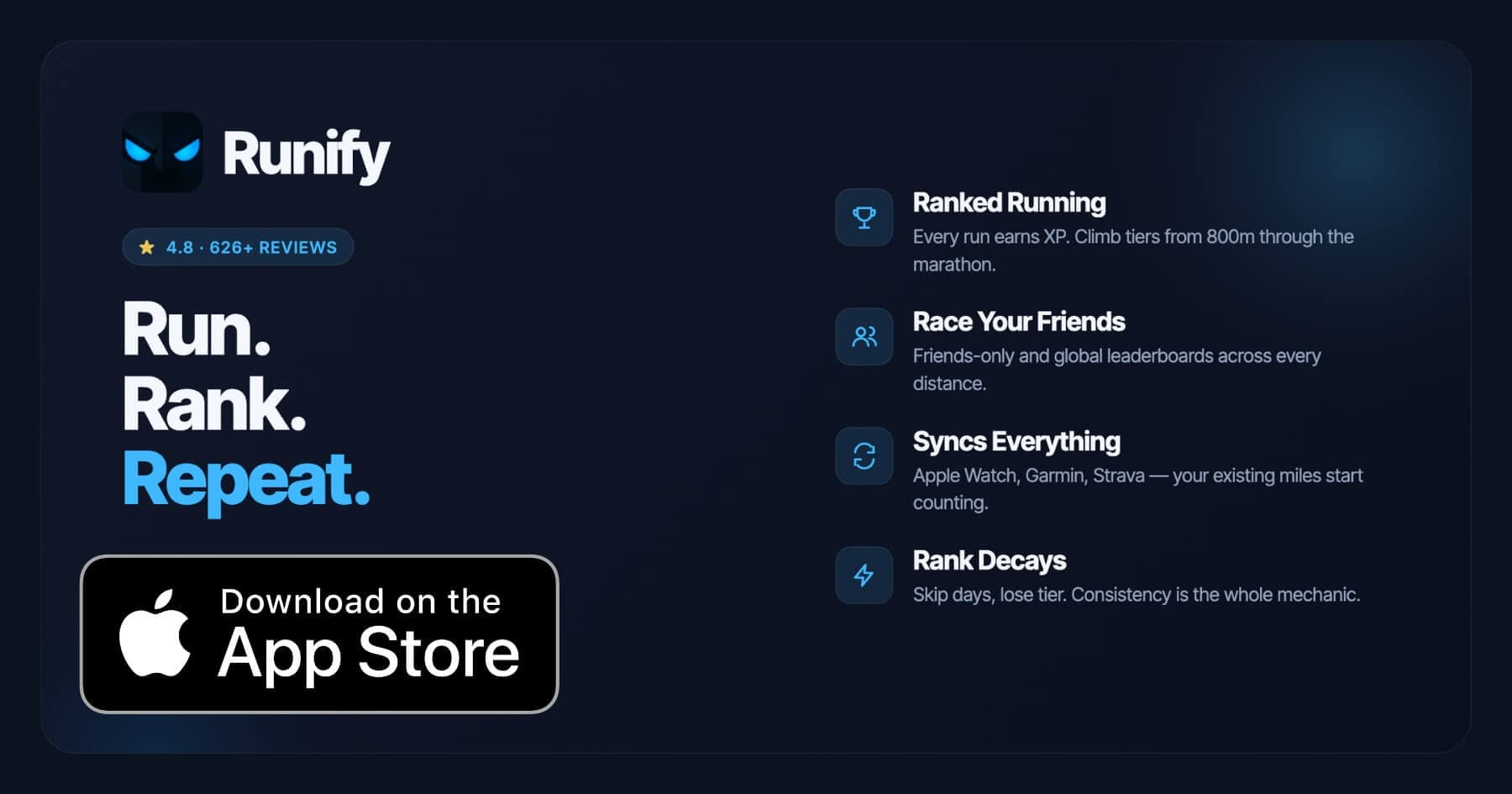
Runify does not host virtual races as a feature - you won't find a scheduled start line or a time-window event on the platform. What Runify does offer is global distance leaderboards across 800m, 1K, 5K, 10K, half marathon, and marathon. Every time you log a run, your best efforts at those distances are ranked against a global pool of Runify runners. That creates a persistent competitive context around your mileage that complements virtual race apps well.
If you race a virtual 5K on Zwift or Strava and want those miles to also count toward your 5K leaderboard rank and your overall tier, syncing to Runify from Apple Watch, Garmin, or Strava closes the loop. The rank progression system and rank decay for inactivity add a layer of accountability that sits alongside virtual challenge motivation rather than replacing it. Pro unlocks distance-specific leaderboards and expanded stats views. Pricing: $4.99/month or $39.99/year with a 7-day free trial on the annual plan.
Runners chasing distance PRs and global competition can see how Runify's leaderboard approach compares to purely training-focused platforms in our best running apps for advanced runners guide.
How to Choose the Best Virtual Race App
Picking the right app depends on what "virtual race" means to you. These five questions help narrow it down.
-
Do you want to race other people in real time or just compare times? Zwift puts you on a shared start line with live avatars. Strava, Race At Your Pace, and Runkeeper compare your time after the fact. Both are legitimate - they just feel different. If the atmosphere of a race is what you're after, Zwift is the clear answer.
-
Are you running outdoors or on a treadmill? Zwift Run is built around treadmill use and requires hardware. Strava, Runkeeper, and Race At Your Pace work with any GPS run - outdoors, treadmill, or track. Runalyze works with synced data from any source.
-
Do you want a physical medal? Race At Your Pace is the only app here that ships a real medal to your door. If the tangible reward is part of your motivation, it's the obvious choice. If not, it's an unnecessary expense.
-
How important is performance data vs. event experience? Runalyze offers the deepest analytics - VO2 max trends, race prognosis, training load. Zwift offers the most immersive event. Strava sits in the middle. Choose based on whether you open your app to analyze a run or to feel the event atmosphere.
-
What's your budget? Zwift Run is free (hardware cost aside). Race At Your Pace charges per challenge. Strava's most useful challenge features are behind an $11.99/month or $79.99/year subscription. Runkeeper Go is $39.99/year. Runalyze's core features are free.
Frequently Asked Questions
What is the best running app with virtual races in 2026?
Zwift Run is the best app for virtual races in 2026 if you want an immersive, real-time experience - you race against live avatars in a rendered virtual world using your treadmill speed. Strava is the best option for outdoor runners who want brand-sponsored virtual events and distance challenges with a large global participant pool. For monthly medal challenges you can run anywhere, Race At Your Pace is the most straightforward pick. The right answer depends on whether you want live competition, social challenges, or flexible distance goals.
Is there a free virtual race app for iOS?
Yes. Zwift Run is free for running features on iOS - you need a treadmill and a foot pod, but the app itself has no subscription fee. Strava's free tier includes access to many public virtual challenges and distance events. Runalyze's core analytics and challenge tracking are also free. Runkeeper offers basic GPS tracking and some challenges at no cost. Race At Your Pace charges a per-challenge entry fee (around $6.95 for medal-free entry). Runify's annual plan includes a 7-day free trial at $39.99/year.
Can I sync my Apple Watch or Garmin runs with a virtual race app?
Most apps here support Apple Watch and Garmin data. Strava, Runkeeper, and Runalyze all sync from Apple Watch via HealthKit and from Garmin Connect. Zwift Run reads speed data from smart treadmills or Bluetooth foot pods rather than GPS. Race At Your Pace syncs activity from Apple Health, meaning Apple Watch runs count automatically toward your monthly challenge. Runify imports from Apple Watch/HealthKit, Garmin Connect, and Strava - so runs you log in any of these ecosystems carry forward into Runify's leaderboard rankings.
What features should I look for in a virtual race app?
- Leaderboard format: Real-time race ranking vs. post-event time comparison vs. cumulative distance tracking - these feel very different
- Entry format: Scheduled events with start times vs. flexible time-window challenges you complete on your own schedule
- Platform requirements: Some apps (Zwift) require specific hardware; others work with any GPS run
- Reward structure: Digital badges, leaderboard placement, physical medals, or real prizes from brand partnerships
- Integration: Check whether the app reads from Apple Health, Garmin Connect, or Strava so your existing device keeps working
Do virtual races count for real competitive rankings?
It depends on the platform. Zwift Run events have their own Zwift ranking system and results pages with genuine competitive weight in the virtual racing community. Strava's fastest-effort challenges are widely referenced among recreational runners but are not affiliated with official race organizations. Runalyze uses your virtual efforts to update your performance models and race prognoses, which carry real training value. For official race certification, virtual times are rarely accepted by governing bodies like World Athletics - but within the running community, personal records set in virtual races are widely respected.
Final Verdict
Virtual racing has matured into a real category. Zwift Run sets the standard for live competition - if the race atmosphere is the point, nothing else on this list matches a shared start line with hundreds of global runners. Strava dominates for runners who want brand partnerships, social visibility, and the flexibility to complete challenges outdoors at their own pace.
Race At Your Pace and Runkeeper serve different motivations: tangible monthly rewards for one, seamless GPS-plus-challenge integration for the other. Runalyze is the specialist pick for performance-focused runners who want their virtual efforts tied to training analysis rather than just event results.
Runify sits alongside these tools rather than competing with them. Its global distance leaderboards across 800m through marathon mean every run you log - whether synced from a Zwift session, an outdoor Strava activity, or an Apple Watch GPS run - feeds into a persistent competitive ranking. The two systems reinforce each other.
Try Runify free for 7 days and see where your best 5K or 10K times rank globally. Download on the App Store and connect your existing Apple Watch, Garmin, or Strava account to get started.

4.8 on the App Store · Built for iOS