Best Running Apps for Recovery Runs 2026
Best Running Apps for Recovery Runs 2026
Your legs are heavy. Yesterday's workout was solid, and your body is asking for a slow, easy effort today. You lace up anyway - but without a clear sense of what heart rate to target or whether your body is actually ready to run, an "easy day" can quietly turn into another hard one. Recovery runs only work when you keep the effort genuinely low, and that takes a bit of guidance.
We compared the top iOS running apps for recovery and easy-effort days - looking at HR zone awareness, daily readiness signals, and "should I run today?" guidance. Here are the six best options.
The best iOS apps for recovery runs in 2026 are: 1) Garmin Connect for Body Battery energy tracking and post-run recovery time, 2) Polar Flow for FitSpark daily workout guidance tied to your Nightly Recharge score, 3) Apple Fitness+ for guided low-intensity runs with real-time heart rate coaching, 4) WHOOP for morning recovery scores built from HRV and sleep, 5) Runna for easy-day pacing targets inside structured training plans, and 6) Runify for logging easy runs that count toward XP and rank. The biggest gap between options is whether an app actively tells you how hard to go, or simply tracks what you did.
1. Garmin Connect - Best for Body Battery and Recovery Time
Garmin Connect is the companion iOS app for Garmin watches, and for recovery-focused runners it is probably the most complete picture available on your phone. The free app pairs with any compatible Garmin device to surface Body Battery, recovery time suggestions, and HRV status - three signals that together give you a clear read on whether a true Zone 1-2 effort is appropriate or whether a full rest day makes more sense.
Why Garmin Connect Stands Out
Body Battery is the headline feature for recovery days. Garmin calculates it continuously from heart rate variability, stress levels, sleep quality, and activity data, presenting your available energy as a 0-100 score. A score below 30 when you wake up is a strong signal that easy is genuinely easy, or that you skip the run entirely.
Recovery time, shown after harder efforts, tells you in hours how long Garmin estimates before your body is ready for another quality session. That countdown pairs well with recovery run planning: if the app shows 36 hours remaining and you are at hour 24, a 30-minute Zone 2 jog is exactly the kind of run that fits without extending the recovery window.
For HR zone context, Garmin's zone data feeds directly into the app's training load analysis. If you are curious how recovery runs fit into the bigger picture, our breakdown of the best apps for heart rate zone training covers that angle in depth.
Key Features
- Body Battery: A 0-100 energy score updated around the clock using HRV, stress, sleep, and activity data - a reliable guide for choosing run intensity.
- Recovery Time: Post-workout estimate in hours before your next hard effort, shown directly in the app after syncing your Garmin watch.
- HRV Status: Morning HRV trend over time, flagging when your baseline drops and suggesting reduced intensity.
- Sleep Alignment (2026): Circadian rhythm consistency data added in the Q1 2026 update, helping you spot patterns between poor sleep and suppressed Body Battery.
- Training Load and Readiness: Acute vs. chronic load tracking with readiness guidance across your recent training history.
Pricing
Garmin Connect is free on the App Store. A compatible Garmin watch is required - Garmin devices range from around $149 to $999+ depending on the model.
Best For
- Runners who already own a Garmin watch
- Anyone who wants a morning energy score before deciding on effort level
- Runners balancing hard training blocks and needing clear recovery windows
Limitations
- Requires a Garmin device - no standalone iPhone-only mode
- Body Battery accuracy depends on wearing the watch overnight for sleep tracking
- Recovery time does not always account for non-training stress like illness or travel
2. Polar Flow - Best for FitSpark Recovery Guidance
Polar Flow is the iOS companion to Polar sports watches, and its FitSpark feature is the most direct answer to the question "what should I do today?" FitSpark reads your Nightly Recharge score from the previous night and generates two to four workout options each morning, always including one that matches your current recovery level. On heavy-legged mornings, that suggestion is typically a low-intensity cardio session in Zone 1-2.
Key Features
- FitSpark Daily Suggestions: Two to four workout options each day built around your fitness level, training history, and overnight recovery score.
- Nightly Recharge: Overnight HRV and autonomic nervous system recovery score that feeds FitSpark's daily recommendations.
- Heart Rate Zone Analysis: Post-run zone breakdown showing exactly how much time you spent in each zone, helpful for confirming your recovery run stayed genuinely easy.
- Training Load Pro: Strain and tolerance tracking across sessions so you can see when your load is creeping too high.
Pricing
Polar Flow is free on the App Store. FitSpark requires a compatible Polar watch (Vantage V2, Ignite series, and others). Polar devices range from around $139 to $599+.
Best For
- Polar watch owners who want daily "should I run?" guidance
- Runners who prefer data-driven workout suggestions over self-assessment
Limitations
- iOS-only app use requires a paired Polar device for full feature access
- FitSpark's recovery suggestions are tailored to Polar's ecosystem and may feel limited if you cross-train heavily with gear the watch does not track
3. Apple Fitness+ - Best for Guided Easy-Effort Runs
Apple Fitness+ sits in a different category from pure data apps - it provides actual guided workouts with trainers on screen, including Outdoor Walks and low-intensity runs designed around Zone 1-2 effort. For recovery day runners who want a human voice keeping pace rather than a number on a screen, Fitness+ delivers that experience natively on iPhone and Apple Watch.
Key Features
- Guided Outdoor Runs: Trainer-led runs with real-time heart rate zone coaching visible on Apple Watch, designed to keep effort genuinely easy.
- Time to Walk / Time to Run: Audio and video sessions structured around low-intensity movement - the closest thing Fitness+ has to a dedicated recovery session.
- Apple Watch Heart Rate Integration: Live zone feedback on your wrist during guided sessions, with the trainer calling out when to ease off.
- New 2026 Programs: "Make your Fitness Comeback" program added in early 2026, built around gradual, low-intensity reintroduction to training.
Pricing
$9.99/month or $79.99/year. Requires Apple Watch for real-time heart rate coaching during workouts.
Best For
- Apple Watch users who want guided, low-intensity run sessions with a trainer
- Runners returning from a break or injury who want structured easy-effort guidance
Limitations
- Not a data-heavy recovery analysis tool - no HRV scores, Body Battery, or readiness ratings
- Guided runs follow fixed session structures rather than adapting to your specific training load
4. WHOOP - Best for Morning Recovery Scores
WHOOP takes a different approach to recovery: instead of showing you zone data during a run, it tells you each morning whether your body is ready to push or needs to protect. The app's daily Recovery Score is calculated from HRV, resting heart rate, respiratory rate, and sleep performance - and it produces a straightforward percentage with a clear recommendation. A low recovery score is a direct prompt to keep that day's run in Zone 1-2 and call it early.
Key Features
- Daily Recovery Score: A morning percentage score (0-100%) generated from HRV, resting HR, sleep, and respiratory rate - the clearest "should I run hard today?" signal in this list.
- Strain Score: Tracks cardiovascular load from every workout so you can see when daily strain is accumulating toward overtraining.
- Sleep Performance: Detailed sleep stage breakdown and quality score that feeds directly into next-morning recovery.
- Blood Pressure Insights (WHOOP 5.0): Patent-pending wrist-based blood pressure monitoring added in 2026.
Pricing
WHOOP 5.0 requires a membership at $239/year or $30/month. The hardware is included with the subscription - you do not buy the device separately.
Best For
- Runners who want the clearest daily readiness signal before deciding on effort
- Athletes serious enough about recovery to invest in a dedicated wearable
Limitations
- Expensive relative to other options on this list
- WHOOP hardware is required - no app-only mode
- Does not provide HR zone coaching during a run; it informs before and analyzes after
5. Runna - Best Easy-Day Pacing Inside a Training Plan
Runna is a personalized running coach app that builds structured training plans from the 5K to the marathon. Recovery runs and easy days are baked into every Runna plan, and the app assigns specific pace targets for each session - so your recovery run has an actual number to aim for rather than "just go slow." For runners training toward a race who want easy days to be easy on purpose rather than accidentally, Runna delivers that structure clearly.
For marathoners and half marathoners, Runna's approach to easy-day integration is particularly relevant - you can read more about how training plan apps structure the full training cycle in our guide to the best apps for marathon training and our half marathon training app comparison.
Key Features
- Structured Training Plans with Easy Days Built In: Recovery runs appear on the weekly schedule with assigned paces, taking the guesswork out of how slow is slow enough.
- Apple Watch, Garmin, COROS, and Suunto Integration: Workouts push to your watch so pace targets are on your wrist during the run.
- Recovery Blueprints: Post-race and post-injury recovery plans designed around gradual, low-intensity rebuilding.
- Personalized Plan Adjustments: Plans adapt to your schedule and fitness level, including the balance between easy and hard sessions.
Pricing
$19.99/month or $119.99/year (standalone). A Strava + Runna combined plan is available at $149.99/year. First week is free.
Best For
- Runners following a structured training plan who want easy days prescribed precisely
- Runners who need pace targets rather than heart rate zone guidance
Limitations
- Better suited to runners with a race goal than those running casually
- Recovery scoring (HRV, readiness) is not a Runna feature - it focuses on pacing and plan structure
6. Runify - Best for Making Recovery Runs Count Toward Your Rank
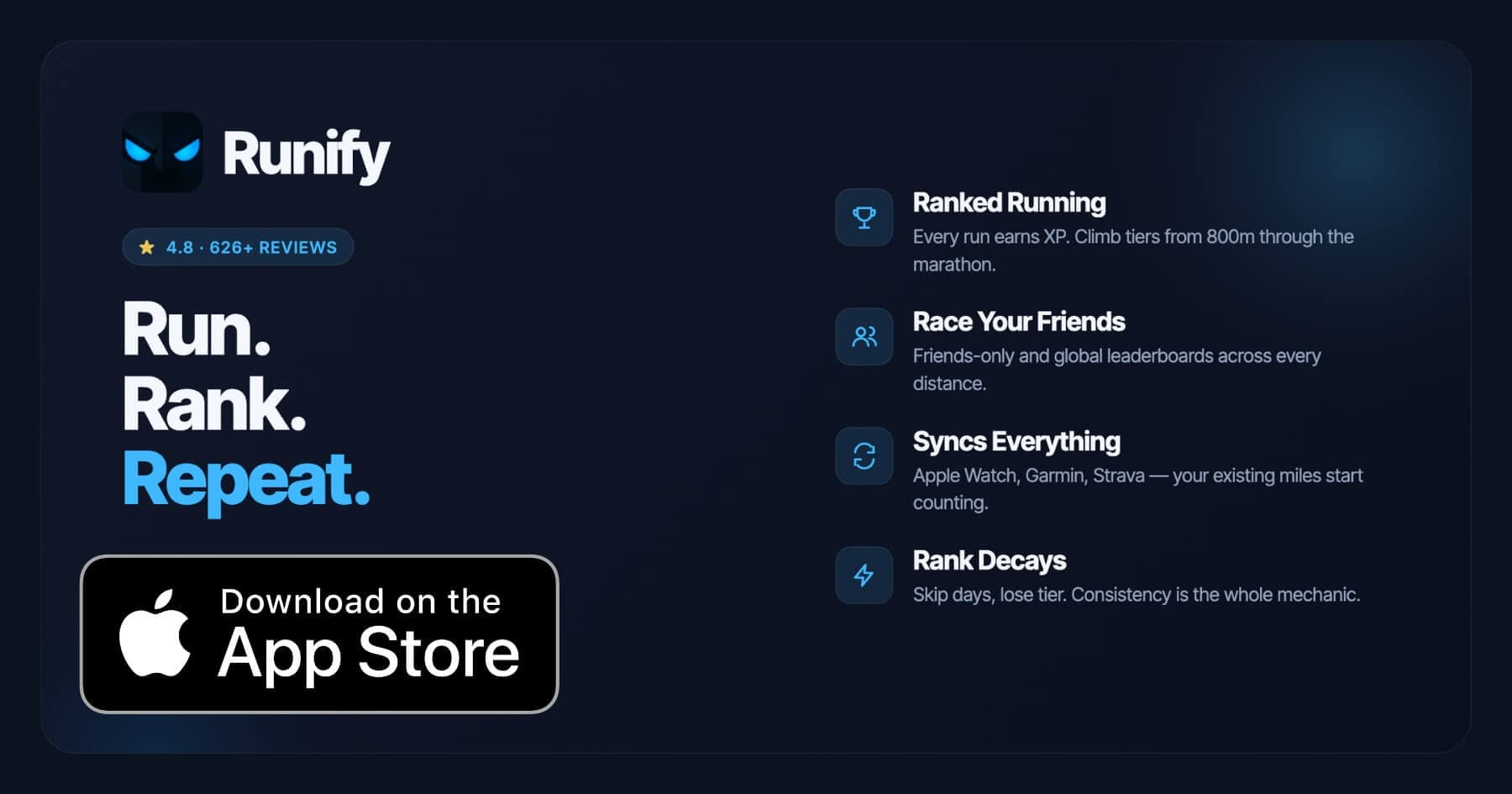
Runify is the first ranked running app - every run you log, including easy recovery efforts, earns XP and moves you through a competitive tier system with friends-only and global leaderboards across distances from 800m to the marathon. With a 4.8-star App Store rating and 626+ reviews, it has built a community of runners who want their miles to matter beyond just the stats.
Runify is not a recovery coaching app. You will not find HR zone alerts during your run or a morning readiness score. What Runify does is give your easy runs a reason to exist in the competitive sense: every mile, no matter the pace, counts toward your rank and keeps you consistent. Rank decay means going inactive costs you ground, and that accountability applies equally to recovery days as it does to race efforts.
Key Features
- Ranked Progression System: XP from every run - including easy recovery miles - feeds your overall Runify Rank, with post-run rank-up reveals and rank decay if you go inactive.
- Friends and Global Leaderboards: Race your friend group or the world across 800m, 1K, 5K, 10K, half, and marathon distances (Pro).
- Apple Watch, Garmin, and Strava Sync: Import past runs from HealthKit, Garmin Connect, or Strava and auto-detect new ones going forward.
- In-App GPS Tracking: Live GPS with time, distance, and pace, plus post-run summaries with splits and photos.
- Streaks and Smart Reminders: Current-streak visibility and motivational push notifications - easy days count toward your streak too.
Pricing
Monthly: $4.99/month (no free trial). Annual: $39.99/year with a 7-day free trial. Pro unlocks distance-specific leaderboards and expanded profile and history views.
Best For
- Runners who want every run - including slow recovery miles - to count toward something visible
- Apple Watch, Garmin, or Strava users looking for a competitive layer on top of their existing tracking
Limitations
- iOS only - no Android app
- No HR zone coaching during runs, no recovery score, and no "should I run today?" readiness guidance
- Not a structured training plan app
How to Choose the Best Recovery Run App
Recovery run apps serve different needs. Here is how to match the right tool to your situation.
-
Start with your existing hardware: If you own a Garmin watch, Garmin Connect is the obvious first choice - it already has your data and adds Body Battery for free. Polar watch owners get FitSpark through Polar Flow at no extra cost. Apple Watch users get the most from Apple Fitness+ for guided sessions or from any app that reads Apple Health data.
-
Decide whether you want before-run guidance or during-run coaching: WHOOP and Garmin Connect tell you how ready you are before you head out. Apple Fitness+ guides you through the actual run. Runna gives you a pace target to follow. These are meaningfully different use cases.
-
Consider your training context: If you follow a structured plan toward a race, Runna's built-in easy days make more sense than a standalone readiness app. If you run more casually, a single morning recovery score from WHOOP or Garmin is often enough.
-
Think about what motivates you to actually go: Data-heavy apps help analytical runners make smart decisions. Runify's XP and rank system works for runners who need a visible reason to head out even on low-energy days - because easy miles still count.
-
Check the real cost: Garmin Connect and Polar Flow are free if you own the compatible watch. WHOOP is the most expensive option at $239/year including hardware. Runna and Runify sit in the middle at under $120/year on annual plans.
Frequently Asked Questions
What is the best app for recovery runs in 2026?
Garmin Connect is the best app for recovery runs in 2026 if you own a Garmin watch. The free app gives you Body Battery (a 0-100 energy score built from HRV, stress, and sleep), recovery time suggestions after hard efforts, and HRV status trends - three signals that together tell you when Zone 1-2 is the right call. If you want a morning readiness score without Garmin hardware, WHOOP's daily Recovery Score is the most direct equivalent. For guided easy-effort runs on iPhone with Apple Watch, Apple Fitness+ is the strongest option.
Is there a free app for recovery run guidance on iOS?
Yes. Garmin Connect is free on the App Store and delivers Body Battery and recovery time guidance at no cost - you need a compatible Garmin watch, but the app itself costs nothing. Polar Flow is also free, with FitSpark recovery suggestions available if you own a compatible Polar device. Apple Fitness+ offers a one-month free trial for new subscribers. Runify offers a 7-day free trial on its annual plan at $39.99/year, though Runify focuses on XP and leaderboards rather than recovery coaching specifically.
Can I use my Apple Watch data for recovery run guidance?
Yes, several apps on this list read Apple Watch data. Apple Fitness+ uses your Apple Watch heart rate live during guided runs to provide real-time zone feedback. Garmin Connect and Polar Flow rely on their own hardware rather than Apple Watch. WHOOP uses its own proprietary sensor. Runify imports runs from Apple Watch via HealthKit, though it does not use heart rate data for zone coaching. For a deeper look at apps that pair specifically with Apple Watch for zone training, see our heart rate zone training app guide.
What features should I look for in a recovery run app?
The most useful recovery run features are: a morning readiness or recovery score built from HRV and sleep data (so you know how easy to go before you leave the house); real-time heart rate zone feedback during the run (so you stay in Zone 1-2 rather than drifting up); post-run zone distribution breakdowns (to verify the run was actually easy); and recovery time estimates after hard sessions. Apps that only track what you did, without guiding effort level, are less useful for recovery-specific training.
Will keeping my recovery runs slow hurt my fitness or rank?
No. Recovery runs at Zone 1-2 effort are where aerobic base adaptation happens for many runners - the fitness benefit is real even though the pace is slow. In Runify specifically, every run regardless of pace earns XP and counts toward your rank and streak, so easy miles are never wasted in the competitive sense. The key is actually keeping recovery efforts easy: a run that drifts into Zone 3-4 is no longer a recovery run, and it adds training stress without the intended benefit.
Final Verdict
Recovery run apps split into two categories: apps that tell you how ready you are before you go (Garmin Connect, WHOOP), and apps that guide the effort while you run (Apple Fitness+, Runna). Both categories are useful, and the best setup for a serious runner often combines one from each.
For most runners, Garmin Connect is the strongest starting point if you already have a Garmin watch - the Body Battery and recovery time features are exactly what you need, and they cost nothing beyond the device you already own. If you want a dedicated readiness signal and do not own a Garmin, WHOOP's daily Recovery Score is the most direct answer, though the hardware cost is significant. Polar Flow with FitSpark is the equivalent for Polar watch owners.
Runify sits outside the recovery coaching category but fits naturally into a recovery-day routine: easy runs still earn XP, keep your streak alive, and prevent rank decay. If consistency is the challenge - and for many runners it is - that visible accountability is its own kind of recovery tool.
Start your 7-day free trial on Runify's annual plan and let every run, easy or hard, count toward your rank.

4.8 on the App Store · Built for iOS