Best Running Apps for Race Time Prediction 2026
Best Running Apps for Race Time Prediction 2026
You've put in the training. Long runs, tempo work, a few races on the calendar. Now you're staring at your watch and wondering: can I actually break 4 hours? The gap between "I think I'm fit" and "here's my target pace per mile" is exactly where a good race predictor earns its keep. Some apps give you a VO2 max number and call it done. The better ones fold in your training load, recent performances, and course profile to give you a pace plan you can actually race by.
The best apps for race time prediction in 2026 are: 1) Garmin Race Predictor for native, always-on predictions built into your watch, 2) Runalyze for deep VDOT-based analysis and multiple prediction models, 3) Stryd for power-based race planning with course-specific pacing, 4) Strava for AI-driven predictions that update after every run, 5) TrainingPeaks for training load + race readiness via the PMC, and 6) Runify for tracking consistency and competitive benchmarking across your target distances.
1. Garmin Race Predictor - Best Overall for On-Device Race Prediction
Garmin Race Predictor is built into Garmin Connect and surfaces predicted finish times for 5K, 10K, half marathon, and marathon directly on your watch and in the app. It uses Firstbeat Analytics to combine your VO2 max estimate with your recent pace-to-heart-rate ratio and known race performances. For most runners, the 5K and 10K predictions land within 1-3% of actual race results - a strong baseline for setting a realistic pace target.
Why Garmin Race Predictor Stands Out
The predictions are passive - your watch calculates them continuously, so you always have an updated estimate without opening a separate app or logging in anywhere. The more consistently you run with heart rate data, the sharper the predictions get. Garmin also adjusts for heat and altitude on compatible devices, which matters more than most runners expect.
The predictor integrates directly with Garmin's Training Status and race day features. If you use a Garmin watch for your long runs and track workouts, Race Predictor already has everything it needs. There's no extra data entry - just run.
That said, the marathon prediction tends to be optimistic by 8-15% for experienced runners and more for first-timers. The model assumes perfect pacing and execution, which rarely happens over 26.2 miles. Think of the marathon number as an upper ceiling under ideal conditions rather than your target finish time.
Key Features
- VO2 Max-Driven Predictions: Estimates 5K, 10K, half marathon, and marathon finish times using Firstbeat Analytics and your heart rate data.
- Passive, Always-On Updates: Predictions update automatically after every activity - no manual input required.
- Heat and Altitude Adjustment: Compatible Garmin watches factor in temperature and elevation when updating your current VO2 max.
- Race Day Integration: Works alongside Garmin's race calendars, Training Status, and load focus metrics in a single app.
- Connect IQ Predictor Apps: Free third-party apps on the Connect IQ Store offer additional prediction models for specific distances.
Pricing
Garmin Connect is free with any compatible Garmin device. A Garmin running watch ranges from $250 to $1,100+ depending on the model; no separate app subscription is required for Race Predictor.
Best For
- Garmin watch owners who want race predictions without switching apps
- Runners who want passive, always-updated finish time estimates
- Athletes focused on 5K-to-half-marathon distances where accuracy is strongest
Limitations
- Marathon predictions are reliably optimistic - use as a ceiling, not a race plan.
- Requires a Garmin device; predictions are not available without one.
- Does not factor in training specificity - interval-heavy runners get the same marathon projection as long-run-focused runners.
2. Runalyze - Best for VDOT Analysis and Multi-Model Prediction
Runalyze is a web-based analytics platform built for runners who want more than a single number. Its race predictor offers several methods including a VDOT model based on Jack Daniels' running formula, a marathon shape calculator, and a Tanda marathon predictor that accounts for your total mileage and long run history. You can run all models side by side and see which one aligns with your training reality.
Key Features
- Multiple Prediction Models: Choose from VDOT, Tanda marathon predictor, and Runalyze's own effective VO2 max calculator.
- Training Load Analysis: CTL, ATL, and TSB metrics visualize fitness and fatigue - see if you're peaking at the right time.
- Garmin, Coros, Suunto, and Strava Import: Bulk-import past activity files or connect directly; new activities sync automatically.
- Race Prediction Calibration: Previous race results sharpen future predictions within the platform.
Pricing
Runalyze is free for core features including race prediction and data import. A paid supporter/premium tier removes ads and unlocks extended visualizations, historical HRV analysis, and a personal heatmap - priced at approximately €6/month or €66/year.
Best For
- Data-focused runners who want to compare multiple prediction methods
- Runners without a Garmin device who still want VDOT-based estimates
Limitations
- Web-based; the mobile experience is less polished than native iOS apps.
- The sheer volume of metrics can overwhelm runners who just want a quick answer.
3. Stryd - Best for Power-Based Race Pacing
Stryd is a running power meter (a small footpod) paired with a companion iOS app. Its Race Power Calculator doesn't just predict your finish time - it builds a kilometer-by-kilometer pace plan calibrated to your Critical Power score, the race course profile, and expected race-day conditions including temperature and humidity. Stryd supports preloaded courses for Boston, London, New York, Berlin, Tokyo, and more, and lets you upload any custom GPX course.
Key Features
- Race Power Calculator: Predicts finish time and outputs a power target for every section of the course based on Critical Power and Power Duration Curve.
- Course-Specific Pacing: Factor in elevation, temperature, and humidity for fully customized race-day plans.
- Event Planner (iOS): Set a goal time, get a per-section power target, and export the workout to your watch.
- 90-Day Training History: Predictions draw from your last 90 days of running to stay current with your fitness.
Pricing
Stryd 5.0 footpod is $199. The Stryd Membership subscription (adaptive training, workout library, workout builder) is $100/year and is optional - the Race Power Calculator is available to all Stryd users. The footpod ships with 6-12 months of free membership depending on the model purchased.
Best For
- Runners who already train with power or want course-specific race plans
- Marathoners who need precise pacing for hilly or variable-weather races
Limitations
- Requires the $199 hardware purchase - this is not a software-only tool.
- Power-based pacing has a learning curve; it takes several weeks of running to establish a reliable Critical Power baseline.
- iOS app features complement the footpod; without the hardware the app has limited standalone value.
4. Strava - Best for AI-Powered Predictions That Update Automatically
Strava launched Performance Predictions as a premium feature in 2025, and it stands out from earlier prediction tools by using machine learning rather than theoretical VO2 max models. The ML model draws on over 100 athlete data attributes - your all-time run history, top performances, and recent training patterns - to estimate 5K, 10K, half marathon, and marathon finish times. Predictions update after every run and adjust downward during rest periods, so the number always reflects your current fitness.
If you're already using Strava as your activity hub and interested in how it compares to other tools, our best running apps for data analysis breakdown covers how Strava stacks up against dedicated analytics platforms.
Key Features
- AI-Driven Predictions: ML model trained on real athlete outcomes - not just VO2 max formulas.
- Auto-Updating Estimates: Predictions refresh after every run and adjust during deload or rest weeks.
- All Four Key Distances: 5K, 10K, half marathon, and marathon predictions in one place.
- Minimum Activity Requirement: Requires at least 20 outdoor runs in a rolling 24-week window for predictions to activate.
Pricing
Strava Premium is $11.99/month or $79.99/year. Performance Predictions are a premium-only feature.
Best For
- Runners already on Strava who want predictions without adding another app
- Athletes who prefer data-driven ML predictions over formula-based estimates
Limitations
- Requires 20+ outdoor runs in 24 weeks before predictions activate - new users wait.
- Some runners find Strava's predictions skew optimistic for the marathon; the model is still maturing.
- Premium is required; the feature isn't available on the free tier.
5. TrainingPeaks - Best for Training Load + Race Readiness
TrainingPeaks pairs a race predictor with the Performance Management Chart (PMC), the industry-standard tool for plotting fitness (CTL), fatigue (ATL), and form (TSB) over time. Rather than producing a single predicted time, TrainingPeaks helps you answer a more nuanced question: are you actually fit enough to run the time you're targeting? The race predictor gives you a finish time estimate; the PMC shows whether you're likely to arrive at the start line peaked or broken down.
Runners chasing personal records will find this combination useful alongside the PR-tracking tools covered in our best running apps for PR tracking roundup.
Key Features
- Performance Management Chart (PMC): CTL, ATL, and TSB visualization to track fitness and form through a training block.
- Race Predictor: Estimates finish times based on your recent training load and peak fitness data.
- Annual Training Plan (ATP): Periodize your season with target CTL and race-readiness planning built in.
- Coach Integration: Widely used by coaches; easy to share data and get feedback on race readiness.
Pricing
TrainingPeaks Premium is $19.95/month or $134.99/year. The PMC and race predictor require a premium account. A limited free tier exists but does not include these features.
Best For
- Serious runners working with a coach or following a structured season
- Athletes who want load management alongside race time estimates
Limitations
- The interface has a learning curve; it rewards dedicated users rather than casual runners.
- Premium pricing is on the higher end compared to other prediction tools.
- The race predictor is less sophisticated in isolation - the real value comes from combining it with the PMC.
6. Runify - Best for Competitive Benchmarking and Accountability
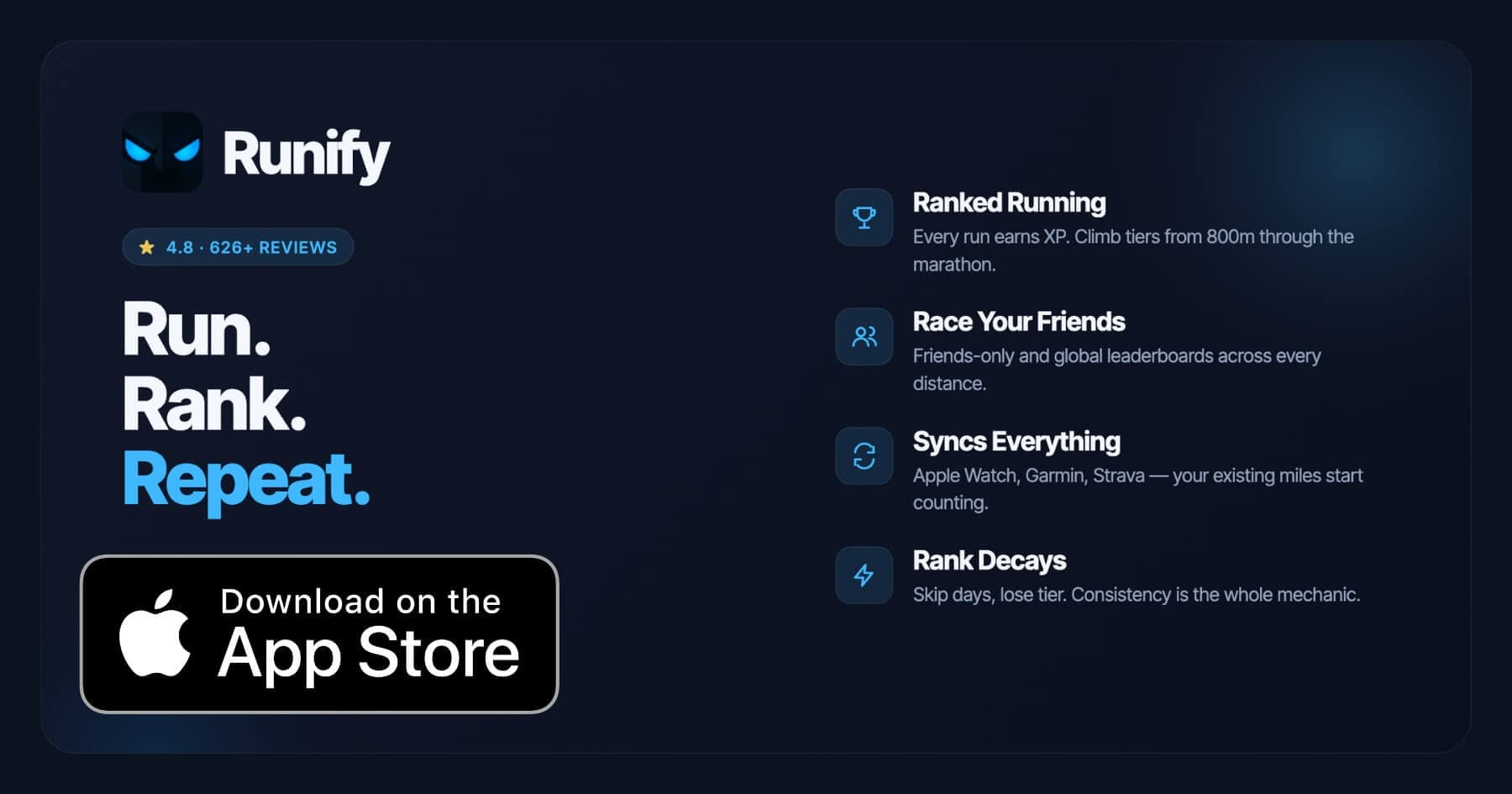
Runify takes a different approach to race time prediction. Rather than a VO2 max formula or ML model, Runify focuses on where you actually stand relative to other runners at your target distance. Distance-specific leaderboards (800m, 1K, 5K, 10K, half marathon, marathon) let you benchmark your times against a global and friends-only field. The ranked tier system - driven by XP from every run with rank decay for inactivity - creates accountability that keeps the training consistent enough to make any prediction meaningful.
Runify holds a 4.8-star App Store rating across 626+ reviews worldwide. It syncs from Apple Watch, Garmin, and Strava, so your existing runs count from day one.
Why Runify Fits Here
Race time prediction only matters if you actually show up to the finish line trained. Runify's rank decay mechanic means you can't coast - going quiet costs you rank, making consistency a tangible, visible motivator between race cycles. Post-run rank-up reveals and shareable recap templates keep the daily runs feeling like more than just mileage accumulation.
If you're building toward a goal race, Runify sits alongside your prediction tool of choice: use Garmin or Runalyze for the target time, use Runify to stay honest about whether you're actually putting in the work.
Key Features
- Distance Leaderboards: Friends and global ladders across 800m, 1K, 5K, 10K, half, and marathon.
- Ranked Progression System: XP from every run, rank-up reveals, and rank decay to keep consistency rewarded.
- Apple Watch, Garmin, and Strava Sync: Bulk-import past runs; new runs auto-detect going forward.
- In-App GPS Tracking: Live pace, distance, and route with 99.5% GPS routing accuracy.
- Shareable Run Recaps: Stylized recap templates and one-tap Instagram Stories sharing.
- Streaks and Smart Reminders: Streak visibility, streak celebrations, and inactivity push notifications.
Pricing
Monthly: $4.99/month (no free trial). Annual: $39.99/year with a 7-day free trial. Pro unlocks distance-specific leaderboards and expanded profile/history views (weekly, monthly, yearly, all-time stats).
Best For
- Runners who want to benchmark times against real people at their goal distance
- Athletes who need accountability and consistency between race cycles
- Apple Watch, Garmin, or Strava users who want their miles ranked automatically
Limitations
- iOS only. Android is not available today.
- Not a race time calculator - Runify shows you where you rank, not a projected finish time.
- No structured training plans, audio coaching, or route discovery.
How to Choose the Best Race Time Prediction App
The right tool depends on the question you're actually trying to answer. Here are five factors that separate a good fit from a poor one.
-
What hardware do you already use? Garmin watch owners already have the best passive predictor built in. Stryd users have a course-specific power planner. If you run with Apple Watch only, Runalyze or Strava fills the gap.
-
Distance and ambition level: 5K predictions are accurate across most platforms. Marathon predictions vary wildly - Garmin and Strava skew optimistic; Runalyze's Tanda model tends to be more conservative and realistic for volume-based training.
-
Do you want a number or a plan? Garmin and Strava give you a predicted finish time. Stryd and TrainingPeaks give you an actionable pacing plan calibrated to the actual course. If you're racing a hilly course, a finish time estimate without a split strategy isn't enough.
-
How much data entry are you willing to do? Garmin and Strava update automatically. Runalyze rewards users who import full history and tune their settings. TrainingPeaks requires the most manual attention to get full value.
-
Training consistency as a variable: A predicted time from any tool is only as good as the training that produced the data. If consistency is your weak link, pairing a prediction tool with something like Runify - where rank decay punishes gaps and leaderboards create accountability - strengthens the underlying training more than a better algorithm does.
Frequently Asked Questions
What is the best app for race time prediction in 2026?
Garmin Race Predictor is the strongest choice for runners who already use a Garmin watch - predictions are passive, always updated, and accurate within 1-3% for 5K and 10K distances. For runners without a Garmin device, Runalyze offers the most rigorous multi-model approach including VDOT and Tanda marathon analysis, all on a free core plan. Strava's AI-powered Performance Predictions are the best option for runners already on the platform who want predictions that learn from real activity data rather than formulas alone.
Is there a free app for race time prediction?
Yes. Runalyze's core plan is free and includes race prediction using VDOT and Tanda models, plus full activity import from Garmin, Strava, and other platforms. Garmin Race Predictor is also free with any compatible Garmin watch - no subscription required. Strava's Performance Predictions require a premium subscription ($79.99/year). TrainingPeaks' race predictor and PMC require premium ($134.99/year). Runify's annual plan includes a 7-day free trial at $39.99/year.
Can I sync my Apple Watch or Garmin runs with these prediction apps?
Yes. Runalyze imports from Garmin Connect, Strava, and direct file uploads - Apple Watch runs get in via HealthKit export or the Strava connection. TrainingPeaks connects to Garmin, Apple Health, and Strava. Stryd syncs to Garmin, Apple Watch, and most major platforms via the Stryd app. Runify syncs natively from Apple Watch via HealthKit, Garmin Connect, and Strava - new runs auto-detect and log automatically after the initial connection.
What features matter most in a race time prediction app?
Look for: (1) the prediction model used - VO2 max, VDOT, ML, or power-based models have different strengths by distance; (2) how often predictions update - passive auto-update vs. manual input; (3) whether it outputs a pacing plan or just a finish time - a per-kilometer target is more actionable on race day; (4) course-profile support - hilly courses need elevation-adjusted targets; (5) training load context - knowing whether your fitness is peaking or declining matters as much as the predicted time itself.
Are race time predictions accurate for the marathon?
Less accurate than for shorter distances. Most apps predict 5K and 10K within 2-5% for runners with consistent training data. Marathon predictions are more variable because the distance amplifies pacing errors, fueling, and fatigue in ways that no formula fully captures. Garmin's marathon predictor is commonly 8-15% optimistic. Runalyze's Tanda model - which factors in your weekly volume and long run history specifically - tends to be more conservative and closer to real-world outcomes for high-mileage runners. Strava's ML model is improving but still maturing on marathon-distance predictions.
Final Verdict
The best race time prediction app for most runners in 2026 is Garmin Race Predictor - if you own a compatible Garmin watch. Predictions are passive, updated after every run, and accurate enough at 5K-to-half-marathon distances to use as a real pacing anchor. For runners who want to go deeper, Runalyze adds VDOT and Tanda modeling at no cost, and Stryd brings course-specific power pacing for runners who need a split-by-split plan.
Strava Premium's AI predictions are worth using if you're already paying for the platform. TrainingPeaks earns its premium price for athletes working with a coach or managing a serious periodized season. All five of these tools answer the "how fast can I go" question in different ways.
Runify approaches the problem from a different direction: rather than predicting a time, it shows you where you rank at your goal distance and holds you accountable to training consistently enough to improve it. The two approaches are complementary. A prediction tool gives you a target; Runify helps you earn it.
Ready to see where you rank at your goal distance? Download Runify on the App Store and turn every training run into a step up the ladder.

4.8 on the App Store · Built for iOS