Best Running Apps for Finish Time Prediction 2026
Best Running Apps for Finish Time Prediction 2026
You've put in months of training. Your long runs are solid, your tempo pace is clicking, and race day is six weeks out. But the big question is still sitting there unanswered: what time can you actually run?
Race finish time prediction turns your training data into a realistic race-day target. Some apps do this with VO2 max estimates, some with running power, some with machine-learning models built from millions of logged activities. The quality gap between them is wide.
We researched and compared the top options. Here are the 5 best tools for predicting your finish time in 2026.
The best running apps for finish time prediction in 2026 are: 1) Garmin Connect for its integrated Race Predictor across all compatible devices, 2) Runalyze for VDOT-based multi-model predictions with deep data analysis, 3) Stryd for power-based predictions that account for terrain and conditions, 4) Strava for ML-driven predictions that use real activity data, and 5) Runify for tracking, ranking, and motivating the training that makes predictions matter. The best option depends on whether you already own a Garmin watch, run with a power meter, or want the broadest community context.
1. Garmin Connect - Best Race Predictor for Garmin Watch Owners
Garmin Connect is the companion app and platform for Garmin GPS watches. Its built-in Race Predictor estimates your finish time for 5K, 10K, half marathon, and marathon based on your VO2 max and rolling training history. If you already train with a compatible Garmin device, this is the most seamlessly integrated prediction tool available - no extra app or subscription required.
Why Garmin Connect Stands Out
The Race Predictor updates automatically as your fitness changes. On compatible devices like the Forerunner 955, Fenix 7, and Forerunner 265, predictions are refined by course elevation data and forecast weather when you link a specific race event. That combination of VO2 max, training load, and course-specific context puts Garmin's predictor a step ahead of generic calculators.
Predictions live both on the watch face and inside the Garmin Connect mobile app under Performance Stats. You can track how your predicted times shift week by week as your training block progresses - a useful signal for whether your current load is translating into fitness gains. If you also care about longer-term fitness trends, our comparison of running apps for VO2 max tracking covers how Garmin stacks up against other platforms on that metric.
The main caveat: forum feedback and independent testing consistently show the predictor tends to skew optimistic, particularly for marathon distances. Treat predictions as a fitness indicator and a useful bracket, not a precision pacing target.
Key Features
- Race Predictor: Predicted finish times for 5K, 10K, half marathon, and marathon, updating automatically with each training run.
- VO2 Max Tracking: On-device estimate that feeds the prediction model, refined by real heart rate and pace data over time.
- Course-Aware Predictions: On supported devices, links to specific race events to factor in elevation and weather forecasts.
- PacePro Integration: Once you have a target time, PacePro generates a segment-by-segment pacing plan for a real course.
- Training Load & Recovery: Tracks acute and chronic training load so predictions reflect current fitness, not just peak fitness.
Pricing
Free with any compatible Garmin watch (Forerunner series, Fenix series, Epix, and others). No separate subscription needed for Race Predictor or the Garmin Connect app.
Best For
- Garmin watch owners who want predictions built into their existing workflow
- Runners preparing for a specific race who want course-aware pacing support
Limitations
- Requires a compatible Garmin watch - not useful without one.
- Predictions skew optimistic for many runners, particularly at the marathon distance.
- No Android-specific limitation here, but iOS app parity is full.
2. Runalyze - Best for VDOT-Based Multi-Model Prediction
Runalyze is a web-based training analysis platform with a companion iOS app. Its race prediction engine offers multiple models in one place: VDOT (Jack Daniels method), CPP by Robert Bock, Herbert Steffny's method, and David Cameron's formula. You can compare outputs across all four models from a single interface, which is especially useful when they disagree.
Key Features
- Multi-Model Predictions: VDOT, CPP, Steffny, and Cameron formulas side by side for 5K through marathon.
- Effective VO2 Max: Ongoing estimate derived from real training data, not just a one-time test value.
- Marathon Shape Calculator: Specific to marathon distance, accounts for recent long run volume and fatigue.
- Training Load Metrics: Acute and chronic load tracking using heart rate data.
Pricing
Free tier available with core features. Premium: approximately €6/month or €66/year (early-subscriber rate: €5.50/month or €60/year). Premium unlocks advanced analytics and removes ads.
Best For
- Runners who want to cross-reference multiple prediction methods
- Data-focused athletes who already use web-based training logs
Limitations
- Web-first experience; the mobile app is a companion, not a replacement.
- Interface has a steep learning curve for newer runners.
- Predictions require consistent data logging to be accurate.
3. Stryd - Best Power-Based Finish Time Predictor
Stryd is a running power meter platform built around a small footpod that clips to your shoe. Its Race Power Calculator predicts finish times using power output rather than pace or VO2 max. Because power accounts for gradient, wind, and surface, Stryd's predictions adapt to course conditions in a way that pace-based models cannot.
Key Features
- Race Power Calculator: Predicts target power and estimated finish time for distances from 1 mile to marathon, drawing on the previous 90 days of running.
- Event Planner: Build a full race plan with power targets per segment for real course profiles.
- Condition Adjustments: Surface type, elevation, temperature, and humidity all feed into the prediction model.
- 12 Verified Race Courses: Pre-loaded popular race courses for quick setup; custom distances also supported.
Pricing
Stryd Next Gen pod: $249. Stryd Duo (two pods): $299 plus a 12-month membership commitment. Stryd Membership (optional, unlocks advanced analytics): approximately $100/year. A free membership period is included with pod purchase.
Best For
- Runners who want terrain- and weather-adjusted finish time predictions
- Athletes who already train with power and want race-day precision
Limitations
- Requires purchasing the Stryd pod hardware ($249+) - not a free or low-cost option.
- Power-based training has a learning curve; raw predictions are less intuitive for pace-focused runners.
4. Strava - Best ML-Driven Prediction for Strava Users
Strava's Performance Predictions feature uses a machine-learning model trained on over 100 athlete data attributes, including full run history and top performances. Unlike VO2 max-based predictors, Strava uses only real logged activity data. Predictions are available for 5K, 10K, half marathon, and marathon and update after every run.
Strava requires at least 20 run activities within a rolling 24-week window to generate predictions, so it's most useful for runners with consistent recent activity. Predictions live in the Progress tab on the Strava app. If you're already tracking personal records on Strava, our overview of the best PR tracking apps covers how Strava's data layer compares to dedicated tools.
Key Features
- ML-Powered Predictions: Model uses 100+ data points from your personal history plus benchmarks from runners with similar training profiles.
- Automatic Updates: Predictions refresh after every logged run.
- Four Race Distances: 5K, 10K, half marathon, marathon.
- Training Integration: Connects naturally to segments, kudos, and the rest of the Strava ecosystem.
Pricing
Strava membership required: $11.99/month or $79.99/year (US pricing). Performance Predictions is a subscriber-only feature.
Best For
- Runners already using Strava as their primary activity log
- Athletes who prefer data-driven predictions over physiological models
Limitations
- Subscriber-only; not available on the free Strava tier.
- Requires 20 recent runs to generate predictions - newer or returning runners may not qualify initially.
- No course-specific adjustments for elevation or conditions.
5. Runify - Best for Motivating the Training Behind the Prediction
Runify is not a race time predictor. It does not generate a finish time estimate for your next 5K or half marathon. What it does is build the consistency and competitive accountability that makes accurate predictions possible in the first place.
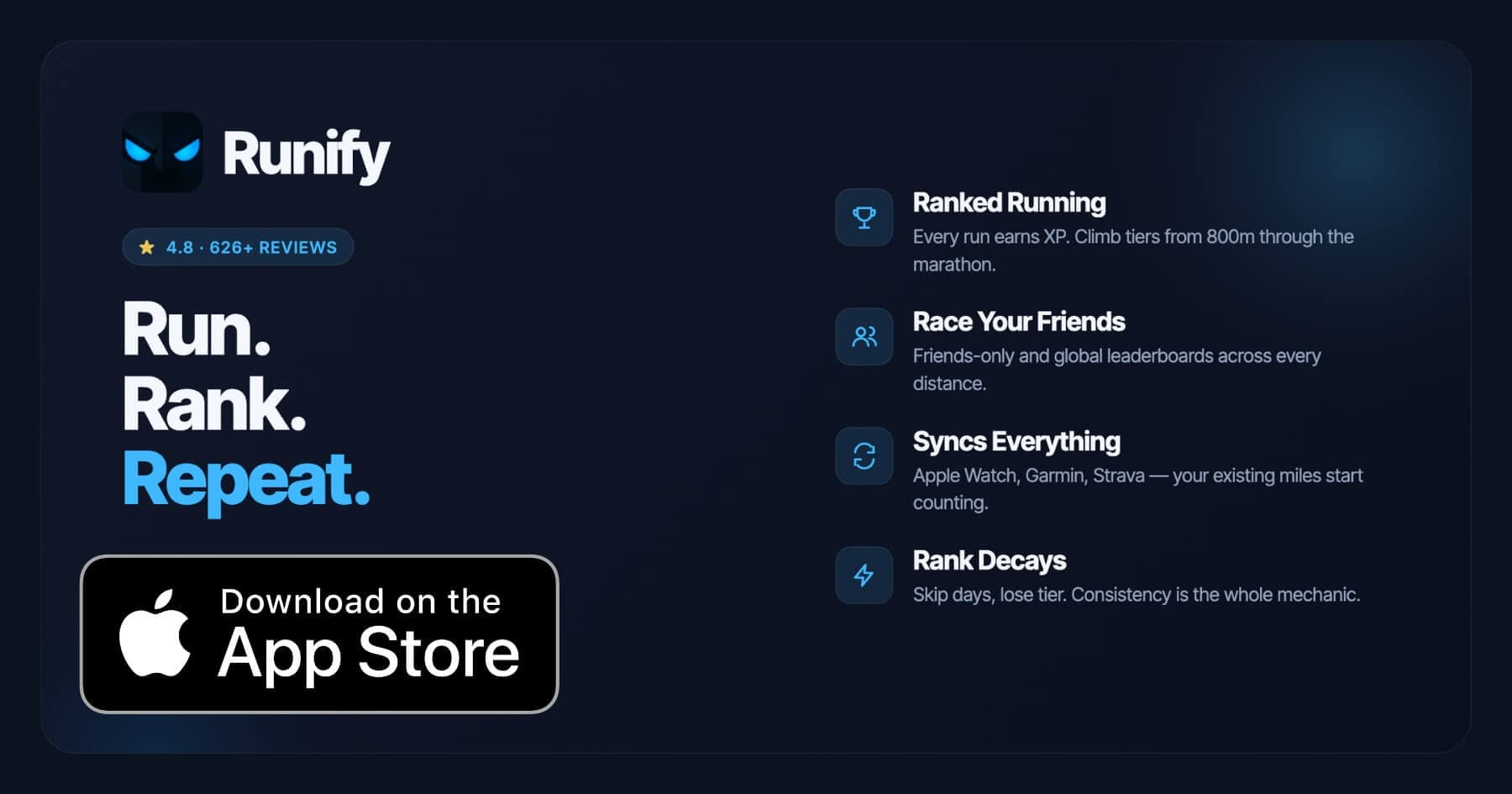
Every run you log or sync from Apple Watch, Garmin, or Strava earns XP and moves you through a ranked tier system. Leaderboards span 800m through marathon for both friends-only and global competition. The rank decay mechanic - losing rank when you go inactive - turns "keep training" from a vague intention into a visible, daily motivator.
Runners who use Runify alongside a prediction tool like Garmin Connect or Strava tend to have the consistent training data those models need. You can read more about how to build that data foundation in our guide to the best running apps for data analysis.
Runify holds a 4.8-star App Store rating with 626+ reviews, and the community has logged over 100,000 runs and 500,000+ miles.
Key Features
- Ranked Progression System: XP from every run, post-run rank-up reveals, and rank decay after inactivity.
- Friends & Global Leaderboards: 800m, 1K, 5K, 10K, half, marathon - both friends-only and global rankings (Pro).
- Apple Watch, Garmin & Strava Sync: Bulk-import past runs from HealthKit, Garmin Connect, or Strava; new runs auto-detect.
- In-App GPS Tracking: Live pace, distance, route, and splits with 99.5% GPS routing accuracy.
- Shareable Run Recaps: Stylized post-run templates with one-tap Instagram Stories sharing.
- Streaks & Smart Reminders: Streak tracking, celebrations, and inactivity notifications.
Pricing
Monthly: $4.99/month (no free trial). Annual: $39.99/year with a 7-day free trial. Pro unlocks distance-specific leaderboards and expanded profile/history views.
Best For
- Runners who need competitive accountability to stay consistent through a training block
- Apple Watch, Garmin, or Strava users who want their miles to count toward a rank
- Runners who use Garmin Connect or Strava for predictions and want a motivation layer on top
Limitations
- iOS only. No Android version available.
- No built-in race finish time predictor - pair it with Garmin Connect or Strava for that.
- No structured training plans, pace coaching during runs, or audio coaching.
How to Choose the Best Finish Time Prediction App
Picking the right predictor depends on your hardware, your data habits, and how you plan to use the output.
-
Your Watch or Device: If you run with a Garmin, the Race Predictor built into Garmin Connect is already there and costs nothing extra. If you run with Apple Watch, Strava or Runalyze will make better use of your data than a Garmin-specific tool.
-
Pace vs. Power: Most apps predict finish times from pace and VO2 max. Stryd predicts from power, which handles hills and wind far better. If your target race is hilly or weather-dependent, a power-based prediction is worth the hardware investment.
-
Single Model vs. Multi-Model: Garmin and Strava each use a single underlying method. Runalyze shows you four formulas at once. If you want to cross-reference predictions rather than trust one number, Runalyze gives you more information to work with.
-
Prediction Frequency: Strava updates predictions after every run. Garmin updates automatically as VO2 max shifts. Runalyze requires you to log runs consistently but recalculates on each import. More frequent updates are useful mid-block when your fitness is changing quickly.
-
What You Do With the Prediction: A predicted time without a pacing plan is only half the answer. Garmin's PacePro and Stryd's Event Planner both turn a target finish time into a segment-by-segment race strategy. If race execution is your main concern, pick a tool that connects prediction to pacing.
Frequently Asked Questions
What is the best app for finish time prediction in 2026?
Garmin Connect is the best overall finish time predictor in 2026 for runners with a compatible Garmin watch. Its Race Predictor uses VO2 max and training history to estimate your 5K, 10K, half marathon, and marathon times, and it updates automatically as your fitness changes. On supported devices it also factors in course elevation and forecast weather for a specific race event. Runners without a Garmin watch should look at Strava's Performance Predictions feature, which uses a machine-learning model built from your real logged activity data and requires no additional hardware.
Is there a free app for race finish time prediction?
Garmin Connect's Race Predictor is free for any compatible Garmin watch owner - no separate subscription required. Runalyze has a free tier with access to basic race prediction tools. Strava's Performance Predictions is subscriber-only, at $11.99/month or $79.99/year. Stryd requires purchasing a hardware pod starting at $249. For runners without a Garmin or Stryd pod, Runalyze's free tier provides VDOT-based predictions without a paywall, though premium unlocks the full analytical depth.
Can I sync my Apple Watch or Garmin runs with these prediction apps?
Strava syncs with both Apple Watch via HealthKit and Garmin via automatic activity import. Runalyze supports Garmin Connect sync and file uploads from most devices. Garmin Connect works natively with Garmin devices; Apple Watch data can be imported via connected apps. Runify syncs from Apple Watch via HealthKit, Garmin Connect, and Strava, making it easy to layer the motivation side on top of whichever predictor you use. Stryd has its own iOS app and syncs with Garmin and Apple Watch.
What features should I look for in a race finish time prediction app?
Look for an app that uses your actual training data rather than a single time trial or generic formula. Automatic updates after each run matter more than a one-time calculation, especially mid-training-block when fitness is changing. Course-awareness (elevation, weather) separates the precision tools like Garmin and Stryd from basic calculators. Consider whether the app connects the prediction to a pacing plan - knowing you can run a 1:48 half is useful, but a plan for how to pace the first 5K is what keeps you on track on race day.
How accurate are race finish time prediction apps?
Accuracy varies by app and distance. Independent testing and runner feedback consistently show that VO2 max-based predictors like Garmin's Race Predictor tend to skew optimistic, especially at the marathon distance. Strava's ML model, trained on real athlete performances, is generally considered more calibrated for recreational runners. Stryd's power-based approach is precise for runners who have calibrated their power zones on real courses. All predictors perform best when they have at least 8-12 weeks of recent, consistent training data to draw from. Treat any prediction as a fitness-based range, not a guaranteed outcome.
Final Verdict
Race finish time prediction has moved well beyond simple pace tables. The top apps now draw on VO2 max estimates, running power, machine learning, and course-specific data to give you a grounded target before race day.
Garmin Connect is the clear choice if you already train with a compatible Garmin device. The Race Predictor is free, integrated, and improves as your fitness does. Runalyze earns its place for data-focused runners who want multiple models side by side. Strava's Performance Predictions is the strongest option for runners without Garmin hardware who already have a deep activity history logged. Stryd sits at a premium price point but delivers the most condition-aware predictions of any platform.
Runify belongs in the mix as the accountability layer that keeps training consistent long enough for any predictor to produce accurate results. The two tools are complementary rather than competing.
Download Runify on the App Store and start building the consistent training record that makes every prediction more accurate. Get Runify free for 7 days

4.8 on the App Store · Built for iOS