Best Runmeter Alternatives 2026
What Are the Best Runmeter Alternatives?
Runmeter is a long-running iOS app with strong data customization, splits, interval tools, and a $10/year Elite upgrade. It is powerful for solo data nerds but lacks competitive ranking, social features, and a meaningful community layer. The best Runmeter alternatives in 2026 are: Runify (ranked running with XP, tiers, and leaderboards from 800m through marathon), Strava (social segments and the largest running community), Garmin Connect (deepest training data for watch owners), Nike Run Club (free guided runs), and Runkeeper (straightforward GPS tracking with coaching options).
At a Glance: Runmeter Alternatives Compared
| App | Best For | Pricing | Standout Feature | Main Limitation |
|---|---|---|---|---|
| Runify | Ranked running across race distances | $4.99/mo or $39.99/yr | Ranked tier system + leaderboards 800m-marathon | iOS only |
| Strava | Social sharing and global segments | Free; Premium $11.99/mo | Segments and friend challenges | Many features paywalled |
| Garmin Connect | Data-rich training for watch owners | Free with Garmin device | VO2max, Training Load, Body Battery | Requires Garmin hardware |
| Nike Run Club | Free guided runs and coaching | Free | Audio-guided runs from Nike coaches | Limited advanced metrics |
| Runkeeper | Simple GPS tracking with coaching | Free; Go $9.99/mo | Goal setting and coaching plans | Interface feels dated |
Why Look for Runmeter Alternatives?
Runmeter has served iOS runners since the early App Store era with deep customization and solid interval tools. But its design and feature set have aged, and several common complaints appear repeatedly across reviews.
- Phone dependency: Despite Apple Watch support, users report that Runmeter requires the phone to be nearby for the Watch to function properly - a significant limitation for runners who leave their phone at home.
- No social or competitive layer: Runmeter collects your data but offers no leaderboards, ranking system, or community to run alongside.
- Aging interface: The app has not received a major UI refresh in years, and the configuration screens can feel overwhelming compared to modern alternatives.
- Small community: With no social feed or friend system, Runmeter keeps you training in isolation even when other runners on the same route could be pushing you harder.
For runners who want their data to mean something beyond personal bests, a more socially connected or competitively structured app makes a real difference.
Alternative #1: Runify - Best for Ranked, Competitive Running
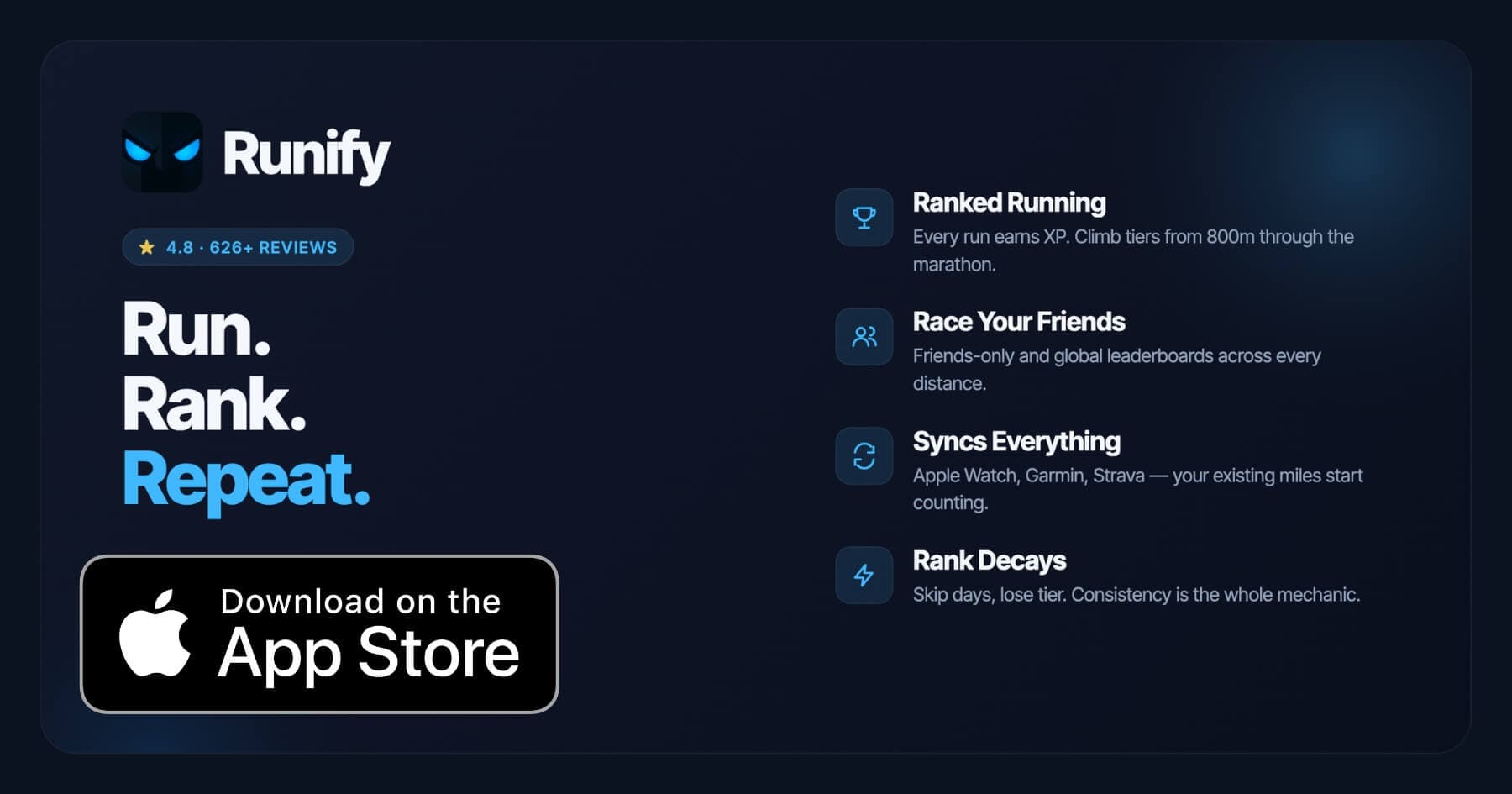
Runify is the first ranked running app, earning a 4.8-star rating on the App Store from 626+ reviews. Every run you log earns XP that moves you through a competitive tier system, with friends-only and global leaderboards across distances from 800m through the marathon. You can sync Apple Watch, Garmin, or Strava - so switching from Runmeter does not mean abandoning your data or your watch.
If Runmeter's data depth appeals to you but you want a layer of accountability and competition on top, Runify adds that without requiring you to drop your existing tracker. For more on how Runify fits into the iOS running app landscape, our best running apps for iPhone guide covers the full picture.
Why Choose Runify Over Runmeter?
- Progression that compounds: Runmeter tracks your splits; Runify builds a rank from them. XP from every run moves you up a real competitive tier, with rank decay if you go inactive - a fundamentally different kind of motivation.
- Apple Watch native: Runify integrates with HealthKit and Apple Watch without the phone dependency issues that Runmeter users report.
- Social competition: Friends-only and global leaderboards across 800m, 1K, 5K, 10K, half, and marathon give your numbers a competitive context.
- Shareable recaps: Stylized run recap templates with one-tap Instagram Stories sharing make it easy to show off progress.
Key Features
- Ranked Progression System: XP from every run, post-run rank-up reveals, and a decay mechanic that turns consistency into a visible incentive. Unlike a pile of badges, Runify builds a real tier you can lose.
- Friends & Global Leaderboards: Compete on a friends-only ladder or go global, and switch between overall Runify Rank and distance-specific ladders from 800m through the marathon.
- Apple Watch, Garmin & Strava Sync: Keep your existing tracker. Runify imports from HealthKit/Apple Watch, Garmin, and Strava, bulk-imports past runs, and auto-detects new ones.
- In-App GPS Tracking: Live GPS with time, distance, pace, and route, plus a post-run summary with splits, photos, and route map.
- Shareable Run Recaps: Stylized recap templates that auto-fill with your time, distance, pace, and route, with one-tap Instagram Stories sharing.
- Streaks & Smart Reminders: Current-streak visibility, streak celebrations, and motivational push notifications for inactivity and post-run follow-up.
Pricing
Monthly: $4.99/month (no free trial). Annual: $39.99/year (includes a 7-day free trial, then auto-renews). Pro unlocks distance-specific leaderboards and expanded profile/history views (weekly, monthly, yearly, all-time stats).
When to Choose Runify
- You want a visible, competitive reason to keep running (XP, rank, rank decay)
- You already track on Apple Watch, Garmin, or Strava and want those miles to count toward something
- You care about distance-specific performance (800m through marathon) on friends and global leaderboards
- You like sharing stylized run recaps to Instagram Stories
When Not to Choose Runify
- You're on Android. Runify is iOS only today.
- You want structured training plans, pace coaching during a run, or audio-coached workouts. Runify focuses on tracking, ranking, and social competition - not coaching.
- You need complex interval programming or custom workout structures. Runify tracks your runs but does not build structured sessions.
Alternative #2: Strava - Best for Social Running and Segments
Strava has grown to 195 million users and offers the largest running social network on the planet. Its segment system creates mini-races on any stretch of road or trail, with KOM/QOM crowns for the fastest times. For Runmeter users who want more community and competitive context beyond their own splits, Strava's social feed and segment leaderboards are a significant upgrade.
Our best Strava alternatives breakdown covers Strava's feature set in depth if you want to compare it to other community-focused options.
Key Features
- Global segments with KOM/QOM crowns and age-group leaderboards
- Social feed with kudos, comments, and club challenges
- Training load and fitness/freshness charts (Premium)
- Route builder using the Strava heatmap
Pricing
Free tier with basic GPS tracking and social feed. Strava Premium: $11.99/month or $79.99/year.
When to Choose Strava
You want the world's largest running community with segment-based competition and social accountability.
When Not to Choose Strava
Core competitive features like full segment leaderboards and training analysis are paywalled, making the free tier feel limited for serious runners.
Alternative #3: Garmin Connect - Best for Training Data Depth
Garmin Connect is the free companion to Garmin watches and one of the most data-rich training platforms available. VO2max, Training Load, Body Battery, HRV, sleep tracking, and recovery time all feed into a unified dashboard. For runners who want the kind of detailed analytics that Runmeter approximates but without the configuration complexity, Garmin Connect is a strong choice - provided you run with a Garmin.
Key Features
- VO2max estimates, Training Load, Body Battery, and Training Readiness
- Detailed GPS route maps with elevation and pace by lap
- Free coaching plans and structured workout library
- Health snapshot combining sleep, HRV, and stress data
Pricing
Free with any Garmin device. Garmin Connect+ (advanced features): $6.99/month or $49.99/year.
When to Choose Garmin Connect
You own a Garmin watch and want deep training analytics without paying a separate subscription.
When Not to Choose Garmin Connect
Garmin Connect requires Garmin hardware. Apple Watch and phone-GPS runners get no data here.
Alternative #4: Nike Run Club - Best Free Option
Nike Run Club is entirely free, with no subscription tier needed for core features. It offers audio-guided runs with Nike coaches and athletes, basic GPS tracking, and milestone challenges. For runners who found Runmeter's Elite subscription hard to justify, Nike Run Club offers zero cost entry.
Key Features
- Audio-guided runs from Nike coaches and athletes
- Milestone badges and friends challenges
- Basic GPS tracking with pace, distance, and map
- Free training plans for 5K through marathon
Pricing
Free, no subscription required.
When to Choose Nike Run Club
You want free guided motivation with basic tracking and you are not yet focused on performance data.
When Not to Choose Nike Run Club
Nike Run Club lacks the data depth Runmeter users typically want - no detailed interval analysis, minimal metrics, and no meaningful leaderboard competition.
Alternative #5: Runkeeper - Best for Simple Goal-Based Tracking
Runkeeper (by ASICS) has been tracking runners since 2008. Its interface is clean, its GPS is reliable, and it offers basic coaching plans and goal-setting tools. The free tier covers the essentials; Runkeeper Go at $9.99/month or $39.99/year adds training plans, heart rate analysis, and custom interval workouts.
Our best Runkeeper alternatives guide covers how it stacks up in the broader field.
Key Features
- Goal setting by distance, pace, or duration
- Training plans from beginner 5K to marathon (Go tier)
- Heart rate zone tracking (with compatible devices)
- GPS tracking with automatic route saving
Pricing
Free with basic tracking. Runkeeper Go: $9.99/month or $39.99/year.
When to Choose Runkeeper
You want a clean, low-friction tracker with goal-setting tools and you do not need the configuration depth of Runmeter.
When Not to Choose Runkeeper
Runkeeper's interface feels dated compared to newer apps, and its social features are minimal for runners who want community or competition.
How to Choose the Right Runmeter Alternative
-
Identify what Runmeter is missing. If it is community and competition, Runify or Strava fills that gap. If it is training data depth, Garmin Connect is the most comprehensive free option.
-
Consider your hardware. Runify, Strava, Nike Run Club, and Runkeeper all work with Apple Watch via HealthKit. Garmin Connect requires a Garmin device.
-
Check platform needs. Runify is iOS only. Strava, Nike Run Club, and Runkeeper support both iOS and Android.
-
Set a budget. Nike Run Club is free. Runkeeper Go costs $39.99/year. Runify is $39.99/year with a 7-day free trial on the annual plan. Strava Premium is $79.99/year.
-
Decide on motivation style. Data-first runners lean toward Garmin Connect or Strava Premium. Runners who need external accountability and competitive pressure do better with Runify's rank system.
Frequently Asked Questions
Is Runmeter still worth using in 2026?
Runmeter remains a capable iOS tracking tool in 2026, especially for runners who love granular configuration of intervals, announcements, and split views. The Elite subscription at $10/year is one of the best-value upgrades in the running app space. However, its phone dependency with Apple Watch, aging interface, and lack of social or competitive features make it a hard sell as a primary app when alternatives offer more for similar or lower cost.
What is the best free alternative to Runmeter?
Nike Run Club is the strongest fully free option for basic GPS tracking and guided motivation. Strava's free tier adds a social community layer and basic performance data. If you want to try Runify's ranked system, the annual plan includes a 7-day free trial before the $39.99/year charge starts.
Can I use Runmeter and Runify together?
Yes, via Strava. Runmeter syncs completed workouts to Strava, and Runify imports from Strava automatically. That means your Runmeter runs earn XP in Runify and update your rank without any extra steps. It is a clean way to keep Runmeter's data tools while adding Runify's competitive layer.
Which Runmeter alternative is best for ranked, competitive running?
Runify is the only option here with a structured tier and rank system. Every run earns XP, you see rank-up reveals after strong sessions, and distance-specific leaderboards from 800m through the marathon give your splits a competitive meaning. Strava's segment KOMs add competition on specific routes, but Runify's overall rank covers every run you log.
How long does it take to switch from Runmeter?
If Runmeter syncs to Strava, connecting Runify to Strava during onboarding brings your full run history across in minutes - bulk import is automatic. If you track Apple Watch workouts via HealthKit, Runify reads those directly. Either way, you start Runify with a real rank based on your history, not from zero.
Final Verdict
Runmeter earned its reputation among iOS runners who want configuration depth and reliable split tracking. The $10/year Elite price is genuinely fair. But the app's isolation from any community or competitive structure means runners who use it are leaving motivation on the table.
If you want your data to drive real accountability, Runify's ranked tier system turns every split and every mile into progress on a leaderboard. You can keep using Runmeter for its interval tools if you want - they pair naturally through Strava sync - while Runify adds the competitive layer that keeps you lacing up consistently.
Ready to put your miles on the leaderboard? Download Runify on the App Store and start earning XP from your next run.

4.8 on the App Store · Built for iOS