Best Garmin Race Predictor Alternatives 2026
What Are the Best Garmin Race Predictor Alternatives?
Garmin's Race Predictor estimates your finish time across popular distances by reading your VO2 max estimate and recent training load. It works reasonably well for steady-state runners, but many runners find the predictions drift when training volume changes quickly, when they race shorter distances more often, or when they switch to different terrain. If the number Garmin gives you feels off, several dedicated tools do a better job.
The top Garmin Race Predictor alternatives in 2026 are: Runify for runners who want ranked competitive progression tied to actual race distances (800m through marathon); Strava for pace-based fitness estimates inside a large social network; COROS Training Hub for serious athletes who want scientific load management; Polar Flow for physiological-age-based predictions; and Runalyze for free, data-dense analytics with community benchmarks.
At a Glance: Garmin Race Predictor Alternatives Compared
| App | Best For | Pricing | Standout Feature | Main Limitation |
|---|---|---|---|---|
| Runify | Ranked running across race distances | $4.99/mo or $39.99/yr | Leaderboards from 800m to marathon + rank decay | iOS only |
| Strava | Social running with pace-trend estimates | Free; Premium $11.99/mo | Fitness and Freshness trend graph | Predictions locked behind paywall |
| COROS Training Hub | Scientific load management and race timing | Free with COROS watch | Daily Suggested Workouts + race prediction | Requires COROS hardware |
| Polar Flow | Physiological age and recovery-based estimates | Free with Polar watch | Running Index with FTP-style score | Accuracy dips without consistent HR data |
| Runalyze | Free deep analytics with community benchmarks | Free; Supporter from $3/mo | VDOT-based race time predictions | Desktop-heavy, weak mobile app |
Why Look for Garmin Race Predictor Alternatives?
Garmin Race Predictor is built into Garmin Connect and works without extra setup. That convenience comes with trade-offs that push runners toward other tools.
- VO2 max drift: Garmin's estimate can lag by several weeks when you peak or taper. A 1-2 ml/kg/min error in VO2 max translates to a 3-5 minute swing in marathon prediction.
- Short-distance bias: The model is tuned toward half-marathon and marathon. Runners who race 5Ks and 10Ks frequently report that predictions for those distances are less reliable.
- No competitive context: The predicted time sits in isolation. You cannot see how your projection compares to friends, your age group, or global runners at the same distance. Our best Garmin Connect alternatives breakdown covers this broader gap in detail.
- Ecosystem lock-in: The feature only runs inside Garmin Connect. If you use a Polar or COROS watch, or just want a second opinion, the predictor is unavailable.
Most runners searching for alternatives want either more-accurate predictions, a social or competitive layer around those predictions, or both.
Alternative #1: Runify - Best for Ranked, Competitive Running
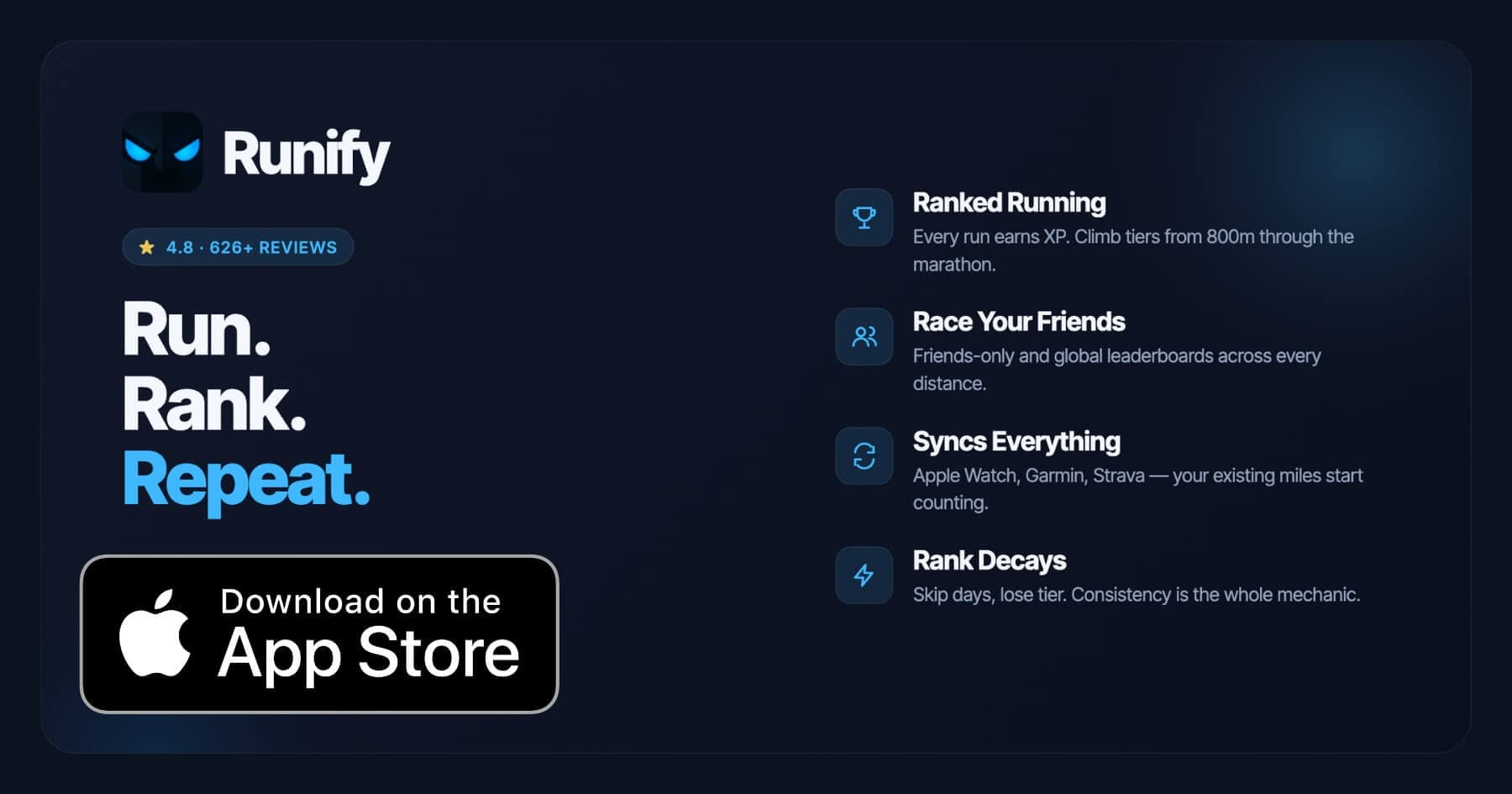
Runify is the first ranked running app, rated 4.8 stars on the App Store across 626+ reviews. Every run you log - or sync from Apple Watch, Garmin, or Strava - earns XP and moves you through a competitive tier system with friends-only and global leaderboards across six distances: 800m, 1K, 5K, 10K, half-marathon, and marathon. Where Garmin Race Predictor gives you a number in a vacuum, Runify puts that same focus on race distances inside an active competitive ladder.
Why Choose Runify Over Garmin Race Predictor?
- Distance-specific ladders: Runify tracks your performance at each race distance separately. You can see not just a predicted time, but your actual rank against global runners at the 5K or half-marathon, updated each time you run.
- Works with your existing tracker: You do not have to ditch Garmin. Connect your Garmin account and your runs flow into Runify automatically. Every mile you already ran earns rank on day one.
- Rank decay as accountability: Going inactive costs you rank. That mechanic is more motivating than a static prediction because it gives you a tangible reason to keep training consistently.
- Shareable recaps: Post-run recap cards with your time, distance, and pace slot straight into Instagram Stories - useful when you finally nail a personal best at your target distance.
Key Features
- Ranked Progression System: XP from every run, post-run rank-up reveals, and a decay mechanic that turns consistency into a visible incentive. Unlike a pile of badges, Runify builds a real tier you can lose.
- Friends & Global Leaderboards: Compete on a friends-only ladder or go global, and switch between overall Runify Rank and distance-specific ladders from 800m through the marathon.
- Apple Watch, Garmin & Strava Sync: Keep your existing tracker. Runify imports from HealthKit/Apple Watch, Garmin, and Strava, bulk-imports past runs, and auto-detects new ones.
- In-App GPS Tracking: Live GPS with time, distance, pace, and route, plus a post-run summary with splits, photos, and route map.
- Shareable Run Recaps: Stylized recap templates that auto-fill with your time, distance, pace, and route, with one-tap Instagram Stories sharing.
- Streaks & Smart Reminders: Current-streak visibility, streak celebrations, and motivational push notifications for inactivity and post-run follow-up.
Pricing
Monthly: $4.99/month (no free trial). Annual: $39.99/year (includes a 7-day free trial, then auto-renews). Pro unlocks distance-specific leaderboards and expanded profile/history views (weekly, monthly, yearly, all-time stats).
When to Choose Runify
- You want a competitive context around your race-distance performance, not just a predicted time
- You already train with Garmin and want those runs to count toward something beyond a dashboard
- You care about your 5K or half-marathon rank relative to friends or global runners
- You like sharing stylized run recaps to Instagram Stories
When Not to Choose Runify
- You're on Android. Runify is iOS only today.
- You want structured training plans, pace coaching during a run, or audio-coached workouts. Runify focuses on tracking, ranking, and social competition.
- You want route discovery or race signup features. Runify does not provide these.
Alternative #2: Strava - Best for Social Running with Pace Trends
Strava is the largest running social network with over 120 million athletes and a built-in Fitness & Freshness graph that estimates your fitness trajectory over time. The Premium tier adds estimated best efforts and a pacing guide based on your recent training data.
Key Features
- Fitness & Freshness (Training Load) trend chart for paid users
- Segments with global and local leaderboards
- Group challenges and clubs
- Estimated best efforts at common distances based on your activity data
Pricing
Free plan covers core tracking and social features. Strava Premium costs $11.99/month or $79.99/year. Race prediction and Fitness & Freshness are Premium features.
When to Choose Strava
If you already use Strava for the social side and want pace estimates baked into the same app, the upgrade makes sense. Its segment benchmarks also give you real-world performance context.
When Not to Choose Strava
Strava's predicted times are less precise than dedicated VO2-max-based tools. If you want a prediction you can race against with confidence, Strava is a supplement, not a replacement.
Alternative #3: COROS Training Hub - Best for Science-Backed Race Timing
COROS Training Hub is the companion platform for COROS watches and offers one of the most detailed race prediction engines available to non-professionals. It models cumulative load, acute recovery, and race-readiness into a predicted finish time at your target distance.
Key Features
- Race Time Prediction updated after each session
- Daily Suggested Workouts calibrated to your recovery and goal race
- Training Load and Strain metrics across run, bike, and swim
- Long-term periodization view with base, build, and peak phases
Pricing
Free with any COROS watch. No separate subscription required for race prediction or training features.
When to Choose COROS Training Hub
You own a COROS watch and want the most accurate science-backed race estimate available from a consumer platform without paying a monthly fee.
When Not to Choose COROS Training Hub
No COROS watch, no access. If you train with a Garmin, Apple Watch, or Polar device, this option is unavailable without switching hardware.
Alternative #4: Polar Flow - Best for Physiological Age and Recovery Metrics
Polar Flow pairs with Polar watches to provide a Running Index score - essentially an estimate of your aerobic fitness at a point in time - and uses it to project race times across distances. Its recovery tracking via Orthostatic Test and Nightly Recharge feeds into prediction accuracy.
Key Features
- Running Index (VO2max estimate) calculated from training runs
- Race time projections based on Running Index at each distance
- Nightly Recharge and Orthostatic Test for recovery-adjusted predictions
- Training Load Pro for volume and intensity monitoring
Pricing
Free with any Polar watch. Polar Premium is $7.99/month and adds deeper analytics, but race prediction is available on the free tier.
When to Choose Polar Flow
You run with a Polar watch and want predictions that account for your recovery status, not just raw fitness. If you sleep and HRV data matter to you, Polar's integration is strong.
When Not to Choose Polar Flow
Polar hardware required. The app experience is functional but older-feeling compared to Garmin Connect or Strava. If you want a polished mobile-first experience, look elsewhere.
Alternative #5: Runalyze - Best for Free, Data-Dense Analytics
Runalyze is an open-source running analytics platform with one of the most detailed free race prediction tools available. It uses VDOT methodology (Jack Daniels' system) to estimate your performance across distances from 800m to the marathon based on any recent race or time trial.
Key Features
- VDOT-based race time predictions across all distances
- Personal benchmarks compared against community percentile data
- Training log with pace, HR, elevation, and power analysis
- Supports imports from Garmin Connect, Strava, and GPX/TCX files
Pricing
Free with an account. Supporter tier starts at approximately $3/month and removes data limits, but VDOT predictions are available at no cost.
When to Choose Runalyze
You want the most accurate free race prediction tool and are comfortable with a desktop-heavy interface. The community benchmarks are useful for understanding where your fitness sits relative to other runners.
When Not to Choose Runalyze
Runalyze's mobile app is limited. If you manage training primarily from your phone, the experience is frustrating. The interface has a learning curve that casual runners may find steep.
How to Choose the Right Garmin Race Predictor Alternative
A predicted finish time is only useful if it translates into better training decisions or more motivation to run. Here is how to match the right tool to what you actually need.
-
Decide whether you want hardware-tied or hardware-agnostic predictions. COROS Training Hub and Polar Flow are free and accurate - but only if you own their respective hardware. Runalyze, Strava, and Runify all work regardless of what watch you wear.
-
Consider whether competitive context matters to you. A time estimate alone is abstract. If you want to know how your 5K or half-marathon stacks up against real runners, Runify's distance-specific leaderboards give you that context. If you want to benchmark against your past self, Runalyze's VDOT approach works well. Runners exploring this question often find our best running apps for Garmin watches guide a useful starting point.
-
Factor in your training discipline. If you follow a structured plan and want predictions that update in real time with load and recovery data, COROS Training Hub is the most sophisticated free option. If you run by feel and want a rough estimate, Strava or Runalyze is sufficient.
-
Think about the social layer. Garmin Race Predictor is a solitary metric. Strava and Runify both add a community dimension - Strava through segments and clubs, Runify through a rank-based tier system. The best Garmin Coach alternatives post is worth reading if you want coaching and accountability bundled together.
-
Check iOS vs. Android compatibility. Runify is iOS only. Strava, Runalyze, COROS, and Polar Flow all support Android. If you're on Android, Runalyze or COROS Training Hub offer the strongest prediction tools.
Frequently Asked Questions
Is Garmin Race Predictor still worth using in 2026?
Garmin Race Predictor remains useful as a quick estimate if you own a Garmin watch and already use Garmin Connect. It requires zero setup and updates automatically with each run. The main weaknesses are its tendency to lag during rapid fitness changes and its limited value at shorter distances like 5K and 10K. For marathon and half-marathon estimates on a consistent training block, it performs acceptably. For 5K and 10K predictions, or if you want a second opinion, a VDOT-based tool like Runalyze will usually be more accurate.
What is the best free alternative to Garmin Race Predictor?
Runalyze offers the strongest free race prediction using VDOT methodology, which most running coaches consider more reliable than VO2 max-based estimates for specific distance predictions. You can import your Garmin runs directly and get projected times from 800m to the marathon at no cost. Runify offers a 7-day free trial on the annual plan, which lets you see your distance-specific rank and compare your performance against other runners at your target distances before committing.
Can I use Garmin and Runify together?
Yes, and this is one of the cleanest pairings for Garmin owners. Connect your Garmin account to Runify and every run you log on your Garmin device syncs automatically. You keep Garmin Connect for its native analytics and race predictor, while Runify adds a ranked competitive layer with friends and global leaderboards from 800m through the marathon. Runify also bulk-imports past runs, so your existing history counts toward your rank from day one.
Which alternative is best for ranked, competitive running?
Runify is the only app in this list built specifically around competitive ranked progression at race distances. It uses a tier system with XP, rank-up reveals, and rank decay to make every run feel meaningful beyond a raw time. Leaderboards cover 800m, 1K, 5K, 10K, half-marathon, and marathon, with both friends-only and global views. Strava has segments and challenges, but Runify's rank system is more persistent and more directly tied to the specific distances you care about racing.
How long does it take to switch from Garmin Race Predictor?
Switching is less disruptive than it sounds because you do not need to stop using Garmin. Runify connects to Garmin and bulk-imports your past runs in a few minutes, so your training history carries over and your initial rank reflects your real fitness level. For Runalyze, importing a Garmin export file takes around 10 minutes and you will immediately see VDOT-based race predictions for all your distances. Neither option requires abandoning your Garmin device or watch.
Final Verdict
Garmin Race Predictor is a convenient starting point, but it is not the most accurate tool available and it gives no competitive or social context around your projected times. The right alternative depends on what is missing for you.
If you want race-distance leaderboards, rank decay, and a reason to keep showing up consistently, Runify is the clearest upgrade. It layers directly on top of your Garmin data rather than replacing it. If you want the most accurate free prediction methodology, Runalyze's VDOT approach is hard to beat for serious runners doing occasional time trials or races.
COROS Training Hub and Polar Flow are worth considering if you own that hardware and want predictions tied to real-time recovery data. Strava Premium adds value if you are already embedded in its social ecosystem.
Ready to add a competitive layer to your race-distance training? Try Runify free for 7 days - download on the App Store and connect your Garmin runs today.

4.8 on the App Store · Built for iOS