Best Fitbit Alternatives 2026
What Are the Best Fitbit Alternatives?
If you run and want a competitive reason to keep going, Runify is the best Fitbit alternative on iOS. It turns every run into XP, rank, and leaderboard position across distances from 800m through marathon. Apple Watch with Apple Health is the cleanest exit for iPhone users who want a polished smartwatch experience. Garmin Connect suits data-heavy runners who want subscription-free hardware. Strava is the social and segments default. Whoop is the closest screenless tracker for recovery and strain. Choose based on platform, budget, and whether you want gamified motivation or pure metrics.
At a Glance: Fitbit Alternatives Compared
| App | Best For | Pricing | Standout Feature | Main Limitation |
|---|---|---|---|---|
| Runify | Ranked running across race distances | $4.99/mo or $39.99/yr | Ranked tier system + leaderboards 800m-marathon | iOS only |
| Apple Watch + Apple Health | iPhone users wanting full smartwatch | Watch from $249; Health free | Tight iOS integration and Activity rings | Requires iPhone |
| Garmin Connect | Data-driven runners and multisport | Free with Garmin watch | Deep metrics with no subscription | Hardware costs $200-$1000 |
| Strava | Social sharing and segments | Free; Premium $11.99/mo | Global segments and group challenges | Paywalls many core features |
| Whoop | Recovery and strain tracking | $199/yr or $239/yr | Screenless 24/7 strain and recovery | Subscription required forever |
Why Look for Fitbit Alternatives?
Fitbit users have real reasons to leave in 2026. Google has been folding the brand into its broader hardware strategy, and the writing is on the wall for longtime users.
- Forced Google account migration: The mandatory deadline arrived May 19, 2026. After it, Fitbit accounts that have not migrated stop syncing entirely.
- Hardware lineup shrinkage: No new Sense, Versa, or Inspire since 2022. The Charge 6 from 2023 was the last mainstream tracker, and Fitbit smartwatches were discontinued in 2024.
- Premium paywall expansion: Fitbit Premium runs $9.99/month or $79.99/year. Many features that used to be free now sit behind that paywall, including detailed sleep analysis and readiness scores.
- Privacy concerns: Many users balked at handing health data over to a Google account, particularly after years of being told Fitbit data was separate.
- Basic running analytics: For serious runners, Fitbit's running insights lag behind Garmin, Strava, and Apple Watch.
The right alternative depends on your phone, your watch, and how much you want to spend.
Alternative #1: Runify - Best for Ranked, Competitive Running
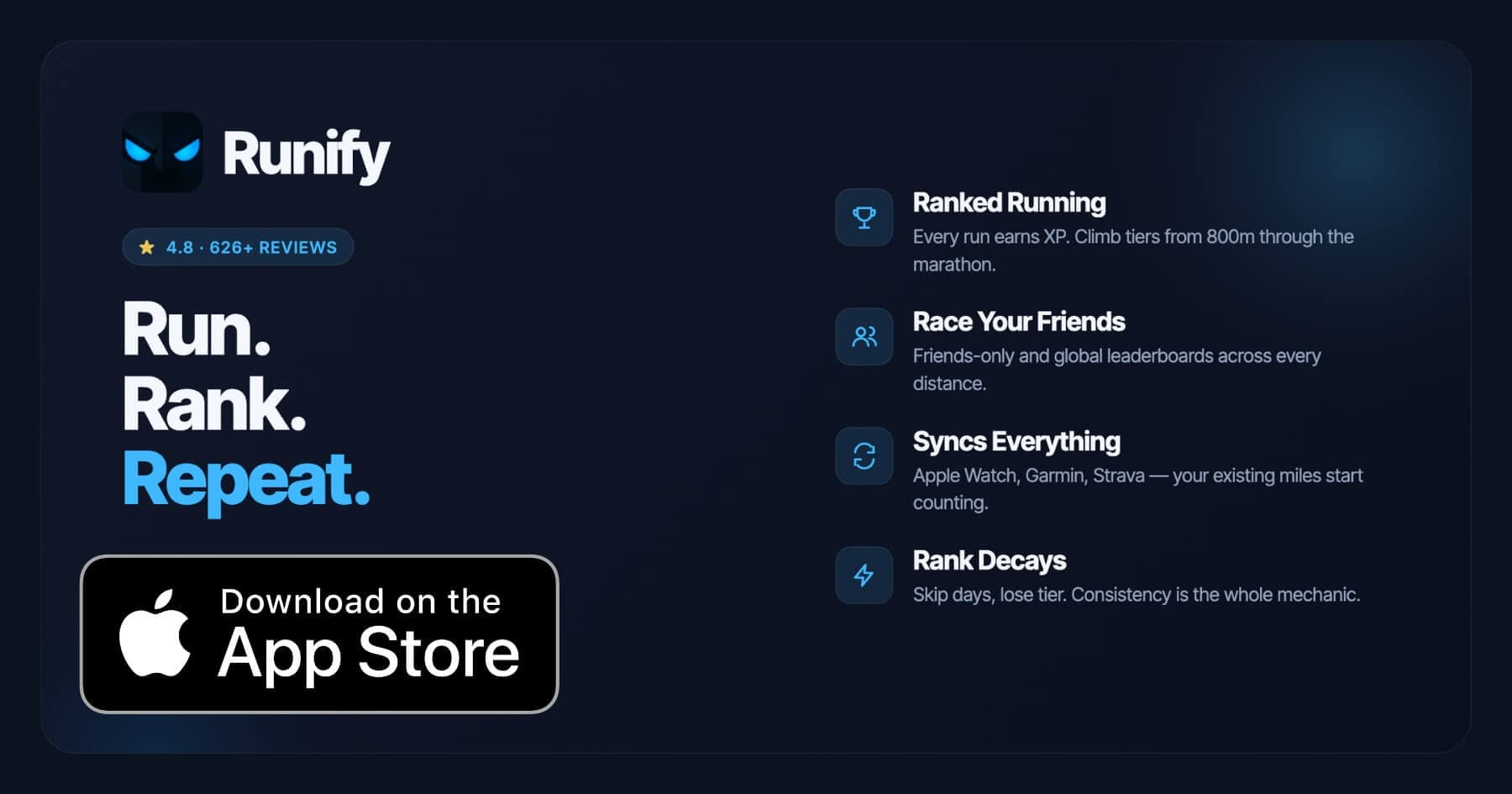
Runify is the first ranked running app. Every run you log inside the app or sync from Apple Watch, Garmin, or Strava earns XP, moves you through a competitive tier system, and puts you on friends-only or global leaderboards across distances from 800m through the marathon. The app sits at 4.8 stars on the App Store with 626+ reviews.
For Fitbit users on iPhone who feel stuck without a clear next step, Runify offers something Fitbit never did: a real reason to log tomorrow's run, beyond a green ring or a step count. Your existing Apple Watch, Garmin, or Strava data flows in automatically, so your old runs count toward your starting rank from day one.
Why Choose Runify Over Fitbit?
- Real competitive progression: Fitbit gives you badges and step goals. Runify gives you a tier system with rank-up reveals and a decay mechanic that turns inactivity into a visible cost.
- Race-distance leaderboards: Compete on dedicated ladders for 800m, 1K, 5K, 10K, half marathon, and marathon. Fitbit treats every run as generic activity.
- Bring-your-own watch: Runify imports from Apple Watch/HealthKit, Garmin, and Strava. You do not have to abandon any existing tracker, and Garmin owners do not have to pick a side.
- Stylized recap sharing: One-tap Instagram Stories sharing with auto-filled run data. Fitbit's sharing options feel basic by comparison.
Key Features
- Ranked Progression System: XP from every run, post-run rank-up reveals, and rank decay if you go inactive. A real tier you can lose, not just badges piled in a drawer.
- Friends & Global Leaderboards: Friends-only ladder or global, switchable between overall Runify Rank and distance-specific ladders from 800m through marathon.
- Apple Watch, Garmin & Strava Sync: Connect HealthKit/Apple Watch, Garmin, or Strava. Bulk-import past runs and auto-detect new ones.
- In-App GPS Tracking: Live GPS with time, distance, pace, and route. Post-run summary includes splits, photos, and route map.
- Shareable Run Recaps: Stylized recap templates that auto-fill your time, distance, pace, and route. One-tap to Instagram Stories.
- Streaks & Smart Reminders: Current-streak visibility, streak celebrations, and motivational push notifications when you go quiet.
Pricing
Monthly: $4.99/month (no free trial). Annual: $39.99/year (includes a 7-day free trial, then auto-renews). Pro unlocks distance-specific leaderboards and expanded profile/history views (weekly, monthly, yearly, all-time stats).
When to Choose Runify
- You run on iPhone and want a visible, competitive reason to keep going
- You already use Apple Watch, Garmin, or Strava and want those miles to count toward something
- You care about distance-specific performance from 800m through marathon
- You like sharing recaps to Instagram Stories without manual editing
When Not to Choose Runify
- You are on Android. Runify is iOS only today, so Android Fitbit users should look at Strava, Garmin Connect, or Health Connect-based options below.
- You want structured training plans, pace coaching during a run, or audio-coached workouts. Runify focuses on tracking, ranking, and social competition, not coaching.
- You want sleep tracking, stress scores, or 24/7 health monitoring. Runify is a running app, not a wellness tracker.
Alternative #2: Apple Watch + Apple Health - Best for iPhone Switchers
For iPhone users leaving Fitbit, the Apple Watch and Apple Health combination is the most natural exit. You get tight integration with Messages, calls, and apps, plus solid running, cycling, and workout tracking with no monthly subscription on the basics.
Key Features
- Activity rings (Move, Exercise, Stand) for daily motivation
- Built-in GPS, heart rate, ECG, sleep stages, and fall detection on most models
- Native workout app with running, cycling, swimming, HIIT, and dozens of other types
- Apple Health centralizes data from third-party apps including Runify
Pricing
Apple Watch SE starts around $249. Series 11 starts around $399. Ultra 3 sits around $799. Apple Health is free. Apple Fitness+ is $9.99/month or $79.99/year if you want guided workouts.
When to Choose Apple Watch
You already use an iPhone and want a smartwatch that handles fitness, notifications, and apps in one polished package. See our Apple Fitness alternatives breakdown if you want fitness without the smartwatch lock-in.
When Not to Choose Apple Watch
You are on Android, you want week-long battery life, or you do not want to add a $249+ device to your setup.
Alternative #3: Garmin Connect - Best for Data-Driven Runners
Garmin Connect is the companion app for Garmin watches, and it remains the gold standard for runners who want deep training metrics without paying a monthly fee. Training Status, VO2 max estimates, race predictions, and recovery time are all included with the watch.
Key Features
- Training Status, Training Load, and recovery time
- Race predictions and Garmin Coach plans for 5K through marathon
- Detailed sleep tracking, Body Battery, and stress scores
- Strong third-party ecosystem including Strava and Runify sync
Pricing
The app is free. Hardware ranges widely: Forerunner 165 around $250, Forerunner 265 around $450, Fenix 8 around $999. No mandatory subscription for core features.
When to Choose Garmin Connect
You want subscription-free analytics and you are willing to invest in a watch. Multisport athletes and serious marathoners get the most value.
When Not to Choose Garmin Connect
The interface feels dated, and the app can be overwhelming for casual users who just want step counts and a daily nudge.
Alternative #4: Strava - Best for Social and Segments
Strava is the default social network for runners and cyclists. Segments, kudos, and group challenges drive its appeal, and it imports activities from almost every watch on the market, Fitbit included.
Key Features
- Global segments with leaderboards by age and gender
- Activity feed with kudos, comments, and photos
- Routes, heatmaps, and group challenges
- Imports from Fitbit, Garmin, Apple Watch, and most major trackers
Pricing
Free tier with basic activity logging. Strava Premium is $11.99/month or $79.99/year, and many useful features (segment matching, advanced training analysis, route planning) are now Premium-gated.
When to Choose Strava
You care about social validation, segments, and seeing what your friends are doing. Our Strava alternatives breakdown covers options if Strava's expanded paywall pushes you elsewhere.
When Not to Choose Strava
You want a personal, competitive driver rather than a social feed. Or you resent paying for features that used to be free.
Alternative #5: Whoop - Best for Recovery and Strain
Whoop is a screenless fitness band built around recovery, strain, and sleep. There is no display, no notifications, and no step count. Just continuous tracking and a coaching layer that tells you how hard to push each day.
Key Features
- 24/7 heart rate, HRV, and respiratory rate tracking
- Daily Recovery, Strain, and Sleep scores
- Journal feature to correlate behaviors (caffeine, alcohol, stress) with recovery
- Coaching prompts based on physiological data
Pricing
Whoop One is $199/year and includes the band. Whoop Peak is $239/year. Whoop Life is $359/year and adds ECG and blood pressure insights. Subscription is mandatory; the band is useless without it.
When to Choose Whoop
You care more about recovery and overtraining prevention than about steps, screens, or notifications. Endurance athletes and lifters tend to like it.
When Not to Choose Whoop
You hate the idea of a perpetual subscription, you want a screen and notifications, or you want competitive leaderboards.
How to Choose the Right Fitbit Alternative
Five factors decide which alternative fits.
-
Your phone platform. iPhone users have the cleanest path: Apple Watch + Runify or Apple Health. Android users should look at Garmin Connect, Strava, or Health Connect-based apps because Runify is iOS only today.
-
What you actually do. If running is the primary activity, Runify and Strava both win on motivation. If you cross-train, swim, or cycle a lot, Garmin Connect or Apple Watch covers more ground.
-
Hardware budget. Strava and Runify work with what you already own. Garmin and Apple Watch require new devices that range from $249 to $999.
-
Subscription tolerance. Garmin charges nothing extra. Runify is $4.99/month. Strava and Whoop are $11.99/month and $199/year respectively. Whoop demands a subscription forever or the band stops working.
-
What kept you logging on Fitbit. If it was the daily streak and the visible progress, Runify's rank-and-decay system is the closest replacement. If it was sleep and stress scores, Apple Watch or Whoop fit better.
For iPhone runners who want a competitive driver to keep showing up, see our iPhone running leaderboards roundup for a deeper look at apps built around competition rather than tracking alone.
Frequently Asked Questions
Is Fitbit still worth using in 2026?
For casual step counting and basic sleep tracking, Fitbit still works. But the picture has changed. Google made account migration mandatory by May 19, 2026, no new mainstream Fitbit hardware shipped between 2023 and early 2026, and Premium at $9.99/month now gates features that used to be free. If you bought a Charge 6 and you are happy, keep using it. If you are buying new or your account is up for migration, this is the natural moment to look at alternatives.
What is the best free alternative to Fitbit?
Strava's free tier is the best truly-free starting point if you want social and segment features. Apple Health is free if you already own an iPhone, and it pairs well with any Apple Watch. Runify offers a 7-day free trial on the annual plan, which is enough time to see your first rank reveal and decide if competitive running suits you. Garmin Connect is free with any Garmin watch, but the watch itself is the cost.
Can I use Fitbit and Runify together?
Not directly today. Runify imports runs from Apple Watch/HealthKit, Garmin, and Strava. If you sync your Fitbit data to Strava through a third-party bridge, those runs can flow into Runify that way. The cleanest setup is to switch your primary tracker to Apple Watch or another Strava-compatible device, which is exactly what many migrating Fitbit users are doing in 2026.
Which Fitbit alternative is best for ranked, competitive running?
Runify, on iPhone. It is the first running app built around a real ranked tier system, with XP from every run, post-run rank-up reveals, and rank decay if you stop logging. Leaderboards cover 800m, 1K, 5K, 10K, half marathon, and marathon, on either friends-only or global views. Apple Watch and Strava give you metrics and social validation, but neither builds a competitive tier you can rise through and lose.
How long does it take to switch from Fitbit?
A few minutes to a few days, depending on data volume. Apple Watch + Apple Health takes minutes once the watch is paired. Strava and Garmin Connect both accept Fitbit data exports through third-party tools. Runify bulk-imports past runs from Apple Watch/HealthKit, Garmin, and Strava, so once you connect a source your history populates automatically. The hardest part is choosing the right replacement, not the technical migration.
Final Verdict
Fitbit is not dead, but it is no longer the obvious choice. The Google migration, the hardware drought, and the Premium paywall have given longtime users a clear reason to look elsewhere in 2026.
For iPhone runners who want a real reason to keep showing up, Runify is the best replacement. It takes the visible-progress feeling that hooked you on Fitbit streaks and turns it into a ranked, competitive system across actual race distances. Your existing Apple Watch, Garmin, or Strava data flows in, so nothing is wasted.
If you are on Android, Strava and Garmin Connect are the strongest paths. If you want a smartwatch on iPhone, Apple Watch is the polished default. If you care about recovery above everything else, Whoop is the closest screenless replacement. Pick the one that matches how you actually train.
Ready to make every run count toward something? Download Runify on the App Store and see your first rank in under five minutes.

4.8 on the App Store · Built for iOS